

Pilgrim
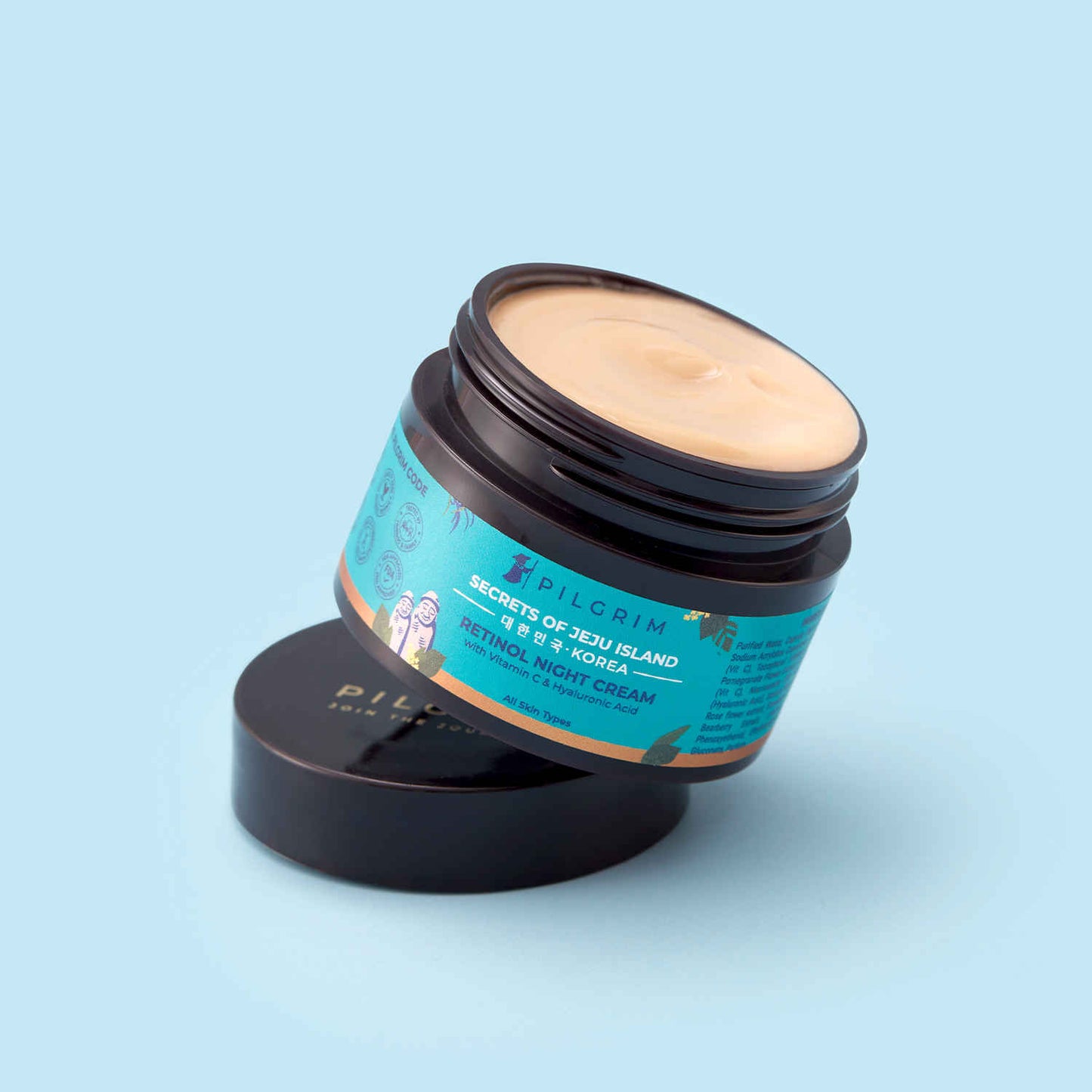
Pilgrim Retinol Night Cream with Hyaluronic Acid & Vitamin C for youthful & rejuvenated skin - 50 gm

Pilgrim Retinol Night Cream with Hyaluronic Acid & Vitamin C for youthful & rejuvenated skin - 50 gm
Pilgrim
pilgrim-retinol-night-cream-with-hyaluronic-acid-vitamin-c-for-youthful-rejuvenated-skin-50-gm
Moisturize
10084847321381
Morning or Evening?
How often will you use this product?
Notes


Highlights
WHAT IS IT?
Night Cream with multiple active ingredients
FEATURES
Enriched with Minerals, Revitalizes, Renews, Hydrates, Treats signs of ageing, Reverses fine lines and wrinkles, Fades sun spots, Smoothens complexion, Enhances glow, Refines skin texture, Improves blemishes and acne scars, Ultra hydrating, Increases cell turnover, Quick absorbing, Suitable for all skin types, Natural ingredients, No toxins
BEST FOR
dry, normal, oily, combination, sensitive
CHECKS
No Paraben, No Sulphate, No Mineral Oils, No Harsh Chemicals
Who Is It For?
Both Men And Women All Skin TypesWhat Does It Help With?
Signs Of Ageing Fine Lines Wrinkles Age Spots Skin Texture Blemishes Acne Scars DrynessBudget
Mid-range ($30-$75)How To Use
Which routine should it be used in?
Instructions:
Key Information


What Pilgrim Says
Product Description:
Pilgrim's Retinol Night Cream is enriched with high level of minerals. It revitalizes, renews and hydrates the skin resulting in a radiant glowing complexion. Treats Signs of Ageing: Reverses fine lines & wrinkles, fades sun spots and smoothens the complexion. This Anti Aging Night Cream is formulated with the best of ingredients that support repair and regeneration to keep aging at bay. Enhances Glow: Refines the texture of the skin and improves appearance of blemishes and acne scars. This Anti aging cream for oily & dry skin ultra-hydrating cream provides moisture through the night to plump the skin and smooth out lines. Youthful Skin: Increases cell turnover rate to reveal fresh and youthful skin. Pilgrim Retinol anti aging cream for women is thoughtfully crafted to work synergistically with Night's natural repair process and to enhance it. SUITABLE FOR DRY, NORMAL, OILY, COMBINATION & SENSITIVE SKIN: Formulated using only the purest ingredients, this night cream for women anti ageing is ideal to be used for all skin types by both men and women. One of the features is Quick Absorbing. NATURAL INGREDIENTS NO TOXINS: Crafted following strict guidelines of THE PILGRIM CODE, this gel is FDA approved Contains No Paraben, No Sulphate, No Mineral Oils as well as other harsh chemicals and is Cruelty free.
About the Brand:
Ingredients Overview
Ingredients List
Almond Oil, Bearberry Extract, Caprylic Capric Triglyceride, Carbomer, Cranberry Extract Ethylhexylglycerin, Lecithin, Maltodextrin, Mulberry Extract, Niacinamide (Vit B3), Panthenol (Vitamin B5), Parfum, Phenoxyethanol, Pomegranate Flower Extract, Potassium Sorbate, Purified Water, Retinol, Rose Flower Extract, Sodium Acrylates Copolymer, Sodium Ascorbate (Vit C), Sodium Ascorbyl Phosphate (Vit C), Sodium Benzoate, Sodium Gluconate, Sodium Hyaluronate (Hyaluronic Acid), Strawberry Extract, Tocopherol (Vitamin E), Lab Synthesized, Sodium Gluconate, Sugarcane Extract and Tocopherol Acetate (Vitamin E)
Key Ingredients
Retinol, Hyaluronic Acid, Vitamin C
Ingredients Details
Almond Oil
Common Name(s): Almond oil,botanical carrier oil,emollient fatty acid delivery
CAS Number: N/a
DESCRIPTION
What It Does: Softens and conditions skin by integrating into sc lipid bilayers, delivers essential fatty acids (oleic, linoleic, linolenic) for barrier lipid synthesis, and provides rich, non-stripping moisturisation.
Why It's Used: Natural carrier oils provide the closest compositional match to endogenous sc lipids, delivering emolliency through genuine barrier integration rather than simple surface occlusion.
How It Works: Fatty acid triglycerides partition into sc lipid bilayers — oleic acid (c18:1) provides fluid, emollient integration; linoleic acid (c18:2) acts as essential ceramide precursor; saturated fatty acids provide more occlusive barrier reinforcement.
Typically Found In: Moisturisers,facial oils,natural skin care
TECHNICAL DETAILS
Primary Category: Functional ingredient – emollient
Secondary Functions: Barrier sealing,softening
Application Areas:

Facial Skincare
Body Care
Hair Care

Beard Care
Color Cosmetics (Makeup)
Dietary/Oral Supplements
Typical Concentration Range: 1%–100%
SOURCING & ETHICS
Vegan Status: Conditional
Halal Status: Yes
Source Notes: Plant-derived, synthetic or animal-derived. verify source.
SKIN COMPATIBILITY
Irritancy Rating: 1/5 – very low
Comedogenicity Rating: 1/5 – low; formulation-dependent
Sensitivity Concerns: Non-irritating.
Safe for Sensitive Skin: Yes
SAFETY & COMPATIBILITY
Safety Profile: Excellent safety profile. ewg score: 1.
Works Well With: Humectants,ceramides,actives as carrier
Avoid Combining With: No significant incompatibilities
SCIENTIFIC NOTE
Essential fatty acids — linoleic (c18:2, n-6) and α-linolenic (c18:3, n-3) acids — cannot be synthesised by the body; topical delivery through carrier oils provides direct substrate for ceramide and eicosanoid biosynthesis in the epidermis.
Last Verified: Cosing database,almond oil carrier oil botanical review
Primary Sources: 2026-03-12
Bearberry Extract
Common Name(s): Bearberry extract,botanical extract,phytochemical active
CAS Number: N/a
DESCRIPTION
What It Does: Provides antioxidant protection from reactive oxygen species, reduces inflammatory cytokine production in skin, and conditions skin surface through the plant's secondary metabolite complex.
Why It's Used: Chosen for its natural origin narrative, traditional use heritage, and multi-functional phytochemical profile that supports several concurrent skin care claims from one ingredient.
How It Works: Polyphenols, terpenoids, and alkaloids in the extract scavenge ros via hydrogen atom transfer, inhibit nf-kb or cox-2 inflammatory pathways, and interact with skin surface proteins for conditioning.
Typically Found In: Botanical skin care,natural products
TECHNICAL DETAILS
Primary Category: Active ingredient – antioxidant
Secondary Functions: Free radical scavenging,anti-aging
Application Areas:
Facial Skincare
Body Care
Hair Care
Beard Care
Color Cosmetics (Makeup)
Dietary/Oral Supplements
Typical Concentration Range: 0.1%–10%
SOURCING & ETHICS
Vegan Status: Yes
Halal Status: Yes
Source Notes: Plant-derived extract or synthetic.
SKIN COMPATIBILITY
Irritancy Rating: 1/5 – very low
Comedogenicity Rating: 0/5 – non-comedogenic
Sensitivity Concerns: Non-irritating; well-tolerated.
Safe for Sensitive Skin: Yes
SAFETY & COMPATIBILITY
Safety Profile: Excellent safety profile. ewg score: 1.
Works Well With: Vitamin c,vitamin e,ferulic acid,spf,other antioxidants
Avoid Combining With: No significant incompatibilities
SCIENTIFIC NOTE
Plant secondary metabolites evolved as uv photoprotectants and antimicrobial agents — mechanisms that directly translate to cosmetic antioxidant and anti-inflammatory activity in human skin.
Last Verified: Cosing database,bearberry extract botanical review
Primary Sources: 2026-03-12
Caprylic Capric Triglyceride
Common Name(s): Caprylic capric triglyceride
DESCRIPTION
What It Does: Delivers targeted skin-conditioning or bioactive benefits through a specific mechanism of action suited to the formulation's intended purpose.
Why It's Used: Specialty actives address specific skin concerns through targeted molecular mechanisms, providing efficacy beyond what base formulation ingredients alone can achieve.
How It Works: The bioactive compound interacts with specific molecular targets in skin cells or the extracellular matrix — enzymes, receptors, structural proteins, or signaling molecules — triggering beneficial biological responses.
Typically Found In: Serums,treatments,moisturizers,specialty products
TECHNICAL DETAILS
Primary Category: Specialty actives
Secondary Functions: Skin-conditioning,anti-aging
Application Areas:
Facial Skincare
Body Care
Hair Care
Beard Care
Color Cosmetics (Makeup)
Dietary/Oral Supplements
Typical Concentration Range: 0.01–5%
SOURCING & ETHICS
Vegan Status: Yes
Halal Status: Yes
Source Notes: Specialty active ingredient; check individual sourcing for vegan status.
SKIN COMPATIBILITY
Irritancy Rating: 1899-12-31 00:00:00 -0800
Sensitivity Concerns: Low sensitization potential at recommended use concentrations.
Safe for Sensitive Skin: Yes
SAFETY & COMPATIBILITY
Safety Profile: Well-characterized cosmetic ingredient with established safety profile. generally non-irritating at typical use concentrations. suitable for leave-on and rinse-off cosmetics.
Works Well With: Niacinamide,hyaluronic acid,vitamin c,peptides
Avoid Combining With: Incompatible with oxidizing agents; check ph stability
SCIENTIFIC NOTE
Specialty actives typically work through enzyme inhibition (e.g., tyrosinase inhibition for brightening, mmp inhibition for anti-aging), receptor activation (e.g., retinoid receptors, ppar-γ for barrier genes), or transcription factor modulation (e.g., nrf2 for antioxidant gene upregulation). structure-activity relationships determine potency and selectivity.
Last Verified: Cosing eu database; pcpc cosmetic ingredient safety reviews; ingredient-specific safety and efficacy literature
Primary Sources: 2025-01-15
Carbomer
Common Name(s): Carbopol,polyacrylic acid,carboxyvinyl polymer
DESCRIPTION
What It Does: Provides transparent gel textures and thickening at very low concentrations via ph-responsive swelling.
Why It's Used: The most widely used gel thickener – provides crystal-clear, stable gels at concentrations as low as 0.1-0.5% with ph-controlled viscosity.
How It Works: Highly crosslinked polyacrylic acid remains tightly coiled at acidic ph. neutralization with naoh or triethanolamine ionizes carboxylic groups causing electrostatic repulsion that unfolds and swells the polymer coils, dramatically increasing viscosity. concentration-dependent thickening.
Typically Found In: Gels,serums,emulsions,sunscreens
TECHNICAL DETAILS
Primary Category: Functional ingredient – polyacrylic acid thickener
Secondary Functions: Skin conditioning
Application Areas:
Facial Skincare
Body Care
Hair Care
Beard Care
Color Cosmetics (Makeup)
Dietary/Oral Supplements
Typical Concentration Range: 0.1%–2%
SOURCING & ETHICS
Vegan Status: Yes – synthetic
Halal Status: Yes
Source Notes: Commercially produced for cosmetic use. verify vegan/halal status with supplier.
SKIN COMPATIBILITY
Irritancy Rating: 1/5 – very low
Comedogenicity Rating: 0/5 – non-comedogenic
Sensitivity Concerns: Well-tolerated by most skin types.
Safe for Sensitive Skin: Yes
SAFETY & COMPATIBILITY
Safety Profile: Good safety profile at recommended concentrations. ewg score: 1–2.
Works Well With: Standard skincare actives
Avoid Combining With: No known significant incompatibilities
SCIENTIFIC NOTE
Carbomer's ph-responsive swelling mechanism provides an elegant formulation control tool: a neutralized gel can be liquefied by ph reduction (adding acid) and re-thickened by reneutralization. this reversible rheology control allows two-phase products that mix on application without the need for mechanical emulsification.
Last Verified: Cosing database,cir safety assessment
Primary Sources: 2026-03-12
