

AfricanBotanicsStaging
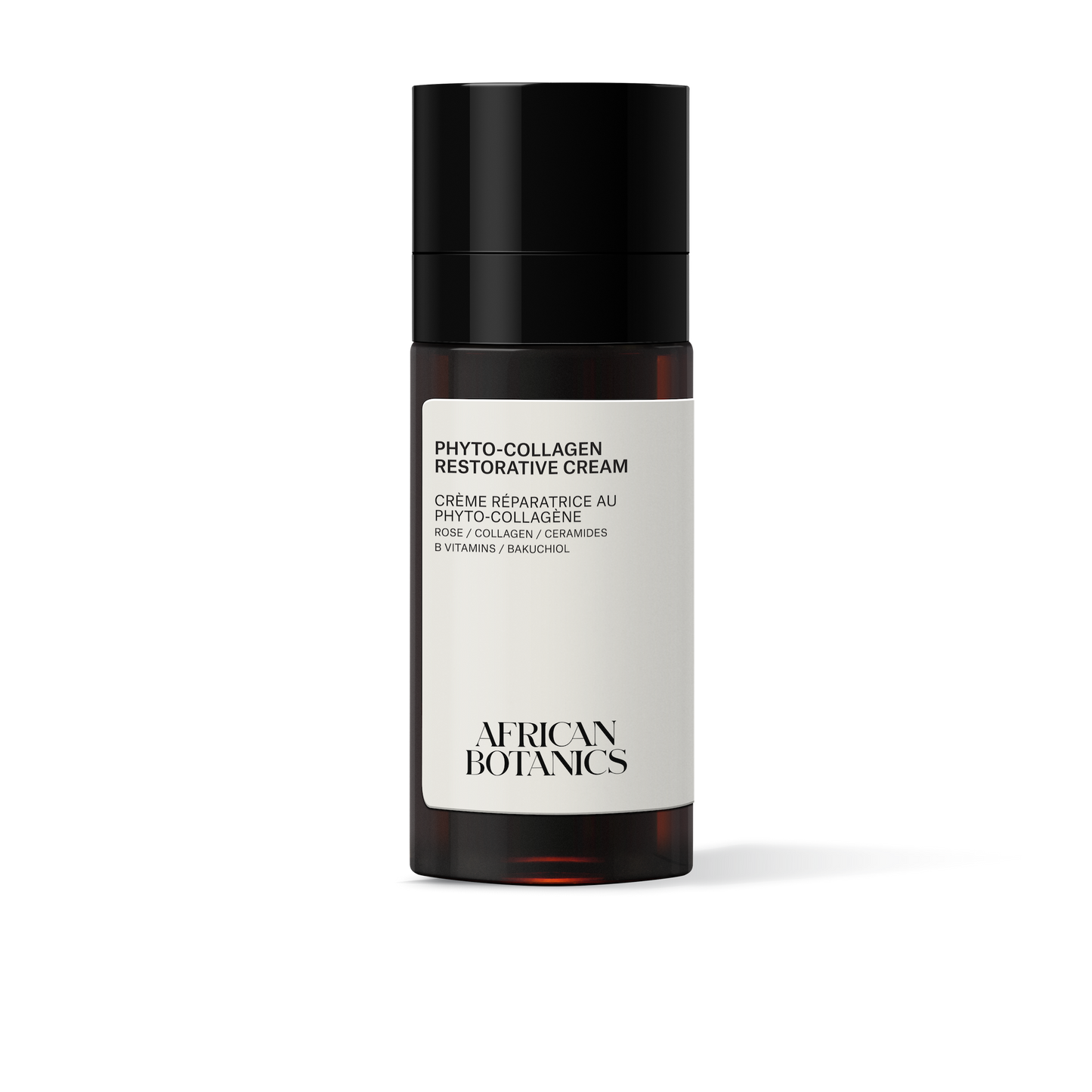
Phyto-Collagen Restorative Cream

Phyto-Collagen Restorative Cream
AfricanBotanicsStaging
phyto-collagen-restorative-cream
Moisturize
9784845304101
Morning or Evening?
How often will you use this product?
Notes


Highlights
WHAT IS IT?
Restorative face cream with plant-based collagen
FEATURES
Hydrating, lifting, firming, volumizing, reduces fine lines, facial-filling effect
BEST FOR
dry
CHECKS
Parabens-free, silicones-free, phthalates-free, mineral oil-free, artificial fragrance-free, colorants-free, SLS-free
Who Is It For?
Mature Skin All GendersWhat Does It Help With?
Hydration Firmness Fine Lines Skin SculptingBudget
Professional (over $150)How To Use
Which routine should it be used in?
Instructions:
Key Information


What AfricanBotanicsStaging Says
Product Description:
Intensely hydrating and nourishing, the Phyto-Collagen Restorative Cream contains plant-derived collagen, ceramides and bakuchiol to lift, firm and volumize the skin. Suitable for normal, combination, dry and mature skin types, the velvety cream provides a facial-filling effect to sculpt the skin and reduce the appearance of fine lines.
About the Brand:
Ingredients Overview
Ingredients List
Aqua, Vitis Vinifera (Grape) Seed Oil, Niacinamide, Glycerin, Butyrospermum Parkii (Shea) Butter, Isopropyl Myristate, Ceramide NP, Ceramide AP, Ceramide EOP, Phytosphingosine, Cholesterol, Sodium Lauroyl Lactylate, Carbomer, Xanthan Gum, Algin, Sodium Benzoate, Calcium Citrate, Sodium Hyaluronate, Collagen (Plant-derived), Mannose, Glucose, Polyglutamic Acid, Butylene Glycol, Panthenol, Cetearyl Alcohol, Cetearyl Glucoside, Carbomer, Humulus Lupulus (Hops) Extract, Rosmarinus Officinalis (Rosemary) Leaf Extract, Equisetum Arvense Extract, Pinus Sylvestris Cone Extract, Citrus Limon (Lemon) Fruit Extract, Squalane, Bakuchiol, Lactobacillus Ferment Lysate, Tocopherol, Bulbine Frutescens Leaf Juice, Sodium Benzoate, Potassium Sorbate, Kigelia Africana Leaf Extract, Cyclopia Genistoides Leaf Extract, Aspalathus Linearis Leaf Extract, Adansonia Digitata Seed Oil, Citrullus Lanatus (Kalahari Melon) Seed Oil, Sclerocarya Birrea (Marula) Seed Oil, Rosa Damascena Flower (Rose Absolute) Oil, Cetyl Alcohol, Dipropylene glycol, Styrax benzoin (Benzoin) Gum Oil, Potassium Cetyl Phosphate, Boswellia Serrata (Frankincense) Resin, Sodium Hydroxide, Phenoxyethanol, Ethylhexylglycerin
Key Ingredients
plant-derived-collagen, ceramides, bakuchiol
Ingredients Details
Butyrospermum Parkii Shea Butter
Common Name(s): Butyrospermum parkii shea butter
DESCRIPTION
What It Does: Delivers targeted skin-conditioning or bioactive benefits through a specific mechanism of action suited to the formulation's intended purpose.
Why It's Used: Specialty actives address specific skin concerns through targeted molecular mechanisms, providing efficacy beyond what base formulation ingredients alone can achieve.
How It Works: The bioactive compound interacts with specific molecular targets in skin cells or the extracellular matrix — enzymes, receptors, structural proteins, or signaling molecules — triggering beneficial biological responses.
Typically Found In: Serums,treatments,moisturizers,specialty products
TECHNICAL DETAILS
Primary Category: Specialty actives
Secondary Functions: Skin-conditioning,anti-aging
Application Areas:

Facial Skincare

Body Care
Hair Care
Beard Care
Color Cosmetics (Makeup)
Dietary/Oral Supplements
Typical Concentration Range: 0.01–5%
SOURCING & ETHICS
Vegan Status: Yes
Halal Status: Yes
Source Notes: Specialty active ingredient; check individual sourcing for vegan status.
SKIN COMPATIBILITY
Irritancy Rating: 1899-12-31 00:00:00 -0800
Sensitivity Concerns: Low sensitization potential at recommended use concentrations.
Safe for Sensitive Skin: Yes
SAFETY & COMPATIBILITY
Safety Profile: Well-characterized cosmetic ingredient with established safety profile. generally non-irritating at typical use concentrations. suitable for leave-on and rinse-off cosmetics.
Works Well With: Niacinamide,hyaluronic acid,vitamin c,peptides
Avoid Combining With: Incompatible with oxidizing agents; check ph stability
SCIENTIFIC NOTE
Specialty actives typically work through enzyme inhibition (e.g., tyrosinase inhibition for brightening, mmp inhibition for anti-aging), receptor activation (e.g., retinoid receptors, ppar-γ for barrier genes), or transcription factor modulation (e.g., nrf2 for antioxidant gene upregulation). structure-activity relationships determine potency and selectivity.
Last Verified: Cosing eu database; pcpc cosmetic ingredient safety reviews; ingredient-specific safety and efficacy literature
Primary Sources: 2025-01-15
Ceramide Ap
Common Name(s): Ceramide 6 ii,n-(2-hydroxy)-stearoyl phytosphingosine,alpha-hydroxy ceramide
CAS Number: 100403-19-8
DESCRIPTION
What It Does: Provides alpha-hydroxy ceramide for complementary barrier repair alongside ceramide np and eop.
Why It's Used: Essential barrier ceramide trio component — ceramide ap's alpha-hydroxy fatty acid provides the specific lamellar body formation chemistry needed for complete barrier restoration with ceramide np and ceramide eop.
How It Works: N-(2-hydroxyfatty acid) phytosphingosine: 2-hydroxylation of fatty acid is critical for optimal packing of ceramide ap in lamellar lipid bilayers. the alpha-hydroxy group creates stronger intermolecular hydrogen bonding between ceramide ap molecules than non-hydroxylated ceramides. used in combination with ceramide np and ceramide eop for comprehensive barrier repair.
Typically Found In: Complete barrier repair formulas,triple ceramide systems,eczema treatment
TECHNICAL DETAILS
Primary Category: Active ingredient – alpha-hydroxy ceramide
Secondary Functions: Skin conditioning
Application Areas:
Facial Skincare
Body Care
Hair Care
Beard Care
Color Cosmetics (Makeup)
Dietary/Oral Supplements
Typical Concentration Range: 0.01%–1%
SOURCING & ETHICS
Vegan Status: Conditional – plant-derived phytosphingosine available
Halal Status: Yes
Source Notes: Commercially produced for cosmetic use. verify vegan/halal status with supplier.
SKIN COMPATIBILITY
Irritancy Rating: 1/5 – very low
Comedogenicity Rating: 0/5 – non-comedogenic
Sensitivity Concerns: Well-tolerated by most skin types.
Safe for Sensitive Skin: Yes
SAFETY & COMPATIBILITY
Safety Profile: Good safety profile at recommended concentrations. ewg score: 1–2.
Works Well With: Standard skincare actives
Avoid Combining With: No known significant incompatibilities
SCIENTIFIC NOTE
The ceramide np + ceramide ap + ceramide eop triple combination mimics the natural ratio of ceramide classes in healthy stratum corneum (approximately 1:0.5:0.3 ratio). clinical studies comparing single ceramide vs triple ceramide barrier repair show significantly greater tewl reduction with triple ceramide combinations — the complementary molecular packing geometries of different ceramide classes creating a more complete lamellar bilayer than any single ceramide can provide.
Last Verified: Cosing database,elias & feingold barrier ceramide review
Primary Sources: 2026-03-12
Ceramide Eop
Common Name(s): Ceramide 1,omega-hydroxy ceramide linoleate,acylceramide
CAS Number: N/a
DESCRIPTION
What It Does: Provides the essential acylceramide scaffold for stratum corneum lamellar lipid organisation and barrier architecture.
Why It's Used: The architectural ceramide — ceramide eop's covalent corneocyte envelope binding is unique among ceramides and essential for organising the lamellar lipid matrix of the stratum corneum barrier.
How It Works: Omega-hydroxy ceramide esterified with linoleic acid at the omega-end. omega-hydroxyl group covalently bonds to involucrin/envoplakin proteins of corneocyte envelope via ester bond. this covalent anchor organises the lamellar lipid bilayers around each corneocyte. linoleate deficiency impairs this covalent anchoring — the biochemical basis of linoleic acid deficiency skin disease.
Typically Found In: Complete barrier repair systems,eczema treatment,omega-ceramide products
TECHNICAL DETAILS
Primary Category: Active ingredient – linoleate acylceramide
Secondary Functions: Skin conditioning
Application Areas:
Facial Skincare
Body Care
Hair Care
Beard Care
Color Cosmetics (Makeup)
Dietary/Oral Supplements
Typical Concentration Range: 0.001%–0.5%
SOURCING & ETHICS
Vegan Status: Conditional – plant-derived linoleate available
Halal Status: Yes
Source Notes: Commercially produced for cosmetic use. verify vegan/halal status with supplier.
SKIN COMPATIBILITY
Irritancy Rating: 1/5 – very low
Comedogenicity Rating: 0/5 – non-comedogenic
Sensitivity Concerns: Well-tolerated by most skin types.
Safe for Sensitive Skin: Yes
SAFETY & COMPATIBILITY
Safety Profile: Good safety profile at recommended concentrations. ewg score: 1–2.
Works Well With: Standard skincare actives
Avoid Combining With: No known significant incompatibilities
SCIENTIFIC NOTE
Ceramide eop's covalent corneocyte envelope binding is the only covalent interaction in the stratum corneum lipid structure — all other lamellar lipids interact via non-covalent van der waals and hydrogen bonds. this unique covalent anchoring of eop to the protein envelope provides the mechanical scaffold from which the entire lamellar lipid architecture is organised, making ceramide eop architecturally irreplaceable in barrier function.
Last Verified: Cosing database,holleran et al. ceramide eop review
Primary Sources: 2026-03-12
Ceramide Np
Common Name(s): Ceramide 3,n-stearoyl phytosphingosine,ceramide type iii
CAS Number: 100403-19-8
DESCRIPTION
What It Does: Provides the most abundant natural skin ceramide for precise stratum corneum barrier lipid replacement.
Why It's Used: The primary skin ceramide — ceramide np's identity as the dominant stratum corneum ceramide fraction makes it the most physiologically relevant barrier lipid replacement for dry skin and eczema.
How It Works: N-stearoyl-phytosphingosine provides the exact molecular structure of the most abundant natural skin ceramide. integrates into stratum corneum lamellar lipid bilayers restoring barrier architecture. reduces tewl, improves corneometer moisture, restores barrier integrity. synergistic with cholesterol and fatty acids in barrier restoration.
Typically Found In: Barrier repair moisturisers,eczema care,dry skin treatment
TECHNICAL DETAILS
Primary Category: Active ingredient – phytosphingosine ceramide
Secondary Functions: Skin conditioning
Application Areas:
Facial Skincare
Body Care
Hair Care
Beard Care
Color Cosmetics (Makeup)
Dietary/Oral Supplements
Typical Concentration Range: 0.01%–5%
SOURCING & ETHICS
Vegan Status: Conditional – from wheat or phytosphingosine fermentation; plant-derived available
Halal Status: Yes
Source Notes: Commercially produced for cosmetic use. verify vegan/halal status with supplier.
SKIN COMPATIBILITY
Irritancy Rating: 1/5 – very low
Comedogenicity Rating: 0/5 – non-comedogenic
Sensitivity Concerns: Well-tolerated by most skin types.
Safe for Sensitive Skin: Yes
SAFETY & COMPATIBILITY
Safety Profile: Good safety profile at recommended concentrations. ewg score: 1–2.
Works Well With: Standard skincare actives
Avoid Combining With: No known significant incompatibilities
SCIENTIFIC NOTE
Ceramide np's structural identity to natural skin ceramide 3 (the dominant sc ceramide at approximately 18% of total sc ceramide fraction) means it integrates into the stratum corneum's lamellar bilayer structure with perfect molecular recognition. no other moisturising ingredient can achieve this level of structural identity to the natural barrier component it replaces — providing barrier repair rather than simply occlusive surface coating.
Last Verified: Cosing database,elias skin barrier ceramide review,cir safety assessment
Primary Sources: 2026-03-12
