
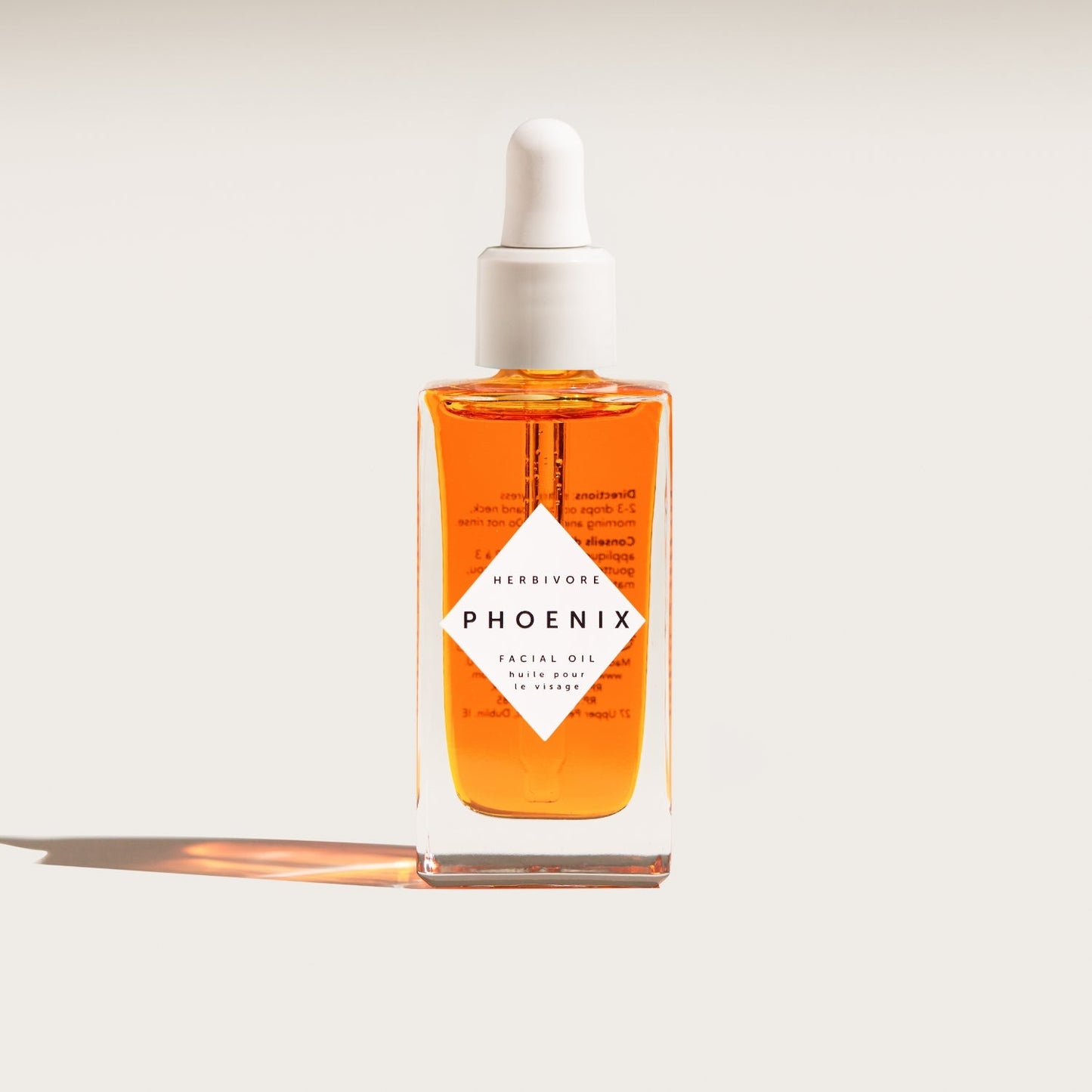

Herbivore Botanicals
PHOENIX Rosehip Anti-Aging Face Oil

PHOENIX Rosehip Anti-Aging Face Oil
Herbivore Botanicals
phoenix-rosehip-anti-aging-face-oil
Face Oil
9784767021349
Morning or Evening?
How often will you use this product?
Notes


Highlights
WHAT IS IT?
Anti-aging facial oil
FEATURES
Anti-aging, barrier repair, hydrating properties
BEST FOR
dry
CHECKS
Free of synthetic ingredients, mineral oils, colorants, fragrances, parabens
Who Is It For?
Adults With Dry Or Sensitive SkinWhat Does It Help With?
Fine Lines Dryness Texture Improvement Pore ReductionBudget
Premium ($76-$150)How To Use
Which routine should it be used in?
Instructions:
Key Information


About the Brand:
Ingredients Overview
Ingredients List
Rosehip Oil, Sea Buckthorn Oil, Chia Seed Oil, Meadowfoam Seed Oil, Neroli Oil, Simmondsia Chinensis (Jojoba) Seed Oil, Rosa Canina Seed Oil, Limnanthes Alba (Meadowfoam) Seed Oil, Salvia Hispanica Seed Oil, Caprylic/Capric Triglyceride, Hippophae Rhamnoides Oil, Tocopherol, Ubiquinone, Rosa Damascena Flower Extract, Citrus Aurantium Flower Oil, Linalool, Citronellol, Geraniol, Limonene, Eugenol, Farnesol
Key Ingredients
rosehip-oil
Ingredients Details
Limnanthes Alba (meadowfoam) Seed Oil
Common Name(s): Limnanthes alba (meadowfoam) seed oil,botanical oil,phytochemical active
CAS Number: N/a
DESCRIPTION
What It Does: Provides antioxidant protection from reactive oxygen species, reduces inflammatory cytokine production in skin, and conditions skin through the plant's phytochemical complex.
Why It's Used: Natural origin narrative, traditional use heritage, and multi-functional phytochemical profile supporting concurrent skin care claims from one ingredient.
How It Works: Polyphenols, terpenoids, and alkaloids scavenge ros via h• donation, inhibit nf-kb or cox-2 inflammatory pathways, and interact with skin surface proteins for conditioning.
Typically Found In: Botanical skin care,natural products
TECHNICAL DETAILS
Primary Category: Active ingredient – antioxidant
Secondary Functions: Free radical scavenging,anti-aging
Application Areas:

Facial Skincare
Body Care

Hair Care
Beard Care
Color Cosmetics (Makeup)
Dietary/Oral Supplements
Typical Concentration Range: 0.1%–10%
SOURCING & ETHICS
Vegan Status: Conditional - supplier confirmation required
Halal Status: Yes
Source Notes: Plant-derived extract or synthetic. [audit 2026-07-29 rev2: status downgraded on audit. determination requires shariah-panel sign-off.]
SKIN COMPATIBILITY
Irritancy Rating: 1/5 – very low
Comedogenicity Rating: 0/5 – non-comedogenic
Sensitivity Concerns: Non-irritating; well-tolerated.
Safe for Sensitive Skin: Yes
SAFETY & COMPATIBILITY
Safety Profile: Excellent safety profile. ewg score: 1.
Works Well With: Vitamin c,vitamin e,ferulic acid,spf,other antioxidants
Avoid Combining With: No significant incompatibilities
SCIENTIFIC NOTE
Plant secondary metabolites evolved as photoprotectants and antimicrobials — mechanisms directly applicable to cosmetic antioxidant and anti-inflammatory activity in human skin.
Last Verified: 2026-03-12
Primary Sources: Cosing database,limnanthes alba (meadowfoam) seed o botanical review
Meadowfoam Seed Oil
Common Name(s): Meadowfoam seed oil
DESCRIPTION
What It Does: Forms a long-lasting protective film providing exceptional moisture retention and hair conditioning with outstanding stability.
Why It's Used: Unique long-chain fatty acid oil providing extended moisture retention and exceptional film-forming properties not available from conventional triglyceride oils.
How It Works: Very long-chain fatty acids (c20:1, c22:1, c22:2) create a uniquely stable, film-forming emollient with minimal oxidation susceptibility. long chains pack more efficiently in hair cuticle scales and skin surface for extended wear and conditioning.
Typically Found In: Long-wearing moisturizers,hair conditioners,glossy finishes,lip products
TECHNICAL DETAILS
Primary Category: Functional ingredient – emollient
Secondary Functions: Film-forming,exceptional stability,hair gloss
Application Areas:
Facial Skincare
Body Care
Hair Care
Beard Care
Color Cosmetics (Makeup)
Dietary/Oral Supplements
Typical Concentration Range: 1%–30%
SOURCING & ETHICS
Vegan Status: Yes – from limnanthes alba seeds
Halal Status: Yes
Source Notes: Cold-pressed from meadowfoam seeds – a sustainable pacific northwest crop. shell life 5+ years without antioxidants.
SKIN COMPATIBILITY
Irritancy Rating: 1/5 – very low
Comedogenicity Rating: 1/5 – very low
Sensitivity Concerns: Non-irritating.
Safe for Sensitive Skin: Yes
SAFETY & COMPATIBILITY
Safety Profile: Excellent safety profile. ewg score: 1.
Works Well With: Humectants,ceramides,actives as carrier
Avoid Combining With: No significant incompatibilities
SCIENTIFIC NOTE
Meadowfoam oil's very long-chain fatty acid composition (>95% c20-c22 fatty acids vs most plant oils' c16-c18 dominance) provides uniquely efficient film formation from tighter packing of the longer carbon chains, explaining its superior moisturization duration and hair conditioning film formation.
Last Verified: 2026-03-12
Primary Sources: Cosing database,cir safety assessment
Neroli Oil
Common Name(s): Neroli oil,orange blossom oil,petitgrain alternative
CAS Number: 8016-38-4
DESCRIPTION
What It Does: Provides the most prized orange blossom floral fragrance note with aromatherapy calming effects.
Why It's Used: The luxury citrus floral – genuine neroli oil commands €1,000-2,000/kg and provides a floral complexity unavailable from any synthetic reconstruction.
How It Works: Contains linalool (25-50%), linalyl acetate, geraniol, nerol, farnesol, and unique indole that provides 'animalic' depth. linalool provides gaba-a mediated anxiolytic activity. total composition provides unique floral-indolic-citrus that cannot be fully synthesised.
Typically Found In: Luxury fragrances,aromatherapy products,premium cosmetics
TECHNICAL DETAILS
Primary Category: Fragrance – luxury botanical
Secondary Functions: Skin conditioning
Application Areas:
Facial Skincare
Body Care
Hair Care
Beard Care
Color Cosmetics (Makeup)
Dietary/Oral Supplements
Typical Concentration Range: 0.001%–0.5%
SOURCING & ETHICS
Vegan Status: Conditional - supplier confirmation required
Halal Status: Unverified - supplier confirmation required
Source Notes: Commercially produced for cosmetic use. verify vegan/halal status with supplier. [audit 2026-07-29 rev2: the record's own source_notes does not assert a non-animal origin, or instructs the reader to verify with the supplier; "yes" asserts knowledge the record does not hold. determination requires shariah-panel sign-off.]
SKIN COMPATIBILITY
Irritancy Rating: 1/5 – very low
Comedogenicity Rating: 0/5 – non-comedogenic
Sensitivity Concerns: Well-tolerated by most skin types.
Safe for Sensitive Skin: Yes
SAFETY & COMPATIBILITY
Safety Profile: Multiple eu fragrance allergens naturally present (linalool, limonene, geraniol, citral). requires full allergen declaration.
Works Well With: Standard skincare actives
Avoid Combining With: No known significant incompatibilities
SCIENTIFIC NOTE
Neroli oil's unique character comes partly from trace indole (0.1-0.5%) providing the slight animalic warmth that elevates pure floral to sensual complexity. indole at trace concentrations smells floral; at higher concentrations it smells unpleasant (feces). the extraordinary olfactory context-dependence of indole – floral at ppb, repulsive at ppm – demonstrates how concentration-dependent scent character enables complex natural fragrance compositions.
Last Verified: 2026-03-12
Primary Sources: Cosing database,ifra standards
Rosa Canina Seed Oil
Common Name(s): Rosa canina seed oil,botanical oil,phytochemical active
CAS Number: N/a
DESCRIPTION
What It Does: Provides antioxidant protection from reactive oxygen species, reduces inflammatory cytokine production in skin, and conditions skin through the plant's phytochemical complex.
Why It's Used: Natural origin narrative, traditional use heritage, and multi-functional phytochemical profile supporting concurrent skin care claims from one ingredient.
How It Works: Polyphenols, terpenoids, and alkaloids scavenge ros via h• donation, inhibit nf-kb or cox-2 inflammatory pathways, and interact with skin surface proteins for conditioning.
Typically Found In: Botanical skin care,natural products
TECHNICAL DETAILS
Primary Category: Active ingredient – antioxidant
Secondary Functions: Free radical scavenging,anti-aging
Application Areas:
Facial Skincare
Body Care
Hair Care
Beard Care
Color Cosmetics (Makeup)
Dietary/Oral Supplements
Typical Concentration Range: 0.1%–10%
SOURCING & ETHICS
Vegan Status: Conditional - supplier confirmation required
Halal Status: Yes
Source Notes: Plant-derived extract or synthetic. [audit 2026-07-29 rev2: status downgraded on audit. determination requires shariah-panel sign-off.]
SKIN COMPATIBILITY
Irritancy Rating: 1/5 – very low
Comedogenicity Rating: 0/5 – non-comedogenic
Sensitivity Concerns: Non-irritating; well-tolerated.
Safe for Sensitive Skin: Yes
SAFETY & COMPATIBILITY
Safety Profile: Excellent safety profile. ewg score: 1.
Works Well With: Vitamin c,vitamin e,ferulic acid,spf,other antioxidants
Avoid Combining With: No significant incompatibilities
SCIENTIFIC NOTE
Plant secondary metabolites evolved as photoprotectants and antimicrobials — mechanisms directly applicable to cosmetic antioxidant and anti-inflammatory activity in human skin.
Last Verified: 2026-03-12
Primary Sources: Cosing database,rosa canina seed oil botanical review