
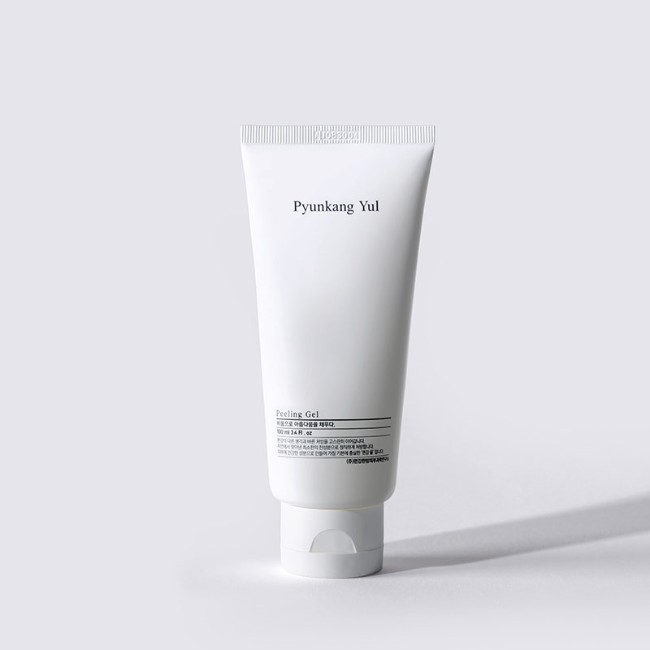

Pyunkang Yul
Peeling Gel 100ml

Peeling Gel 100ml
Pyunkang Yul
peeling-gel-100ml
Exfoliation
9706814406949
Morning or Evening?
How often will you use this product?
Notes


Highlights
WHAT IS IT?
Exfoliating gel with natural-derived ingredients
FEATURES
Gentle exfoliation, Deep cleansing, Hydrating, Soothing
BEST FOR
Sensitive skin
CHECKS
Free of parabens, artificial fragrances, colorants
Who Is It For?
Adults Both Women And MenWhat Does It Help With?
Removes Dead Skin Cells Unclogs Pores Improves Skin Texture Minimizes PoresBudget
AffordableHow To Use
Which routine should it be used in?
Instructions:
Key Information


What Pyunkang Yul Says
Product Description:
The Pyunkang Yul Peeling Gel provides gentle exfoliation using natural cellulose to remove dead skin cells, promoting a smoother and brighter complexion without irritation, making it ideal for sensitive skin. Its deep cleansing formula, enriched with papaya extract and AHA, unclogs pores and removes impurities, improving skin texture and minimizing the appearance of pores. Additionally, with hydrating and soothing ingredients like Centella Asiatica and Hyaluronic Acid, the gel ensures the skin remains soft and moisturized, preventing over-drying and irritation, making it perfect for regular use.
About the Brand:
Ingredients Overview
Ingredients List
Water, Propylene Glycol, Carbomer, 1,2-Hexanediol, Betaine Salicylate, Quaternium-60, Allantoin, Disodium EDTA, Hydroxyethyl Urea
Key Ingredients
Papaya extract, AHA, Centella Asiatica, Hyaluronic Acid
Ingredients Details
12 Hexanediol
Common Name(s): 12 hexanediol
DESCRIPTION
What It Does: Delivers targeted skin-conditioning or bioactive benefits through a specific mechanism of action suited to the formulation's intended purpose.
Why It's Used: Specialty actives address specific skin concerns through targeted molecular mechanisms, providing efficacy beyond what base formulation ingredients alone can achieve.
How It Works: The bioactive compound interacts with specific molecular targets in skin cells or the extracellular matrix — enzymes, receptors, structural proteins, or signaling molecules — triggering beneficial biological responses.
Typically Found In: Serums,treatments,moisturizers,specialty products
TECHNICAL DETAILS
Primary Category: Specialty actives
Secondary Functions: Skin-conditioning,anti-aging
Application Areas:

Facial Skincare

Body Care
Hair Care
Beard Care
Color Cosmetics (Makeup)
Dietary/Oral Supplements
Typical Concentration Range: 0.01–5%
SOURCING & ETHICS
Vegan Status: Yes
Halal Status: Yes
Source Notes: Specialty active ingredient; check individual sourcing for vegan status.
SKIN COMPATIBILITY
Irritancy Rating: 1899-12-31 00:00:00 -0800
Sensitivity Concerns: Low sensitization potential at recommended use concentrations.
Safe for Sensitive Skin: Yes
SAFETY & COMPATIBILITY
Safety Profile: Well-characterized cosmetic ingredient with established safety profile. generally non-irritating at typical use concentrations. suitable for leave-on and rinse-off cosmetics.
Works Well With: Niacinamide,hyaluronic acid,vitamin c,peptides
Avoid Combining With: Incompatible with oxidizing agents; check ph stability
SCIENTIFIC NOTE
Specialty actives typically work through enzyme inhibition (e.g., tyrosinase inhibition for brightening, mmp inhibition for anti-aging), receptor activation (e.g., retinoid receptors, ppar-γ for barrier genes), or transcription factor modulation (e.g., nrf2 for antioxidant gene upregulation). structure-activity relationships determine potency and selectivity.
Last Verified: Cosing eu database; pcpc cosmetic ingredient safety reviews; ingredient-specific safety and efficacy literature
Primary Sources: 2025-01-15
Allantoin
Common Name(s): 5-ureidohydantoin,glyoxyldiureide,aluminum dihydroxy allantoinate
CAS Number: 97-59-6
DESCRIPTION
What It Does: Soothes irritation, accelerates wound healing, promotes skin cell renewal, and provides mild keratolytic exfoliation.
Why It's Used: Gold standard multi-function soothing active – one of the most widely used cosmetic ingredients across all product types for its exceptional tolerability and clinically proven multi-action skin conditioning.
How It Works: Promotes keratinocyte proliferation and fibroblast migration for wound healing. mild keratolytic activity by disrupting corneocyte binding. anti-irritant via direct protein binding and anti-inflammatory cytokine reduction. humectant activity via hydroxyl groups.
Typically Found In: Post-procedure products,sensitive skin formulas,wound care,anti-acne treatments,baby products
TECHNICAL DETAILS
Primary Category: Active ingredient – soothing / anti-inflammatory
Secondary Functions: Wound healing,keratolytic,anti-irritant
Application Areas:
Facial Skincare
Body Care
Hair Care
Beard Care
Color Cosmetics (Makeup)
Dietary/Oral Supplements
Typical Concentration Range: 0.1%–2%
SOURCING & ETHICS
Vegan Status: Yes – synthetic or comfrey-derived
Halal Status: Yes
Source Notes: Plant-derived extract or synthetic.
SKIN COMPATIBILITY
Irritancy Rating: 1/5 – very low
Comedogenicity Rating: 0/5 – non-comedogenic
Sensitivity Concerns: Exceptionally well-tolerated; suitable for all skin types including baby and compromised skin.
Safe for Sensitive Skin: Yes – particularly recommended for sensitive skin
SAFETY & COMPATIBILITY
Safety Profile: Excellent safety profile. ewg score: 1.
Works Well With: Ceramides,panthenol,allantoin,hyaluronic acid,centella asiatica
Avoid Combining With: No significant incompatibilities
SCIENTIFIC NOTE
Allantoin's keratinocyte proliferation stimulation occurs via receptor-mediated signaling (possibly machr activation) rather than non-specific irritation-driven proliferation, making it a true wound-healing stimulant rather than a pro-inflammatory proliferative signal.
Last Verified: Cosing database,cir safety assessment,araújo et al. allantoin review
Primary Sources: 2026-03-12
Betaine Salicylate
Common Name(s): Betaine salicylate,trimethylglycine salicylate
CAS Number: 24077-28-9
DESCRIPTION
What It Does: Provides bha exfoliation and pore clearing with improved gentleness vs free salicylic acid.
Why It's Used: Salicylic acid alternative for sensitive or reactive skin where standard bha causes excessive irritation; popular in korean skincare.
How It Works: Betaine salt form provides buffered release of salicylate ions, moderating the rate of keratolytic activity for gentler exfoliation vs free salicylic acid.
Typically Found In: Sensitive acne treatments,korean bha toners,gentle exfoliants
TECHNICAL DETAILS
Primary Category: Active ingredient – bha derivative
Secondary Functions: Anti-acne,pore clearing,gentle exfoliation
Application Areas:
Facial Skincare
Body Care
Hair Care
Beard Care
Color Cosmetics (Makeup)
Dietary/Oral Supplements
Typical Concentration Range: 0.5%–4%
SOURCING & ETHICS
Vegan Status: Conditional – betaine may be plant-derived
Halal Status: Yes
Source Notes: Synthetic via kolbe-schmitt reaction or from willow bark extract.
SKIN COMPATIBILITY
Irritancy Rating: 1/5 – very low; gentler than free salicylic acid
Comedogenicity Rating: 0/5 – anti-comedogenic
Sensitivity Concerns: Can cause dryness, peeling. follow with moisturizer. not for use in pregnancy.
Safe for Sensitive Skin: Yes – preferred over salicylic acid for sensitive skin
SAFETY & COMPATIBILITY
Safety Profile: Safe at otc concentrations (0.5–2%). avoid in pregnancy at high concentrations.
Works Well With: Niacinamide,zinc,hyaluronic acid,ceramides
Avoid Combining With: Multiple exfoliating acids simultaneously; avoid in pregnancy at high concentrations
SCIENTIFIC NOTE
Betaine salt modification provides buffered, slower release of salicylate ions compared to free salicylic acid, reducing peak irritant concentration at the skin surface while maintaining keratolytic and anti-acne efficacy.
Last Verified: Cosing database,cir safety assessment,korean cosmetic research
Primary Sources: 2026-03-12
Carbomer
Common Name(s): Carbopol,polyacrylic acid,carboxyvinyl polymer
DESCRIPTION
What It Does: Provides transparent gel textures and thickening at very low concentrations via ph-responsive swelling.
Why It's Used: The most widely used gel thickener – provides crystal-clear, stable gels at concentrations as low as 0.1-0.5% with ph-controlled viscosity.
How It Works: Highly crosslinked polyacrylic acid remains tightly coiled at acidic ph. neutralization with naoh or triethanolamine ionizes carboxylic groups causing electrostatic repulsion that unfolds and swells the polymer coils, dramatically increasing viscosity. concentration-dependent thickening.
Typically Found In: Gels,serums,emulsions,sunscreens
TECHNICAL DETAILS
Primary Category: Functional ingredient – polyacrylic acid thickener
Secondary Functions: Skin conditioning
Application Areas:
Facial Skincare
Body Care
Hair Care
Beard Care
Color Cosmetics (Makeup)
Dietary/Oral Supplements
Typical Concentration Range: 0.1%–2%
SOURCING & ETHICS
Vegan Status: Yes – synthetic
Halal Status: Yes
Source Notes: Commercially produced for cosmetic use. verify vegan/halal status with supplier.
SKIN COMPATIBILITY
Irritancy Rating: 1/5 – very low
Comedogenicity Rating: 0/5 – non-comedogenic
Sensitivity Concerns: Well-tolerated by most skin types.
Safe for Sensitive Skin: Yes
SAFETY & COMPATIBILITY
Safety Profile: Good safety profile at recommended concentrations. ewg score: 1–2.
Works Well With: Standard skincare actives
Avoid Combining With: No known significant incompatibilities
SCIENTIFIC NOTE
Carbomer's ph-responsive swelling mechanism provides an elegant formulation control tool: a neutralized gel can be liquefied by ph reduction (adding acid) and re-thickened by reneutralization. this reversible rheology control allows two-phase products that mix on application without the need for mechanical emulsification.
Last Verified: Cosing database,cir safety assessment
Primary Sources: 2026-03-12
