

Paula's Choice
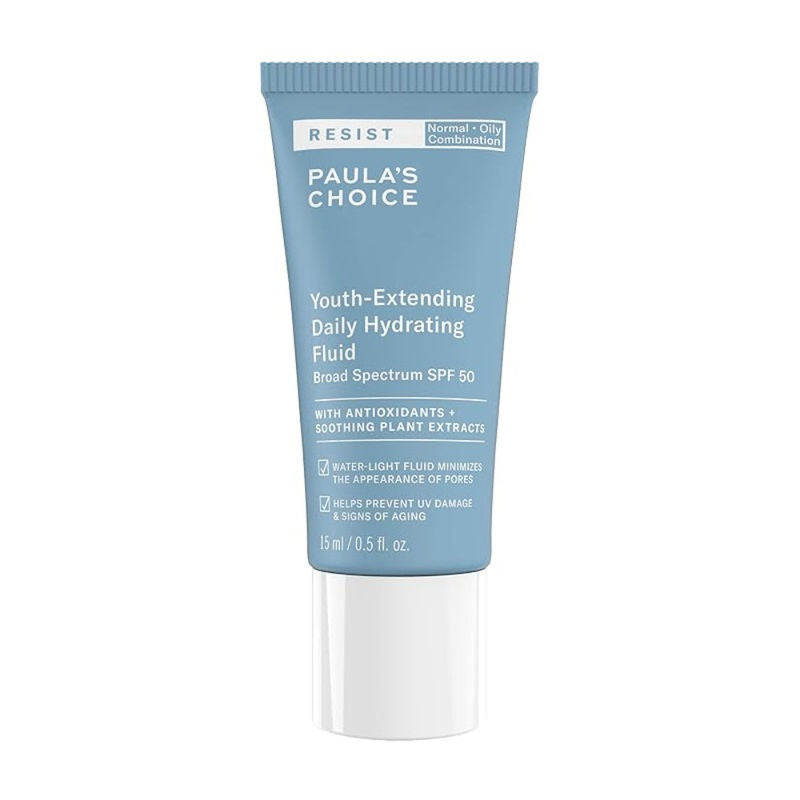
Paula's Choice Resist Youth-Extending Daily Hydrating Fluid

Paula's Choice Resist Youth-Extending Daily Hydrating Fluid
Paula's Choice
paulas-choice-resist-youth-extending-daily-hydrating-fluid
Moisturize
10084955980069
Morning or Evening?
How often will you use this product?
Notes


Highlights
WHAT IS IT?
Face Moisturizer & Day Cream with multiple antioxidant ingredients
FEATURES
Promotes a healthier, younger-looking appearance,Fights environmental stressors,Matte finish formula,Cruelty-free, alcohol-free, fragrance-free
BEST FOR
normal
CHECKS
No alcohol, No fragrance, No cruelty
Who Is It For?
What Does It Help With?
Visible Signs Of Aging Environmental Stress Protection HydrationBudget
Affordable (under $30)How To Use
Which routine should it be used in?
Instructions:
Key Information


What Paula's Choice Says
Product Description:
Paula's Choice RESIST Youth-Extending Daily Hydrating Fluid is a synthetic, ultra-lightweight moisturizer that delivers powerful broad-spectrum sun protection while defending against visible signs of aging. Enriched with a vital blend of antioxidants, it helps combat environmental stressors, promoting a healthier, younger-looking complexion. Features include promoting a healthier, younger-looking appearance, fighting against environmental stressors, fluid formula leaves a matte finish, cruelty-free, alcohol-free, and fragrance-free. Use as the last step in your AM skincare routine.
About the Brand:
Ingredients Overview
Ingredients List
Water,Octinoxate,Glycerin,Octisalate,Silica,Avobenzone,Octocrylene,Dimethicone,Tocopherol,Chamomilla-Recutita-(Matricaria)-Flower-Extract,Vitis-Vinifera-(Grape)-Seed-Extract,Camellia-Sinensis-Leaf-Extract,Camellia-Oleifera-(Green-Tea)-Leaf-Extract,Peucedanum-Graveolens-(Dill)-Extract,Sambucus-Nigra-Fruit-Extract,Oat-Bran-Extract,Punica-Granatum-Fruit-Extract,Lycium-Barbarum-Fruit-Extract,Hydrogenated-Lecithin,Titanium-Dioxide,Dimethicone/Vinyl-Dimethicone-Crosspolymer,Diethylhexyl-Syringylidenemalonate,Hydroxyethyl-Acrylate/Sodium-Acryloyldimethyl-Taurate-Copolymer,Xanthan-Gum,Sodium-Carbomer,Benzyl-Alcohol,Sodium-Benzoate,Potassium-Sorbate,Phenoxyethanol
Key Ingredients
Green Tea,Goji Fruit Extract,Grape Seed Extract,Oat Bran Extract,Pomegranate Extract,Black Elderberry,Hydrogenated Lecithin,Avobenzone,Titanium Dioxide
Ingredients Details
Avobenzone
Common Name(s): Parsol 1789,avobenzone
DESCRIPTION
What It Does: Provides uva-i protection (340-400nm) critical for photoaging prevention — the only widely available chemical uva-i filter.
Why It's Used: The essential uva-i filter — avobenzone is the only commonly approved chemical filter providing protection in the photoaging-critical 340-400nm range essential for broad-spectrum sunscreen claims.
How It Works: Dibenzoylmethane chromophore absorbs uva-i (λmax 357nm, εmax ~36,000). photodegrades via photoisomerisation requiring photostabilisation (octocrylene, bemotrizinol) for durability.
Typically Found In: Broad-spectrum sunscreens,anti-aging spf products
TECHNICAL DETAILS
Primary Category: Active ingredient – chemical uva-i filter
Secondary Functions: Skin conditioning
Application Areas:

Facial Skincare

Body Care
Hair Care
Beard Care
Color Cosmetics (Makeup)
Dietary/Oral Supplements
Typical Concentration Range: Up to 5% (eu), 3% (us fda)
SOURCING & ETHICS
Vegan Status: Yes – synthetic
Halal Status: Yes
Source Notes: Commercially produced for cosmetic use. verify vegan/halal status with supplier.
SKIN COMPATIBILITY
Irritancy Rating: 1/5 – very low
Comedogenicity Rating: 0/5 – non-comedogenic
Sensitivity Concerns: Well-tolerated by most skin types.
Safe for Sensitive Skin: Yes
SAFETY & COMPATIBILITY
Safety Profile: Eu max 5%. fda: 3%. ewg score: 2. requires photostabilisation. photoallergy risk in some individuals.
Works Well With: Standard skincare actives
Avoid Combining With: No known significant incompatibilities
SCIENTIFIC NOTE
Avobenzone's photodegradation discovery drove development of photostabilisation technology — the period from avobenzone's 1978 introduction to development of effective photostabilisers in the 1990s was marked by sunscreens with inadequate uva durability. bemotrizinol (tinosorb s) development provided the most elegant solution by providing a photostable molecule with equivalent uva coverage.
Last Verified: Cosing database,fda uv filter otc monograph,shaath sunscreen photostabilisation review
Primary Sources: 2026-03-12
Dimethicone
Common Name(s): Pdms,polydimethylsiloxane,silicone fluid
CAS Number: 9006-65-9
DESCRIPTION
What It Does: Provides silicone-characteristic silky feel and skin protection with adjustable viscosity.
Why It's Used: The benchmark cosmetic silicone – sets the gold standard for silky application feel, spreadability, and skin protection in virtually all skin care categories.
How It Works: Polydimethylsiloxane chain flexibility provides extremely low surface tension and high spreadability. inert si-o backbone provides chemical stability and excellent skin tolerance. occlusive film formation reduces tewl. higher viscosity grades provide more intense conditioning.
Typically Found In: Moisturizers,foundations,primers,sunscreens – nearly universal
TECHNICAL DETAILS
Primary Category: Functional ingredient – polydimethylsiloxane
Secondary Functions: Barrier sealing,softening
Application Areas:
Facial Skincare
Body Care
Hair Care
Beard Care
Color Cosmetics (Makeup)
Dietary/Oral Supplements
Typical Concentration Range: 0.1%–30%
SOURCING & ETHICS
Vegan Status: Yes – synthetic
Halal Status: Yes
Source Notes: Plant-derived, synthetic or animal-derived. verify source.
SKIN COMPATIBILITY
Irritancy Rating: 1/5 – very low
Comedogenicity Rating: 1/5 – low; formulation-dependent
Sensitivity Concerns: Non-irritating.
Safe for Sensitive Skin: Yes
SAFETY & COMPATIBILITY
Safety Profile: Excellent safety profile. ewg score: 1.
Works Well With: Humectants,ceramides,actives as carrier
Avoid Combining With: No significant incompatibilities
SCIENTIFIC NOTE
Dimethicone's exceptional silky feel arises from its very low intermolecular attractive forces (weak van der waals forces due to non-polar methyl groups) that allow silicone chains to slide freely over skin. the coefficient of kinetic friction for pdms against skin (~0.04) is among the lowest of any cosmetic material – explaining why even small amounts transform product feel.
Last Verified: Cosing database,cir safety assessment
Primary Sources: 2026-03-12
Glycerin
Common Name(s): Glycerol,glycerine,1,2,3-propanetriol
CAS Number: 56-81-5
DESCRIPTION
What It Does: Glycerin pulls water from the environment and deeper skin layers into the outer skin layer (epidermis), boosting moisture levels and keeping skin soft, smooth, and plump.
Why It's Used: It is used in virtually every moisturizer, serum, and cleanser because it is highly effective at hydrating skin, is well-tolerated by all skin types, and enhances the texture and spreadability of formulations.
How It Works: As a humectant, glycerin forms hydrogen bonds with water molecules, trapping them in the skin. it also reinforces the skin barrier by integrating into lipid structures between skin cells.
Typically Found In: Moisturizers,serums,cleansers,toners,sheet masks,sunscreens,body lotions,shampoos,conditioners
TECHNICAL DETAILS
Primary Category: Humectant
Secondary Functions: Skin barrier support,emollient,solvent
Application Areas:
Facial Skincare
Body Care
Hair Care
Beard Care
Color Cosmetics (Makeup)
Dietary/Oral Supplements
Typical Concentration Range: 1%–30% (typical: 3–10%)
SOURCING & ETHICS
Vegan Status: Yes – plant-derived (coconut, soy, palm) or synthetic
Halal Status: Yes – when plant-derived or synthetic; verify source with supplier
Source Notes: Derived from plant oils via hydrolysis or saponification; synthetic versions also available. palm-derived glycerin carries sustainability concerns.
SKIN COMPATIBILITY
Irritancy Rating: 1/5 – very low; non-irritating at all standard concentrations
Comedogenicity Rating: 0/5 – non-comedogenic
Sensitivity Concerns: Extremely rare allergic reactions; generally safe for all skin types including sensitive and baby skin
Safe for Sensitive Skin: Yes
SAFETY & COMPATIBILITY
Safety Profile: Widely recognized as safe. ewg hazard score: 1. no significant concerns for irritation, sensitization, or toxicity at typical concentrations (up to 50%).
Works Well With: Hyaluronic acid,ceramides,niacinamide,panthenol,urea,peptides,retinol,ahas/bhas
Avoid Combining With: No known incompatibilities at standard concentrations
SCIENTIFIC NOTE
Glycerin is an endogenous skin component found naturally in the stratum corneum. aquaporin-3 channels in keratinocytes facilitate glycerin transport, making it integral to natural skin hydration pathways.
Last Verified: Cosing database,cir safety assessment,ewg skin deep,inci decoder
Primary Sources: 2026-03-12
Octinoxate
Common Name(s): Octyl methoxycinnamate,omc,parsol mcx
CAS Number: 5466-77-3
DESCRIPTION
What It Does: Provides the most widely used uvb chemical filtration with light, elegant aesthetics.
Why It's Used: The global uvb standard — octyl methoxycinnamate's combination of potent uvb absorption, light texture, and global approval makes it the most-used chemical uvb filter worldwide.
How It Works: Trans-cinnamate chromophore absorbs uvb at λmax 308nm (εmax ~24,000 l/mol·cm). undergoes trans-cis photoisomerisation reducing uv protection over time — requires photostabilisation with avobenzone or octocrylene. oil-soluble for elegant formulation.
Typically Found In: Sunscreens,foundation with spf,tinted moisturisers
TECHNICAL DETAILS
Primary Category: Active ingredient – chemical uvb filter
Secondary Functions: Skin conditioning
Application Areas:
Facial Skincare
Body Care
Hair Care
Beard Care
Color Cosmetics (Makeup)
Dietary/Oral Supplements
Typical Concentration Range: Up to 10% (eu), 7.5% (us fda)
SOURCING & ETHICS
Vegan Status: Yes – synthetic
Halal Status: Yes
Source Notes: Commercially produced for cosmetic use. verify vegan/halal status with supplier.
SKIN COMPATIBILITY
Irritancy Rating: 1/5 – very low
Comedogenicity Rating: 0/5 – non-comedogenic
Sensitivity Concerns: Well-tolerated by most skin types.
Safe for Sensitive Skin: Yes
SAFETY & COMPATIBILITY
Safety Profile: Eu max 10%. aquatic toxicity/coral reef concerns; hawaii and some us states restrict omc. requires photostabilisation for durable spf. ewg score: 5.
Works Well With: Standard skincare actives
Avoid Combining With: No known significant incompatibilities
SCIENTIFIC NOTE
Omc's trans-cis photoisomerisation (absorbing uv → converting trans to less-absorbing cis form) was identified as the mechanism for sunscreen product spf decay after uv exposure. this photodegradation led to development of octocrylene and avobenzone photostabilisation strategies — a pharmacokinetic discovery that fundamentally changed sunscreen formulation science.
Last Verified: Cosing database,fda uv filter otc monograph,eu cosmetics annex vi
Primary Sources: 2026-03-12
