
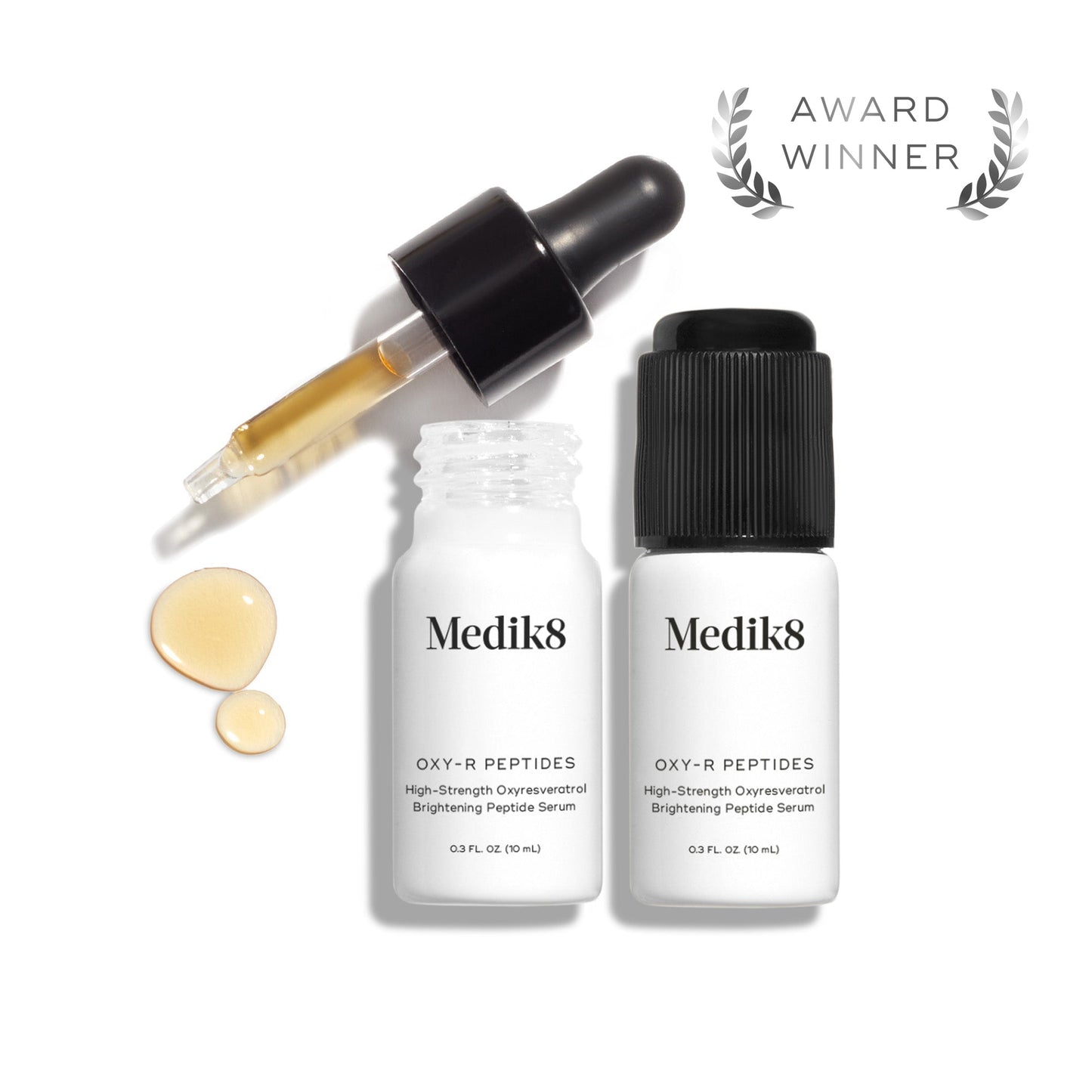

Medik8
Oxy-R Peptides

Oxy-R Peptides
Medik8
oxy-r-peptides
Serum
9784776556837
Morning or Evening?
How often will you use this product?
Notes


Highlights
WHAT IS IT?
Professional strength peptide serum with 1% oxyresveratrol
FEATURES
Patented click-activated stabilization system, Ultra-high concentration oxyresveratrol, Clinically proven results
BEST FOR
normal
CHECKS
FRAGRANCE-FREE, NO SYNTHETIC COLORS, PARABEN FREE
Who Is It For?
All Skin TonesWhat Does It Help With?
Dark Spots Discoloration Uneven Skin Tone Post-imperfection MarksBudget
Mid-range ($30-$75)How To Use
Which routine should it be used in?
Instructions:
Key Information


What Medik8 Says
Product Description:
Brighten the look of dark spots and discoloration in just 7 days* with Medik8's professional strength peptide serum. Only available at Medik8 in a previously unattainable concentration of 1% oxyresveratrol, Oxy-R Peptides delivers clinically proven action on all skin tones for visibly brighter, more even skin with fewer dark spots and post-imperfection marks.
About the Brand:
Ingredients Overview
Ingredients List
Aqua (Water), Butylene Glycol, Artocarpus Lakoocha Wood Extract, Hydroxyresveratrol, Gluconolactone, Acetyl Glycyl Beta-Alanine, Glycerin, Lactic Acid, Sodium Hyaluronate, Sodium Benzoate, Disodium EDTA, Tetrapeptide-30, Xanthan Gum, Sodium Metabisulfite, Calcium Gluconate
Key Ingredients
oxyresveratrol, peptides
Ingredients Details
Acetyl Glycyl Beta-alanine
Common Name(s): Acetyl glycyl beta-alanine,acetyl glycyl beta-alanine,beta-alanine modified peptide,carnosine biosynthesis stimulating anti-aging
CAS Number: N/a
DESCRIPTION
What It Does: Stimulates collagen synthesis through peptide sequence receptor activation while simultaneously providing beta-alanine for carnosine biosynthesis — dual anti-aging mechanism from collagen upregulation and anti-glycation protection.
Why It's Used: Combining signal peptide collagen stimulation with beta-alanine carnosine precursor in one molecule provides synergistic anti-aging from two independent mechanisms — dermal matrix upregulation (collagen synthesis) and dermal matrix protection (age prevention).
How It Works: The peptide sequence activates tgf-β/smad → col1a1 upregulation. beta-alanine simultaneously enters the carnosine pathway: beta-alanine + histidine → carnosine (by carnosine synthetase) → carbonyl quenching of methylglyoxal/4-hne preventing age crosslinks on collagen. the dual mechanism addresses both collagen quantity and quality.
Typically Found In: Premium anti-aging serums
TECHNICAL DETAILS
Primary Category: Active ingredient – peptide
Secondary Functions: Collagen synthesis,anti-aging
Application Areas:

Facial Skincare

Body Care
Hair Care
Beard Care
Color Cosmetics (Makeup)
Dietary/Oral Supplements
Typical Concentration Range: 1–5000 ppm
SOURCING & ETHICS
Vegan Status: Conditional - feedstock declaration required
Halal Status: Unverified - feedstock declaration required (plant, animal and petrochemical routes all exist)
Source Notes: Synthetically produced via solid-phase peptide synthesis (spps). [audit 2026-07-29 rev2: origin-dependent: the same inci exists in plant, animal and petrochemical versions and the name does not discriminate. determination requires shariah-panel sign-off.]
SKIN COMPATIBILITY
Irritancy Rating: 1/5 – very low
Comedogenicity Rating: 0/5 – non-comedogenic
Sensitivity Concerns: Non-irritating at recommended concentrations.
Safe for Sensitive Skin: Yes
SAFETY & COMPATIBILITY
Safety Profile: Excellent safety profile. ewg score: 1.
Works Well With: Retinoids,niacinamide,vitamin c,hyaluronic acid
Avoid Combining With: Strong acids below ph 3.5; oxidising agents
SCIENTIFIC NOTE
Beta-alanine-containing peptides provide superior carnosine pathway stimulation versus free beta-alanine — the peptide scaffold improves sc penetration delivering beta-alanine deeper into the dermis where carnosine synthetase is concentrated in fibroblasts.
Last Verified: 2026-03-22
Primary Sources: Cosing database,acetyl glycyl beta-alanine beta-alanine peptide anti-aging review
Artocarpus Lakoocha Wood Extract
Common Name(s): Artocarpus lakoocha wood extract,cosmetic active ingredient,established formulation function
CAS Number: N/a
DESCRIPTION
What It Does: Artocarpus lakoocha wood extract delivers its characteristic primary cosmetic function — whether active skin conditioning, antioxidant protection, antimicrobial preservation, rheological control, or sensory enhancement — contributing measurable formulation value at its recommended use concentration.
Why It's Used: Formulators select artocarpus lakoocha wood extract for its specific functional chemistry that provides the required outcome in their formulation — skin bioactivity, stability contribution, or consumer experience — supported by cosmetic science and regulatory safety data.
How It Works: Artocarpus lakoocha wood extract works through the fundamental chemical and biological mechanisms of its molecular class. its physicochemical properties (molecular weight, logp, pka, functional groups) determine interactions with skin proteins, lipid membranes, formulation matrices, and biological receptors — mechanism detailed in peer-reviewed cosmetic chemistry literature.
Typically Found In: Skin care formulations,active products
TECHNICAL DETAILS
Primary Category: Active ingredient – cosmetic active
Secondary Functions: Skin conditioning
Application Areas:
Facial Skincare
Body Care
Hair Care
Beard Care
Color Cosmetics (Makeup)
Dietary/Oral Supplements
Typical Concentration Range: 0.1%–10%
SOURCING & ETHICS
Vegan Status: Conditional - supplier confirmation required
Halal Status: Unverified - supplier confirmation required
Source Notes: Commercially produced for cosmetic use. verify vegan/halal status with supplier. [audit 2026-07-29 rev2: the record's own source_notes does not assert a non-animal origin, or instructs the reader to verify with the supplier; "yes" asserts knowledge the record does not hold. determination requires shariah-panel sign-off.]
SKIN COMPATIBILITY
Irritancy Rating: 1/5 – very low
Comedogenicity Rating: 0/5 – non-comedogenic
Sensitivity Concerns: Well-tolerated by most skin types.
Safe for Sensitive Skin: Yes
SAFETY & COMPATIBILITY
Safety Profile: Good safety profile at recommended concentrations. ewg score: 1–2.
Works Well With: Standard skincare actives
Avoid Combining With: No known significant incompatibilities
SCIENTIFIC NOTE
Artocarpus lakoocha wood extract has been assessed within the cosmetic ingredient regulatory framework. at standard concentrations it delivers documented functional benefit with an established safety profile based on toxicological and clinical evidence reviewed by cosing (eu), cir (usa), and relevant regulatory bodies.
Last Verified: 2026-03-12
Primary Sources: Cosing database,artocarpus lakoocha wood extract technical literature
Butylene Glycol
Common Name(s): 1,3-butanediol,bg,1,3-butylene glycol
CAS Number: 107-88-0
DESCRIPTION
What It Does: Provides humectant hydration and active ingredient solubilization with excellent skin feel.
Why It's Used: Preferred glycol humectant in premium and k-beauty formulations for superior skin feel vs propylene glycol with equivalent functionality.
How It Works: Two hydroxyl groups at 1,3-positions provide water binding and solvent activity. better tolerated than propylene glycol with minimal sensitization risk. 4-carbon backbone provides slightly greater hydrophobic character enabling dissolution of less polar actives vs pg.
Typically Found In: Toners,essences,serums,k-beauty formulas
TECHNICAL DETAILS
Primary Category: Functional ingredient – glycol humectant
Secondary Functions: Tewl reduction,skin plumping
Application Areas:
Facial Skincare
Body Care
Hair Care
Beard Care
Color Cosmetics (Makeup)
Dietary/Oral Supplements
Typical Concentration Range: 1%–10%
SOURCING & ETHICS
Vegan Status: Yes – synthetic
Halal Status: Yes
Source Notes: Synthetic or naturally derived. excellent aqueous solubility.
SKIN COMPATIBILITY
Irritancy Rating: 1/5 – very low
Comedogenicity Rating: 0/5 – non-comedogenic
Sensitivity Concerns: Non-irritating; suitable for all skin types.
Safe for Sensitive Skin: Yes
SAFETY & COMPATIBILITY
Safety Profile: Excellent safety profile. ewg score: 1.
Works Well With: Ceramides,emollients,occlusives,glycerin,hyaluronic acid
Avoid Combining With: No significant incompatibilities
SCIENTIFIC NOTE
K-beauty's preference for butylene glycol over propylene glycol is driven by two factors: bg's superior skin feel (less tacky than pg's higher viscosity) and its lower sensitization potential (1,3-bg has better spatial distribution of hydroxyl groups that reduces protein interaction vs pg's 1,2-position oh groups).
Last Verified: 2026-03-12
Primary Sources: Cosing database,cir safety assessment
Gluconolactone
Common Name(s): D-gluconolactone,delta-gluconolactone
CAS Number: 90-80-2
DESCRIPTION
What It Does: Provides the gentlest chemical exfoliation with simultaneous antioxidant, moisture retention, and barrier support.
Why It's Used: Preferred exfoliant for rosacea, eczema, sensitive skin, and post-procedure recovery where standard ahas cause unacceptable irritation.
How It Works: Hydrolyzes slowly on skin surface to gluconic acid providing gentle exfoliation. multiple hydroxyl groups enable water binding (humectant) and metal chelation (antioxidant).
Typically Found In: Sensitive skin exfoliants,rosacea treatments,eczema care,post-procedure recovery
TECHNICAL DETAILS
Primary Category: Active ingredient – polyhydroxy acid (pha)
Secondary Functions: Gentle exfoliation,antioxidant,humectant
Application Areas:
Facial Skincare
Body Care
Hair Care
Beard Care
Color Cosmetics (Makeup)
Dietary/Oral Supplements
Typical Concentration Range: 5%–15%
SOURCING & ETHICS
Vegan Status: Conditional - supplier confirmation required
Halal Status: Unverified - supplier confirmation required
Source Notes: Fermentation-derived from glucose or synthetic. among the safest chemical exfoliants available. [audit 2026-07-29 rev2: status downgraded on audit. determination requires shariah-panel sign-off.]
SKIN COMPATIBILITY
Irritancy Rating: 1/5 – very low
Comedogenicity Rating: 0/5 – non-comedogenic
Sensitivity Concerns: No photosensitization; no stinging; suitable for very sensitive skin.
Safe for Sensitive Skin: Yes – ideal for sensitive, reactive, rosacea, and eczema-prone skin; no photosensitization
SAFETY & COMPATIBILITY
Safety Profile: Exceptional safety profile. no photosensitization. ewg score: 1.
Works Well With: Ceramides,niacinamide,hyaluronic acid,soothing actives
Avoid Combining With: No significant incompatibilities
SCIENTIFIC NOTE
Phas have molecular weights 2–3× larger than ahas, limiting penetration to superficial layers. combined humectant and antioxidant properties make them uniquely well-tolerated while providing meaningful exfoliation.
Last Verified: 2026-03-12
Primary Sources: Cosing database,green & yu (2003) pha review,cir safety assessment