

NUXE
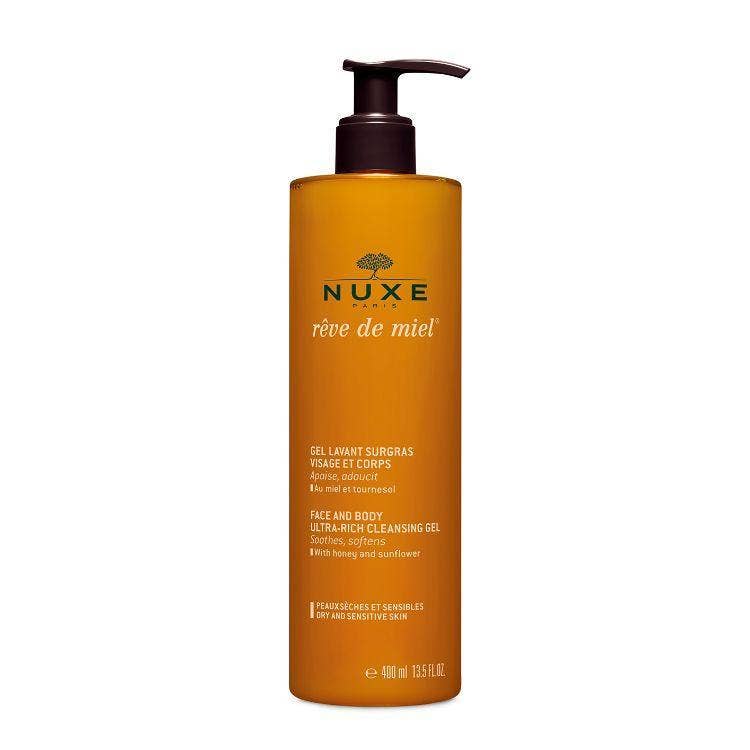
Nuxe Reve De Miel Face Cleansing And Body Ultra-Rich Cleansing Gel 400ml

Nuxe Reve De Miel Face Cleansing And Body Ultra-Rich Cleansing Gel 400ml
NUXE
nuxe-reve-de-miel-face-cleansing-and-body-ultra-rich-cleansing-gel-400ml
Cleanse
10084711661861
Morning or Evening?
How often will you use this product?
Notes


Highlights
WHAT IS IT?
Ultra-rich cleansing gel, 21 Ingredients
FEATURES
Nourishing cleansing gel suitable for dry and sensitive skin of body and face, enriched with nourishing lipids, maintains normal skin pH, paraben-free, plant-derived washing base
BEST FOR
sensitive
CHECKS
Parabens
Who Is It For?
What Does It Help With?
Cleansing Soothing Nourishing Dry And Sensitive SkinBudget
Mid-range ($30-$75)How To Use
Which routine should it be used in?
Instructions:
Key Information


What NUXE Says
Product Description:
This face and body ultra-rich cleansing gel with honey and sunflower is thick and deliciously honeyed for daily use on dry and sensitive skin while maintaining the hydro-lipidic film. It cleans without drying out the face or body. A moment of pure pampering in the shower.
About the Brand:
Ingredients Overview
Ingredients List
AQUA/WATER,GLYCERIN,SODIUM-COCOAMPHOACETATE,SODIUM-LAUROYL-SARCOSINATE,LAURYL-GLUCOSIDE,PARFUM/FRAGRANCE,MEL/HONEY,SUNFLOWER-SEED-OIL-PEG-8-ESTERS,SODIUM-COCOYL-GLUTAMATE,SODIUM-LAURYL-GLUCOSE-CARBOXYLATE,ACRYLATES/C10-30-ALKYL-ACRYLATE-CROSSPOLYMER,PHENOXYETHANOL,GLUCONOLACTONE,SODIUM-HYDROXIDE,COCO-GLUCOSIDE,GLYCERYL-OLEATE,CITRIC-ACID,ALLANTOIN,SODIUM-BENZOATE,TETRASODIUM-GLUTAMATE-DIACETATE,1,2-HEXANEDIOL,CAPRYLYL-GLYCOL,CARAMEL,CALCIUM-GLUCONATE,TROPOLONE,HYDROGENATED-PALM-GLYCERIDES-CITRATE,TOCOPHEROL
Key Ingredients
Honey, Sunflower seed oil, Glycerin
Ingredients Details
1-2-hexanediol
Common Name(s): 1-2-hexanediol,cosmetic active,functional ingredient
CAS Number: N/a
DESCRIPTION
What It Does: Delivers characteristic cosmetic function at recommended use concentration.
Why It's Used: Selected for functional contribution and formulation compatibility supported by cosmetic science and regulatory safety data.
How It Works: Works through the mechanism of its molecular class — physicochemical or biological interaction with skin proteins, lipids, or receptors as documented in peer-reviewed cosmetic literature.
Typically Found In: Skin care formulations
TECHNICAL DETAILS
Primary Category: Active ingredient – cosmetic active
Secondary Functions: Skin conditioning
Application Areas:

Facial Skincare

Body Care
Hair Care
Beard Care
Color Cosmetics (Makeup)
Dietary/Oral Supplements
Typical Concentration Range: 0.1%–10%
SOURCING & ETHICS
Vegan Status: Conditional
Halal Status: Yes
Source Notes: Commercially produced for cosmetic use. verify vegan/halal status with supplier.
SKIN COMPATIBILITY
Irritancy Rating: 1/5 – very low
Comedogenicity Rating: 0/5 – non-comedogenic
Sensitivity Concerns: Well-tolerated by most skin types.
Safe for Sensitive Skin: Yes
SAFETY & COMPATIBILITY
Safety Profile: Good safety profile at recommended concentrations. ewg score: 1–2.
Works Well With: Standard skincare actives
Avoid Combining With: No known significant incompatibilities
SCIENTIFIC NOTE
1-2-hexanediol has an established safety and efficacy profile within the cosmetic regulatory framework at standard use concentrations.
Last Verified: Cosing database,1-2-hexanediol technical literature
Primary Sources: 2026-03-12
Allantoin
Common Name(s): 5-ureidohydantoin,glyoxyldiureide,aluminum dihydroxy allantoinate
CAS Number: 97-59-6
DESCRIPTION
What It Does: Soothes irritation, accelerates wound healing, promotes skin cell renewal, and provides mild keratolytic exfoliation.
Why It's Used: Gold standard multi-function soothing active – one of the most widely used cosmetic ingredients across all product types for its exceptional tolerability and clinically proven multi-action skin conditioning.
How It Works: Promotes keratinocyte proliferation and fibroblast migration for wound healing. mild keratolytic activity by disrupting corneocyte binding. anti-irritant via direct protein binding and anti-inflammatory cytokine reduction. humectant activity via hydroxyl groups.
Typically Found In: Post-procedure products,sensitive skin formulas,wound care,anti-acne treatments,baby products
TECHNICAL DETAILS
Primary Category: Active ingredient – soothing / anti-inflammatory
Secondary Functions: Wound healing,keratolytic,anti-irritant
Application Areas:
Facial Skincare
Body Care
Hair Care
Beard Care
Color Cosmetics (Makeup)
Dietary/Oral Supplements
Typical Concentration Range: 0.1%–2%
SOURCING & ETHICS
Vegan Status: Yes – synthetic or comfrey-derived
Halal Status: Yes
Source Notes: Plant-derived extract or synthetic.
SKIN COMPATIBILITY
Irritancy Rating: 1/5 – very low
Comedogenicity Rating: 0/5 – non-comedogenic
Sensitivity Concerns: Exceptionally well-tolerated; suitable for all skin types including baby and compromised skin.
Safe for Sensitive Skin: Yes – particularly recommended for sensitive skin
SAFETY & COMPATIBILITY
Safety Profile: Excellent safety profile. ewg score: 1.
Works Well With: Ceramides,panthenol,allantoin,hyaluronic acid,centella asiatica
Avoid Combining With: No significant incompatibilities
SCIENTIFIC NOTE
Allantoin's keratinocyte proliferation stimulation occurs via receptor-mediated signaling (possibly machr activation) rather than non-specific irritation-driven proliferation, making it a true wound-healing stimulant rather than a pro-inflammatory proliferative signal.
Last Verified: Cosing database,cir safety assessment,araújo et al. allantoin review
Primary Sources: 2026-03-12
Caramel
Common Name(s): Caramel colour,natural brown,e150
CAS Number: 8028-89-5
DESCRIPTION
What It Does: Provides natural warm-brown colour from heat-treated sugar for natural cosmetics.
Why It's Used: Natural brown colorant with food-grade safety credentials for clean beauty formulations requiring warm brown or amber shades.
How It Works: Complex mixture of pyranose-ring condensation products from heat-treated sugars. 5-hmf and melanoidin polymers provide brown colour. ph-stable in acidic formulations. soluble in water and lower alcohols.
Typically Found In: Natural cosmetics,bronzers,hair products
TECHNICAL DETAILS
Primary Category: Colorant – natural brown dye
Secondary Functions: Skin conditioning
Application Areas:
Facial Skincare
Body Care
Hair Care
Beard Care
Color Cosmetics (Makeup)
Dietary/Oral Supplements
Typical Concentration Range: 0.01%–5%
SOURCING & ETHICS
Vegan Status: Yes – from sucrose, glucose (plant sugars)
Halal Status: Yes
Source Notes: Commercially produced for cosmetic use. verify vegan/halal status with supplier.
SKIN COMPATIBILITY
Irritancy Rating: 1/5 – very low
Comedogenicity Rating: 0/5 – non-comedogenic
Sensitivity Concerns: Well-tolerated by most skin types.
Safe for Sensitive Skin: Yes
SAFETY & COMPATIBILITY
Safety Profile: Good safety profile at recommended concentrations. ewg score: 1–2.
Works Well With: Standard skincare actives
Avoid Combining With: No known significant incompatibilities
SCIENTIFIC NOTE
Caramel's colour develops through the maillard reaction between reducing sugars and amino acids at elevated temperatures, creating a complex mixture of coloured polymer (melanoidin) and small molecule chromophores. unlike single-compound dyes with defined absorption spectra, caramel's broad-spectrum absorption from multiple chromophores provides a naturally warm, complex brown impossible to replicate with a single synthetic dye.
Last Verified: Cosing database,fda 21 cfr color additives
Primary Sources: 2026-03-12
Coco-glucoside
Common Name(s): Coconut glucoside,apg c8-c16
CAS Number: 68515-73-1
DESCRIPTION
What It Does: Provides gentle, natural-origin cleansing with good foam from mixed coconut chain alkyl glucosides.
Why It's Used: Widely used natural surfactant for green beauty formulations requiring good foam performance with natural-origin and mild credentials.
How It Works: Mixed c8-c16 fatty alcohol chain lengths from coconut provide broader foam stability than single-chain glucosides. non-ionic glucoside headgroup provides mildness. better detergency and rinsing than individual chain-length apgs due to mixed chain distribution.
Typically Found In: Natural shampoos,body washes,facial cleansers
TECHNICAL DETAILS
Primary Category: Functional ingredient – coconut alkyl glucoside
Secondary Functions: Skin conditioning
Application Areas:
Facial Skincare
Body Care
Hair Care
Beard Care
Color Cosmetics (Makeup)
Dietary/Oral Supplements
Typical Concentration Range: 2%–20%
SOURCING & ETHICS
Vegan Status: Yes – from coconut fatty alcohols and glucose
Halal Status: Yes
Source Notes: Commercially produced for cosmetic use. verify vegan/halal status with supplier.
SKIN COMPATIBILITY
Irritancy Rating: 1/5 – very low
Comedogenicity Rating: 0/5 – non-comedogenic
Sensitivity Concerns: Well-tolerated by most skin types.
Safe for Sensitive Skin: Yes
SAFETY & COMPATIBILITY
Safety Profile: Good safety profile at recommended concentrations. ewg score: 1–2.
Works Well With: Standard skincare actives
Avoid Combining With: No known significant incompatibilities
SCIENTIFIC NOTE
Coco-glucoside's natural chain length distribution (c8-c16) provides synergistic surfactant effects where different chain lengths optimize different properties: shorter chains provide initial foam burst, longer chains provide foam stability and soil removal, creating better overall performance than any single chain length alone.
Last Verified: Cosing database,cir safety assessment
Primary Sources: 2026-03-12
