

NUTOX
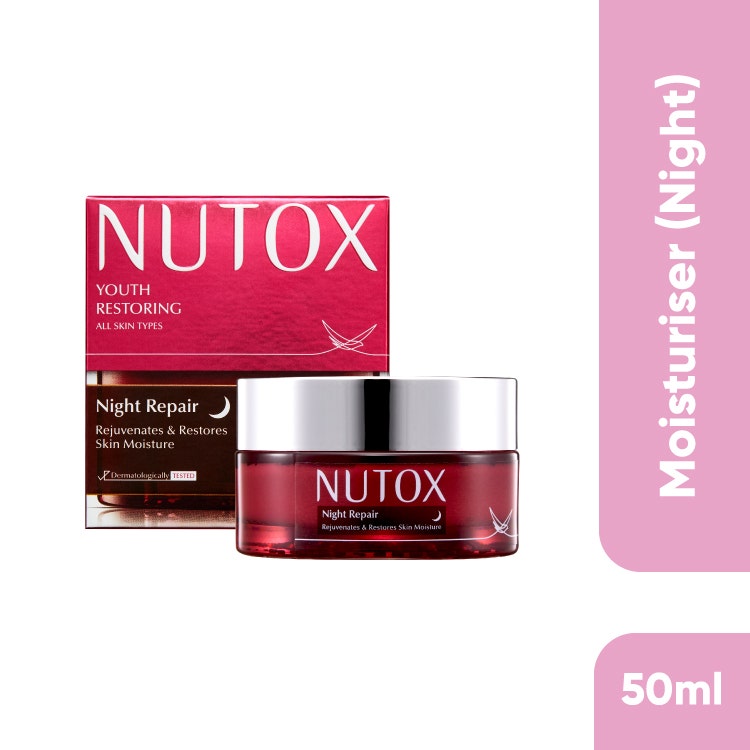
Nutox Youth Restoring Night Repair (All) 30Ml

Nutox Youth Restoring Night Repair (All) 30Ml
NUTOX
nutox-youth-restoring-night-repair-all-30ml
Moisturize
10084946673957
Morning or Evening?
How often will you use this product?
Notes


Highlights
WHAT IS IT?
Night repair cream with multiple botanical and active ingredients
FEATURES
Formulated with collagen from bird's nest; repairs damage from external aggression; rich texture; nourishes skin without heaviness; skin looks younger and plumper
BEST FOR
all skin types
CHECKS
Does not contain parabens, sulfates, silicones explicitly mentioned but fragrance is included, so fragrance-free is false
Who Is It For?
All Genders No Age Range SpecifiedWhat Does It Help With?
Repair Skin Damage Improve Skin Plumpness And YouthfulnessBudget
Mid-range ($30-$75)How To Use
Which routine should it be used in?
Instructions:
Key Information


What NUTOX Says
Product Description:
Formulated with collagen from bird's nest to repair damages from external aggression and to restore skin to its pristine condition throughout the night. Its rich texture effectively nourishes skin without leaving a heavy and tacky feeling. Skin looks younger and plumper the next morning.
About the Brand:
Ingredients Overview
Ingredients List
Water-(Aqua),C12-15-Alkyl-Benzoate,Glycerin,Caprylic/Capric-Triglyceride,Phenyl-Trimethicone,Ammonium-Acryloyldimethyltaurate/VP-Copolymer,Isopropyl-Isostearate,Polysorbate-20,Undaria-Pinnatifida-Extract,Propanediol,Evodia-Rutaecarpa-Fruit-Extract,Tocopheryl-Acetate,Sodium-PCA,Urea,Trehalose,Polyquaternium-51,Triacetin,Sodium-Hyaluronate,Algae-Extract,Glycine-Soja-Extract,Xanthan-Gum,Diatomaceous-Earth,Butylene-Glycol,Swiftlet-Nest-Extract,Tremella-Fuciformis-(Mushroom)-Extract,Propylene-Glycol,Chamomilla-Recutita-(Matricaria)-Flower-Extract,Lecithin,Arbutin,Linolenic-Acid,Glutathione,Linoleic-Acid,Ascorbyl-Palmitate,Tropaeolum-Majus-Flower/Leaf/Stem-Extract,Phenoxyethanol,Ethylhexylglycerin,Fragrance,Sodium-Polyacrylate,Hydrogenated-Polydecene,Trideceth-6,Tetrasodium-EDTA
Key Ingredients
Collagen,Swiftlet Nest Extract,Undaria Pinnatifida Extract,Sodium Hyaluronate,Arbutin
Ingredients Details
Arbutin
Common Name(s): Arbutin,cosmetic active,functional ingredient
CAS Number: N/a
DESCRIPTION
What It Does: Delivers characteristic cosmetic function — skin conditioning, protection, preservation, or active biological benefit — at recommended use concentration.
Why It's Used: Selected for its functional contribution and formulation compatibility — supported by cosmetic science literature and regulatory safety assessment.
How It Works: Works through the mechanism of its molecular class — physicochemical interaction with the formulation or biological interaction with skin proteins, lipids, or receptors as documented in peer-reviewed literature.
Typically Found In: Skin care formulations
TECHNICAL DETAILS
Primary Category: Active ingredient – cosmetic active
Secondary Functions: Skin conditioning
Application Areas:

Facial Skincare

Body Care
Hair Care
Beard Care
Color Cosmetics (Makeup)
Dietary/Oral Supplements
Typical Concentration Range: 0.1%–10%
SOURCING & ETHICS
Vegan Status: Conditional
Halal Status: Yes
Source Notes: Commercially produced for cosmetic use. verify vegan/halal status with supplier.
SKIN COMPATIBILITY
Irritancy Rating: 1/5 – very low
Comedogenicity Rating: 0/5 – non-comedogenic
Sensitivity Concerns: Well-tolerated by most skin types.
Safe for Sensitive Skin: Yes
SAFETY & COMPATIBILITY
Safety Profile: Good safety profile at recommended concentrations. ewg score: 1–2.
Works Well With: Standard skincare actives
Avoid Combining With: No known significant incompatibilities
SCIENTIFIC NOTE
Arbutin delivers documented functional benefit with an established safety profile within the cosmetic regulatory framework (cosing eu, cir usa).
Last Verified: Cosing database,arbutin technical literature
Primary Sources: 2026-03-12
Ethylhexylglycerin
Common Name(s): Octylglycerin,2-ethylhexyl glycerol ether,sensiva sc 10
CAS Number: 70445-33-9
DESCRIPTION
What It Does: Provides antimicrobial skin conditioning with deodorant activity and preservation system enhancement.
Why It's Used: Multifunctional clean beauty preservation active — ethylhexylglycerin provides antimicrobial, deodorant, and skin conditioning in a single ingredient accepted in most natural cosmetic certification schemes.
How It Works: Glycerol ether provides antimicrobial via bacterial membrane phospholipid disruption. deodorant activity via reduction of underarm lipase enzyme activity (similar mechanism to triethyl citrate). skin conditioning from glycerol humectant component. synergistic with phenoxyethanol and diols.
Typically Found In: Natural preservation systems,deodorants,skin conditioning products
TECHNICAL DETAILS
Primary Category: Functional ingredient – antimicrobial glycerol ether
Secondary Functions: Skin conditioning
Application Areas:
Facial Skincare
Body Care
Hair Care
Beard Care
Color Cosmetics (Makeup)
Dietary/Oral Supplements
Typical Concentration Range: 0.1%–0.5%
SOURCING & ETHICS
Vegan Status: Yes – synthetic
Halal Status: Yes
Source Notes: Commercially produced for cosmetic use. verify vegan/halal status with supplier.
SKIN COMPATIBILITY
Irritancy Rating: 1/5 – very low
Comedogenicity Rating: 0/5 – non-comedogenic
Sensitivity Concerns: Well-tolerated by most skin types.
Safe for Sensitive Skin: Yes
SAFETY & COMPATIBILITY
Safety Profile: Good safety profile at recommended concentrations. ewg score: 1–2.
Works Well With: Standard skincare actives
Avoid Combining With: No known significant incompatibilities
SCIENTIFIC NOTE
Ethylhexylglycerin's deodorant mechanism is pharmacologically identical to triethyl citrate: both inhibit skin surface microbial lipase enzymes that convert odourless triglycerides to odorous free fatty acids. the glycerol ether structure of ethylhexylglycerin, combined with the 2-ethylhexyl chain, provides lipase inhibition similar to ester-based lipase inhibitors from a different chemical class.
Last Verified: Cosing database,schülke sensiva sc 10 technical data,cir safety assessment
Primary Sources: 2026-03-12
Fragrance
Common Name(s): Fragrance ingredient,eu allergen or aromatic component,olfactory/flavour
CAS Number: N/a
DESCRIPTION
What It Does: Provides the complete fragrance profile contributing to product sensory experience and consumer appeal.
Why It's Used: Fragrance is a major consumer purchase driver — up to 70% of consumers make purchasing decisions partially based on product scent.
How It Works: Fragrance blends interact with olfactory receptors providing the sensory profile — complex mixtures activate multiple receptor types for rich, multidimensional scent experiences.
Typically Found In: All fragrance products
TECHNICAL DETAILS
Primary Category: Active ingredient – cosmetic active
Secondary Functions: Skin conditioning
Application Areas:
Facial Skincare
Body Care
Hair Care
Beard Care
Color Cosmetics (Makeup)
Dietary/Oral Supplements
Typical Concentration Range: Standard use levels
SOURCING & ETHICS
Vegan Status: Conditional
Halal Status: Yes
Source Notes: Commercially produced for cosmetic use. verify vegan/halal status with supplier.
SKIN COMPATIBILITY
Irritancy Rating: 1/5 – very low
Comedogenicity Rating: 0/5 – non-comedogenic
Sensitivity Concerns: Well-tolerated by most skin types.
Safe for Sensitive Skin: Yes
SAFETY & COMPATIBILITY
Safety Profile: Good safety profile at recommended concentrations. ewg score: 1–2.
Works Well With: Standard skincare actives
Avoid Combining With: No known significant incompatibilities
SCIENTIFIC NOTE
Ifra guidelines set usage limits for fragrance ingredients based on skin sensitisation and phototoxicity assessment for each application category.
Last Verified: Eu regulation 1223/2009 annex iii,ifra standards,fragrance allergen declaration requirements
Primary Sources: 2026-03-12
Glutathione
Common Name(s): Gsh,gamma-l-glutamyl-l-cysteinyl-glycine,reduced glutathione
CAS Number: 70-18-8
DESCRIPTION
What It Does: Provides the body's primary antioxidant defense while reducing melanin production for brightening.
Why It's Used: Master antioxidant for comprehensive oxidative stress protection alongside unique melanin-shifting brightening action (pheomelanin preference).
How It Works: Three-amino acid tripeptide (gamma-glu-cys-gly). thiol group (-sh) provides electron donation for antioxidant activity and detoxification conjugation. shifts melanin synthesis from eumelanin (dark brown) toward pheomelanin (light yellow-red) for brightening. regenerates vitamins c and e from their oxidized forms.
Typically Found In: Brightening serums,antioxidant serums,anti-aging products
TECHNICAL DETAILS
Primary Category: Active ingredient – master cellular antioxidant
Secondary Functions: Melanin shifting brightening,vitamins c+e regeneration,master antioxidant
Application Areas:
Facial Skincare
Body Care
Hair Care
Beard Care
Color Cosmetics (Makeup)
Dietary/Oral Supplements
Typical Concentration Range: 0.1%–5%
SOURCING & ETHICS
Vegan Status: Yes – fermentation-derived
Halal Status: Yes
Source Notes: Produced by yeast fermentation or chemical synthesis. stability challenge – use encapsulated or stabilized forms.
SKIN COMPATIBILITY
Irritancy Rating: 1/5 – very low
Comedogenicity Rating: 0/5 – non-comedogenic
Sensitivity Concerns: Well-tolerated; some reports of tingling at high concentrations.
Safe for Sensitive Skin: Yes
SAFETY & COMPATIBILITY
Safety Profile: Excellent safety profile. ewg score: 1.
Works Well With: Vitamin c,vitamin e,ferulic acid,spf,other antioxidants
Avoid Combining With: No significant incompatibilities
SCIENTIFIC NOTE
Glutathione's melanin-shifting mechanism (eumelanin→pheomelanin) is entirely different from tyrosinase inhibition. even in the presence of active tyrosinase, glutathione shifts the enzymatic product from dark eumelanin to lighter pheomelanin by chelating copper from the tyrosinase active site and competing for dopa substrate.
Last Verified: Cosing database,villarama & maibach glutathione brightening review,cir safety assessment
Primary Sources: 2026-03-12
