

NIVEA
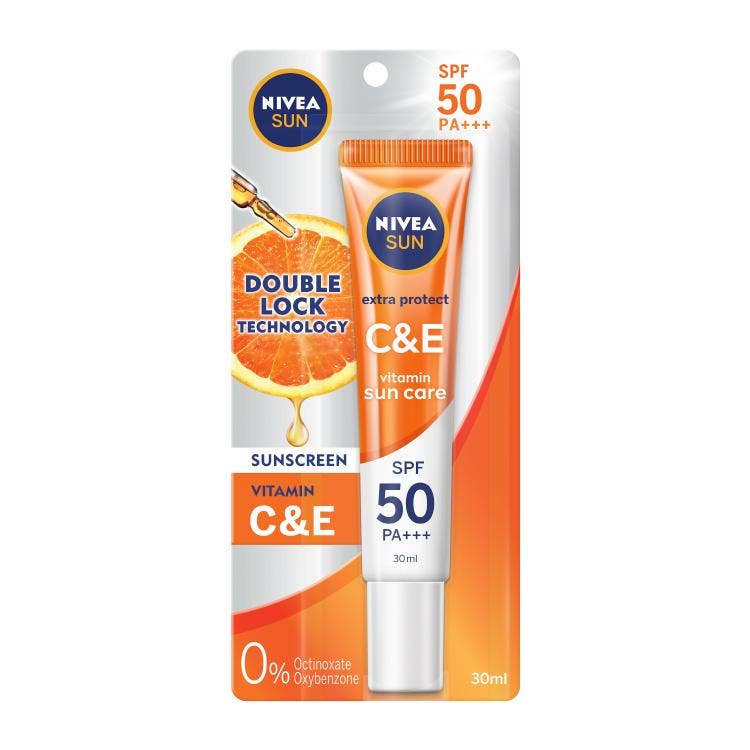
Nivea Sun Extra Protect C&E Vitamin Suncare Spf50 Pa+++ 30Ml

Nivea Sun Extra Protect C&E Vitamin Suncare Spf50 Pa+++ 30Ml
NIVEA
nivea-sun-extra-protect-c-e-vitamin-suncare-spf50-pa-30ml
Serum
10084763599141
Morning or Evening?
How often will you use this product?
Notes


Highlights
WHAT IS IT?
Suncare serum with multiple active ingredients (30 total)
FEATURES
Double lock technology to effectively filter UVA & UVB, contains Vitamin C & Vitamin E to repair and moisturise skin, absorbs quickly, protects skin from sun damage, gives radiant, moisturised and youthful skin
BEST FOR
sensitive
CHECKS
Alcohol denat., Paraben, Sulfate
Who Is It For?
All Genders Adult Age RangeWhat Does It Help With?
Sun Protection Skin Repair Moisturization Anti-aging Radiant SkinBudget
Mid-range ($30-$75)How To Use
Which routine should it be used in?
Instructions:
Key Information


What NIVEA Says
Product Description:
NIVEA C&E SUN PROTECT SERUM 30ML with double lock technology to effectively filter UVA & UVB to protect your skin against sun damage. Also contains Vitamin C & Vitamin E to repair & moisturise skin. With regular use, this concentrated formula not only absorbs quickly but the combination of Vitamin C & E skin benefits, can effectively protect your skin and give you noticeably radiant, moisturised & youthful skin.
About the Brand:
Ingredients Overview
Ingredients List
Aqua,C12-15-alkyl-benzoate,Alcohol-denat.,Distarch-phosphate,Octocrylene,Phenylbenzimidazole-sulfonic-acid,Butyl-methoxydibenzoylmethane,Glycerin,Polyglyceryl-3-methylglucose-distearate,Dimethicone,Silica,Sodium-ascorbyl-phosphate,Tocopheryl-acetate,Panthenol,4-Butylresorcinol,Ginkgo-biloba-leaf-extract,Panax-ginseng-root-extract,Glycyrrhiza-glabra-root-extract,Behenyl-alcohol,Cetyl-alcohol,Polyisobutene,Carbomer,Acrylates/C10-30-alkyl-acrylate-crosspolymer,Acrylamide/Ammonium-acrylate-copolymer,Silica-dimethyl-silylate,VP/Hexadecene-copolymer,Xanthan-gum,Sorbitan-isostearate,PEG-40-hydrogenated-castor-oil,Pantolactone,Polysorbate-20,Glucose,Citric-acid,Trideceth-9,Lactic-acid,Propylene-glycol,Trisodium-EDTA,Phenoxyethanol,Methylparaben,Sodium-hydroxide,Sodium-benzoate,Potassium-sorbate,Caramel,Parfum,CI-77891
Key Ingredients
Vitamin-C,Sodium-Ascorbyl-Phosphate,Vitamin-E,Tocopheryl-Acetate,Panthenol
Ingredients Details
4-butylresorcinol
Common Name(s): P-butylresorcinol,rucinol
CAS Number: 18979-61-8
DESCRIPTION
What It Does: Provides exceptional brightening through the most potent tyrosinase inhibition of any commonly used cosmetic brightening agent.
Why It's Used: The most potent tyrosinase inhibitor available in cosmetics – exceptional for refractory hyperpigmentation and melasma where standard brighteners provide insufficient efficacy.
How It Works: Resorcinol backbone competitively inhibits both tyrosine hydroxylase (reaction 1) and dopa oxidase (reaction 2) activities of tyrosinase. n-butyl chain provides superior membrane affinity for enhanced delivery to melanosomes.
Typically Found In: High-potency brightening serums,melasma treatments,stubborn hyperpigmentation products
TECHNICAL DETAILS
Primary Category: Active ingredient – resorcinol tyrosinase inhibitor
Secondary Functions: Dual tyrosinase reaction inhibition,potent brightening
Application Areas:

Facial Skincare

Body Care
Hair Care
Beard Care
Color Cosmetics (Makeup)
Dietary/Oral Supplements
Typical Concentration Range: 0.1%–1%
SOURCING & ETHICS
Vegan Status: Yes – synthetic
Halal Status: Yes
Source Notes: Synthetic or plant-derived.
SKIN COMPATIBILITY
Irritancy Rating: 2/5 – low to moderate
Comedogenicity Rating: 0/5 – non-comedogenic
Sensitivity Concerns: Use with spf; introduce gradually. photosensitizing.
Safe for Sensitive Skin: Yes
SAFETY & COMPATIBILITY
Safety Profile: Excellent safety profile. use with spf for maximum efficacy. ewg score: 1.
Works Well With: Niacinamide,vitamin c,alpha-arbutin,tranexamic acid,spf
Avoid Combining With: No significant incompatibilities
SCIENTIFIC NOTE
4-butylresorcinol's inhibition of both tyrosinase catalytic reactions (tyrosine→dopa and dopa→dopaquinoneoxidase) is unique among common brighteners. most tyrosinase inhibitors only block the first reaction (tyrosine→dopa). blocking both steps provides more complete melanin biosynthesis inhibition.
Last Verified: ##########
Primary Sources: Cosing database,choi et al. 4-butylresorcinol study,sccs opinion on butylresorcinol
Caramel
Common Name(s): Caramel colour,natural brown,e150
CAS Number: 8028-89-5
DESCRIPTION
What It Does: Provides natural warm-brown colour from heat-treated sugar for natural cosmetics.
Why It's Used: Natural brown colorant with food-grade safety credentials for clean beauty formulations requiring warm brown or amber shades.
How It Works: Complex mixture of pyranose-ring condensation products from heat-treated sugars. 5-hmf and melanoidin polymers provide brown colour. ph-stable in acidic formulations. soluble in water and lower alcohols.
Typically Found In: Natural cosmetics,bronzers,hair products
TECHNICAL DETAILS
Primary Category: Colorant – natural brown dye
Secondary Functions: Skin conditioning
Application Areas:
Facial Skincare
Body Care
Hair Care
Beard Care
Color Cosmetics (Makeup)
Dietary/Oral Supplements
Typical Concentration Range: 0.01%–5%
SOURCING & ETHICS
Vegan Status: Conditional - supplier confirmation required
Halal Status: Unverified - supplier confirmation required
Source Notes: Commercially produced for cosmetic use. verify vegan/halal status with supplier. [audit 2026-07-29 rev2: the record's own source_notes does not assert a non-animal origin, or instructs the reader to verify with the supplier; "yes" asserts knowledge the record does not hold. determination requires shariah-panel sign-off.]
SKIN COMPATIBILITY
Irritancy Rating: 1/5 – very low
Comedogenicity Rating: 0/5 – non-comedogenic
Sensitivity Concerns: Well-tolerated by most skin types.
Safe for Sensitive Skin: Yes
SAFETY & COMPATIBILITY
Safety Profile: Good safety profile at recommended concentrations. ewg score: 1–2.
Works Well With: Standard skincare actives
Avoid Combining With: No known significant incompatibilities
SCIENTIFIC NOTE
Caramel's colour develops through the maillard reaction between reducing sugars and amino acids at elevated temperatures, creating a complex mixture of coloured polymer (melanoidin) and small molecule chromophores. unlike single-compound dyes with defined absorption spectra, caramel's broad-spectrum absorption from multiple chromophores provides a naturally warm, complex brown impossible to replicate with a single synthetic dye.
Last Verified: 2026-03-12
Primary Sources: Cosing database,fda 21 cfr color additives
Carbomer
Common Name(s): Carbopol,polyacrylic acid,carboxyvinyl polymer
DESCRIPTION
What It Does: Provides transparent gel textures and thickening at very low concentrations via ph-responsive swelling.
Why It's Used: The most widely used gel thickener – provides crystal-clear, stable gels at concentrations as low as 0.1-0.5% with ph-controlled viscosity.
How It Works: Highly crosslinked polyacrylic acid remains tightly coiled at acidic ph. neutralization with naoh or triethanolamine ionizes carboxylic groups causing electrostatic repulsion that unfolds and swells the polymer coils, dramatically increasing viscosity. concentration-dependent thickening.
Typically Found In: Gels,serums,emulsions,sunscreens
TECHNICAL DETAILS
Primary Category: Functional ingredient – polyacrylic acid thickener
Secondary Functions: Skin conditioning
Application Areas:
Facial Skincare
Body Care
Hair Care
Beard Care
Color Cosmetics (Makeup)
Dietary/Oral Supplements
Typical Concentration Range: 0.1%–2%
SOURCING & ETHICS
Vegan Status: Conditional - supplier confirmation required
Halal Status: Unverified - supplier confirmation required
Source Notes: Commercially produced for cosmetic use. verify vegan/halal status with supplier. [audit 2026-07-29 rev2: the record's own source_notes does not assert a non-animal origin, or instructs the reader to verify with the supplier; "yes" asserts knowledge the record does not hold. determination requires shariah-panel sign-off.]
SKIN COMPATIBILITY
Irritancy Rating: 1/5 – very low
Comedogenicity Rating: 0/5 – non-comedogenic
Sensitivity Concerns: Well-tolerated by most skin types.
Safe for Sensitive Skin: Yes
SAFETY & COMPATIBILITY
Safety Profile: Good safety profile at recommended concentrations. ewg score: 1–2.
Works Well With: Standard skincare actives
Avoid Combining With: No known significant incompatibilities
SCIENTIFIC NOTE
Carbomer's ph-responsive swelling mechanism provides an elegant formulation control tool: a neutralized gel can be liquefied by ph reduction (adding acid) and re-thickened by reneutralization. this reversible rheology control allows two-phase products that mix on application without the need for mechanical emulsification.
Last Verified: 2026-03-12
Primary Sources: Cosing database,cir safety assessment
Dimethicone
Common Name(s): Pdms,polydimethylsiloxane,silicone fluid
CAS Number: 9006-65-9
DESCRIPTION
What It Does: Provides silicone-characteristic silky feel and skin protection with adjustable viscosity.
Why It's Used: The benchmark cosmetic silicone – sets the gold standard for silky application feel, spreadability, and skin protection in virtually all skin care categories.
How It Works: Polydimethylsiloxane chain flexibility provides extremely low surface tension and high spreadability. inert si-o backbone provides chemical stability and excellent skin tolerance. occlusive film formation reduces tewl. higher viscosity grades provide more intense conditioning.
Typically Found In: Moisturizers,foundations,primers,sunscreens – nearly universal
TECHNICAL DETAILS
Primary Category: Functional ingredient – polydimethylsiloxane
Secondary Functions: Barrier sealing,softening
Application Areas:
Facial Skincare
Body Care
Hair Care
Beard Care
Color Cosmetics (Makeup)
Dietary/Oral Supplements
Typical Concentration Range: 0.1%–30%
SOURCING & ETHICS
Vegan Status: Conditional - supplier confirmation required
Halal Status: Unverified - supplier confirmation required
Source Notes: Plant-derived, synthetic or animal-derived. verify source. [audit 2026-07-29 rev2: the record's own source_notes does not assert a non-animal origin, or instructs the reader to verify with the supplier; "yes" asserts knowledge the record does not hold. determination requires shariah-panel sign-off.]
SKIN COMPATIBILITY
Irritancy Rating: 1/5 – very low
Comedogenicity Rating: 1/5 – low; formulation-dependent
Sensitivity Concerns: Non-irritating.
Safe for Sensitive Skin: Yes
SAFETY & COMPATIBILITY
Safety Profile: Excellent safety profile. ewg score: 1.
Works Well With: Humectants,ceramides,actives as carrier
Avoid Combining With: No significant incompatibilities
SCIENTIFIC NOTE
Dimethicone's exceptional silky feel arises from its very low intermolecular attractive forces (weak van der waals forces due to non-polar methyl groups) that allow silicone chains to slide freely over skin. the coefficient of kinetic friction for pdms against skin (~0.04) is among the lowest of any cosmetic material – explaining why even small amounts transform product feel.
Last Verified: 2026-03-12
Primary Sources: Cosing database,cir safety assessment