

AfricanBotanicsStaging
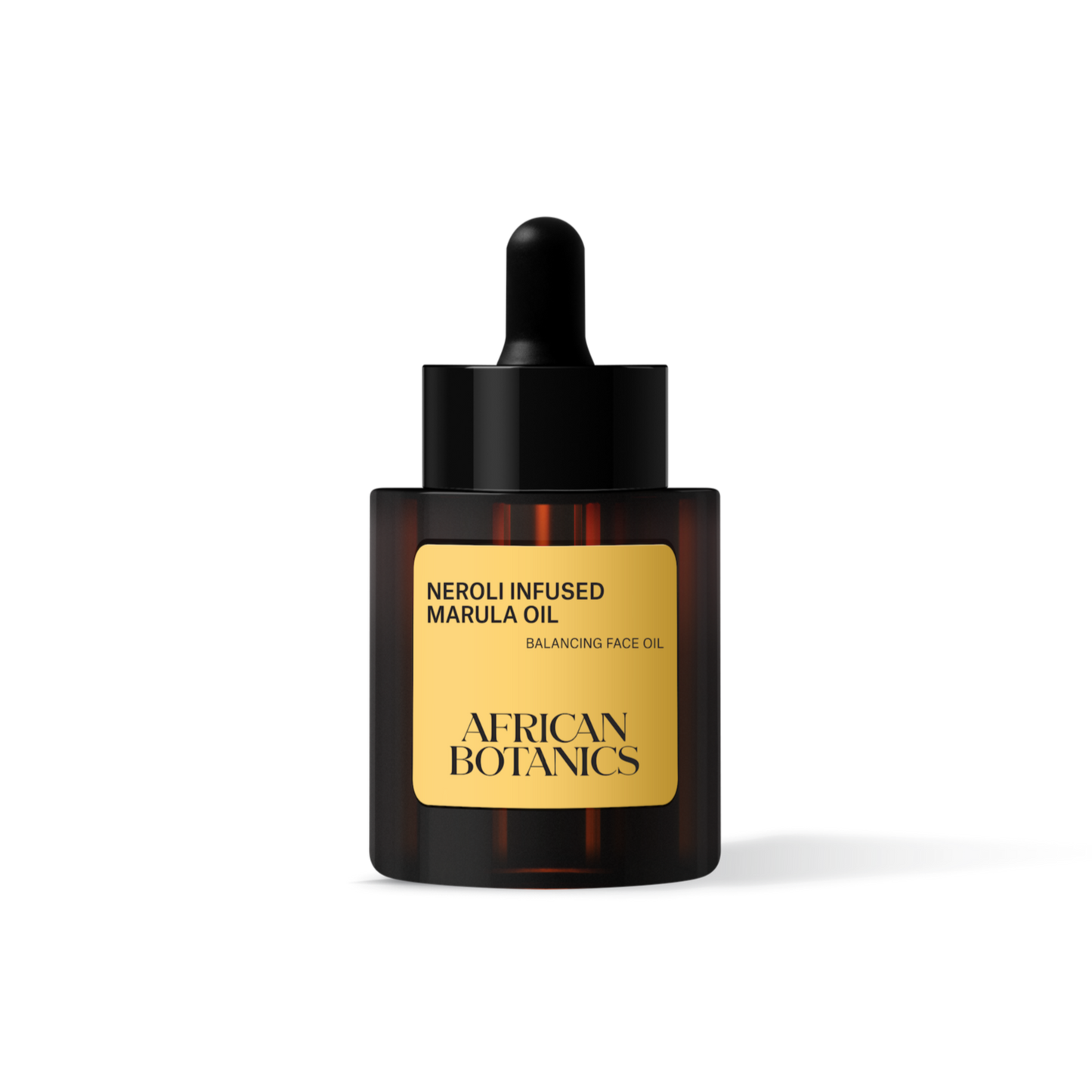
Neroli Infused Marula Oil

Neroli Infused Marula Oil
AfricanBotanicsStaging
neroli-infused-marula-oil
Face Oil
9784845893925
Morning or Evening?
How often will you use this product?
Notes


Highlights
WHAT IS IT?
Facial oil with Marula and Neroli infusion
FEATURES
Lightweight, rapid absorption, maximum nutrient delivery, balancing
BEST FOR
normal
CHECKS
Parabens-free, silicones-free, phthalates-free, mineral oil-free, artificial fragrance-free, colorants-free, SLS-free
Who Is It For?
All Ages All GendersWhat Does It Help With?
Skin Balance Firmness Suppleness Even ComplexionBudget
Premium ($76-$150)How To Use
Which routine should it be used in?
Instructions:
Key Information


What AfricanBotanicsStaging Says
Product Description:
Featuring a luxurious, lightweight base of incredibly potent and nutrient-rich wild-grown Marula Oil rich in Tocopherols, Tocotrienols, Flavonoids, Phenolic compounds and Phytosterols. The ultra-fine molecular structure of this infusion allows for rapid, maximum absorbency of all its nutrients. Your skin is left balanced, supple and firm with an even, dewy complexion.
About the Brand:
Ingredients Overview
Ingredients List
Sclerocarya Birrea (Marula) Seed Oil*, Citrus Aurantium (Neroli) Flower Extract, Linalool**, Limonene, Benzyl Alcohol**, Tocopherol (Vitamin E), Citronellol**, Hexyl Cinnamal**, Hydroxycitronellal**. _x0003_*Single origin, biodynamic & unrefined. **Components of natural essential oils
Key Ingredients
marula oil, neroli oil
Ingredients Details
Benzyl Alcohol
Common Name(s): Phenylcarbinol,benzenemethanol,alpha-hydroxytoluene
CAS Number: 100-51-6
DESCRIPTION
What It Does: Provides dual fragrance and preservative activity as an aromatic alcohol.
Why It's Used: Multi-function ingredient serving as both fragrance component and preservative – reduces formulation complexity by providing both functions in one ingredient.
How It Works: Phenylcarbinol provides antimicrobial activity via membrane disruption (effective vs gram-positive bacteria and moulds). solvent for fragrances and difficult-to-dissolve actives. mild oxidative conversion to benzaldehyde provides sweet almond-like fragrance.
Typically Found In: Fragrances,preserved cosmetics,solvent systems
TECHNICAL DETAILS
Primary Category: Fragrance component / preservative
Secondary Functions: Skin conditioning
Application Areas:

Facial Skincare

Body Care
Hair Care
Beard Care
Color Cosmetics (Makeup)
Dietary/Oral Supplements
Typical Concentration Range: 0.001%–1% (fragrance); up to 1% as preservative
SOURCING & ETHICS
Vegan Status: Yes - standard ethanol routes are non-animal; confirm denaturant origin
Halal Status: Conditional - ethanol production route and residual concentration; jurisdiction-dependent, refer to certifier stance
Source Notes: Commercially produced for cosmetic use. verify vegan/halal status with supplier. [audit 2026-07-29 rev2: ethanol pathway; determination depends on route, on whether the plant also produces beverage alcohol, and on residual concentration. determination requires shariah-panel sign-off.]
SKIN COMPATIBILITY
Irritancy Rating: 1/5 – very low
Comedogenicity Rating: 0/5 – non-comedogenic
Sensitivity Concerns: Well-tolerated by most skin types.
Safe for Sensitive Skin: Yes
SAFETY & COMPATIBILITY
Safety Profile: Eu cosmetics regulation: declared fragrance allergen. also listed as approved preservative (annex v, max 1%). dual regulatory status (fragrance + preservative) depending on function and concentration.
Works Well With: Standard skincare actives
Avoid Combining With: No known significant incompatibilities
SCIENTIFIC NOTE
Benzyl alcohol's dual regulatory status (fragrance allergen and approved preservative) creates a formulation paradox: it must be listed as a fragrance allergen if present >0.001% (leave-on) regardless of whether it was added for fragrance or preservation. this regulatory dual identity means a preservative added for antimicrobial function triggers the same allergen declaration requirement as a fragrance added for scent.
Last Verified: 2026-03-12
Primary Sources: Cosing database,ifra standards,eu preservative annex v
Citronellol
Common Name(s): (r)-3,7-dimethyl-6-octen-1-ol,rhodinol
CAS Number: 106-22-9
DESCRIPTION
What It Does: Provides soft, lasting rose-floral fragrance note.
Why It's Used: Essential rose fragrance monoterpene for lasting smooth floral notes in high-quality perfumery and cosmetic fragrances.
How It Works: Allylic alcohol monoterpene provides fixative property in fragrance blends. good skin substantivity for lasting scent. softer, rounder rose note vs geraniol's fresher character. natural in rose otto at 18-34%.
Typically Found In: Rose perfumes,floral fragrances,luxury skincare
TECHNICAL DETAILS
Primary Category: Fragrance component – monoterpene alcohol
Secondary Functions: Skin conditioning
Application Areas:
Facial Skincare
Body Care
Hair Care
Beard Care
Color Cosmetics (Makeup)
Dietary/Oral Supplements
Typical Concentration Range: 0.001%–1%
SOURCING & ETHICS
Vegan Status: Conditional - supplier confirmation required
Halal Status: Unverified - supplier confirmation required
Source Notes: Commercially produced for cosmetic use. verify vegan/halal status with supplier. [audit 2026-07-29 rev2: the record's own source_notes does not assert a non-animal origin, or instructs the reader to verify with the supplier; "yes" asserts knowledge the record does not hold. determination requires shariah-panel sign-off.]
SKIN COMPATIBILITY
Irritancy Rating: 1/5 – very low
Comedogenicity Rating: 0/5 – non-comedogenic
Sensitivity Concerns: Well-tolerated by most skin types.
Safe for Sensitive Skin: Yes
SAFETY & COMPATIBILITY
Safety Profile: Eu cosmetics regulation: declared fragrance allergen. ifra guidelines apply.
Works Well With: Standard skincare actives
Avoid Combining With: No known significant incompatibilities
SCIENTIFIC NOTE
Citronellol's r-enantiomer (natural) vs s-enantiomer (synthetic) provide meaningfully different scent character – a remarkable demonstration of chiral scent discrimination by olfactory receptors. the (r) form provides the characteristic rose note while the (s) form has a distinctly different, less pleasant character. this enantiomeric scent difference means that the biological handedness of naturally-sourced vs racemic synthetic citronellol produces perceptibly different fragrance quality.
Last Verified: 2026-03-12
Primary Sources: Cosing database,ifra standards
Hexyl Cinnamal
Common Name(s): Hexyl cinnamic aldehyde,alpha-hexyl cinnamic aldehyde
CAS Number: 101-86-0
DESCRIPTION
What It Does: Provides sweet jasmine-like floral fragrance note.
Why It's Used: The jasmine-character synthetic aldehyde – hexyl cinnamal provides jasmine's sweet floral note at a fraction of the cost of natural jasmine absolute.
How It Works: Alpha,beta-unsaturated aldehyde provides jasmine-like scent character. absorbs to skin proteins for long-lasting fragrance. fixative properties from aldehyde-protein interactions.
Typically Found In: Virtually all fragranced cosmetics,detergents
TECHNICAL DETAILS
Primary Category: Fragrance component – aldehyde
Secondary Functions: Skin conditioning
Application Areas:
Facial Skincare
Body Care
Hair Care
Beard Care
Color Cosmetics (Makeup)
Dietary/Oral Supplements
Typical Concentration Range: 0.001%–1%
SOURCING & ETHICS
Vegan Status: Conditional - supplier confirmation required
Halal Status: Unverified - supplier confirmation required
Source Notes: Commercially produced for cosmetic use. verify vegan/halal status with supplier. [audit 2026-07-29 rev2: the record's own source_notes does not assert a non-animal origin, or instructs the reader to verify with the supplier; "yes" asserts knowledge the record does not hold. determination requires shariah-panel sign-off.]
SKIN COMPATIBILITY
Irritancy Rating: 1/5 – very low
Comedogenicity Rating: 0/5 – non-comedogenic
Sensitivity Concerns: Well-tolerated by most skin types.
Safe for Sensitive Skin: Yes
SAFETY & COMPATIBILITY
Safety Profile: Eu cosmetics regulation: declared fragrance allergen. one of the most commonly reported fragrance allergens. ifra guidelines apply.
Works Well With: Standard skincare actives
Avoid Combining With: No known significant incompatibilities
SCIENTIFIC NOTE
Hexyl cinnamal's status as one of the most commonly identified fragrance allergens (along with linalool and limonene) reflects both its widespread use and its alpha,beta-unsaturated aldehyde structure. alpha,beta-unsaturated carbonyl compounds are michael acceptors that react with lysine and cysteine residues in skin proteins, forming protein-hapten conjugates that trigger ige-mediated type iv sensitisation reactions.
Last Verified: 2026-03-12
Primary Sources: Cosing database,ifra standards,schnuch et al. fragrance allergen frequency study
Limonene
Common Name(s): D-limonene,(r)-limonene,dipentene
CAS Number: 5989-27-5
DESCRIPTION
What It Does: Provides the defining fresh citrus fragrance note alongside solvent and antimicrobial properties.
Why It's Used: The citrus industry's primary fragrance compound and the most abundant terpene in essential oils – limonene provides the clean, universally appealing fresh citrus scent character.
How It Works: D-limonene activates trpv1 mildly at high concentrations. antimicrobial via membrane disruption. solvent for oils and lipophilic compounds. cleaning via emulsification of lipid soils.
Typically Found In: Citrus-scented products,cleaning products,fragrance compounds
TECHNICAL DETAILS
Primary Category: Fragrance component – cyclic monoterpene
Secondary Functions: Skin conditioning
Application Areas:
Facial Skincare
Body Care
Hair Care
Beard Care
Color Cosmetics (Makeup)
Dietary/Oral Supplements
Typical Concentration Range: 0.001%–3%
SOURCING & ETHICS
Vegan Status: Conditional - supplier confirmation required
Halal Status: Unverified - supplier confirmation required
Source Notes: Commercially produced for cosmetic use. verify vegan/halal status with supplier. [audit 2026-07-29 rev2: the record's own source_notes does not assert a non-animal origin, or instructs the reader to verify with the supplier; "yes" asserts knowledge the record does not hold. determination requires shariah-panel sign-off.]
SKIN COMPATIBILITY
Irritancy Rating: 1/5 – very low
Comedogenicity Rating: 0/5 – non-comedogenic
Sensitivity Concerns: Well-tolerated by most skin types.
Safe for Sensitive Skin: Yes
SAFETY & COMPATIBILITY
Safety Profile: Eu cosmetics regulation: declared fragrance allergen. oxidises to sensitising compounds (limonene hydroperoxides) on air exposure – use with antioxidant stabilisers. ifra guidelines apply.
Works Well With: Standard skincare actives
Avoid Combining With: No known significant incompatibilities
SCIENTIFIC NOTE
Limonene's sensitisation risk arises not from limonene itself but from its autooxidation products (limonene-1,2-epoxide and limonene hydroperoxides) formed on air exposure. fresh limonene has low sensitisation potential, but air-oxidised limonene's hydroperoxide products are potent skin sensitisers. this explains why oxidation-stabilised formulations (with bht or other antioxidants) are required to manage limonene safety.
Last Verified: 2026-03-12
Primary Sources: Cosing database,ifra standards,bråred christensson et al. limonene oxidation study