
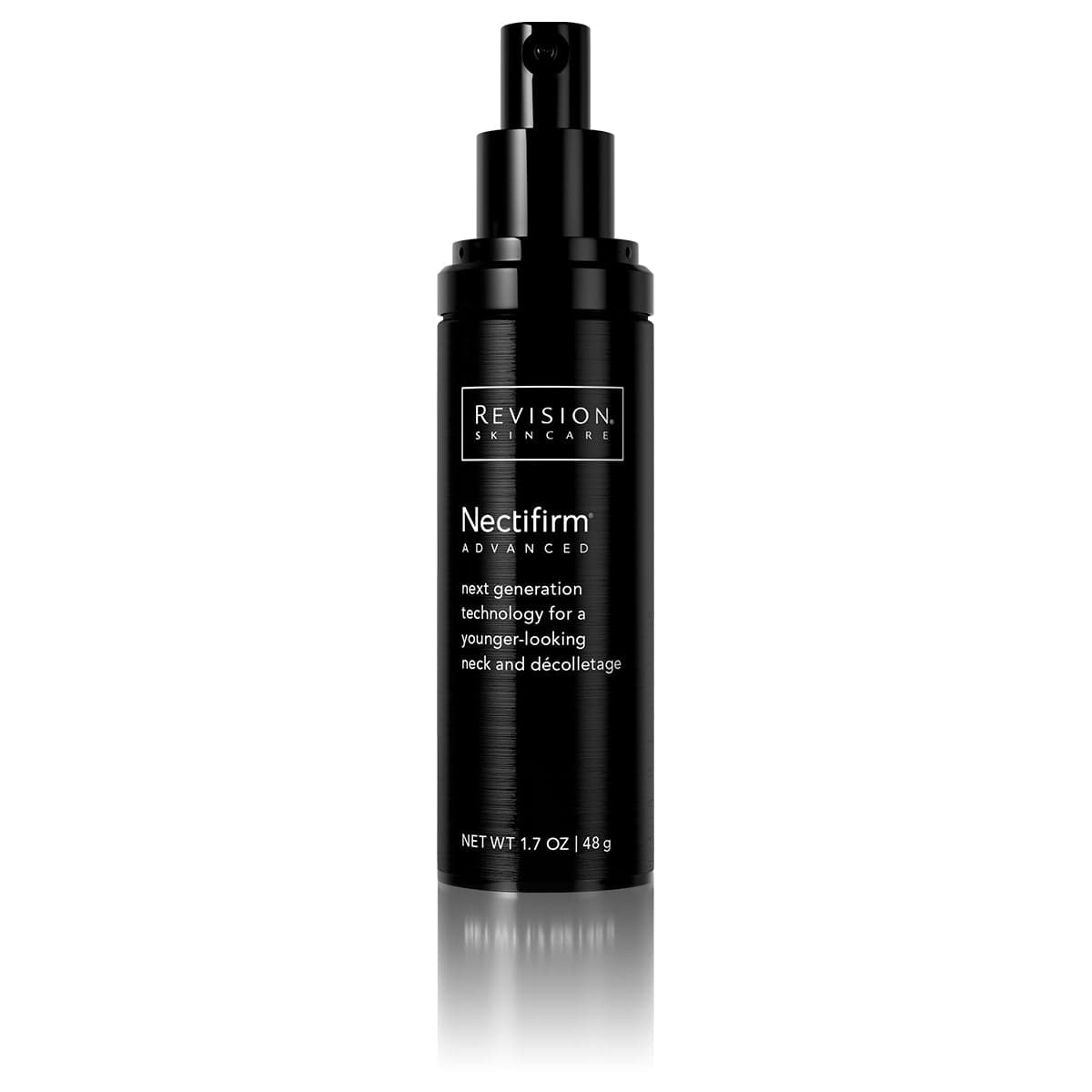

Revision Skincare
Nectifirm® ADVANCED

Nectifirm® ADVANCED
Revision Skincare
nectifirm-r-advanced
Moisturize
9784773181733
Morning or Evening?
How often will you use this product?
Notes


Highlights
WHAT IS IT?
Neck cream with eight distinctive peptides
FEATURES
Addresses moderate to advancing visible signs of aging, Industry-leading Microbiome technology, Smart Antioxidant Technology, Reduces appearance of adipose tissue and crepey skin
BEST FOR
normal
CHECKS
FRAGRANCE-FREE, NO ARTIFICIAL DYES, PARABEN FREE, PHTHALATES FREE, ALCOHOL FREE, FORMALDEHYDES FREE, NO HORMONES
Who Is It For?
All Skin Types Ages 36-55 And AboveWhat Does It Help With?
Brightening Firming Reducing Fine Lines And Wrinkles Sculpting Neck And Décolletage AreaBudget
Professional (over $150)How To Use
Which routine should it be used in?
Instructions:
Key Information


What Revision Skincare Says
Product Description:
Award-winning, age defying neck product that harnesses the power of the skin's own Microbiome with a groundbreaking formula that combats the visible signs of moderate to advanced aging on the neck and décolletage. Features eight distinctive peptides and Smart Antioxidant Technology for advanced results.
About the Brand:
Ingredients Overview
Ingredients List
Water (Aqua), Glycerin, Porphyridium Polysaccharide, Cetearyl Alcohol, Isosorbide Dicaprylate, Butylene Glycol, Methylsilanol Carboxymethyl Theophylline Alginate, Canarium Indicum Oil, Tricaprylin, C12-15 Alkyl Benzoate, Lauryl Lactate, Dimethicone/Vinyl Dimethicone Crosspolymer, Squalane, Cocos Nucifera (Coconut) Fruit Extract, Ruscus Aculeatus Root Extract, Tetrahexyldecyl Ascorbate, Palmitoyl Tripeptide-38, Helichrysum Stoechas Extract, Camellia Sinensis (Green Tea) Leaf Extract, Vaccinium Vitis-Idaea Fruit Extract, Palmitoyl Tripeptide-5, Glyceryl Caprylate, Tetradecyl Aminobutyroylvalylaminobutyric Urea Trifluoroacetate, Ceramide NG, Solidago Virgaurea (Goldenrod) Extract, Astragalus Membranaceus Root Extract, Palmitoyl Dipeptide-5 Diaminobutyroyl Hydroxythreonine, Citrus Limon (Lemon) Peel Extract, Undaria Pinnatifida (Algae) Extract, Hydrolyzed Lupine Protein, Trifluoroacetyl Tripeptide-2, Epigallocatechin Gallate, Steareth-20, Acetyl Tetrapeptide-2, Palmitoyl Hexapeptide-12, Hydrolyzed Manihot Esculenta Tuber Extract, Cetyl Alcohol, Acetyl Dipeptide-1 Cetyl Ester, Diglucosyl Gallic Acid, Dicetyl Phosphate, Steareth-10, Ceteth-10 Phosphate, Laureth-3, Tocopherol, PEG-10 Phytosterol, Dimethicone, Leuconostoc/Radish Root Ferment Filtrate, Caprylyl Glycol, Tribehenin, Dextran, Carbomer, Disodium EDTA, Hydroxypropyl Cyclodextrin, Xanthan Gum, Hydroxyethylcellulose, Silica, Aminomethyl Propanol, Propanediol, Potassium Sorbate, Magnesium Chloride, Citric Acid, Sodium Benzoate, Fragrance
Key Ingredients
peptides, antioxidants
Ingredients Details
Butylene Glycol
Common Name(s): 1,3-butanediol,bg,1,3-butylene glycol
CAS Number: 107-88-0
DESCRIPTION
What It Does: Provides humectant hydration and active ingredient solubilization with excellent skin feel.
Why It's Used: Preferred glycol humectant in premium and k-beauty formulations for superior skin feel vs propylene glycol with equivalent functionality.
How It Works: Two hydroxyl groups at 1,3-positions provide water binding and solvent activity. better tolerated than propylene glycol with minimal sensitization risk. 4-carbon backbone provides slightly greater hydrophobic character enabling dissolution of less polar actives vs pg.
Typically Found In: Toners,essences,serums,k-beauty formulas
TECHNICAL DETAILS
Primary Category: Functional ingredient – glycol humectant
Secondary Functions: Tewl reduction,skin plumping
Application Areas:

Facial Skincare
Body Care
Hair Care

Beard Care
Color Cosmetics (Makeup)
Dietary/Oral Supplements
Typical Concentration Range: 1%–10%
SOURCING & ETHICS
Vegan Status: Yes – synthetic
Halal Status: Yes
Source Notes: Synthetic or naturally derived. excellent aqueous solubility.
SKIN COMPATIBILITY
Irritancy Rating: 1/5 – very low
Comedogenicity Rating: 0/5 – non-comedogenic
Sensitivity Concerns: Non-irritating; suitable for all skin types.
Safe for Sensitive Skin: Yes
SAFETY & COMPATIBILITY
Safety Profile: Excellent safety profile. ewg score: 1.
Works Well With: Ceramides,emollients,occlusives,glycerin,hyaluronic acid
Avoid Combining With: No significant incompatibilities
SCIENTIFIC NOTE
K-beauty's preference for butylene glycol over propylene glycol is driven by two factors: bg's superior skin feel (less tacky than pg's higher viscosity) and its lower sensitization potential (1,3-bg has better spatial distribution of hydroxyl groups that reduces protein interaction vs pg's 1,2-position oh groups).
Last Verified: 2026-03-12
Primary Sources: Cosing database,cir safety assessment
C12-15 Alkyl Benzoate
Common Name(s): C12-15 alkyl benzoate,cosmetic active,functional ingredient
CAS Number: N/a
DESCRIPTION
What It Does: Delivers characteristic cosmetic function at recommended use concentration.
Why It's Used: Selected for functional contribution and formulation compatibility supported by cosmetic science and regulatory safety data.
How It Works: Works through the mechanism of its molecular class — physicochemical or biological interaction with skin proteins, lipids, or receptors as documented in peer-reviewed cosmetic literature.
Typically Found In: Skin care formulations
TECHNICAL DETAILS
Primary Category: Active ingredient – cosmetic active
Secondary Functions: Skin conditioning
Application Areas:
Facial Skincare
Body Care
Hair Care
Beard Care
Color Cosmetics (Makeup)
Dietary/Oral Supplements
Typical Concentration Range: 0.1%–10%
SOURCING & ETHICS
Vegan Status: Conditional - supplier confirmation required
Halal Status: Unverified - supplier confirmation required
Source Notes: Commercially produced for cosmetic use. verify vegan/halal status with supplier. [audit 2026-07-29 rev2: the record's own source_notes does not assert a non-animal origin, or instructs the reader to verify with the supplier; "yes" asserts knowledge the record does not hold. determination requires shariah-panel sign-off.]
SKIN COMPATIBILITY
Irritancy Rating: 1/5 – very low
Comedogenicity Rating: 0/5 – non-comedogenic
Sensitivity Concerns: Well-tolerated by most skin types.
Safe for Sensitive Skin: Yes
SAFETY & COMPATIBILITY
Safety Profile: Good safety profile at recommended concentrations. ewg score: 1–2.
Works Well With: Standard skincare actives
Avoid Combining With: No known significant incompatibilities
SCIENTIFIC NOTE
C12-15 alkyl benzoate has an established safety and efficacy profile within the cosmetic regulatory framework at standard use concentrations.
Last Verified:
Cetearyl Alcohol
Common Name(s): Cetostearyl alcohol,c16-18 fatty alcohol
CAS Number: 8005-44-5
DESCRIPTION
What It Does: Provides fatty alcohol emulsification and thickening for stable, well-textured emulsions.
Why It's Used: The most widely used fatty alcohol in cosmetics – provides emulsification, thickening, and emolliency simultaneously from a single ingredient with excellent safety profile.
How It Works: Forms bilayer lamellar structures in water with emulsifiers creating a viscous structured network that thickens and stabilizes emulsions. fatty alcohol emolliency provides direct skin conditioning. bilayer formation reduces inter-droplet coalescence in emulsions.
Typically Found In: Creams,lotions,conditioners – virtually all emulsion products
TECHNICAL DETAILS
Primary Category: Functional ingredient – fatty alcohol emulsifier/thickener
Secondary Functions: Barrier sealing,softening
Application Areas:
Facial Skincare
Body Care
Hair Care
Beard Care
Color Cosmetics (Makeup)
Dietary/Oral Supplements
Typical Concentration Range: 1%–25%
SOURCING & ETHICS
Vegan Status: Yes - standard ethanol routes are non-animal; confirm denaturant origin
Halal Status: Conditional - ethanol production route and residual concentration; jurisdiction-dependent, refer to certifier stance
Source Notes: Plant-derived, synthetic or animal-derived. verify source. [audit 2026-07-29 rev2: ethanol pathway; determination depends on route, on whether the plant also produces beverage alcohol, and on residual concentration. determination requires shariah-panel sign-off.]
SKIN COMPATIBILITY
Irritancy Rating: 1/5 – very low
Comedogenicity Rating: 1/5 – low; formulation-dependent
Sensitivity Concerns: Non-irritating.
Safe for Sensitive Skin: Yes
SAFETY & COMPATIBILITY
Safety Profile: Excellent safety profile. ewg score: 1.
Works Well With: Humectants,ceramides,actives as carrier
Avoid Combining With: No significant incompatibilities
SCIENTIFIC NOTE
Cetearyl alcohol's ability to form lamellar liquid crystal structures ('krafft phases') with water and co-emulsifiers provides not only emulsion stability but also enhanced skin penetration via the lamellar skin barrier pathway. these crystalline structures can act as a reservoir for active ingredients, slowly releasing them as the lamellar structure melts on skin contact.
Last Verified: 2026-03-12
Primary Sources: Cosing database,cir safety assessment
Dimethicone/vinyl Dimethicone Crosspolymer
Common Name(s): Dimethicone/vinyl dimethicone crosspolymer
DESCRIPTION
What It Does: Creates a smooth, silky skin feel, reduces friction, and forms a breathable film on skin that enhances product application and wear.
Why It's Used: Silicones provide unmatched aesthetic elegance, thermal stability, and formulation flexibility that enhance both consumer experience and product performance.
How It Works: Siloxane backbone provides a flexible, chemically inert polymer that forms thin, breathable films on skin surface, filling surface irregularities and providing low surface energy for exceptional slip and spreadability.
Typically Found In: Moisturizers,primers,foundations,sunscreens,hair products
TECHNICAL DETAILS
Primary Category: Silicones
Secondary Functions: Emollient,film former
Application Areas:
Facial Skincare
Body Care
Hair Care
Beard Care
Color Cosmetics (Makeup)
Dietary/Oral Supplements
Typical Concentration Range: 0.5–30%
SOURCING & ETHICS
Vegan Status: Yes
Halal Status: Yes
Source Notes: Synthetic silicone polymer; not plant-derived but generally considered vegan.
SKIN COMPATIBILITY
Irritancy Rating: 1
Comedogenicity Rating: 0
Sensitivity Concerns: Low sensitization potential at recommended use concentrations.
Safe for Sensitive Skin: Yes
SAFETY & COMPATIBILITY
Safety Profile: Well-characterized cosmetic ingredient with established safety profile. generally non-irritating at typical use concentrations. suitable for leave-on and rinse-off cosmetics.
Works Well With: Other emollients,uv filters,pigments
Avoid Combining With: Silicone-sensitive formulations; biodegradability concerns in eco-formulations
SCIENTIFIC NOTE
Silicone polymers are poly(dimethylsiloxane) backbones with si-o bond energy (105 kcal/mol) significantly higher than c-c (83 kcal/mol), providing exceptional thermal and oxidative stability. the low surface energy (21 mn/m vs 30+ mn/m for organic polymers) accounts for silicone's unique slip feel, and the si-o bond's flexibility (rotation barrier ~0.3 kcal/mol) enables fluid behavior across wide temperature ranges.
Last Verified: 2025-01-15
Primary Sources: Cosing eu database; pcpc cosmetic ingredient safety reviews; ingredient-specific safety and efficacy literature