

NANOWHITE
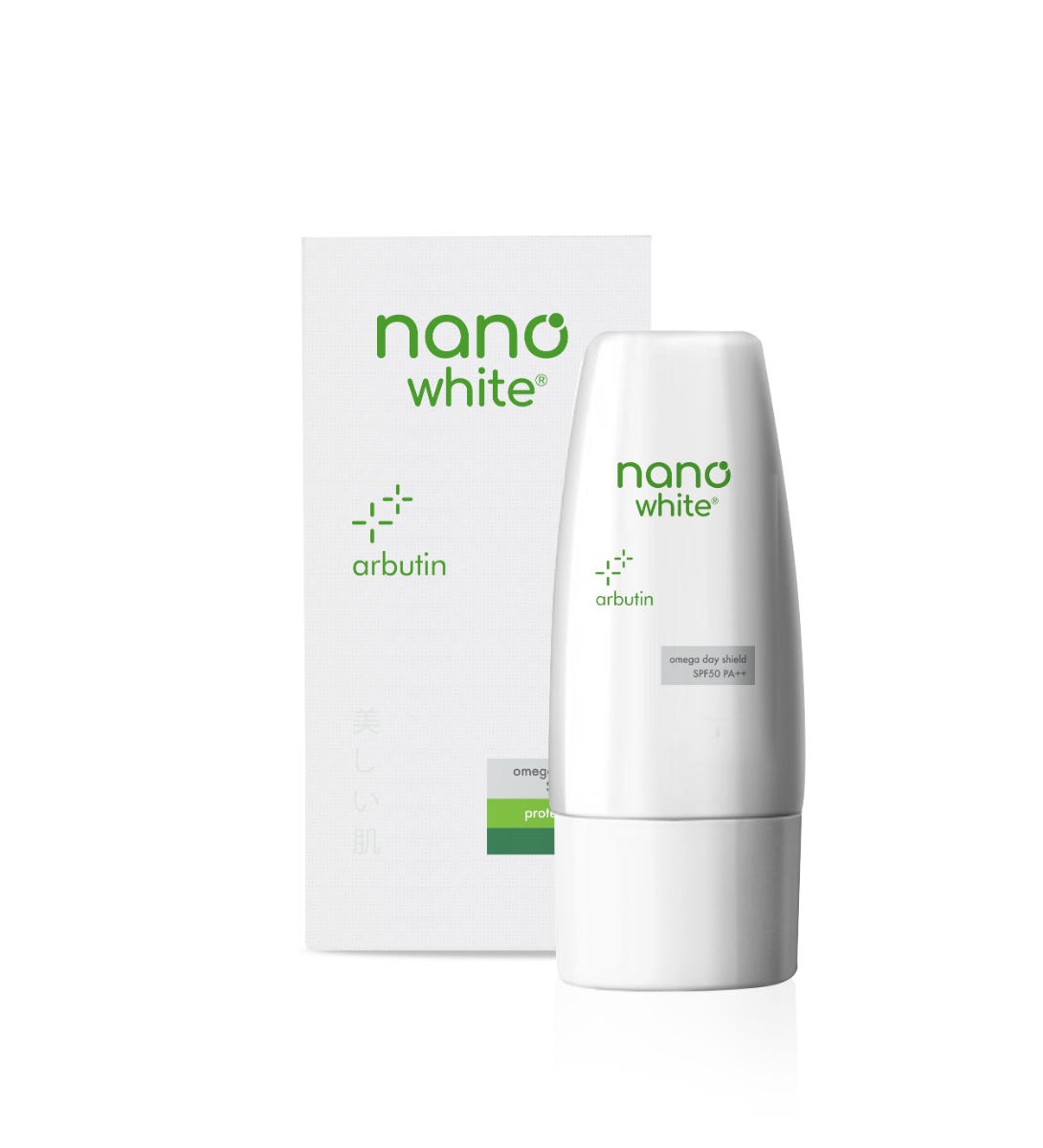
Nanowhite Omega Shield Spf50 35Ml

Nanowhite Omega Shield Spf50 35Ml
NANOWHITE
nanowhite-omega-shield-spf50-35ml
Suncare
10084947362085
Morning or Evening?
How often will you use this product?
Notes


Highlights
WHAT IS IT?
Sun Block with multiple active ingredients
FEATURES
Lightweight, non-greasy, protects against UVA and UVB radiation, reduces pigmentation, does not clog pores, visible results in 3 days
BEST FOR
sensitive
CHECKS
Doesn't clog pores, free from harsh allergens
Who Is It For?
All Genders All Adult AgesWhat Does It Help With?
Protection From Sun Damage Minimizes PigmentationBudget
Mid-range ($30-$75)How To Use
Which routine should it be used in?
Instructions:
Key Information


What NANOWHITE Says
Product Description:
This lightweight and non-greasy texture of Omega Day Shield SPF50 PA++ with infused with HappyDermalogyTM, nano technology and Omega White-C guarantees to shield your skin from both UVA & UVB radiation to help minimize stubborn pigmentation. This must-try SPF product does not clog pores and promises uncompromising, noticeable results in just 3 days*.
About the Brand:
Ingredients Overview
Ingredients List
Water,Ethylhexyl-Methoxycinnamate,Titanium-Dioxide,Hydrogenated-Polydecene,Hydroxystearic-Acid,Butylene-Glycol,Cetearyl-Alcohol,Ceteareth-20,Fructan,Hydrogenated-Polydecene,Glyceryl-Stearate,Tribehenin-PEG-20-Esters,Phenyl-Trimethicone,Dimethicone/Vinyl-Dimethicone-Crosspolymer,Silica,Cetyl-Alcohol,Lecithin,Arbutin,Linolenic-Acid,Linoleic-Acid,Tocopheryl-Acetate,Ascorbyl-Palmitate,Glutathione,Fragrance,Methylparaben,Imidazolidinyl-Urea,Propylparaben,Disodium-EDTA,Butyl-Methoxydibenzoylmethane,Vitex-Agnus-Castus-Extract,Glycerin,Ascorbyl-Tetraisopalmitate,Tocopherol,Caprylic/Capric-Triglyceride,Cyclodextrin,Ascorbyl-Glucoside,Silanediol-Salicylate,Humulus-Lupulus-(Hops)-Extract,Cucumis-Sativus-(Cucumber)-Fruit-Extract,Aloe-Barbadensis-Leaf-Extract,Saponaria-Officinalis-Leaf-Extract,Chamomilla-Recutita-(Matricaria)-Extract,Asparagopsis-Armata-Extract,Hydrolyzed-Elastin,Hydrolyzed-Collagen,Lavandula-Angustifolia-(Lavender)-oil,PEG-35-Castor-Oil,Sodium-Lauroyl-Sarcosinate,Propylene-Glycol
Key Ingredients
Ethylhexyl Methoxycinnamate,Titanium Dioxide,Arbutin,Glutathione,Butyl Methoxydibenzoylmethane
Ingredients Details
Arbutin
Common Name(s): Arbutin,cosmetic active,functional ingredient
CAS Number: N/a
DESCRIPTION
What It Does: Delivers characteristic cosmetic function — skin conditioning, protection, preservation, or active biological benefit — at recommended use concentration.
Why It's Used: Selected for its functional contribution and formulation compatibility — supported by cosmetic science literature and regulatory safety assessment.
How It Works: Works through the mechanism of its molecular class — physicochemical interaction with the formulation or biological interaction with skin proteins, lipids, or receptors as documented in peer-reviewed literature.
Typically Found In: Skin care formulations
TECHNICAL DETAILS
Primary Category: Active ingredient – cosmetic active
Secondary Functions: Skin conditioning
Application Areas:

Facial Skincare

Body Care
Hair Care
Beard Care
Color Cosmetics (Makeup)
Dietary/Oral Supplements
Typical Concentration Range: 0.1%–10%
SOURCING & ETHICS
Vegan Status: Conditional
Halal Status: Yes
Source Notes: Commercially produced for cosmetic use. verify vegan/halal status with supplier.
SKIN COMPATIBILITY
Irritancy Rating: 1/5 – very low
Comedogenicity Rating: 0/5 – non-comedogenic
Sensitivity Concerns: Well-tolerated by most skin types.
Safe for Sensitive Skin: Yes
SAFETY & COMPATIBILITY
Safety Profile: Good safety profile at recommended concentrations. ewg score: 1–2.
Works Well With: Standard skincare actives
Avoid Combining With: No known significant incompatibilities
SCIENTIFIC NOTE
Arbutin delivers documented functional benefit with an established safety profile within the cosmetic regulatory framework (cosing eu, cir usa).
Last Verified: Cosing database,arbutin technical literature
Primary Sources: 2026-03-12
Ceteareth-20
Common Name(s): Polyethylene glycol cetearyl ether,peg-20 cetearyl ether
CAS Number: 68439-49-6
DESCRIPTION
What It Does: Provides high-hlb o/w emulsification for stable cream formation from ethoxylated cetearyl alcohol.
Why It's Used: Classic self-emulsifying wax component for standard pharmaceutical and cosmetic cream formulation.
How It Works: 20 eo units on cetearyl alcohol chain provide hlb ~15-17 for strong o/w emulsification. often pre-blended with cetearyl alcohol as 'emulsifying wax' for simplified cream making. combined low-hlb cetearyl alcohol + high-hlb ceteareth-20 forms a balanced self-emulsifying system.
Typically Found In: Classic pharmaceutical and cosmetic creams
TECHNICAL DETAILS
Primary Category: Functional ingredient – ethoxylated fatty alcohol emulsifier
Secondary Functions: Skin conditioning
Application Areas:
Facial Skincare
Body Care
Hair Care
Beard Care
Color Cosmetics (Makeup)
Dietary/Oral Supplements
Typical Concentration Range: 1%–8%
SOURCING & ETHICS
Vegan Status: Conditional – peg petroleum; cetearyl vegetable
Halal Status: Yes
Source Notes: Commercially produced for cosmetic use. verify vegan/halal status with supplier.
SKIN COMPATIBILITY
Irritancy Rating: 1/5 – very low
Comedogenicity Rating: 0/5 – non-comedogenic
Sensitivity Concerns: Well-tolerated by most skin types.
Safe for Sensitive Skin: Yes
SAFETY & COMPATIBILITY
Safety Profile: Good safety profile at recommended concentrations. ewg score: 1–2.
Works Well With: Standard skincare actives
Avoid Combining With: No known significant incompatibilities
SCIENTIFIC NOTE
Ceteareth-20's combination with cetearyl alcohol in the classic 'emulsifying wax nf' creates what is called a 'mixed emulsifier system' where the fatty alcohol forms lamellar crystal phases that physically trap and stabilize oil droplets. this physical (lamellar crystal) + chemical (hlb balance) dual stabilization provides superior stability compared to either component alone.
Last Verified: Cosing database,cir safety assessment
Primary Sources: 2026-03-12
Cyclodextrin
Common Name(s): Bcd,cycloheptaamylose,betadex
CAS Number: 7585-39-9
DESCRIPTION
What It Does: Provides molecular encapsulation for improved solubility, stability, and controlled release of challenging cosmetic actives.
Why It's Used: Molecular encapsulation technology — beta-cyclodextrin's toroidal cavity provides a hydrophobic microenvironment for solubilising and stabilising oil-soluble actives in aqueous formulations.
How It Works: 7 glucose units in cyclic toroidal structure provide 6.0-6.5å inner cavity. hydrophobic interior complexes lipophilic guest molecules. complexation improves water solubility (guest molecule becomes water-dispersible), stability (protection from oxidation and hydrolysis), and controlled release (guest releases gradually by diffusion). outer hydrophilic face provides water compatibility.
Typically Found In: Active delivery systems,fragrance encapsulation,stability-challenged actives
TECHNICAL DETAILS
Primary Category: Functional ingredient – inclusion complex host
Secondary Functions: Skin conditioning
Application Areas:
Facial Skincare
Body Care
Hair Care
Beard Care
Color Cosmetics (Makeup)
Dietary/Oral Supplements
Typical Concentration Range: 0.1%–10%
SOURCING & ETHICS
Vegan Status: Yes – from starch (corn, potato)
Halal Status: Yes
Source Notes: Commercially produced for cosmetic use. verify vegan/halal status with supplier.
SKIN COMPATIBILITY
Irritancy Rating: 1/5 – very low
Comedogenicity Rating: 0/5 – non-comedogenic
Sensitivity Concerns: Well-tolerated by most skin types.
Safe for Sensitive Skin: Yes
SAFETY & COMPATIBILITY
Safety Profile: Good safety profile at recommended concentrations. ewg score: 1–2.
Works Well With: Standard skincare actives
Avoid Combining With: No known significant incompatibilities
SCIENTIFIC NOTE
Beta-cyclodextrin's pharmaceutical drug delivery applications (dozens of fda-approved cd-drug complexes) provide unparalleled safety and efficacy documentation for a cosmetic excipient. the same cd technology that delivers cholesterol-lowering drugs and antifungals in pharmaceutical formulations enables cosmetic actives to be delivered more effectively — a pharmaceutical innovation directly adapted to cosmetic performance enhancement.
Last Verified: Cosing database,loftsson & brewster cyclodextrin review
Primary Sources: 2026-03-12
Fragrance
Common Name(s): Fragrance ingredient,eu allergen or aromatic component,olfactory/flavour
CAS Number: N/a
DESCRIPTION
What It Does: Provides the complete fragrance profile contributing to product sensory experience and consumer appeal.
Why It's Used: Fragrance is a major consumer purchase driver — up to 70% of consumers make purchasing decisions partially based on product scent.
How It Works: Fragrance blends interact with olfactory receptors providing the sensory profile — complex mixtures activate multiple receptor types for rich, multidimensional scent experiences.
Typically Found In: All fragrance products
TECHNICAL DETAILS
Primary Category: Active ingredient – cosmetic active
Secondary Functions: Skin conditioning
Application Areas:
Facial Skincare
Body Care
Hair Care
Beard Care
Color Cosmetics (Makeup)
Dietary/Oral Supplements
Typical Concentration Range: Standard use levels
SOURCING & ETHICS
Vegan Status: Conditional
Halal Status: Yes
Source Notes: Commercially produced for cosmetic use. verify vegan/halal status with supplier.
SKIN COMPATIBILITY
Irritancy Rating: 1/5 – very low
Comedogenicity Rating: 0/5 – non-comedogenic
Sensitivity Concerns: Well-tolerated by most skin types.
Safe for Sensitive Skin: Yes
SAFETY & COMPATIBILITY
Safety Profile: Good safety profile at recommended concentrations. ewg score: 1–2.
Works Well With: Standard skincare actives
Avoid Combining With: No known significant incompatibilities
SCIENTIFIC NOTE
Ifra guidelines set usage limits for fragrance ingredients based on skin sensitisation and phototoxicity assessment for each application category.
Last Verified: Eu regulation 1223/2009 annex iii,ifra standards,fragrance allergen declaration requirements
Primary Sources: 2026-03-12
