

PREQUEL
MULTI-QUENCH

MULTI-QUENCH
PREQUEL
multi-quench
Serum
9873693901093
Morning or Evening?
How often will you use this product?
Notes


Highlights
WHAT IS IT?
Hydrating serum with polyglutamic acid
FEATURES
Clinically tested 48-hour hydration, plumping effect, improves skin barrier
BEST FOR
dry
CHECKS
Who Is It For?
All Ages And GendersWhat Does It Help With?
Hydration Plumping Radiance Youthful AppearanceBudget
Affordable (under $30)How To Use
Which routine should it be used in?
Instructions:
Key Information

What PREQUEL Says
Product Description:
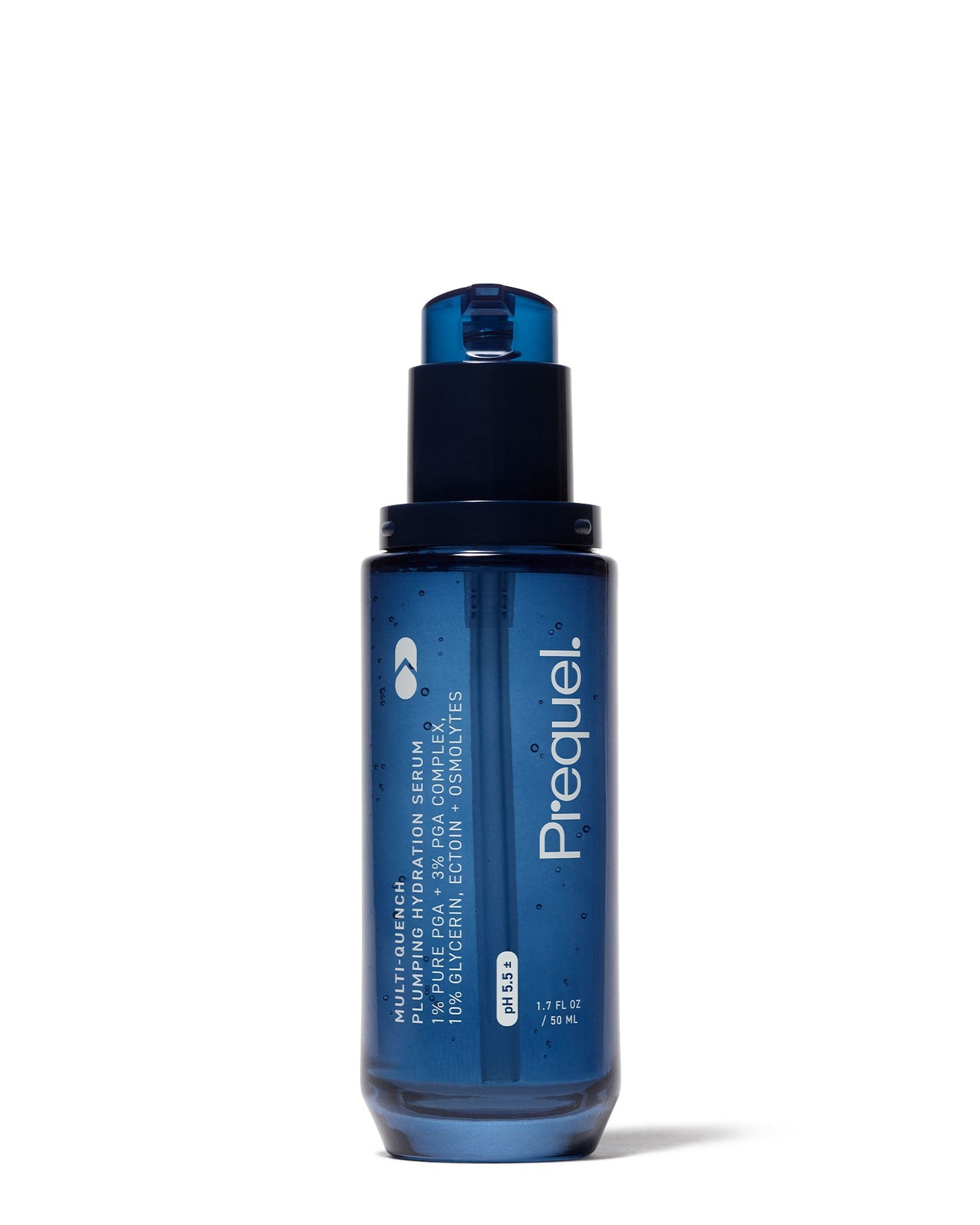
A multi-level, hydrating serum formulated with dual weight polyglutamic acid, glycerin, osmolytes and ectoin that provide excellent skin moisturization, improve the skin barrier, and support skin's Natural Moisturizing Factor. Great for dry skin.
About the Brand:
Ingredients Overview
Ingredients List
polyglutamic-acid,glycerin,osmolytes,ectoin
Key Ingredients
dual weight polyglutamic acid, glycerin, osmolytes, ectoin
Ingredients Details
Ectoin
Common Name(s): Ectoin,extremophile stress protector,anti-aging humectant
CAS Number: N/a
DESCRIPTION
What It Does: Hydrates by forming a water-shell around skin biomolecules, stabilises cellular membranes against heat/uv stress, and reduces inflammatory cytokine release in stressed skin.
Why It's Used: Provides dual humectancy plus cellular protection — unique among humectants for its documented ability to stabilise skin proteins and membranes against uv and environmental stress, not just attract water.
How It Works: Ectoin's tetrahydropyrimidine ring forms an ordered hydration shell around proteins, lipid bilayers, and dna through kosmotropic water structuring. this preferential hydration excludes denaturants and uv-stress mediators from biomolecule surfaces while simultaneously providing humectant moisture binding.
Typically Found In: Sensitive skin,uv protection actives,anti-inflammatory
TECHNICAL DETAILS
Primary Category: Functional ingredient – humectant
Secondary Functions: Tewl reduction,skin plumping
Application Areas:

Facial Skincare
Body Care
Hair Care

Beard Care
Color Cosmetics (Makeup)
Dietary/Oral Supplements
Typical Concentration Range: 0.1%–2%
SOURCING & ETHICS
Vegan Status: Conditional - supplier confirmation required
Halal Status: Unverified - supplier confirmation required
Source Notes: Synthetic or naturally derived. excellent aqueous solubility. [audit 2026-07-29 rev2: status downgraded on audit. determination requires shariah-panel sign-off.]
SKIN COMPATIBILITY
Irritancy Rating: 1/5 – very low
Comedogenicity Rating: 0/5 – non-comedogenic
Sensitivity Concerns: Non-irritating; suitable for all skin types.
Safe for Sensitive Skin: Yes
SAFETY & COMPATIBILITY
Safety Profile: Excellent safety profile. ewg score: 1.
Works Well With: Ceramides,emollients,occlusives,glycerin,hyaluronic acid
Avoid Combining With: No significant incompatibilities
SCIENTIFIC NOTE
Extremophile bacteria accumulate ectoin at up to 15% intracellular concentration to survive 100°c temperatures and extreme salinity — the same biomolecule protection mechanism applies to human skin cells at cosmetic concentrations.
Last Verified: 2026-03-12
Primary Sources: Cosing database,ectoin extremophile anti-stress clinical review
Glycerin
Common Name(s): Glycerol,glycerine,1,2,3-propanetriol
CAS Number: 56-81-5
DESCRIPTION
What It Does: Glycerin pulls water from the environment and deeper skin layers into the outer skin layer (epidermis), boosting moisture levels and keeping skin soft, smooth, and plump.
Why It's Used: It is used in virtually every moisturizer, serum, and cleanser because it is highly effective at hydrating skin, is well-tolerated by all skin types, and enhances the texture and spreadability of formulations.
How It Works: As a humectant, glycerin forms hydrogen bonds with water molecules, trapping them in the skin. it also reinforces the skin barrier by integrating into lipid structures between skin cells.
Typically Found In: Moisturizers,serums,cleansers,toners,sheet masks,sunscreens,body lotions,shampoos,conditioners
TECHNICAL DETAILS
Primary Category: Humectant
Secondary Functions: Skin barrier support,emollient,solvent
Application Areas:
Facial Skincare
Body Care
Hair Care
Beard Care
Color Cosmetics (Makeup)
Dietary/Oral Supplements
Typical Concentration Range: 1%–30% (typical: 3–10%)
SOURCING & ETHICS
Vegan Status: Conditional - feedstock declaration required
Halal Status: Unverified - feedstock declaration required (plant, animal and petrochemical routes all exist)
Source Notes: Derived from plant oils via hydrolysis or saponification; synthetic versions also available. palm-derived glycerin carries sustainability concerns. [audit 2026-07-29 rev2: origin-dependent: the same inci exists in plant, animal and petrochemical versions and the name does not discriminate. determination requires shariah-panel sign-off.]
SKIN COMPATIBILITY
Irritancy Rating: 1/5 – very low; non-irritating at all standard concentrations
Comedogenicity Rating: 0/5 – non-comedogenic
Sensitivity Concerns: Extremely rare allergic reactions; generally safe for all skin types including sensitive and baby skin
Safe for Sensitive Skin: Yes
SAFETY & COMPATIBILITY
Safety Profile: Widely recognized as safe. ewg hazard score: 1. no significant concerns for irritation, sensitization, or toxicity at typical concentrations (up to 50%).
Works Well With: Hyaluronic acid,ceramides,niacinamide,panthenol,urea,peptides,retinol,ahas/bhas
Avoid Combining With: No known incompatibilities at standard concentrations
SCIENTIFIC NOTE
Glycerin is an endogenous skin component found naturally in the stratum corneum. aquaporin-3 channels in keratinocytes facilitate glycerin transport, making it integral to natural skin hydration pathways.
Last Verified: 2026-03-12
Primary Sources: Cosing database,cir safety assessment,ewg skin deep,inci decoder
Polyglutamic Acid
Common Name(s): Pga,poly-l-glutamic acid,natto gum
CAS Number: 25513-46-6
DESCRIPTION
What It Does: Provides 4-5× greater water retention than hyaluronic acid for unmatched skin hydration.
Why It's Used: The most powerful humectant available – 4-5× the water-binding capacity of ha – for formulations requiring maximum hydration intensity in a single ingredient.
How It Works: High density of free glutamic acid carboxylate groups provides exceptional water binding capacity (~5000× its dry weight in water, vs ha's ~1000×). forms thin hydrating film on skin surface. inhibits hyaluronidase, protecting endogenous ha from degradation. also promotes ha synthesis.
Typically Found In: Premium hydrating serums,ultra-hydration products
TECHNICAL DETAILS
Primary Category: Active ingredient – microbial humectant
Secondary Functions: Maximum water retention,ha protection,film forming
Application Areas:
Facial Skincare
Body Care
Hair Care
Beard Care
Color Cosmetics (Makeup)
Dietary/Oral Supplements
Typical Concentration Range: 0.1%–5%
SOURCING & ETHICS
Vegan Status: Yes – bacillus subtilis fermentation
Halal Status: Yes
Source Notes: Synthetic or naturally derived. excellent aqueous solubility.
SKIN COMPATIBILITY
Irritancy Rating: 1/5 – very low
Comedogenicity Rating: 0/5 – non-comedogenic
Sensitivity Concerns: Non-irritating; suitable for all skin types.
Safe for Sensitive Skin: Yes
SAFETY & COMPATIBILITY
Safety Profile: Excellent safety profile. ewg score: 1.
Works Well With: Ceramides,emollients,occlusives,glycerin,hyaluronic acid
Avoid Combining With: No significant incompatibilities
SCIENTIFIC NOTE
Pga's water-holding capacity of ~5000g water/g pga (vs ha's ~1000g water/g) derives from its exceptionally dense carboxylate group array. the glutamic acid polymer backbone provides a carboxylate group every ~0.37nm along the chain – the highest density of water-binding anionic groups achievable in a linear biopolymer structure.
Last Verified: 2026-03-12
Primary Sources: Cosing database,shen et al. polyglutamic acid cosmetic review