
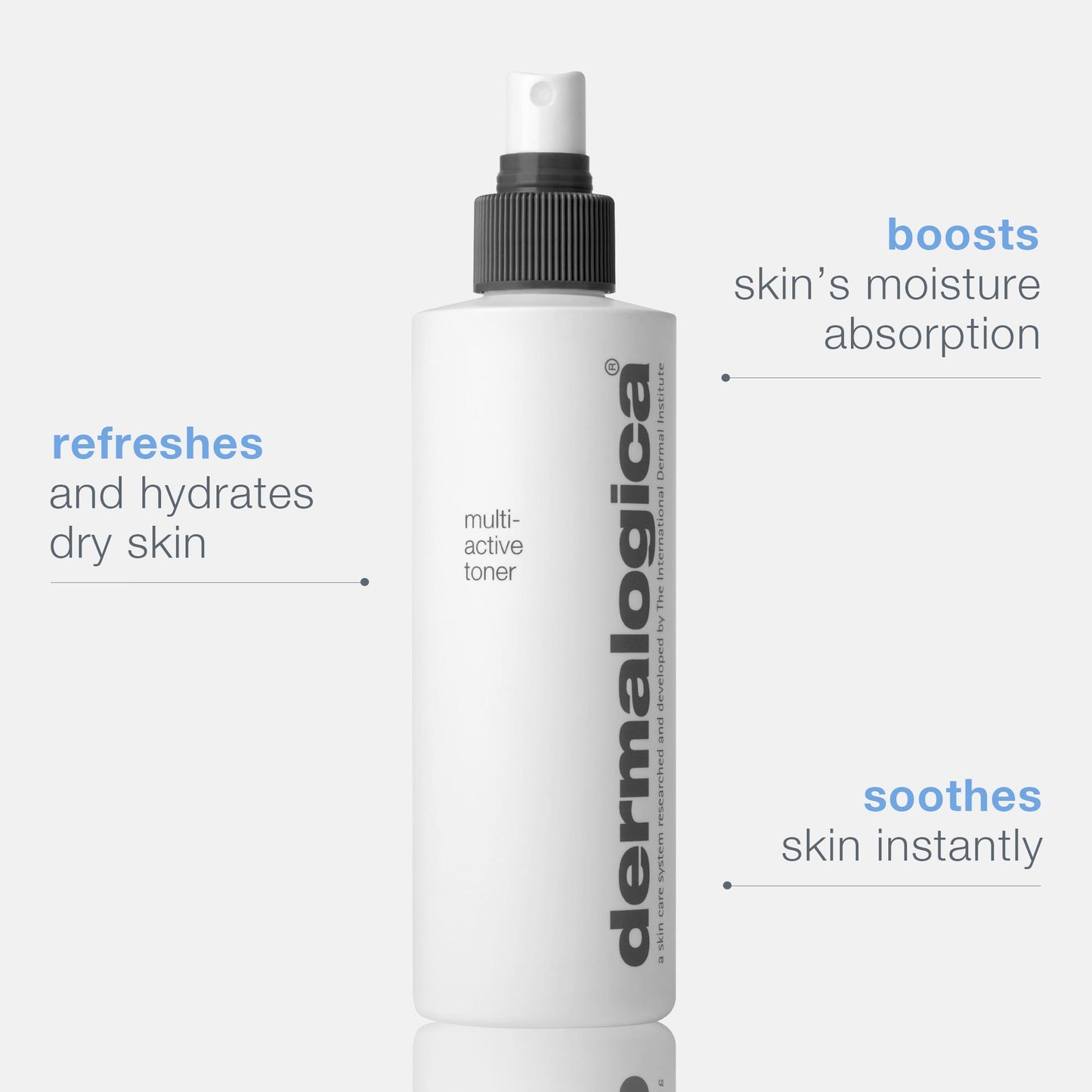

dermalogica
multi-active toner

multi-active toner
dermalogica
multi-active-toner
Tone
9784808603941
Morning or Evening?
How often will you use this product?
Notes


Highlights
WHAT IS IT?
Hydrating facial toner with moisture-binding humectants
FEATURES
Ultra-light, hydrating, refreshing, conditions and preps skin for moisture absorption
BEST FOR
normal
CHECKS
Free of parabens, formaldehydes, formaldehyde-releasing agents, phthalates, mineral oil, retinyl palmitate, oxybenzone, coal tar, hydroquinone, sulfates SLS & SLES, triclocarban, triclosan, gluten
Who Is It For?
All Skin TypesWhat Does It Help With?
Dryness Dehydration Dullness Uneven TextureBudget
Mid-range ($30-$75)How To Use
Which routine should it be used in?
Instructions:
Key Information


What dermalogica Says
Product Description:
Light facial toner hydrates and refreshes. This ultra-light toner with moisture-binding humectants helps condition and prep skin for proper moisture absorption. Soothing Arnica, Balm Mint and Lavender refresh the skin, making this spritz ideal for skin hydration after cleansing and throughout the day.
About the Brand:
Ingredients Overview
Ingredients List
Water/Aqua/Eau, Butylene Glycol, Aloe Barbadensis Leaf Extract, Arginine, Lavandula Angustifolia (Lavender) Flower/Leaf/Stem Extract, Melissa Officinalis Leaf Extract, Citrus Limon (Lemon) Peel Oil, Citrus Aurantium Bergamia (Bergamot) Fruit Oil, Cymbopogon Nardus (Citronella) Oil, Glycine, Alanine, Serine, Lavandula Angustifolia (Lavender) Oil, Dipotassium Glycyrrhizate, Cucumis Sativus (Cucumber) Fruit Extract, Arnica Montana Flower Extract, Hedera Helix (Ivy) Extract, Malva Sylvestris (Mallow) Flower Extract, Parietaria Officinalis Extract, Sambucus Nigra Flower Extract, Tocopherol, Phenylalanine, Histidine, Valine, Isoleucine, Proline, Threonine, Sodium PCA, Sodium Lactate, Citric Acid, Polyquaternium-4, Aspartic Acid, PCA, Ethylhexylglycerin, Methyl Gluceth-20, Polysorbate 20, 1,2-Hexanediol, Caprylyl Glycol, PEG-12 Dimethicone, Ricinoleth-40, Sodium Citrate, Sodium Hydroxide, Tetrasodium Glutamate Diacetate, Linalool, Limonene, Citral, Geraniol, Phenoxyethanol.
Key Ingredients
arnica, balm mint, lavender
Ingredients Details
Alanine
Common Name(s): L-alanine,2-aminopropanoic acid
CAS Number: 56-41-7
DESCRIPTION
What It Does: Provides nmf-type humectant moisture retention and skin conditioning.
Why It's Used: Simple, well-tolerated nmf amino acid humectant for skin conditioning formulations.
How It Works: Small methyl side chain contributes to protein hydrophobic core but as free amino acid provides direct humectant activity via amino and carboxyl groups. converted to pyruvate for cellular atp production via gluconeogenesis.
Typically Found In: Nmf moisturizers,skin conditioning products
TECHNICAL DETAILS
Primary Category: Active ingredient – amino acid
Secondary Functions: Nmf component,cellular energy
Application Areas:

Facial Skincare

Body Care
Hair Care
Beard Care
Color Cosmetics (Makeup)
Dietary/Oral Supplements
Typical Concentration Range: 0.5%–5%
SOURCING & ETHICS
Vegan Status: Conditional - feedstock declaration required
Halal Status: Unverified - feedstock declaration required (plant, animal and petrochemical routes all exist)
Source Notes: Fermentation-derived or synthetic. natural skin component. [audit 2026-07-29 rev2: origin-dependent: the same inci exists in plant, animal and petrochemical versions and the name does not discriminate. determination requires shariah-panel sign-off.]
SKIN COMPATIBILITY
Irritancy Rating: 1/5 – very low
Comedogenicity Rating: 0/5 – non-comedogenic
Sensitivity Concerns: Non-irritating; endogenous skin molecule.
Safe for Sensitive Skin: Yes
SAFETY & COMPATIBILITY
Safety Profile: Excellent safety profile. natural skin nmf component. ewg score: 1.
Works Well With: Hyaluronic acid,ceramides,peptides,other amino acids
Avoid Combining With: No significant incompatibilities
SCIENTIFIC NOTE
Free alanine is among the most abundant amino acids in the stratum corneum nmf, where it contributes to the aqueous phase hydration that keeps the stratum corneum flexible and functional.
Last Verified: 2026-03-12
Primary Sources: Cosing database,cir safety assessment
Aloe Barbadensis Leaf Extract
Common Name(s): Aloe barbadensis leaf extract,botanical extract,phytochemical active
CAS Number: N/a
DESCRIPTION
What It Does: Provides antioxidant protection from reactive oxygen species, reduces inflammatory cytokine production in skin, and conditions skin surface through the plant's secondary metabolite complex.
Why It's Used: Chosen for its natural origin narrative, traditional use heritage, and multi-functional phytochemical profile that supports several concurrent skin care claims from one ingredient.
How It Works: Polyphenols, terpenoids, and alkaloids in the extract scavenge ros via hydrogen atom transfer, inhibit nf-kb or cox-2 inflammatory pathways, and interact with skin surface proteins for conditioning.
Typically Found In: Botanical skin care,natural products
TECHNICAL DETAILS
Primary Category: Active ingredient – antioxidant
Secondary Functions: Free radical scavenging,anti-aging
Application Areas:
Facial Skincare
Body Care
Hair Care
Beard Care
Color Cosmetics (Makeup)
Dietary/Oral Supplements
Typical Concentration Range: 0.1%–10%
SOURCING & ETHICS
Vegan Status: Yes
Halal Status: Yes
Source Notes: Plant-derived extract or synthetic.
SKIN COMPATIBILITY
Irritancy Rating: 1/5 – very low
Comedogenicity Rating: 0/5 – non-comedogenic
Sensitivity Concerns: Non-irritating; well-tolerated.
Safe for Sensitive Skin: Yes
SAFETY & COMPATIBILITY
Safety Profile: Excellent safety profile. ewg score: 1.
Works Well With: Vitamin c,vitamin e,ferulic acid,spf,other antioxidants
Avoid Combining With: No significant incompatibilities
SCIENTIFIC NOTE
Plant secondary metabolites evolved as uv photoprotectants and antimicrobial agents — mechanisms that directly translate to cosmetic antioxidant and anti-inflammatory activity in human skin.
Last Verified: 2026-03-12
Primary Sources: Cosing database,aloe barbadensis leaf extract botanical review
Arginine
Common Name(s): L-arginine,2-amino-5-guanidinopentanoic acid
CAS Number: 74-79-3
DESCRIPTION
What It Does: Conditions skin, attracts moisture, supports wound healing, and improves microcirculation via no synthesis.
Why It's Used: Multi-functional amino acid for skin hydration, conditioning, and wound healing in peptide and nmf formulations.
How It Works: Guanidinium group binds water (humectant). substrate for nitric oxide synthase (enos) producing nitric oxide that vasodilates capillaries improving skin nutrition. stimulates fibroblast proliferation for wound healing.
Typically Found In: Anti-aging serums,wound healing products,nmf moisturizers,scalp treatments
TECHNICAL DETAILS
Primary Category: Active ingredient – amino acid
Secondary Functions: Wound healing,microcirculation,nmf component
Application Areas:
Facial Skincare
Body Care
Hair Care
Beard Care
Color Cosmetics (Makeup)
Dietary/Oral Supplements
Typical Concentration Range: 0.5%–5%
SOURCING & ETHICS
Vegan Status: Conditional - feedstock declaration required
Halal Status: Unverified - feedstock declaration required (plant, animal and petrochemical routes all exist)
Source Notes: Fermentation-derived or synthetic. natural skin component. [audit 2026-07-29 rev2: origin-dependent: the same inci exists in plant, animal and petrochemical versions and the name does not discriminate. determination requires shariah-panel sign-off.]
SKIN COMPATIBILITY
Irritancy Rating: 1/5 – very low
Comedogenicity Rating: 0/5 – non-comedogenic
Sensitivity Concerns: Non-irritating; endogenous skin molecule.
Safe for Sensitive Skin: Yes
SAFETY & COMPATIBILITY
Safety Profile: Excellent safety profile. natural skin nmf component. ewg score: 1.
Works Well With: Hyaluronic acid,ceramides,peptides,other amino acids
Avoid Combining With: No significant incompatibilities
SCIENTIFIC NOTE
Arginine is a conditionally essential amino acid in wound healing where local demand exceeds synthesis capacity. topical arginine provides the nos substrate locally for no-mediated vasodilation and immune cell function in healing tissue.
Last Verified: 2026-03-12
Primary Sources: Cosing database,cir safety assessment,witte & barbul arginine wound healing review
Butylene Glycol
Common Name(s): 1,3-butanediol,bg,1,3-butylene glycol
CAS Number: 107-88-0
DESCRIPTION
What It Does: Provides humectant hydration and active ingredient solubilization with excellent skin feel.
Why It's Used: Preferred glycol humectant in premium and k-beauty formulations for superior skin feel vs propylene glycol with equivalent functionality.
How It Works: Two hydroxyl groups at 1,3-positions provide water binding and solvent activity. better tolerated than propylene glycol with minimal sensitization risk. 4-carbon backbone provides slightly greater hydrophobic character enabling dissolution of less polar actives vs pg.
Typically Found In: Toners,essences,serums,k-beauty formulas
TECHNICAL DETAILS
Primary Category: Functional ingredient – glycol humectant
Secondary Functions: Tewl reduction,skin plumping
Application Areas:
Facial Skincare
Body Care
Hair Care
Beard Care
Color Cosmetics (Makeup)
Dietary/Oral Supplements
Typical Concentration Range: 1%–10%
SOURCING & ETHICS
Vegan Status: Yes – synthetic
Halal Status: Yes
Source Notes: Synthetic or naturally derived. excellent aqueous solubility.
SKIN COMPATIBILITY
Irritancy Rating: 1/5 – very low
Comedogenicity Rating: 0/5 – non-comedogenic
Sensitivity Concerns: Non-irritating; suitable for all skin types.
Safe for Sensitive Skin: Yes
SAFETY & COMPATIBILITY
Safety Profile: Excellent safety profile. ewg score: 1.
Works Well With: Ceramides,emollients,occlusives,glycerin,hyaluronic acid
Avoid Combining With: No significant incompatibilities
SCIENTIFIC NOTE
K-beauty's preference for butylene glycol over propylene glycol is driven by two factors: bg's superior skin feel (less tacky than pg's higher viscosity) and its lower sensitization potential (1,3-bg has better spatial distribution of hydroxyl groups that reduces protein interaction vs pg's 1,2-position oh groups).
Last Verified: 2026-03-12
Primary Sources: Cosing database,cir safety assessment