

Clinique
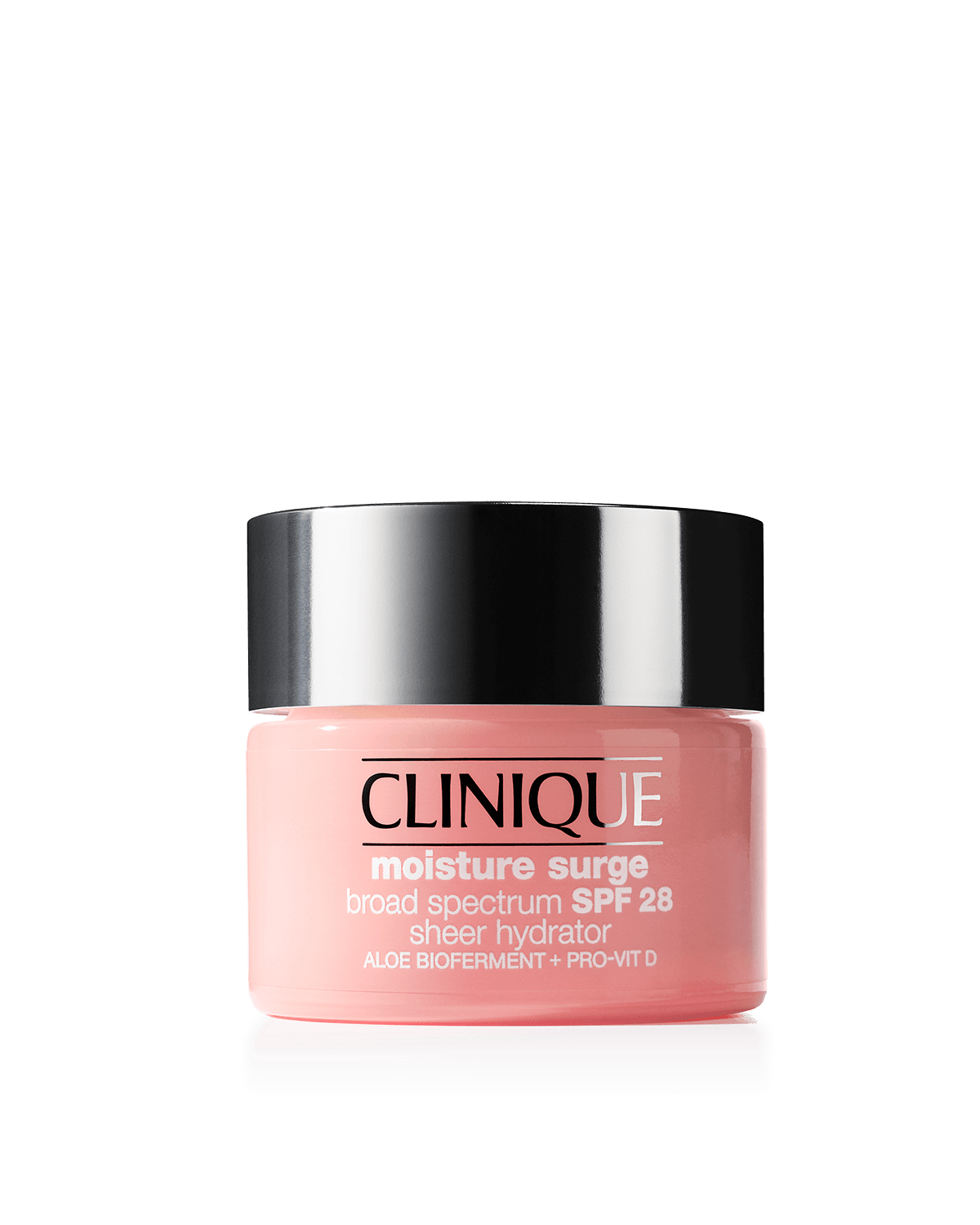
Moisture Surge Broad Spectrum SPF 28 Sheer Hydrator

Moisture Surge Broad Spectrum SPF 28 Sheer Hydrator
Clinique
moisture-surge-broad-spectrum-spf-28-sheer-hydrator
Moisturize
9784802771237
Morning or Evening?
How often will you use this product?
Notes


Highlights
WHAT IS IT?
Cloud-like face moisturizer with SPF
FEATURES
Hydrates and protects against UV rays, delivers sheer sun protection for all skin tones, boosts hydration and glow
BEST FOR
All skin types
CHECKS
Free of Fragrance, Parabens, Phthalates, Oil, Drying alcohol, Oxybenzone
Who Is It For?
All Ages And GendersWhat Does It Help With?
Hydration Sun Protection Glow EnhancementBudget
Mid-range ($30-$75)How To Use
Which routine should it be used in?
Instructions:
Key Information


What Clinique Says
Product Description:
Cloud-like face moisturizer with SPF hydrates and delivers sheer sun protection—even for deep skin tones. 100% instantly show a boost in hydration and glow.
About the Brand:
Ingredients Overview
Ingredients List
Avobenzone 3.0%, Homosalate 7.0%, Octinoxate 7.0%, Octisalate 4.5%Ingredients: Water\Aqua\Eau, Butylene Glycol, Ethylhexyl Methoxycrylene, Butyloctyl Salicylate, Dextrin Palmitate, Polymethylsilsesquioxane, Glycerin, Lactobacillus Ferment Lysate, Aloe Barbadensis Leaf Polysaccharides, Sodium Hyaluronate, Caffeine, Sodium Polyaspartate, 7-Dehydrocholesterol, Caprylyl Glycol, Acrylates Copolymer, Sorbitol, Dimethicone, Polyglyceryl-2 Stearate, Sucrose, Saccharide Isomerate, Hydroxyethyl Urea, Ppg-8-Ceteth-20, Sorbeth-30 Tetraisostearate, Glyceryl Stearate, Sorbitan Sesquiisostearate, Potassium Hydroxide, Carbomer, Dipropylene Glycol, Dehydroxanthan Gum, Stearyl Alcohol, Sodium Polyacryloyldimethyl Taurate, Hexylene Glycol, Acrylates/Beheneth-25 Methacrylate Copolymer, Acrylates/C10-30 Alkyl Acrylate Crosspolymer, Tocopheryl Acetate, Bht, Disodium Edta, Sodium Citrate, Citric Acid, Potassium Sorbate, Sodium Benzoate, Phenoxyethanol, Red 4 (Ci 14700)
Key Ingredients
Aloe Bioferment, Hyaluronic Acid Complex, Provitamin D
Ingredients Details
Aloe Barbadensis Leaf Polysaccharides
Common Name(s): Aloe barbadensis leaf polysaccharides,botanical extract,phytochemical active
CAS Number: N/a
DESCRIPTION
What It Does: Provides antioxidant free radical scavenging from polyphenol h-atom donation, anti-inflammatory activity from nf-kb/cox pathway inhibition, and multi-active skin conditioning.
Why It's Used: Natural extracts support concurrent antioxidant, anti-inflammatory, and conditioning skin care claims with authentic botanical heritage and traditional use backing.
How It Works: Polyphenol catechol groups donate h-atoms to ros quenching radical chain reactions (dpph-type scavenging rate constants 10^6-10^9 m^-1 s^-1). terpenoids inhibit ikb kinase blocking nf-kb nuclear translocation. flavonoids compete with arachidonic acid at cox-1/cox-2 active sites reducing prostaglandin synthesis.
Typically Found In: Botanical skin care
TECHNICAL DETAILS
Primary Category: Active ingredient – antioxidant
Secondary Functions: Free radical scavenging,anti-aging
Application Areas:

Facial Skincare
Body Care

Hair Care
Beard Care
Color Cosmetics (Makeup)
Dietary/Oral Supplements
Typical Concentration Range: 0.1%–30%
SOURCING & ETHICS
Vegan Status: Conditional
Halal Status: Conditional
Source Notes: Plant-derived extract or synthetic.
SKIN COMPATIBILITY
Irritancy Rating: 1/5 – very low
Comedogenicity Rating: 0/5 – non-comedogenic
Sensitivity Concerns: Non-irritating; well-tolerated.
Safe for Sensitive Skin: Yes
SAFETY & COMPATIBILITY
Safety Profile: Excellent safety profile. ewg score: 1.
Works Well With: Vitamin c,vitamin e,ferulic acid,spf,other antioxidants
Avoid Combining With: No significant incompatibilities
SCIENTIFIC NOTE
Plant secondary metabolites evolved under uv and pathogen selection pressure — the same photoprotective and antimicrobial chemistry directly translates to cosmetic antioxidant and anti-inflammatory claims in human skin.
Last Verified: Cosing database,aloe barbadensis leaf polysaccharid botanical review
Primary Sources: 2026-03-12
Butylene Glycol
Common Name(s): 1,3-butanediol,bg,1,3-butylene glycol
CAS Number: 107-88-0
DESCRIPTION
What It Does: Provides humectant hydration and active ingredient solubilization with excellent skin feel.
Why It's Used: Preferred glycol humectant in premium and k-beauty formulations for superior skin feel vs propylene glycol with equivalent functionality.
How It Works: Two hydroxyl groups at 1,3-positions provide water binding and solvent activity. better tolerated than propylene glycol with minimal sensitization risk. 4-carbon backbone provides slightly greater hydrophobic character enabling dissolution of less polar actives vs pg.
Typically Found In: Toners,essences,serums,k-beauty formulas
TECHNICAL DETAILS
Primary Category: Functional ingredient – glycol humectant
Secondary Functions: Tewl reduction,skin plumping
Application Areas:
Facial Skincare
Body Care
Hair Care
Beard Care
Color Cosmetics (Makeup)
Dietary/Oral Supplements
Typical Concentration Range: 1%–10%
SOURCING & ETHICS
Vegan Status: Yes – synthetic
Halal Status: Yes
Source Notes: Synthetic or naturally derived. excellent aqueous solubility.
SKIN COMPATIBILITY
Irritancy Rating: 1/5 – very low
Comedogenicity Rating: 0/5 – non-comedogenic
Sensitivity Concerns: Non-irritating; suitable for all skin types.
Safe for Sensitive Skin: Yes
SAFETY & COMPATIBILITY
Safety Profile: Excellent safety profile. ewg score: 1.
Works Well With: Ceramides,emollients,occlusives,glycerin,hyaluronic acid
Avoid Combining With: No significant incompatibilities
SCIENTIFIC NOTE
K-beauty's preference for butylene glycol over propylene glycol is driven by two factors: bg's superior skin feel (less tacky than pg's higher viscosity) and its lower sensitization potential (1,3-bg has better spatial distribution of hydroxyl groups that reduces protein interaction vs pg's 1,2-position oh groups).
Last Verified: Cosing database,cir safety assessment
Primary Sources: 2026-03-12
Butyloctyl Salicylate
Common Name(s): Butyloctyl salicylate,cosmetic active,functional ingredient
CAS Number: N/a
DESCRIPTION
What It Does: Delivers characteristic cosmetic function at recommended use concentration.
Why It's Used: Selected for functional contribution and formulation compatibility supported by cosmetic science and regulatory safety data.
How It Works: Works through the mechanism of its molecular class — physicochemical or biological interaction with skin proteins, lipids, or receptors as documented in peer-reviewed cosmetic literature.
Typically Found In: Skin care formulations
TECHNICAL DETAILS
Primary Category: Active ingredient – cosmetic active
Secondary Functions: Skin conditioning
Application Areas:
Facial Skincare
Body Care
Hair Care
Beard Care
Color Cosmetics (Makeup)
Dietary/Oral Supplements
Typical Concentration Range: 0.1%–10%
SOURCING & ETHICS
Vegan Status: Conditional
Halal Status: Yes
Source Notes: Commercially produced for cosmetic use. verify vegan/halal status with supplier.
SKIN COMPATIBILITY
Irritancy Rating: 1/5 – very low
Comedogenicity Rating: 0/5 – non-comedogenic
Sensitivity Concerns: Well-tolerated by most skin types.
Safe for Sensitive Skin: Yes
SAFETY & COMPATIBILITY
Safety Profile: Good safety profile at recommended concentrations. ewg score: 1–2.
Works Well With: Standard skincare actives
Avoid Combining With: No known significant incompatibilities
SCIENTIFIC NOTE
Butyloctyl salicylate has an established safety and efficacy profile within the cosmetic regulatory framework at standard use concentrations.
Last Verified: Cosing database,butyloctyl salicylate technical literature
Primary Sources: 2026-03-12
Dextrin Palmitate
Common Name(s): Dextrin palmitate,cosmetic active ingredient,established formulation function
CAS Number: N/a
DESCRIPTION
What It Does: Dextrin palmitate delivers its characteristic primary cosmetic function — whether active skin conditioning, antioxidant protection, antimicrobial preservation, rheological control, or sensory enhancement — contributing measurable formulation value at its recommended use concentration.
Why It's Used: Formulators select dextrin palmitate for its specific functional chemistry that provides the required outcome in their formulation — skin bioactivity, stability contribution, or consumer experience — supported by cosmetic science and regulatory safety data.
How It Works: Dextrin palmitate works through the fundamental chemical and biological mechanisms of its molecular class. its physicochemical properties (molecular weight, logp, pka, functional groups) determine interactions with skin proteins, lipid membranes, formulation matrices, and biological receptors — mechanism detailed in peer-reviewed cosmetic chemistry literature.
Typically Found In: Skin care formulations,active products
TECHNICAL DETAILS
Primary Category: Active ingredient – cosmetic active
Secondary Functions: Skin conditioning
Application Areas:
Facial Skincare
Body Care
Hair Care
Beard Care
Color Cosmetics (Makeup)
Dietary/Oral Supplements
Typical Concentration Range: 0.1%–10%
SOURCING & ETHICS
Vegan Status: Conditional
Halal Status: Yes
Source Notes: Commercially produced for cosmetic use. verify vegan/halal status with supplier.
SKIN COMPATIBILITY
Irritancy Rating: 1/5 – very low
Comedogenicity Rating: 0/5 – non-comedogenic
Sensitivity Concerns: Well-tolerated by most skin types.
Safe for Sensitive Skin: Yes
SAFETY & COMPATIBILITY
Safety Profile: Good safety profile at recommended concentrations. ewg score: 1–2.
Works Well With: Standard skincare actives
Avoid Combining With: No known significant incompatibilities
SCIENTIFIC NOTE
Dextrin palmitate has been assessed within the cosmetic ingredient regulatory framework. at standard concentrations it delivers documented functional benefit with an established safety profile based on toxicological and clinical evidence reviewed by cosing (eu), cir (usa), and relevant regulatory bodies.
Last Verified: Cosing database,dextrin palmitate technical literature
Primary Sources: 2026-03-12
