
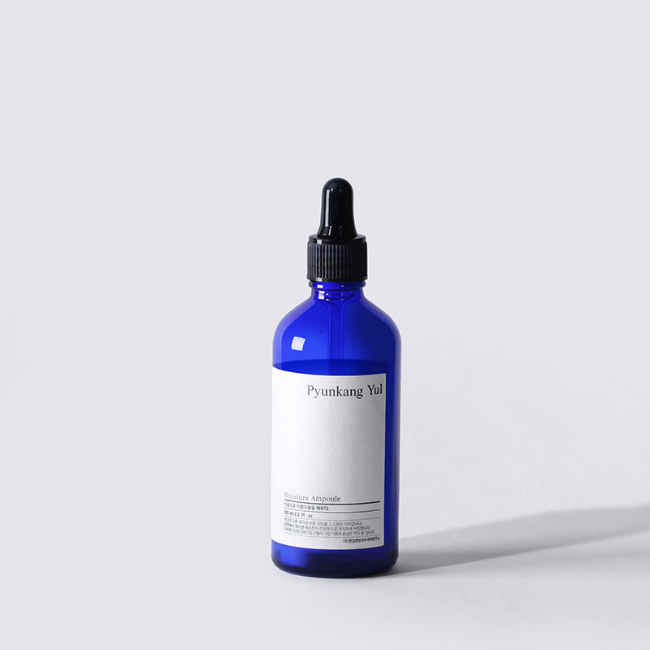

Pyunkang Yul
Moisture Ampoule 100ml

Moisture Ampoule 100ml
Pyunkang Yul
moisture-ampoule-100ml
Serum
9706813653285
Morning or Evening?
How often will you use this product?
Notes


Highlights
WHAT IS IT?
Moisturizing serum with 6 active ingredients
FEATURES
A powerful, hydrating serum designed to replenish and lock in moisture for soft, plump skin
BEST FOR
Dry skin, sensitive skin
CHECKS
Free of parabens, artificial fragrances, colorants
Who Is It For?
Suitable For Adults 18+What Does It Help With?
Dryness MoisturizingBudget
Mid-rangeHow To Use
Which routine should it be used in?
Instructions:
Key Information


What Pyunkang Yul Says
Product Description:
The best well-known K-Beauty brand Pyunkang Yul has its own Eastern Medicine recipe which derived from nature, thoughtfully formulated to help the sensitized skin rest and heal itself. Forms a moisturizing barrier that adheres tightly to dry skin and protects moisture.
About the Brand:
Ingredients Overview
Ingredients List
Coptis Chinensis Root Extract, Polysorbate 80, PEG-150 Distearate, 1,2-Hexanediol, Polysorbate 20, Glyceryl Caprylate
Key Ingredients
Coptis Chinensis Root Extract
Ingredients Details
12 Hexanediol
Common Name(s): 12 hexanediol
DESCRIPTION
What It Does: Delivers targeted skin-conditioning or bioactive benefits through a specific mechanism of action suited to the formulation's intended purpose.
Why It's Used: Specialty actives address specific skin concerns through targeted molecular mechanisms, providing efficacy beyond what base formulation ingredients alone can achieve.
How It Works: The bioactive compound interacts with specific molecular targets in skin cells or the extracellular matrix — enzymes, receptors, structural proteins, or signaling molecules — triggering beneficial biological responses.
Typically Found In: Serums,treatments,moisturizers,specialty products
TECHNICAL DETAILS
Primary Category: Specialty actives
Secondary Functions: Skin-conditioning,anti-aging
Application Areas:

Facial Skincare

Body Care
Hair Care
Beard Care
Color Cosmetics (Makeup)
Dietary/Oral Supplements
Typical Concentration Range: 0.01–5%
SOURCING & ETHICS
Vegan Status: Conditional - supplier confirmation required
Halal Status: Unverified - supplier confirmation required
Source Notes: Specialty active ingredient; check individual sourcing for vegan status. [audit 2026-07-29 rev2: the record's own source_notes does not assert a non-animal origin, or instructs the reader to verify with the supplier; "yes" asserts knowledge the record does not hold. determination requires shariah-panel sign-off.]
SKIN COMPATIBILITY
Irritancy Rating: 1899-12-31 00:00:00 -0800
Sensitivity Concerns: Low sensitization potential at recommended use concentrations.
Safe for Sensitive Skin: Yes
SAFETY & COMPATIBILITY
Safety Profile: Well-characterized cosmetic ingredient with established safety profile. generally non-irritating at typical use concentrations. suitable for leave-on and rinse-off cosmetics.
Works Well With: Niacinamide,hyaluronic acid,vitamin c,peptides
Avoid Combining With: Incompatible with oxidizing agents; check ph stability
SCIENTIFIC NOTE
Specialty actives typically work through enzyme inhibition (e.g., tyrosinase inhibition for brightening, mmp inhibition for anti-aging), receptor activation (e.g., retinoid receptors, ppar-γ for barrier genes), or transcription factor modulation (e.g., nrf2 for antioxidant gene upregulation). structure-activity relationships determine potency and selectivity.
Last Verified: 2025-01-15
Primary Sources: Cosing eu database; pcpc cosmetic ingredient safety reviews; ingredient-specific safety and efficacy literature
Coptis Chinensis Root Extract
Common Name(s): Coptis chinensis root extract
DESCRIPTION
What It Does: Provides antioxidant protection, soothing anti-inflammatory effects, and skin-conditioning benefits through plant-derived polyphenols and phytochemicals.
Why It's Used: Plant extracts concentrate bioactive phytochemicals evolved for environmental protection — uv, microbial, and oxidative stressors — that translate to skin benefits.
How It Works: Polyphenols (flavonoids, phenolic acids) inhibit nf-κb-mediated inflammatory signaling, scavenge reactive oxygen species through electron donation, and chelate pro-oxidant metal ions to reduce oxidative skin damage.
Typically Found In: Serums,toners,moisturizers,masks,essences
TECHNICAL DETAILS
Primary Category: Botanical extracts
Secondary Functions: Antioxidant,anti-inflammatory
Application Areas:
Facial Skincare
Body Care
Hair Care
Beard Care
Color Cosmetics (Makeup)
Dietary/Oral Supplements
Typical Concentration Range: 0.1–10%
SOURCING & ETHICS
Vegan Status: Yes
Halal Status: Yes
Source Notes: Plant-derived extract; no animal components.
SKIN COMPATIBILITY
Irritancy Rating: 1
Comedogenicity Rating: 0
Sensitivity Concerns: Low sensitization potential at recommended use concentrations.
Safe for Sensitive Skin: Yes
SAFETY & COMPATIBILITY
Safety Profile: Well-characterized cosmetic ingredient with established safety profile. generally non-irritating at typical use concentrations. suitable for leave-on and rinse-off cosmetics.
Works Well With: Niacinamide,hyaluronic acid,vitamin c,ceramides
Avoid Combining With: Strong oxidizing agents
SCIENTIFIC NOTE
Plant secondary metabolites (flavonoids, terpenes, phenolic acids) are biosynthesized as defense compounds against uv, herbivores, and pathogens. their anti-inflammatory activity typically derives from competitive inhibition of cox-2 and 5-lox enzymes (ic50 1–50 µm), while antioxidant activity involves single electron transfer (set) and hydrogen atom transfer (hat) mechanisms with structure-dependent rate constants.
Last Verified: ##########
Primary Sources: Cosing eu database; pcpc cosmetic ingredient safety reviews; phytochemical and ethnobotanical literature
Glyceryl Caprylate
Common Name(s): Glycerol monocaprylate,mono caprylate of glycerol,schercemol gmc
CAS Number: 26402-26-6
DESCRIPTION
What It Does: Provides natural origin antimicrobial preservation alongside skin conditioning in clean beauty formulations.
Why It's Used: Natural-origin preservative for truly natural formulations seeking effective preservation without synthetic preservatives.
How It Works: Monoglyceride structure inserts into microbial cell membranes via the caprylic acid chain, disrupting membrane integrity. glycerol moiety contributes skin conditioning. effective against gram-positive bacteria and some yeasts at formulation concentrations.
Typically Found In: Natural and organic cosmetics,clean beauty,cosmos-certified products
TECHNICAL DETAILS
Primary Category: Functional ingredient – natural monoglyceride preservative
Secondary Functions: Skin conditioning
Application Areas:
Facial Skincare
Body Care
Hair Care
Beard Care
Color Cosmetics (Makeup)
Dietary/Oral Supplements
Typical Concentration Range: 0.3%–1.5%
SOURCING & ETHICS
Vegan Status: Conditional - feedstock declaration required
Halal Status: Unverified - feedstock declaration required (plant, animal and petrochemical routes all exist)
Source Notes: From vegetable glycerol and plant-derived caprylic acid (coconut/palm kernel). cosmos-approved for certified natural cosmetics. [audit 2026-07-29 rev2: origin-dependent: the same inci exists in plant, animal and petrochemical versions and the name does not discriminate. determination requires shariah-panel sign-off.]
SKIN COMPATIBILITY
Irritancy Rating: 1/5 – very low
Comedogenicity Rating: 0/5 – non-comedogenic
Sensitivity Concerns: Well-tolerated by most skin types.
Safe for Sensitive Skin: Yes
SAFETY & COMPATIBILITY
Safety Profile: Good safety profile at recommended concentrations. ewg score: 1–2.
Works Well With: Standard skincare actives
Avoid Combining With: No known significant incompatibilities
SCIENTIFIC NOTE
Glyceryl caprylate's preservation mechanism (membrane disruption via monoglyceride structure) is distinct from synthetic preservatives (protein enzyme inhibition). this mechanistic difference is why it is approved in cosmos natural certification where synthetic enzyme inhibitors are not permitted.
Last Verified: 2026-03-12
Primary Sources: Cosing database,cosmos standard,basf technical data
Peg-150 Distearate
Common Name(s): Peg-based nonionic emulsifier,ethoxylate surfactant,o/w solubiliser
CAS Number: N/a
DESCRIPTION
What It Does: Stabilises o/w emulsions by reducing interfacial tension, solubilises oils and fragrances in aqueous systems, and wets oil-phase components for improved formulation homogeneity.
Why It's Used: Peg emulsifiers are selected for their precise hlb, broad ph stability (unlike soap emulsifiers that lose function at acidic ph), and compatibility with both anionic and cationic co-ingredients in the formulation system.
How It Works: Peg chain length determines hlb: longer peg = higher hlb = more hydrophilic = better o/w emulsification. at the o/w interface, the peg chain extends into the water phase forming a hydrated steric barrier that prevents droplet coalescence. nonionic character provides ph-independent function across the full cosmetic ph range.
Typically Found In: Emulsions,fragrance solubilisation
TECHNICAL DETAILS
Primary Category: Active ingredient – cosmetic active
Secondary Functions: Skin conditioning
Application Areas:
Facial Skincare
Body Care
Hair Care
Beard Care
Color Cosmetics (Makeup)
Dietary/Oral Supplements
Typical Concentration Range: 1%–10%
SOURCING & ETHICS
Vegan Status: Conditional - supplier confirmation required
Halal Status: Unverified - supplier confirmation required
Source Notes: Commercially produced for cosmetic use. verify vegan/halal status with supplier. [audit 2026-07-29 rev2: the record's own source_notes does not assert a non-animal origin, or instructs the reader to verify with the supplier; "yes" asserts knowledge the record does not hold. determination requires shariah-panel sign-off.]
SKIN COMPATIBILITY
Irritancy Rating: 1/5 – very low
Comedogenicity Rating: 0/5 – non-comedogenic
Sensitivity Concerns: Well-tolerated by most skin types.
Safe for Sensitive Skin: Yes
SAFETY & COMPATIBILITY
Safety Profile: Good safety profile at recommended concentrations. ewg score: 1–2.
Works Well With: Standard skincare actives
Avoid Combining With: No known significant incompatibilities
SCIENTIFIC NOTE
Mixed peg emulsifier systems (e.g., peg-100 stearate + glyceryl stearate) form more cohesive interfacial films than single emulsifiers — the geometric complementarity of the co-emulsifier pair providing better mechanical emulsion stability than either component alone.
Last Verified: 2026-03-12
Primary Sources: Cosing database,peg-150 distearate peg emulsifier review