

Nykaa E retail limited
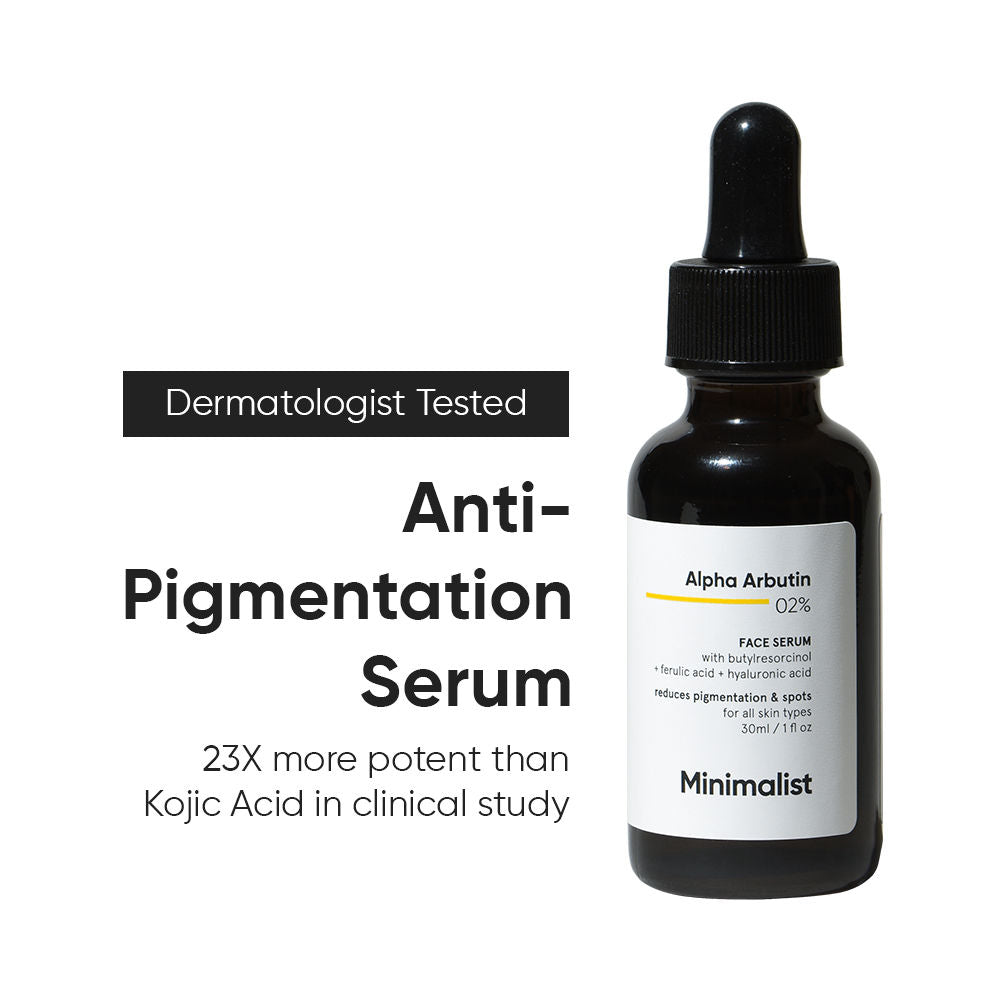
Minimalist 2% Alpha Arbutin Face Serum with Butylresorcinol & Ferulic Acid for Hyperpigmentation

Minimalist 2% Alpha Arbutin Face Serum with Butylresorcinol & Ferulic Acid for Hyperpigmentation
Nykaa E retail limited
minimalist-2-alpha-arbutin-face-serum-with-butylresorcinol-ferulic-acid-for-hyperpigmentation
Serum
10084863934757
Morning or Evening?
How often will you use this product?
Notes


Highlights
WHAT IS IT?
Face serum with 2% Alpha Arbutin
FEATURES
Targets hyperpigmentation
BEST FOR
combination
CHECKS
Who Is It For?
AdultsWhat Does It Help With?
HyperpigmentationBudget
Affordable (under $30)How To Use
Which routine should it be used in?
Instructions:
Key Information


What Nykaa E retail limited Says
Product Description:
A face serum containing 2% Alpha Arbutin, Butylresorcinol, and Ferulic Acid targeting hyperpigmentation
About the Brand:
Ingredients Overview
Ingredients List
Aloe Vera Juice, Dimethyl Isosorbide, Alpha Arbutin, Propanediol, Ethoxydiglycol, Sodium Hyaluronate, Phenoxyethanol, Pullulan, Ethylhexylglycerin, Hydroxyethylcellulose, Xanthan Gum, Sclerotium Gum, Trisodium Ethylenediamine Disuccinate, Lactic Acid, Lecithin
Key Ingredients
alpha arbutin, butylresorcinol, ferulic acid
Ingredients Details
Alpha Arbutin
Common Name(s): Alpha arbutin
DESCRIPTION
What It Does: Delivers targeted skin-conditioning or bioactive benefits through a specific mechanism of action suited to the formulation's intended purpose.
Why It's Used: Specialty actives address specific skin concerns through targeted molecular mechanisms, providing efficacy beyond what base formulation ingredients alone can achieve.
How It Works: The bioactive compound interacts with specific molecular targets in skin cells or the extracellular matrix — enzymes, receptors, structural proteins, or signaling molecules — triggering beneficial biological responses.
Typically Found In: Serums,treatments,moisturizers,specialty products
TECHNICAL DETAILS
Primary Category: Specialty actives
Secondary Functions: Skin-conditioning,anti-aging
Application Areas:

Facial Skincare

Body Care
Hair Care
Beard Care
Color Cosmetics (Makeup)
Dietary/Oral Supplements
Typical Concentration Range: 0.01–5%
SOURCING & ETHICS
Vegan Status: Yes
Halal Status: Yes
Source Notes: Specialty active ingredient; check individual sourcing for vegan status.
SKIN COMPATIBILITY
Irritancy Rating: 1899-12-31 00:00:00 -0800
Sensitivity Concerns: Low sensitization potential at recommended use concentrations.
Safe for Sensitive Skin: Yes
SAFETY & COMPATIBILITY
Safety Profile: Well-characterized cosmetic ingredient with established safety profile. generally non-irritating at typical use concentrations. suitable for leave-on and rinse-off cosmetics.
Works Well With: Niacinamide,hyaluronic acid,vitamin c,peptides
Avoid Combining With: Incompatible with oxidizing agents; check ph stability
SCIENTIFIC NOTE
Specialty actives typically work through enzyme inhibition (e.g., tyrosinase inhibition for brightening, mmp inhibition for anti-aging), receptor activation (e.g., retinoid receptors, ppar-γ for barrier genes), or transcription factor modulation (e.g., nrf2 for antioxidant gene upregulation). structure-activity relationships determine potency and selectivity.
Last Verified: Cosing eu database; pcpc cosmetic ingredient safety reviews; ingredient-specific safety and efficacy literature
Primary Sources: 2025-01-15
Dimethyl Isosorbide
Common Name(s): Dmi,isosorbide dimethyl ether,arlasolve dmi
CAS Number: 5306-85-4
DESCRIPTION
What It Does: Provides biocompatible penetration enhancement for improved active ingredient delivery.
Why It's Used: Biocompatible penetration enhancer from renewable sorbitol — dmi provides penetration enhancement without the toxicity of oleic acid or conventional chemical penetration enhancers.
How It Works: Cyclic ether from sorbitol is biocompatible and biodegradable. disrupts stratum corneum lipid packing via ether oxygen hydrogen bonding. solubilises challenging actives (retinoids, salicylic acid, ahas). enhances penetration 2–5× vs equivalent concentrations without dmi.
Typically Found In: Active delivery formulas,penetration-enhanced products,retinoid vehicles
TECHNICAL DETAILS
Primary Category: Functional ingredient – penetration-enhancing solvent
Secondary Functions: Skin conditioning
Application Areas:
Facial Skincare
Body Care
Hair Care
Beard Care
Color Cosmetics (Makeup)
Dietary/Oral Supplements
Typical Concentration Range: 1%–20%
SOURCING & ETHICS
Vegan Status: Yes – from sorbitol (corn or wheat derived)
Halal Status: Yes
Source Notes: Commercially produced for cosmetic use. verify vegan/halal status with supplier.
SKIN COMPATIBILITY
Irritancy Rating: 1/5 – very low
Comedogenicity Rating: 0/5 – non-comedogenic
Sensitivity Concerns: Well-tolerated by most skin types.
Safe for Sensitive Skin: Yes
SAFETY & COMPATIBILITY
Safety Profile: Good safety profile at recommended concentrations. ewg score: 1–2.
Works Well With: Standard skincare actives
Avoid Combining With: No known significant incompatibilities
SCIENTIFIC NOTE
Dmi's penetration enhancement mechanism differs from oleic acid's lipid disruption: dmi hydrogen bonds to stratum corneum proteins and lipids, temporarily creating more permeable protein-lipid domains without the membrane-fluidisation that causes oleic acid's irritation. this protein-hydrogen-bonding mechanism provides penetration enhancement from a different, gentler pathway.
Last Verified: Cosing database,croda arlasolve dmi technical data,cir safety assessment
Primary Sources: 2026-03-12
Ethoxydiglycol
Common Name(s): Ethoxydiglycol,glycol co-solvent,humectant formulation aid
CAS Number: N/a
DESCRIPTION
What It Does: Provides co-solvent and penetration enhancer in cosmetic formulations, improving active ingredient dissolution and product texture while delivering mild skin conditioning.
Why It's Used: Glycol solvents are essential for dissolving actives with limited water or oil solubility — the intermediate polarity of glycol ethers provides access to the wider solubility parameter space between pure water and oil phases.
How It Works: Hydroxyl and ether groups provide h-bonding for water miscibility; the organic chain provides compatibility with lipophilic actives. medium-chain glycols (c3–c6) provide the optimal balance of water compatibility, lipophilic active dissolution, and skin-compatible humectancy.
Typically Found In: Skin care formulations,co-solvent systems
TECHNICAL DETAILS
Primary Category: Functional ingredient – humectant
Secondary Functions: Tewl reduction,skin plumping
Application Areas:
Facial Skincare
Body Care
Hair Care
Beard Care
Color Cosmetics (Makeup)
Dietary/Oral Supplements
Typical Concentration Range: 1%–30%
SOURCING & ETHICS
Vegan Status: Yes
Halal Status: Yes
Source Notes: Synthetic or naturally derived. excellent aqueous solubility.
SKIN COMPATIBILITY
Irritancy Rating: 1/5 – very low
Comedogenicity Rating: 0/5 – non-comedogenic
Sensitivity Concerns: Non-irritating; suitable for all skin types.
Safe for Sensitive Skin: Yes
SAFETY & COMPATIBILITY
Safety Profile: Excellent safety profile. ewg score: 1.
Works Well With: Ceramides,emollients,occlusives,glycerin,hyaluronic acid
Avoid Combining With: No significant incompatibilities
SCIENTIFIC NOTE
Glycol ether co-solvents enhance sc penetration of co-applied actives by increasing their thermodynamic activity in the sc lipid phase — high thermodynamic activity (near saturation) drives diffusion by concentration gradient even when absolute concentration is low.
Last Verified: Cosing database,ethoxydiglycol glycol solvent review
Primary Sources: 2026-03-12
Ethylhexylglycerin
Common Name(s): Octylglycerin,2-ethylhexyl glycerol ether,sensiva sc 10
CAS Number: 70445-33-9
DESCRIPTION
What It Does: Provides antimicrobial skin conditioning with deodorant activity and preservation system enhancement.
Why It's Used: Multifunctional clean beauty preservation active — ethylhexylglycerin provides antimicrobial, deodorant, and skin conditioning in a single ingredient accepted in most natural cosmetic certification schemes.
How It Works: Glycerol ether provides antimicrobial via bacterial membrane phospholipid disruption. deodorant activity via reduction of underarm lipase enzyme activity (similar mechanism to triethyl citrate). skin conditioning from glycerol humectant component. synergistic with phenoxyethanol and diols.
Typically Found In: Natural preservation systems,deodorants,skin conditioning products
TECHNICAL DETAILS
Primary Category: Functional ingredient – antimicrobial glycerol ether
Secondary Functions: Skin conditioning
Application Areas:
Facial Skincare
Body Care
Hair Care
Beard Care
Color Cosmetics (Makeup)
Dietary/Oral Supplements
Typical Concentration Range: 0.1%–0.5%
SOURCING & ETHICS
Vegan Status: Yes – synthetic
Halal Status: Yes
Source Notes: Commercially produced for cosmetic use. verify vegan/halal status with supplier.
SKIN COMPATIBILITY
Irritancy Rating: 1/5 – very low
Comedogenicity Rating: 0/5 – non-comedogenic
Sensitivity Concerns: Well-tolerated by most skin types.
Safe for Sensitive Skin: Yes
SAFETY & COMPATIBILITY
Safety Profile: Good safety profile at recommended concentrations. ewg score: 1–2.
Works Well With: Standard skincare actives
Avoid Combining With: No known significant incompatibilities
SCIENTIFIC NOTE
Ethylhexylglycerin's deodorant mechanism is pharmacologically identical to triethyl citrate: both inhibit skin surface microbial lipase enzymes that convert odourless triglycerides to odorous free fatty acids. the glycerol ether structure of ethylhexylglycerin, combined with the 2-ethylhexyl chain, provides lipase inhibition similar to ester-based lipase inhibitors from a different chemical class.
Last Verified: Cosing database,schülke sensiva sc 10 technical data,cir safety assessment
Primary Sources: 2026-03-12
