

Milkshake
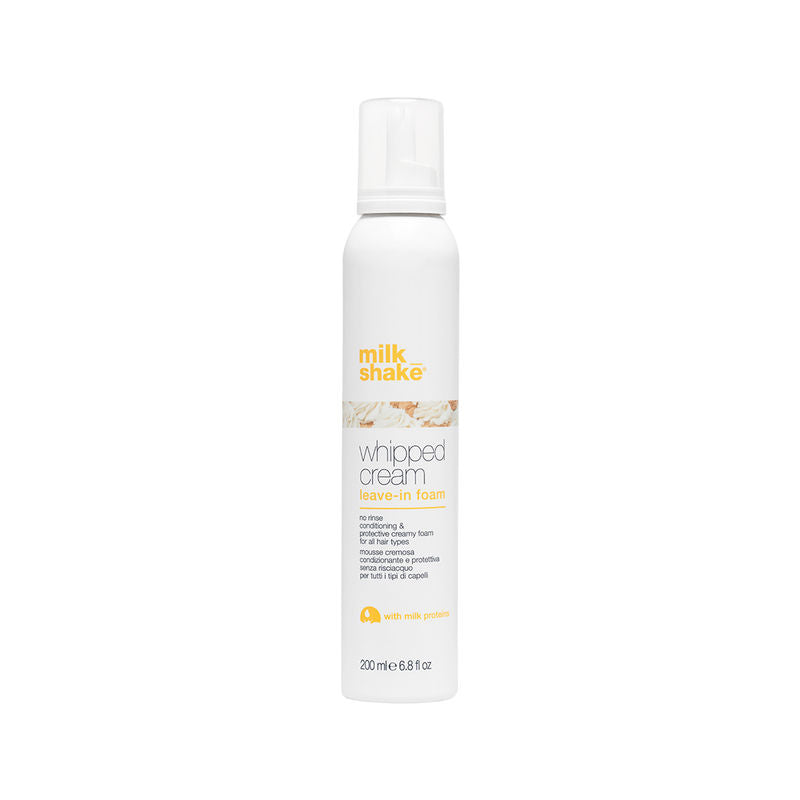
Milkshake Whipped Cream Leave-In Conditioner For Soft & Manageable Hair With UV & Heat Protection
Milkshake Whipped Cream is a versatile leave-in conditioner specifically created to maintain optimum moisture balance and to preserve the integrity of hair color with a sweet milk fragrance. A simple and fast way to condition, the soft and creamy formula instantly makes hair soft and easy to comb without weighing it down. Milkshake whipped cream prevents static electricity and frizziness, and has a pleasant fragrance of sweet milk. Hair is soft, shiny and full of vitality. Hair proteins condition and restructure hair while emollients give long lasting protection. Integrity 41 improves color stability. Leaves hair soft shiny and radiant.
Color-safe
Frizz
Dullness
Condition
Protect
Optimized for Your Environment & Lifestyle
Nykaa
In stock
Recommended

Milkshake Whipped Cream Leave-In Conditioner For Soft & Manageable Hair With UV & Heat Protection
Milkshake
milkshake-whipped-cream-leave-in-conditioner-for-soft-manageable-hair-with-uv-heat-protection
Conditioner
10202942046501
Morning or Evening?
How often will you use this product?
Notes


Secure payment protection
Your Biodata Compatibility Analysis
Based on your 6 hair health indices and environmental factors
Poor Match
Significant incompatibilities
Growth Cycle Health Index
Hair Match
Hair Health Index Alignment
Optimal for OSI, SSI, DI, HSI
Ingredient Efficacy
Matching Ingredient Score
Environment Compatibility
Current UV, Air Quality & Humidity
Why This Works for Your Specific Profile
Damage Index:
Very healthy or severely damaged hair falls outside optimal treatment parameters
Water Quality:
Fine hair becomes weighed down and greasy from heavy formulation
Hair:
No porosity-specific conflicts
Active Lifestyle:
Low activity produces insufficient stress or buildup making product intensity unnecessarily harsh
Your Hair Profile Integration
Your Hair Archetype

Density Level

Washing Frequency

Shedding Level

Oil Level
Your Hair Health Indices
Oil Secretion (OSI)
Very low oil production
Scalp Sensitivity (SSI)
Very low sensitivity
Growth Rate (CMR)
Poor metabolism rate
Damage Index (DI)
Minimal damage
Hair Strength (HSI)
Very weak strength
Softness Index (SI)
Significant improvement needed
Water & Environmental Integration

Water:


Expected Results & Timeline
Key Highlights

What is it?
Leave-In Conditioner

Who Is It For

Budget
$19.29 - $38.58

Timeline
Why You’ll Love It

What Does It Help With?
Frizz, Dullness, Static Electricity

Best for
Frizz

Features
Maintains optimum moisture balance, preserves hair color integrity, soft and easy to comb, prevents static electricity and frizziness, soft shiny hair, contains milk proteins for conditioning and restructuring hair, emollients for long lasting protection, improves color stability

Checks
100% Authentic
Ingredients Overview
Ingredients List
Aqua (Water), Butane, Propane, Isobutane, Myristyl Alcohol, Cetrimonium Chloride, Parfum (Fragrance), Amodimethicone, Imidazolidinyl Urea, Trideceth-10, Citric Acid, Tocopheryl Acetate, Butylene Glycol, Benzyl Alcohol, Glyceryl Oleate, Panthenol, Propylene Glycol, Helianthus Annuus (Sunflower) Seed Extract, PEG-5 Cocomonium Methosulfate, BHT, Hexylene Glycol, BHA, Sodium Glutamate, Hydrolyzed Milk Protein, Phenoxyethanol, Ethylhexylglycerin, Hydroxypropyltrimonium Hydrolyzed Casein, Sodium Cocoyl Glutamate, Hydroxypropyl Guar Hydroxypropyltrimonium Chloride, Ascorbyl Palmitate
Key Ingredients
Hydrolyzed Milk Protein, Amodimethicone, Panthenol
Ingredients Details
Amodimethicone
Common Name(s): Aminosilicone,amino-modified polydimethylsiloxane
CAS Number: 71750-79-3
DESCRIPTION
What It Does: Provides amino group-mediated preferential adsorption to damaged hair for targeted conditioning.
Why It's Used: Premium hair conditioning silicone – amino groups provide substantive adsorption to hair far exceeding pdms, with automatic targeting to the most damaged areas requiring conditioning.
How It Works: Amino (nh2) groups on silicone chain provide cationic character at normal ph, electrostatic adsorption to anionic hair surface. higher charge density at damaged sites increases adsorption where conditioning is most needed. si-o-si backbone provides permanent conditioning film with heat protection.
Typically Found In: Intensive conditioners,anti-frizz products,damage repair conditioners
TECHNICAL DETAILS
Primary Category: Functional ingredient – amino-functional silicone
Secondary Functions: Skin conditioning
Application Areas:

Facial Skincare
Body Care

Hair Care
Beard Care
Color Cosmetics (Makeup)
Dietary/Oral Supplements
Typical Concentration Range: 0.1%–5%
SOURCING & ETHICS
Vegan Status: Conditional - supplier confirmation required
Halal Status: Unverified - supplier confirmation required
Source Notes: Commercially produced for cosmetic use. verify vegan/halal status with supplier. [audit 2026-07-29 rev2: the record's own source_notes does not assert a non-animal origin, or instructs the reader to verify with the supplier; "yes" asserts knowledge the record does not hold. determination requires shariah-panel sign-off.]
SKIN COMPATIBILITY
Irritancy Rating: 1/5 – very low
Comedogenicity Rating: 0/5 – non-comedogenic
Sensitivity Concerns: Well-tolerated by most skin types.
Safe for Sensitive Skin: Yes
SAFETY & COMPATIBILITY
Safety Profile: Good safety profile at recommended concentrations. ewg score: 1–2.
Works Well With: Standard skincare actives
Avoid Combining With: No known significant incompatibilities
SCIENTIFIC NOTE
Amodimethicone's amino group-driven substantivity to damaged hair is dramatically greater than non-functionalized pdms. studies show amodimethicone deposits 50-200× more mass on bleach-damaged hair vs virgin hair, providing an automatic 'damage detection' conditioning system that directs the most conditioning to the hair areas that need it most.
Last Verified: 2026-03-12
Primary Sources: Cosing database,robbins hair science,cir safety assessment
Amodimethicone
Common Name(s): Aminosilicone,amino-modified polydimethylsiloxane
CAS Number: 71750-79-3
DESCRIPTION
What It Does: Provides amino group-mediated preferential adsorption to damaged hair for targeted conditioning.
Why It's Used: Premium hair conditioning silicone – amino groups provide substantive adsorption to hair far exceeding pdms, with automatic targeting to the most damaged areas requiring conditioning.
How It Works: Amino (nh2) groups on silicone chain provide cationic character at normal ph, electrostatic adsorption to anionic hair surface. higher charge density at damaged sites increases adsorption where conditioning is most needed. si-o-si backbone provides permanent conditioning film with heat protection.
Typically Found In: Intensive conditioners,anti-frizz products,damage repair conditioners
TECHNICAL DETAILS
Primary Category: Functional ingredient – amino-functional silicone
Secondary Functions: Skin conditioning
Application Areas:
Facial Skincare
Body Care
Hair Care
Beard Care
Color Cosmetics (Makeup)
Dietary/Oral Supplements
Typical Concentration Range: 0.1%–5%
SOURCING & ETHICS
Vegan Status: Conditional - supplier confirmation required
Halal Status: Unverified - supplier confirmation required
Source Notes: Commercially produced for cosmetic use. verify vegan/halal status with supplier. [audit 2026-07-29 rev2: the record's own source_notes does not assert a non-animal origin, or instructs the reader to verify with the supplier; "yes" asserts knowledge the record does not hold. determination requires shariah-panel sign-off.]
SKIN COMPATIBILITY
Irritancy Rating: 1/5 – very low
Comedogenicity Rating: 0/5 – non-comedogenic
Sensitivity Concerns: Well-tolerated by most skin types.
Safe for Sensitive Skin: Yes
SAFETY & COMPATIBILITY
Safety Profile: Good safety profile at recommended concentrations. ewg score: 1–2.
Works Well With: Standard skincare actives
Avoid Combining With: No known significant incompatibilities
SCIENTIFIC NOTE
Amodimethicone's amino group-driven substantivity to damaged hair is dramatically greater than non-functionalized pdms. studies show amodimethicone deposits 50-200× more mass on bleach-damaged hair vs virgin hair, providing an automatic 'damage detection' conditioning system that directs the most conditioning to the hair areas that need it most.
Last Verified: 2026-03-12
Primary Sources: Cosing database,robbins hair science,cir safety assessment
Ascorbyl Palmitate
Common Name(s): L-ascorbyl-6-palmitate,vitamin c palmitate,fat-soluble vitamin c
CAS Number: 137-66-6
DESCRIPTION
What It Does: Provides lipid-soluble antioxidant protection in skin and oil-based formulations.
Why It's Used: Oil-based formulations as fat-soluble vitamin c active and formulation antioxidant preservative (e304).
How It Works: Skin esterases cleave the bond releasing ascorbic acid and palmitic acid. lipophilic form may integrate into cell membranes for lipid-phase antioxidant protection.
Typically Found In: Oil serums,emulsions,sunscreens,anti-aging creams
TECHNICAL DETAILS
Primary Category: Active ingredient – vitamin c derivative
Secondary Functions: Lipid-soluble antioxidant,formulation preservative
Application Areas:
Facial Skincare
Body Care
Hair Care
Beard Care
Color Cosmetics (Makeup)
Dietary/Oral Supplements
Typical Concentration Range: 0.1%–1%
SOURCING & ETHICS
Vegan Status: Conditional - feedstock declaration required
Halal Status: Unverified - feedstock declaration required (plant, animal and petrochemical routes all exist)
Source Notes: Esterification of ascorbic acid with palmitic acid. gras food additive (e304). [audit 2026-07-29 rev2: origin-dependent: the same inci exists in plant, animal and petrochemical versions and the name does not discriminate. determination requires shariah-panel sign-off.]
SKIN COMPATIBILITY
Irritancy Rating: 1/5 – very low
Comedogenicity Rating: 1/5 – very low; palmitic acid minor concern
Sensitivity Concerns: Non-irritating; suitable for all skin types.
Safe for Sensitive Skin: Yes
SAFETY & COMPATIBILITY
Safety Profile: Excellent safety profile. ewg score: 1.
Works Well With: Tocopherol,ferulic acid,niacinamide,spf
Avoid Combining With: No significant incompatibilities
SCIENTIFIC NOTE
Debate exists about efficiency of ester hydrolysis in intact skin and prooxidant potential of uv degradation products. formulating with the antioxidant triad (c+e+ferulic) mitigates this concern.
Last Verified:
Benzyl Alcohol
Common Name(s): Phenylcarbinol,benzenemethanol,alpha-hydroxytoluene
CAS Number: 100-51-6
DESCRIPTION
What It Does: Provides dual fragrance and preservative activity as an aromatic alcohol.
Why It's Used: Multi-function ingredient serving as both fragrance component and preservative – reduces formulation complexity by providing both functions in one ingredient.
How It Works: Phenylcarbinol provides antimicrobial activity via membrane disruption (effective vs gram-positive bacteria and moulds). solvent for fragrances and difficult-to-dissolve actives. mild oxidative conversion to benzaldehyde provides sweet almond-like fragrance.
Typically Found In: Fragrances,preserved cosmetics,solvent systems
TECHNICAL DETAILS
Primary Category: Fragrance component / preservative
Secondary Functions: Skin conditioning
Application Areas:
Facial Skincare
Body Care
Hair Care
Beard Care
Color Cosmetics (Makeup)
Dietary/Oral Supplements
Typical Concentration Range: 0.001%–1% (fragrance); up to 1% as preservative
SOURCING & ETHICS
Vegan Status: Yes - standard ethanol routes are non-animal; confirm denaturant origin
Halal Status: Conditional - ethanol production route and residual concentration; jurisdiction-dependent, refer to certifier stance
Source Notes: Commercially produced for cosmetic use. verify vegan/halal status with supplier. [audit 2026-07-29 rev2: ethanol pathway; determination depends on route, on whether the plant also produces beverage alcohol, and on residual concentration. determination requires shariah-panel sign-off.]
SKIN COMPATIBILITY
Irritancy Rating: 1/5 – very low
Comedogenicity Rating: 0/5 – non-comedogenic
Sensitivity Concerns: Well-tolerated by most skin types.
Safe for Sensitive Skin: Yes
SAFETY & COMPATIBILITY
Safety Profile: Eu cosmetics regulation: declared fragrance allergen. also listed as approved preservative (annex v, max 1%). dual regulatory status (fragrance + preservative) depending on function and concentration.
Works Well With: Standard skincare actives
Avoid Combining With: No known significant incompatibilities
SCIENTIFIC NOTE
Benzyl alcohol's dual regulatory status (fragrance allergen and approved preservative) creates a formulation paradox: it must be listed as a fragrance allergen if present >0.001% (leave-on) regardless of whether it was added for fragrance or preservation. this regulatory dual identity means a preservative added for antimicrobial function triggers the same allergen declaration requirement as a fragrance added for scent.
Last Verified: 2026-03-12
Primary Sources: Cosing database,ifra standards,eu preservative annex v
Personalized Usage Instructions
How to Use
Medical Chemicals

Protein/Moisture
- Moisture
pH Level
-

Porosity Taget
-
Customized for Your Profile
Scalp Condtions
Climate Suitability
Clinical Claims
Frequency
Product Information

100% Authentic