
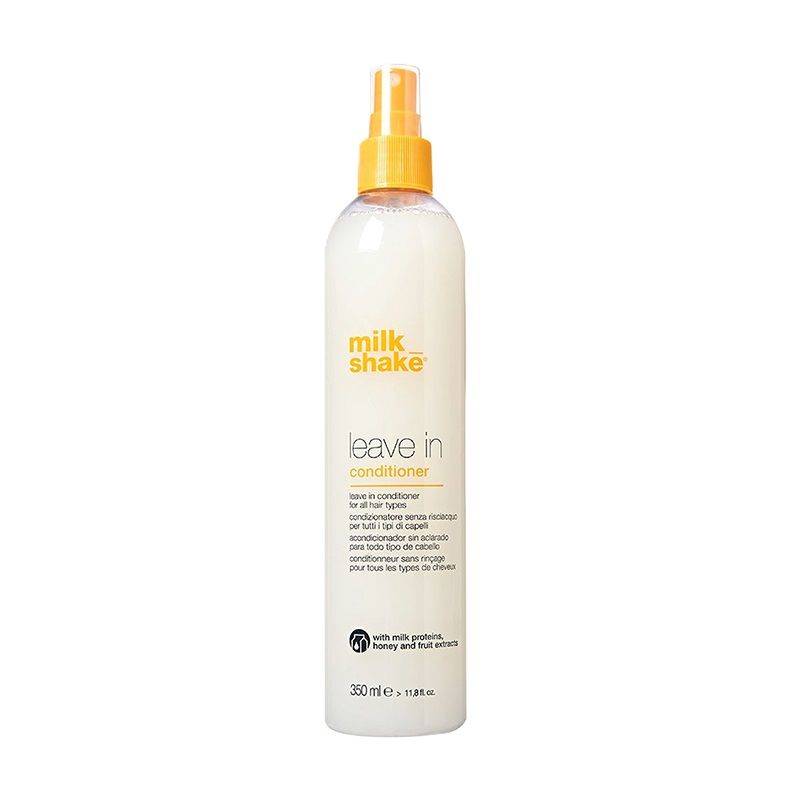

Milkshake
Milkshake Leave-In Conditioner For Damage Control & Detangle
milk_shake Leave-in Conditioner is specifically formulated to condition normal to slightly dry hair and to make damaged hair easier to comb after using other conditioners or treatments. It generates optimum hair moisture balance and outer hair protection. Milk protein, fruit extracts, special silicone, and hydrating and conditioning agents revitalize and improve shine. Integrity 41 and vitamin E guarantee a great color seal. Milk proteins strengthen the internal hair structure, moisturize, condition, and add smoothness. Strawberry, blueberry, and papaya extracts are rich in revitalizing and mineralizing vitamins. Honey extract has conditioning, soothing, and protective properties, while Integrity 41 protects hair color, prevents fading, and increases manageability and shine in the hair. Hydro-glycolic sunflower seed extract, rich in antioxidant polyphenols. Vitamin E protects color against free radicals and the oxidizing effects of environmental agents for a longer lasting, more stable, and shinier color. A leave in conditioner spray that detangles, moisturizes, and leaves your hair smelling divine with a sweet vanilla fragrance.
Sulfate-free
Paraben-free
Color-safe
Silicone-free
Damage Repair
Dryness
Optimized for Your Environment & Lifestyle
Nykaa
In stock
Recommended

Milkshake Leave-In Conditioner For Damage Control & Detangle
Milkshake
milkshake-leave-in-conditioner-for-damage-control-detangle
Conditioner
10202942669093
Morning or Evening?
How often will you use this product?
Notes


Secure payment protection
Your Biodata Compatibility Analysis
Based on your 6 hair health indices and environmental factors
Poor Match
Significant incompatibilities
Growth Cycle Health Index
Hair Match
Hair Health Index Alignment
Optimal for OSI, SSI, DI, HSI
Ingredient Efficacy
Matching Ingredient Score
Environment Compatibility
Current UV, Air Quality & Humidity
Why This Works for Your Specific Profile
Damage Index:
Very healthy or severely damaged hair falls outside optimal treatment parameters
Water Quality:
Fine hair becomes weighed down and greasy from heavy formulation
Hair:
No porosity-specific conflicts
Active Lifestyle:
Low activity produces insufficient stress or buildup making product intensity unnecessarily harsh
Your Hair Profile Integration
Your Hair Archetype

Density Level

Washing Frequency

Shedding Level

Oil Level
Your Hair Health Indices
Oil Secretion (OSI)
Very low oil production
Scalp Sensitivity (SSI)
Very low sensitivity
Growth Rate (CMR)
Poor metabolism rate
Damage Index (DI)
Minimal damage
Hair Strength (HSI)
Very weak strength
Softness Index (SI)
Significant improvement needed
Water & Environmental Integration

Water:


Expected Results & Timeline
Key Highlights

What is it?
Leave-In Conditioner, multiple active ingredients including milk protein and fruit extracts

Who Is It For
All Ages, Unisex

Budget
$18.15 - $36.30

Timeline
Why You’ll Love It

What Does It Help With?
Damage Control, Moisturizing, Detangling, Shine, Color Protection

Best for
Damage Repair

Features
Detangles, moisturizes, protects hair color, enriched with milk protein and fruit extracts, improves manageability, strengthens hair, leaves sweet vanilla fragrance

Checks
Cruelty-free
Ingredients Overview
Ingredients List
Aqua,Polyquaternium-22,Cetrimonium-Chloride,Polyquaternium-7,PEG-40-Hydrogenated-Castor-Oil,Hydrolyzed-Milk-Protein,Hydroxypropyltrimonium-Hydrolyzed-Casein,Mel-Extract,Honey-Extract,Fragaria-Vesca-Strawberry-Fruit-Extract,Carica-Papaya-Papaya-Fruit-Extract,Vaccinium-Myrtillus-Fruit-Leaf-Extract,Helianthus-Annuus-Sunflower-Seed-Extract,PEG-5-Cocomonium-Methosulfate,Sodium-Glutamate,Sodium-Cocoyl-Glutamate,Hydroxypropyl-Guar-Hydroxypropyltrimonium-Chloride,Propylene-Glycol,Amodimethicone,Trideceth-12,Butylene-Glycol,Sodium-Methylparaben,Imidazolidinyl-Urea,Disodium-EDTA,Benzophenone-4,Citric-Acid,Benzyl-Alcohol,Parfum-Fragrance
Key Ingredients
Milk Protein, Strawberry Extract, Blueberry Extract, Papaya Extract, Honey Extract, Integrity 41, Vitamin E, Sunflower Seed Extract
Ingredients Details
Amodimethicone
Common Name(s): Aminosilicone,amino-modified polydimethylsiloxane
CAS Number: 71750-79-3
DESCRIPTION
What It Does: Provides amino group-mediated preferential adsorption to damaged hair for targeted conditioning.
Why It's Used: Premium hair conditioning silicone – amino groups provide substantive adsorption to hair far exceeding pdms, with automatic targeting to the most damaged areas requiring conditioning.
How It Works: Amino (nh2) groups on silicone chain provide cationic character at normal ph, electrostatic adsorption to anionic hair surface. higher charge density at damaged sites increases adsorption where conditioning is most needed. si-o-si backbone provides permanent conditioning film with heat protection.
Typically Found In: Intensive conditioners,anti-frizz products,damage repair conditioners
TECHNICAL DETAILS
Primary Category: Functional ingredient – amino-functional silicone
Secondary Functions: Skin conditioning
Application Areas:

Facial Skincare
Body Care

Hair Care
Beard Care
Color Cosmetics (Makeup)
Dietary/Oral Supplements
Typical Concentration Range: 0.1%–5%
SOURCING & ETHICS
Vegan Status: Conditional - supplier confirmation required
Halal Status: Unverified - supplier confirmation required
Source Notes: Commercially produced for cosmetic use. verify vegan/halal status with supplier. [audit 2026-07-29 rev2: the record's own source_notes does not assert a non-animal origin, or instructs the reader to verify with the supplier; "yes" asserts knowledge the record does not hold. determination requires shariah-panel sign-off.]
SKIN COMPATIBILITY
Irritancy Rating: 1/5 – very low
Comedogenicity Rating: 0/5 – non-comedogenic
Sensitivity Concerns: Well-tolerated by most skin types.
Safe for Sensitive Skin: Yes
SAFETY & COMPATIBILITY
Safety Profile: Good safety profile at recommended concentrations. ewg score: 1–2.
Works Well With: Standard skincare actives
Avoid Combining With: No known significant incompatibilities
SCIENTIFIC NOTE
Amodimethicone's amino group-driven substantivity to damaged hair is dramatically greater than non-functionalized pdms. studies show amodimethicone deposits 50-200× more mass on bleach-damaged hair vs virgin hair, providing an automatic 'damage detection' conditioning system that directs the most conditioning to the hair areas that need it most.
Last Verified: 2026-03-12
Primary Sources: Cosing database,robbins hair science,cir safety assessment
Benzophenone-4
Common Name(s): Benzophenone-4
DESCRIPTION
What It Does: Absorbs or reflects uv radiation, preventing uv-induced dna damage, photo-oxidative stress, and premature skin aging.
Why It's Used: Uv filters are the active ingredients in sun protection — without them, formulations cannot make spf claims or prevent solar-induced skin damage.
How It Works: The uv-absorbing chromophore undergoes photoexcitation by uv photons, then dissipates the absorbed energy through thermal relaxation (chemical filters) or photon scattering/reflection (physical filters), preventing photon penetration to skin cells.
Typically Found In: Sunscreens,moisturizers with spf,foundations with spf
TECHNICAL DETAILS
Primary Category: Uv filters
Secondary Functions: Skin-protecting
Application Areas:
Facial Skincare
Body Care
Hair Care
Beard Care
Color Cosmetics (Makeup)
Dietary/Oral Supplements
Typical Concentration Range: 0.5–25% (within regulatory limits)
SOURCING & ETHICS
Vegan Status: Yes
Halal Status: Yes
Source Notes: Synthetic uv filter; no animal components.
SKIN COMPATIBILITY
Irritancy Rating: 1
Comedogenicity Rating: 0
Sensitivity Concerns: Contact allergy to uv filters occurs in approximately 1–3% of the general population; patch testing recommended for those with known photosensitivity.
Safe for Sensitive Skin: Yes
SAFETY & COMPATIBILITY
Safety Profile: Regulatory approval required per market (eu annex vi, fda otc monograph, etc.). generally non-irritating at approved concentrations.
Works Well With: Other uv filters,antioxidants,emollients
Avoid Combining With: Incompatible filter combinations (photodegradation); check regulatory approvals per region
SCIENTIFIC NOTE
Uv filters operate through two mechanisms: organic/chemical filters absorb uv photons through electronic excitation (π→π* transitions in conjugated systems), then dissipate energy via thermal relaxation; inorganic/physical filters (tio2, zno) scatter and reflect photons through mie scattering (particle size 50–300 nm) and band gap absorption. spf is measured in vivo (iso 24444) as the ratio of minimal erythema doses with and without sunscreen.
Last Verified: 2025-01-15
Primary Sources: Cosing eu database; pcpc cosmetic ingredient safety reviews; eu cosmetics regulation annex vi; iso 24444 (in vivo spf testing)
Honey Extract
Common Name(s): Honey extract,bee honey extract,natural honey
CAS Number: 8028-66-8
DESCRIPTION
What It Does: Provides h2o2 antimicrobial and osmotic healing alongside gluconic acid and flavonoid anti-inflammatory.
Why It's Used: The most ancient healing substance — honey's documented wound healing use spans 8,000 years across all civilisations, with modern research validating the h2o2, osmotic, ph, and mgo antimicrobial mechanisms.
How It Works: Diluted honey releases h2o2 via glucose oxidase for antimicrobial activity. very low water activity (0.56) provides osmotic drawing in wounds. gluconic acid provides mild acidic ph (3.5-4.5) inhibiting bacteria. manuka honey mgo (methylglyoxal) provides antibiotic-independent antimicrobial. flavonoids provide anti-inflammatory activity.
Typically Found In: Wound healing products,natural antimicrobials,humectant masks
TECHNICAL DETAILS
Primary Category: Active ingredient – soothing / anti-inflammatory
Secondary Functions: Redness reduction,anti-inflammatory,calming
Application Areas:
Facial Skincare
Body Care
Hair Care
Beard Care
Color Cosmetics (Makeup)
Dietary/Oral Supplements
Typical Concentration Range: 1%–20%
SOURCING & ETHICS
Vegan Status: No - animal-derived
Halal Status: Conditional - bee-derived; widely held permissible, confirm certifier stance
Source Notes: Plant-derived extract or synthetic. [audit 2026-07-29 rev2: bee-derived; permissibility widely accepted but fatwa varies by jurisdiction. determination requires shariah-panel sign-off.]
SKIN COMPATIBILITY
Irritancy Rating: 1/5 – very low
Comedogenicity Rating: 0/5 – non-comedogenic
Sensitivity Concerns: Non-irritating; ideal for reactive and sensitive skin.
Safe for Sensitive Skin: Yes – particularly recommended for sensitive skin
SAFETY & COMPATIBILITY
Safety Profile: Excellent safety profile. ewg score: 1.
Works Well With: Ceramides,panthenol,allantoin,hyaluronic acid,centella asiatica
Avoid Combining With: No significant incompatibilities
SCIENTIFIC NOTE
Honey is the oldest documented medical treatment with continuous evidence spanning from egyptian ebers papyrus (1550 bc) through islamic medicine (al-qanun fi at-tibb, ibn sina) to modern cochrane reviews confirming wound healing superiority over conventional dressings. medical-grade manuka honey (medihoney) has fda 510(k) clearance for wound care — making honey the only cosmetic humectant with concurrent fda medical device approval for wound management.
Last Verified: 2026-03-12
Primary Sources: Cosing database,molan honey wound review,cochrane review honey vs wound dressings
Milk Protein
Common Name(s): Milk protein,cosmetic active,functional ingredient
CAS Number: N/a
DESCRIPTION
What It Does: Delivers characteristic cosmetic function at recommended use concentration.
Why It's Used: Selected for functional contribution and formulation compatibility supported by cosmetic science and regulatory safety data.
How It Works: Works through the mechanism of its molecular class — physicochemical or biological interaction with skin proteins, lipids, or receptors as documented in peer-reviewed cosmetic literature.
Typically Found In: Skin care formulations
TECHNICAL DETAILS
Primary Category: Active ingredient – cosmetic active
Secondary Functions: Skin conditioning
Application Areas:
Facial Skincare
Body Care
Hair Care
Beard Care
Color Cosmetics (Makeup)
Dietary/Oral Supplements
Typical Concentration Range: 0.1%–10%
SOURCING & ETHICS
Vegan Status: No - animal-derived
Halal Status: Conditional - dairy or egg origin statement required, plus rennet and enzyme origin upstream
Source Notes: Commercially produced for cosmetic use. verify vegan/halal status with supplier. [audit 2026-07-29 rev2: dairy or egg protein; rennet and enzyme origin upstream are undocumented. determination requires shariah-panel sign-off.]
SKIN COMPATIBILITY
Irritancy Rating: 1/5 – very low
Comedogenicity Rating: 0/5 – non-comedogenic
Sensitivity Concerns: Well-tolerated by most skin types.
Safe for Sensitive Skin: Yes
SAFETY & COMPATIBILITY
Safety Profile: Good safety profile at recommended concentrations. ewg score: 1–2.
Works Well With: Standard skincare actives
Avoid Combining With: No known significant incompatibilities
SCIENTIFIC NOTE
Milk protein has an established safety and efficacy profile within the cosmetic regulatory framework at standard use concentrations.
Last Verified: 2026-03-12
Primary Sources: Cosing database,milk protein technical literature
Personalized Usage Instructions
How to Use
Step 1
Spray uniformly on clean and towel dried hair, especially on the most damaged areas
Step 2
Style as desired
Medical Chemicals

Protein/Moisture
- Protein/Moisture balance
pH Level
-

Porosity Taget
- Normal Porosity
Customized for Your Profile
Scalp Condtions
Climate Suitability
Humid, Dry, UV Protection, Pollution Shield, Summer
Clinical Claims
Frequency
Spray uniformly on clean and towel dried hair, especially on the most damaged areas. Style as desired.
Product Information

Cruelty-free