
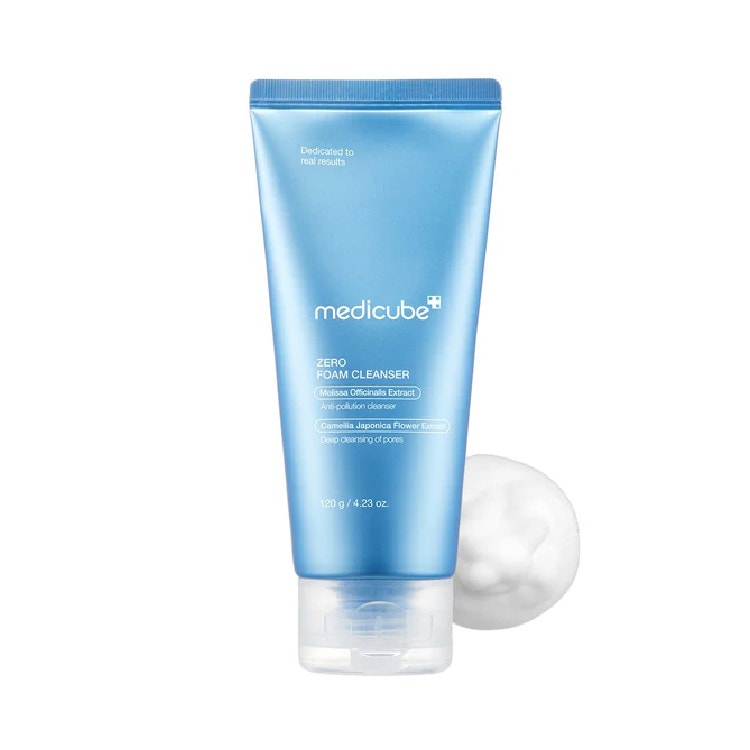

MEDICUBE
Medicube Zero Foam Cleanser 120G

Medicube Zero Foam Cleanser 120G
MEDICUBE
medicube-zero-foam-cleanser-120g
Cleanse
10084707664165
Morning or Evening?
How often will you use this product?
Notes


Highlights
WHAT IS IT?
Foam cleanser with naturally derived ingredients
FEATURES
Deeply cleanses pore impurities, turns into extra rich creamy lather, naturally derived cleansing ingredients, natural salicylic acid, clinically tested for deep pore cleansing and cleansing fine dust
BEST FOR
sensitive
CHECKS
Not Available
Who Is It For?
What Does It Help With?
Deep Pore Cleansing Reducing Impurities Cleansing Fine DustBudget
Mid-range ($30-$75)How To Use
Which routine should it be used in?
Instructions:
Key Information


What MEDICUBE Says
Product Description:
- Daily pore care foam cleanser
- Extra rich creamy lather
- Naturally derived ingredients
- Clinically tested
About the Brand:
Ingredients Overview
Ingredients List
Water, Glycerin, Myristic Acid, Sorbitol, Palmitic Acid, Potassium Hydroxide, Stearic Acid, Lauric Acid, Cetearyl Olivate, Potassium Cocoyl Glycinate, Parfum(Fragrance), Sodium Cocoyl Isethionate, Sorbitan Olivate, Potassium Cocoate, Coconut Acid, Butylene Glycol, Sodium Isethionate, Sodium Polyacrylate, Portulaca Oleracea Extract, Gaultheria Procumbens (Wintergreen) Leaf Extract, Disodium EDTA, Camellia Japonica Flower Extract, Propanediol, Diisopropyl Adipate, Lecithin, 1,2-Hexanediol, Saponaria Officinalis Leaf Extract, Acrylic Acid/Acrylamidomethyl Propane Sulfonic Acid Copolymer, Dimethylmethoxy Chromanol, Glyceryl Caprylate, Citric Acid, Potassium Sorbate, Sodium Benzoate, Xanthan Gum, Chaenomeles Sinensis Fruit Extract, Citrus Aurantium Dulcis (Orange) Flower Extract, Melissa Officinalis Extract
Key Ingredients
natural salicylic acid, naturally derived cleansing ingredients
Ingredients Details
1-2-hexanediol
Common Name(s): 1-2-hexanediol,cosmetic active,functional ingredient
CAS Number: N/a
DESCRIPTION
What It Does: Delivers characteristic cosmetic function at recommended use concentration.
Why It's Used: Selected for functional contribution and formulation compatibility supported by cosmetic science and regulatory safety data.
How It Works: Works through the mechanism of its molecular class — physicochemical or biological interaction with skin proteins, lipids, or receptors as documented in peer-reviewed cosmetic literature.
Typically Found In: Skin care formulations
TECHNICAL DETAILS
Primary Category: Active ingredient – cosmetic active
Secondary Functions: Skin conditioning
Application Areas:

Facial Skincare

Body Care
Hair Care
Beard Care
Color Cosmetics (Makeup)
Dietary/Oral Supplements
Typical Concentration Range: 0.1%–10%
SOURCING & ETHICS
Vegan Status: Conditional - supplier confirmation required
Halal Status: Unverified - supplier confirmation required
Source Notes: Commercially produced for cosmetic use. verify vegan/halal status with supplier. [audit 2026-07-29 rev2: the record's own source_notes does not assert a non-animal origin, or instructs the reader to verify with the supplier; "yes" asserts knowledge the record does not hold. determination requires shariah-panel sign-off.]
SKIN COMPATIBILITY
Irritancy Rating: 1/5 – very low
Comedogenicity Rating: 0/5 – non-comedogenic
Sensitivity Concerns: Well-tolerated by most skin types.
Safe for Sensitive Skin: Yes
SAFETY & COMPATIBILITY
Safety Profile: Good safety profile at recommended concentrations. ewg score: 1–2.
Works Well With: Standard skincare actives
Avoid Combining With: No known significant incompatibilities
SCIENTIFIC NOTE
1-2-hexanediol has an established safety and efficacy profile within the cosmetic regulatory framework at standard use concentrations.
Last Verified: 2026-03-12
Primary Sources: Cosing database,1-2-hexanediol technical literature
Acrylic Acid/acrylamidomethyl Propane Sulfonic Acid Copolymer
Common Name(s): Acrylic acid/acrylamidomethyl propane sulfonic acid copolymer
DESCRIPTION
What It Does: Loosens corneocyte adhesion in the stratum corneum, accelerating cell turnover, refining skin texture, and improving radiance.
Why It's Used: Organic acids at cosmetic ph values provide controlled keratolytic exfoliation that improves skin texture, pore appearance, and radiance without mechanical irritation.
How It Works: At appropriate ph, the acid's undissociated form penetrates the stratum corneum and dissolves the ionic bonds between corneocyte desmosomes (calcium chelation mechanism), facilitating controlled desquamation and cell renewal.
Typically Found In: Toners,exfoliants,serums,peels,cleansers
TECHNICAL DETAILS
Primary Category: Exfoliants
Secondary Functions: Brightening,keratolytic
Application Areas:
Facial Skincare
Body Care
Hair Care
Beard Care
Color Cosmetics (Makeup)
Dietary/Oral Supplements
Typical Concentration Range: 0.5–20%
SOURCING & ETHICS
Vegan Status: Yes
Halal Status: Yes
Source Notes: Synthetic or plant-derived acid; no animal components.
SKIN COMPATIBILITY
Irritancy Rating: 2
Comedogenicity Rating: 0
Sensitivity Concerns: May cause irritation or stinging in sensitive or barrier-compromised skin at high concentrations; patch test recommended.
Safe for Sensitive Skin: Conditional
SAFETY & COMPATIBILITY
Safety Profile: Safe within recommended ph and concentration ranges. sensitization risk increases above 10% aha. patch test recommended for sensitive skin. mildly irritating to some individuals at typical cosmetic use concentrations.
Works Well With: Niacinamide,hyaluronic acid,ceramides,vitamin c
Avoid Combining With: High concentrations on sensitive/broken skin; avoid with physical exfoliants
SCIENTIFIC NOTE
Cosmetic acids function at the pka boundary: only the undissociated acid (rcooh) penetrates the stratum corneum lipid barrier, while the ionized carboxylate (rcoo⁻) does not. the henderson-hasselbalch equation governs the fraction of active species at formulation ph; typically 0.5–3.0% undissociated acid provides efficacy while minimizing irritation.
Last Verified: 2025-01-15
Primary Sources: Cosing eu database; pcpc cosmetic ingredient safety reviews; ingredient-specific safety and efficacy literature
Butylene Glycol
Common Name(s): 1,3-butanediol,bg,1,3-butylene glycol
CAS Number: 107-88-0
DESCRIPTION
What It Does: Provides humectant hydration and active ingredient solubilization with excellent skin feel.
Why It's Used: Preferred glycol humectant in premium and k-beauty formulations for superior skin feel vs propylene glycol with equivalent functionality.
How It Works: Two hydroxyl groups at 1,3-positions provide water binding and solvent activity. better tolerated than propylene glycol with minimal sensitization risk. 4-carbon backbone provides slightly greater hydrophobic character enabling dissolution of less polar actives vs pg.
Typically Found In: Toners,essences,serums,k-beauty formulas
TECHNICAL DETAILS
Primary Category: Functional ingredient – glycol humectant
Secondary Functions: Tewl reduction,skin plumping
Application Areas:
Facial Skincare
Body Care
Hair Care
Beard Care
Color Cosmetics (Makeup)
Dietary/Oral Supplements
Typical Concentration Range: 1%–10%
SOURCING & ETHICS
Vegan Status: Yes – synthetic
Halal Status: Yes
Source Notes: Synthetic or naturally derived. excellent aqueous solubility.
SKIN COMPATIBILITY
Irritancy Rating: 1/5 – very low
Comedogenicity Rating: 0/5 – non-comedogenic
Sensitivity Concerns: Non-irritating; suitable for all skin types.
Safe for Sensitive Skin: Yes
SAFETY & COMPATIBILITY
Safety Profile: Excellent safety profile. ewg score: 1.
Works Well With: Ceramides,emollients,occlusives,glycerin,hyaluronic acid
Avoid Combining With: No significant incompatibilities
SCIENTIFIC NOTE
K-beauty's preference for butylene glycol over propylene glycol is driven by two factors: bg's superior skin feel (less tacky than pg's higher viscosity) and its lower sensitization potential (1,3-bg has better spatial distribution of hydroxyl groups that reduces protein interaction vs pg's 1,2-position oh groups).
Last Verified: 2026-03-12
Primary Sources: Cosing database,cir safety assessment
Camellia Japonica Flower Extract
Common Name(s): Camellia japonica flower extract,botanical extract,phytochemical active
CAS Number: N/a
DESCRIPTION
What It Does: Provides antioxidant protection from reactive oxygen species, reduces inflammatory cytokine production in skin, and conditions skin surface through the plant's secondary metabolite complex.
Why It's Used: Chosen for its natural origin narrative, traditional use heritage, and multi-functional phytochemical profile that supports several concurrent skin care claims from one ingredient.
How It Works: Polyphenols, terpenoids, and alkaloids in the extract scavenge ros via hydrogen atom transfer, inhibit nf-kb or cox-2 inflammatory pathways, and interact with skin surface proteins for conditioning.
Typically Found In: Botanical skin care,natural products
TECHNICAL DETAILS
Primary Category: Active ingredient – antioxidant
Secondary Functions: Free radical scavenging,anti-aging
Application Areas:
Facial Skincare
Body Care
Hair Care
Beard Care
Color Cosmetics (Makeup)
Dietary/Oral Supplements
Typical Concentration Range: 0.1%–10%
SOURCING & ETHICS
Vegan Status: Yes
Halal Status: Yes
Source Notes: Plant-derived extract or synthetic.
SKIN COMPATIBILITY
Irritancy Rating: 1/5 – very low
Comedogenicity Rating: 0/5 – non-comedogenic
Sensitivity Concerns: Non-irritating; well-tolerated.
Safe for Sensitive Skin: Yes
SAFETY & COMPATIBILITY
Safety Profile: Excellent safety profile. ewg score: 1.
Works Well With: Vitamin c,vitamin e,ferulic acid,spf,other antioxidants
Avoid Combining With: No significant incompatibilities
SCIENTIFIC NOTE
Plant secondary metabolites evolved as uv photoprotectants and antimicrobial agents — mechanisms that directly translate to cosmetic antioxidant and anti-inflammatory activity in human skin.
Last Verified: 2026-03-12
Primary Sources: Cosing database,camellia japonica flower extract botanical review