

N.G. Electro Products Pvt. Ltd
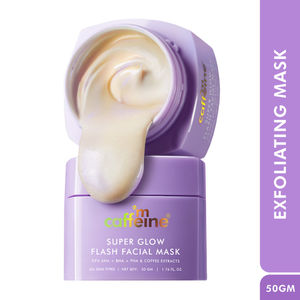
mCaffeine Super Glow Flash Facial 25% AHA+BHA+PHA Mask | Brighter Skin in 5 Mins | Gentle Exfoliates to Unclog Pores & Removes Dead Skin - 50 gm

mCaffeine Super Glow Flash Facial 25% AHA+BHA+PHA Mask | Brighter Skin in 5 Mins | Gentle Exfoliates to Unclog Pores & Removes Dead Skin - 50 gm
N.G. Electro Products Pvt. Ltd
mcaffeine-super-glow-flash-facial-25-aha-bha-pha-mask-brighter-skin-in-5-mins-gentle-exfoliates-to-unclog-pores-removes-dead-skin-50-gm
Face Mask
10085055267109
Morning or Evening?
How often will you use this product?
Notes


Highlights
WHAT IS IT?
Face Mask with 25% AHA, BHA, PHA
FEATURES
Facial Glow in 5 Mins, 25% AHA BHA PHA, Gently exfoliates, Brightens skin, Removes dead skin cells, Clears clogged pores, Soothes and calms skin with 20% Aloe Extract, Hyaluronic Acid, Coffee Extracts, Color changing to holographic shade during application
BEST FOR
oily
CHECKS
Paraben, SLS, Toxic ingredients
Who Is It For?
Both Women And Men No Specific Age Range MentionedWhat Does It Help With?
Open Pores Rough Skin Minimizes Pores Brightens And Smoothes SkinBudget
Affordable (under $30)How To Use
Which routine should it be used in?
Instructions:
Key Information


What N.G. Electro Products Pvt. Ltd Says
Product Description:
A powerful at-home face mask for facial like glow in JUST 5 Minutes! Packed with 25% AHA, BHA & PHA, it gently exfoliates and improves skin texture to reveal brighter, smoother and glowing skin in a flash. The color changing mask transforms to a holographic shade upon application. 20% Aloe Extract soothes, calms skin and prevents irritation. Formulated with 25% AHA (Glycolic Acid, Lactic Acid), BHA (Salicylic Acid) & PHA (Gluconolactone) it gently exfoliates skin to brighten and give an instant glow. It exfoliates the surface of the skin to remove dead skin cells, clear clogged pores and remove excess oil, revealing smoother and softer skin in a flash. The blend of 20% Aloe Extract, Hyaluronic Acid & Coffee extracts prevent skin irritation by soothing, calming and keeping the skin hydrated. Consumer Study Results: 98% users saw visibly brighter skin instantly, 97% users noticed soft, glowing, and dewy skin in one use, 92% users observed instant and lasting radiance, 90% agreed it exfoliates gunk and dead cells. It is PETA Certified, and free from Paraben, SLS, and all other toxic ingredients. FDA-approved and dermatologically tested.
About the Brand:
Ingredients Overview
Ingredients List
glycolic-acid,lactic-acid,salicylic-acid,gluconolactone,aloe-extract,hyaluronic-acid,coffee-extract
Key Ingredients
Glycolic Acid, Lactic Acid, Salicylic Acid, Gluconolactone, Aloe Extract, Hyaluronic Acid, Coffee Extracts
Ingredients Details
Gluconolactone
Common Name(s): D-gluconolactone,delta-gluconolactone
CAS Number: 90-80-2
DESCRIPTION
What It Does: Provides the gentlest chemical exfoliation with simultaneous antioxidant, moisture retention, and barrier support.
Why It's Used: Preferred exfoliant for rosacea, eczema, sensitive skin, and post-procedure recovery where standard ahas cause unacceptable irritation.
How It Works: Hydrolyzes slowly on skin surface to gluconic acid providing gentle exfoliation. multiple hydroxyl groups enable water binding (humectant) and metal chelation (antioxidant).
Typically Found In: Sensitive skin exfoliants,rosacea treatments,eczema care,post-procedure recovery
TECHNICAL DETAILS
Primary Category: Active ingredient – polyhydroxy acid (pha)
Secondary Functions: Gentle exfoliation,antioxidant,humectant
Application Areas:

Facial Skincare

Body Care
Hair Care
Beard Care
Color Cosmetics (Makeup)
Dietary/Oral Supplements
Typical Concentration Range: 5%–15%
SOURCING & ETHICS
Vegan Status: Conditional - supplier confirmation required
Halal Status: Unverified - supplier confirmation required
Source Notes: Fermentation-derived from glucose or synthetic. among the safest chemical exfoliants available. [audit 2026-07-29 rev2: status downgraded on audit. determination requires shariah-panel sign-off.]
SKIN COMPATIBILITY
Irritancy Rating: 1/5 – very low
Comedogenicity Rating: 0/5 – non-comedogenic
Sensitivity Concerns: No photosensitization; no stinging; suitable for very sensitive skin.
Safe for Sensitive Skin: Yes – ideal for sensitive, reactive, rosacea, and eczema-prone skin; no photosensitization
SAFETY & COMPATIBILITY
Safety Profile: Exceptional safety profile. no photosensitization. ewg score: 1.
Works Well With: Ceramides,niacinamide,hyaluronic acid,soothing actives
Avoid Combining With: No significant incompatibilities
SCIENTIFIC NOTE
Phas have molecular weights 2–3× larger than ahas, limiting penetration to superficial layers. combined humectant and antioxidant properties make them uniquely well-tolerated while providing meaningful exfoliation.
Last Verified: 2026-03-12
Primary Sources: Cosing database,green & yu (2003) pha review,cir safety assessment