

HUL Puducherruy
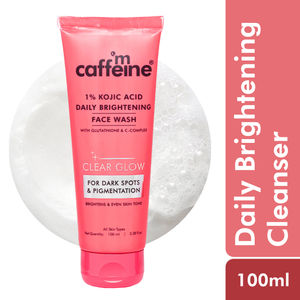
mCaffeine CLEAR GLOW 1% Kojic Acid Daily Brightening Face Wash with Glutathione For Dark Spots & Pigmentation | Brightens Skin, Evens Skin Tone | For Men & Women | Non-Drying, Fragrance Free - 100 ml

mCaffeine CLEAR GLOW 1% Kojic Acid Daily Brightening Face Wash with Glutathione For Dark Spots & Pigmentation | Brightens Skin, Evens Skin Tone | For Men & Women | Non-Drying, Fragrance Free - 100 ml
HUL Puducherruy
mcaffeine-clear-glow-1-kojic-acid-daily-brightening-face-wash-with-glutathione-for-dark-spots-pigmentation-brightens-skin-evens-skin-tone-for-men-women-non-drying-fragrance-free-100-ml
Cleanse
10084990255397
Morning or Evening?
How often will you use this product?
Notes


Highlights
WHAT IS IT?
Face Wash with 2 active ingredients
FEATURES
Cleanses and brightens skin, reduces dark spots and pigmentation, evens skin tone, creamy texture, non-drying, fragrance-free, powered with antioxidant-rich Caffeine and Ceramides, repairs UV damage, suitable for all skin types, PETA certified, free from parabens, SLS and toxic ingredients, FDA-approved, dermatologically tested, zero plastic footprint
BEST FOR
dry
CHECKS
No Paraben, No SLS, No artificial colours, No artificial fragrances, No toxins
Who Is It For?
Men & Women All Skin Types Including Dry SkinWhat Does It Help With?
Uneven Skin Tone Dark Spots Pigmentation Uv Sun DamageBudget
Affordable (under $30)How To Use
Which routine should it be used in?
Instructions:
Key Information


What HUL Puducherruy Says
Product Description:
CLEAR GLOW 1 Kojic Acid Daily Brightening Face Wash cleanses & brightens skin, reduces dark spots & pigmentation, evens skin tone. Made with 1% Kojic Acid and Glutathione which helps in fading dark spots and pigmentation while leaving skin hydrated and glowing. Creamy texture gently cleanses without drying. Powered with C-Complex (antioxidant-rich Caffeine and Ceramides) to repair UV damage. Non-drying, fragrance-free, suitable for all skin types. PETA certified, free from Paraben, SLS, and other toxic ingredients. FDA-approved, dermatologically tested, zero plastic footprint.
About the Brand:
Ingredients Overview
Ingredients List
1% Kojic Acid, Glutathione, Caffeine, Ceramides
Key Ingredients
Kojic Acid, Glutathione, Caffeine, Ceramides
Ingredients Details
Caffeine
Common Name(s): Caffeine,methylxanthine anti-cellulite,antioxidant vasoactive
CAS Number: N/a
DESCRIPTION
What It Does: Stimulates lipolysis in adipocytes by inhibiting phosphodiesterase (preventing camp breakdown), reduces eye puffiness through vasoconstriction of periorbital capillaries, and provides antioxidant dna repair stimulation for photoprotective benefit.
Why It's Used: The only cosmetic active with a well-defined mechanism for anti-cellulite claims — phosphodiesterase inhibition elevating adipocyte camp is the documented biochemical pathway, providing mechanism-based efficacy substantiation superior to most slimming actives.
How It Works: Caffeine inhibits phosphodiesterase (pde3, pde4) preventing camp hydrolysis → elevated camp activates protein kinase a → phosphorylates hormone-sensitive lipase → lipolysis of triglycerides in adipocytes. for eye puffiness: caffeine's adenosine receptor antagonism reduces prostaglandin-mediated capillary dilation in periorbital tissue, reducing fluid accumulation.
Typically Found In: Anti-cellulite,eye creams,antioxidant products
TECHNICAL DETAILS
Primary Category: Active ingredient – antioxidant
Secondary Functions: Free radical scavenging,anti-aging
Application Areas:

Facial Skincare
Body Care

Hair Care
Beard Care
Color Cosmetics (Makeup)
Dietary/Oral Supplements
Typical Concentration Range: 0.1%–3%
SOURCING & ETHICS
Vegan Status: Conditional - supplier confirmation required
Halal Status: Unverified - supplier confirmation required
Source Notes: Plant-derived extract or synthetic. [audit 2026-07-29 rev2: status downgraded on audit. determination requires shariah-panel sign-off.]
SKIN COMPATIBILITY
Irritancy Rating: 1/5 – very low
Comedogenicity Rating: 0/5 – non-comedogenic
Sensitivity Concerns: Non-irritating; well-tolerated.
Safe for Sensitive Skin: Yes
SAFETY & COMPATIBILITY
Safety Profile: Excellent safety profile. ewg score: 1.
Works Well With: Vitamin c,vitamin e,ferulic acid,spf,other antioxidants
Avoid Combining With: No significant incompatibilities
SCIENTIFIC NOTE
Caffeine has one of the highest sc penetration rates of any cosmetic active (logp -0.07, mw 194 da) — the combination of small size and moderate logp providing excellent aqueous solubility with sufficient sc lipid partitioning for effective transdermal delivery to adipose tissue.
Last Verified: 2026-03-12
Primary Sources: Cosing database,caffeine pde inhibitor anti-cellulite lipolysis review
Ceramides
Common Name(s): Ceramides,ceramide sphingolipid,sc barrier lipid
CAS Number: N/a
DESCRIPTION
What It Does: Restores sc lamellar lipid bilayers, reduces trans-epidermal water loss, repairs barrier dysfunction in dry and eczematous skin, and strengthens the physical barrier against environmental irritants.
Why It's Used: Provides direct structural barrier lipid replacement — unlike humectants that attract water, ceramides physically rebuild the lipid bilayer architecture required to retain moisture within the skin.
How It Works: Ceramides integrate into the sc intercellular lamellar bilayer, restoring the ordered orthorhombic packing disrupted in barrier-compromised skin. the sphingosine backbone's amide bond and hydroxyl groups form the h-bonding network that stabilises the lamellar structure.
Typically Found In: Barrier repair,dry skin,eczema-prone
TECHNICAL DETAILS
Primary Category: Functional ingredient – emollient
Secondary Functions: Barrier sealing,softening
Application Areas:
Facial Skincare
Body Care
Hair Care
Beard Care
Color Cosmetics (Makeup)
Dietary/Oral Supplements
Typical Concentration Range: 0.01%–5%
SOURCING & ETHICS
Vegan Status: Conditional - feedstock declaration required
Halal Status: Unverified - feedstock declaration required (plant, animal and petrochemical routes all exist)
Source Notes: Plant-derived, synthetic or animal-derived. verify source. [audit 2026-07-29 rev2: origin-dependent: the same inci exists in plant, animal and petrochemical versions and the name does not discriminate. determination requires shariah-panel sign-off.]
SKIN COMPATIBILITY
Irritancy Rating: 1/5 – very low
Comedogenicity Rating: 1/5 – low; formulation-dependent
Sensitivity Concerns: Non-irritating.
Safe for Sensitive Skin: Yes
SAFETY & COMPATIBILITY
Safety Profile: Excellent safety profile. ewg score: 1.
Works Well With: Humectants,ceramides,actives as carrier
Avoid Combining With: No significant incompatibilities
SCIENTIFIC NOTE
Sc ceramides comprise ~50% of the sc lipid mass (by weight) and are essential for barrier function; ceramide depletion in atopic dermatitis and aged skin is a primary driver of barrier dysfunction and tewl elevation.
Last Verified: 2026-03-12
Primary Sources: Cosing database,ceramides ceramide barrier review
Glutathione
Common Name(s): Gsh,gamma-l-glutamyl-l-cysteinyl-glycine,reduced glutathione
CAS Number: 70-18-8
DESCRIPTION
What It Does: Provides the body's primary antioxidant defense while reducing melanin production for brightening.
Why It's Used: Master antioxidant for comprehensive oxidative stress protection alongside unique melanin-shifting brightening action (pheomelanin preference).
How It Works: Three-amino acid tripeptide (gamma-glu-cys-gly). thiol group (-sh) provides electron donation for antioxidant activity and detoxification conjugation. shifts melanin synthesis from eumelanin (dark brown) toward pheomelanin (light yellow-red) for brightening. regenerates vitamins c and e from their oxidized forms.
Typically Found In: Brightening serums,antioxidant serums,anti-aging products
TECHNICAL DETAILS
Primary Category: Active ingredient – master cellular antioxidant
Secondary Functions: Melanin shifting brightening,vitamins c+e regeneration,master antioxidant
Application Areas:
Facial Skincare
Body Care
Hair Care
Beard Care
Color Cosmetics (Makeup)
Dietary/Oral Supplements
Typical Concentration Range: 0.1%–5%
SOURCING & ETHICS
Vegan Status: Conditional - supplier confirmation required
Halal Status: Unverified - supplier confirmation required
Source Notes: Produced by yeast fermentation or chemical synthesis. stability challenge – use encapsulated or stabilized forms. [audit 2026-07-29 rev2: status downgraded on audit. determination requires shariah-panel sign-off.]
SKIN COMPATIBILITY
Irritancy Rating: 1/5 – very low
Comedogenicity Rating: 0/5 – non-comedogenic
Sensitivity Concerns: Well-tolerated; some reports of tingling at high concentrations.
Safe for Sensitive Skin: Yes
SAFETY & COMPATIBILITY
Safety Profile: Excellent safety profile. ewg score: 1.
Works Well With: Vitamin c,vitamin e,ferulic acid,spf,other antioxidants
Avoid Combining With: No significant incompatibilities
SCIENTIFIC NOTE
Glutathione's melanin-shifting mechanism (eumelanin→pheomelanin) is entirely different from tyrosinase inhibition. even in the presence of active tyrosinase, glutathione shifts the enzymatic product from dark eumelanin to lighter pheomelanin by chelating copper from the tyrosinase active site and competing for dopa substrate.
Last Verified: 2026-03-12
Primary Sources: Cosing database,villarama & maibach glutathione brightening review,cir safety assessment
Kojic Acid
Common Name(s): 5-hydroxy-2-(hydroxymethyl)-4-pyranone,koji acid
CAS Number: 501-30-4
DESCRIPTION
What It Does: Provides potent copper-chelating tyrosinase inhibition for effective hyperpigmentation treatment.
Why It's Used: One of the most effective brightening agents — kojic acid's copper chelation directly blocks the tyrosinase active site providing stronger brightening than most naturally-derived alternatives.
How It Works: Chelates copper in the tyrosinase active site via the 3-hydroxy-4-pyranone chelating group (ic50 ~5μg/ml). without copper cofactor, tyrosinase cannot oxidise tyrosine to dopa or dopa to dopaquinone. inhibits both hydroxylation steps in eumelanin synthesis pathway.
Typically Found In: Brightening serums,hyperpigmentation treatments,anti-spot products
TECHNICAL DETAILS
Primary Category: Active ingredient – fungal brightening agent
Secondary Functions: Melanin inhibition,hyperpigmentation reduction
Application Areas:
Facial Skincare
Body Care
Hair Care
Beard Care
Color Cosmetics (Makeup)
Dietary/Oral Supplements
Typical Concentration Range: 0.5%–2%
SOURCING & ETHICS
Vegan Status: Yes – from aspergillus oryzae or acetobacter fermentation
Halal Status: Yes
Source Notes: Synthetic or plant-derived.
SKIN COMPATIBILITY
Irritancy Rating: 1/5 – very low
Comedogenicity Rating: 0/5 – non-comedogenic
Sensitivity Concerns: Non-irritating; well-tolerated.
Safe for Sensitive Skin: Yes
SAFETY & COMPATIBILITY
Safety Profile: Eu annex iii regulated: max 1% in face products. sensitiser potential — patch test for sensitive skin. photosensitive in formulation — requires stabilisation.
Works Well With: Niacinamide,vitamin c,alpha-arbutin,tranexamic acid,spf
Avoid Combining With: No significant incompatibilities
SCIENTIFIC NOTE
Kojic acid's copper chelation mechanism provides an unusually direct enzyme inhibition: rather than competing with tyrosine substrate (competitive inhibitor) or altering enzyme conformation (allosteric inhibitor), kojic acid simply removes the copper cofactor that is essential for tyrosinase catalytic activity — a metal-chelation mechanism that provides near-complete enzyme inhibition regardless of substrate concentration.
Last Verified: ##########
Primary Sources: Cosing database,eu annex iii,cir safety assessment