

Mario Badescu
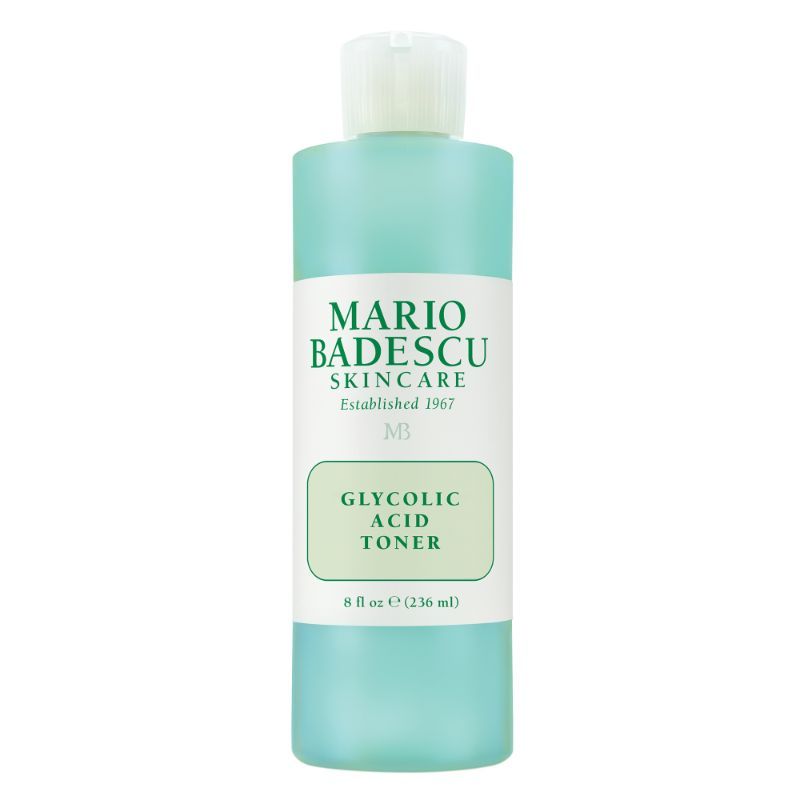
Mario Badescu Glycolic Acid Toner

Mario Badescu Glycolic Acid Toner
Mario Badescu
mario-badescu-glycolic-acid-toner
Tone
10084967317797
Morning or Evening?
How often will you use this product?
Notes


Highlights
WHAT IS IT?
Toner with multiple key ingredients
FEATURES
Gentle exfoliating toner, contains glycolic acid, grapefruit and aloe vera extracts, diminishes dry fine lines and wrinkles, refines pores, suitable for normal, combination and dry skin, vegan and cruelty-free, alcohol-free
BEST FOR
normal
CHECKS
Alcohol-free
Who Is It For?
All Genders No Specific Age Range StatedWhat Does It Help With?
Uneven Skin Tone Dullness Uneven Texture PoresBudget
Premium ($76-$150)How To Use
Which routine should it be used in?
Instructions:
Key Information


What Mario Badescu Says
Product Description:
Glycolic acid, grapefruit, and aloe combine in a rejuvenating formula which works to refine pores and diminish the appearance of dry fine lines, wrinkles, and uneven skin tone-revealing a more radiant and youthful looking complexion. Mario Badescu Glycolic Acid Toner is a mild resurfacing toner that helps brighten and balance skin post-cleanse.
About the Brand:
Ingredients Overview
Ingredients List
Aqua-(Water,-Eau),Aloe-Barbadensis-Leaf-Juice,Propylene-Glycol,Glycolic-Acid,Triethanolamine,Polysorbate-20,Citrus-Grandis-(Grapefruit)-Fruit-Extract,Diazolidinyl-Urea,Benzophenone-4,Methylparaben,Parfum-(Fragrance),PEG-8,Trimethoxybenzylidene-Pentanedione,Hydroxyacetophenone,Propylparaben,Sodium-Benzoate,Citric-Acid,Potassium-Sorbate,Sodium-Chloride,Linalool,Hexyl-Cinnamal,Benzyl-Alcohol,Limonene,Citronellol,Geraniol,CI-42090-(Blue-1),CI-45410-(Red-28),CI-19140-(Yellow-5)
Key Ingredients
Glycolic acid, grapefruit extract, aloe vera extract
Ingredients Details
Benzophenone-4
Common Name(s): Benzophenone-4
DESCRIPTION
What It Does: Absorbs or reflects uv radiation, preventing uv-induced dna damage, photo-oxidative stress, and premature skin aging.
Why It's Used: Uv filters are the active ingredients in sun protection — without them, formulations cannot make spf claims or prevent solar-induced skin damage.
How It Works: The uv-absorbing chromophore undergoes photoexcitation by uv photons, then dissipates the absorbed energy through thermal relaxation (chemical filters) or photon scattering/reflection (physical filters), preventing photon penetration to skin cells.
Typically Found In: Sunscreens,moisturizers with spf,foundations with spf
TECHNICAL DETAILS
Primary Category: Uv filters
Secondary Functions: Skin-protecting
Application Areas:

Facial Skincare

Body Care
Hair Care
Beard Care
Color Cosmetics (Makeup)
Dietary/Oral Supplements
Typical Concentration Range: 0.5–25% (within regulatory limits)
SOURCING & ETHICS
Vegan Status: Yes
Halal Status: Yes
Source Notes: Synthetic uv filter; no animal components.
SKIN COMPATIBILITY
Irritancy Rating: 1
Comedogenicity Rating: 0
Sensitivity Concerns: Contact allergy to uv filters occurs in approximately 1–3% of the general population; patch testing recommended for those with known photosensitivity.
Safe for Sensitive Skin: Yes
SAFETY & COMPATIBILITY
Safety Profile: Regulatory approval required per market (eu annex vi, fda otc monograph, etc.). generally non-irritating at approved concentrations.
Works Well With: Other uv filters,antioxidants,emollients
Avoid Combining With: Incompatible filter combinations (photodegradation); check regulatory approvals per region
SCIENTIFIC NOTE
Uv filters operate through two mechanisms: organic/chemical filters absorb uv photons through electronic excitation (π→π* transitions in conjugated systems), then dissipate energy via thermal relaxation; inorganic/physical filters (tio2, zno) scatter and reflect photons through mie scattering (particle size 50–300 nm) and band gap absorption. spf is measured in vivo (iso 24444) as the ratio of minimal erythema doses with and without sunscreen.
Last Verified: Cosing eu database; pcpc cosmetic ingredient safety reviews; eu cosmetics regulation annex vi; iso 24444 (in vivo spf testing)
Primary Sources: 2025-01-15
Citronellol
Common Name(s): (r)-3,7-dimethyl-6-octen-1-ol,rhodinol
CAS Number: 106-22-9
DESCRIPTION
What It Does: Provides soft, lasting rose-floral fragrance note.
Why It's Used: Essential rose fragrance monoterpene for lasting smooth floral notes in high-quality perfumery and cosmetic fragrances.
How It Works: Allylic alcohol monoterpene provides fixative property in fragrance blends. good skin substantivity for lasting scent. softer, rounder rose note vs geraniol's fresher character. natural in rose otto at 18-34%.
Typically Found In: Rose perfumes,floral fragrances,luxury skincare
TECHNICAL DETAILS
Primary Category: Fragrance component – monoterpene alcohol
Secondary Functions: Skin conditioning
Application Areas:
Facial Skincare
Body Care
Hair Care
Beard Care
Color Cosmetics (Makeup)
Dietary/Oral Supplements
Typical Concentration Range: 0.001%–1%
SOURCING & ETHICS
Vegan Status: Yes – from rose, geranium, citronella oils
Halal Status: Yes
Source Notes: Commercially produced for cosmetic use. verify vegan/halal status with supplier.
SKIN COMPATIBILITY
Irritancy Rating: 1/5 – very low
Comedogenicity Rating: 0/5 – non-comedogenic
Sensitivity Concerns: Well-tolerated by most skin types.
Safe for Sensitive Skin: Yes
SAFETY & COMPATIBILITY
Safety Profile: Eu cosmetics regulation: declared fragrance allergen. ifra guidelines apply.
Works Well With: Standard skincare actives
Avoid Combining With: No known significant incompatibilities
SCIENTIFIC NOTE
Citronellol's r-enantiomer (natural) vs s-enantiomer (synthetic) provide meaningfully different scent character – a remarkable demonstration of chiral scent discrimination by olfactory receptors. the (r) form provides the characteristic rose note while the (s) form has a distinctly different, less pleasant character. this enantiomeric scent difference means that the biological handedness of naturally-sourced vs racemic synthetic citronellol produces perceptibly different fragrance quality.
Last Verified: Cosing database,ifra standards
Primary Sources: 2026-03-12
Geraniol
Common Name(s): (e)-3,7-dimethyl-2,6-octadien-1-ol,geranyl alcohol
CAS Number: 106-24-1
DESCRIPTION
What It Does: Provides fresh rose-geranium floral scent with antimicrobial activity.
Why It's Used: The rose fragrance terpene – geraniol defines the fresh, sweet rose-geranium note found in more than 60 essential oils and is essential for recreating natural floral fragrance profiles.
How It Works: Monoterpene alcohol inhibits bacterial membrane integrity for antimicrobial activity. activates trpv1 for anti-nociception. inhibits nf-kb for anti-inflammatory activity. antioxidant via allylic radical scavenging.
Typically Found In: Rose-scented products,floral fragrances,natural cosmetics
TECHNICAL DETAILS
Primary Category: Fragrance component – acyclic monoterpene alcohol
Secondary Functions: Skin conditioning
Application Areas:
Facial Skincare
Body Care
Hair Care
Beard Care
Color Cosmetics (Makeup)
Dietary/Oral Supplements
Typical Concentration Range: 0.001%–1%
SOURCING & ETHICS
Vegan Status: Yes – from rose, geranium, palmarosa oils
Halal Status: Yes
Source Notes: Commercially produced for cosmetic use. verify vegan/halal status with supplier.
SKIN COMPATIBILITY
Irritancy Rating: 1/5 – very low
Comedogenicity Rating: 0/5 – non-comedogenic
Sensitivity Concerns: Well-tolerated by most skin types.
Safe for Sensitive Skin: Yes
SAFETY & COMPATIBILITY
Safety Profile: Eu cosmetics regulation: declared fragrance allergen. ifra guidelines apply.
Works Well With: Standard skincare actives
Avoid Combining With: No known significant incompatibilities
SCIENTIFIC NOTE
Geraniol's isomers (geraniol, nerol, citronellol) provide subtly different scent characters despite identical molecular formulae (c10h18o): geraniol provides the sweet, fresh rose note while its z-isomer nerol has a more delicate, neroli-like character. these isomeric scent differences arise from different spatial presentation of the hydroxyl and double bond groups to the olfactory receptor – demonstrating the extraordinary structural sensitivity of olfactory perception.
Last Verified: Cosing database,ifra standards
Primary Sources: 2026-03-12
Hydroxyacetophenone
Common Name(s): Para-hydroxyacetophenone,piceol,4-acetylphenol
CAS Number: 99-93-4
DESCRIPTION
What It Does: Provides antioxidant and preservative-boosting activity in a naturally-occurring clean-label phenolic.
Why It's Used: Clean-label preservation support — hydroxyacetophenone provides antioxidant and antimicrobial-boosting properties from a naturally-occurring compound accepted in natural cosmetic certifications.
How It Works: Para-hydroxyl group provides antioxidant radical scavenging. disrupts bacterial cell membrane penetration for preservative system boosting. anti-inflammatory via nf-kb inhibition. occurs naturally in plants including pear and raspberry as a secondary metabolite.
Typically Found In: Natural preservation systems,antioxidant serums,clean beauty
TECHNICAL DETAILS
Primary Category: Functional ingredient – antioxidant preservative booster
Secondary Functions: Free radical scavenging,anti-aging
Application Areas:
Facial Skincare
Body Care
Hair Care
Beard Care
Color Cosmetics (Makeup)
Dietary/Oral Supplements
Typical Concentration Range: 0.1%–1%
SOURCING & ETHICS
Vegan Status: Yes – natural from plants or synthetic
Halal Status: Yes
Source Notes: Plant-derived extract or synthetic.
SKIN COMPATIBILITY
Irritancy Rating: 1/5 – very low
Comedogenicity Rating: 0/5 – non-comedogenic
Sensitivity Concerns: Non-irritating; well-tolerated.
Safe for Sensitive Skin: Yes
SAFETY & COMPATIBILITY
Safety Profile: Excellent safety profile. ewg score: 1.
Works Well With: Vitamin c,vitamin e,ferulic acid,spf,other antioxidants
Avoid Combining With: No significant incompatibilities
SCIENTIFIC NOTE
Hydroxyacetophenone's natural occurrence in fruits (pear, raspberry, passion fruit) at detectable concentrations provides clean-label justification for use in natural cosmetics. its cosmos certification acceptance reflects the growing demand for functional preservation ingredients that meet natural certification criteria — an ingredient with genuine plant-origin credentials that provides meaningful antimicrobial and antioxidant functions simultaneously.
Last Verified: Cosing database,cosmos-standard approved ingredients,cir safety assessment
Primary Sources: 2026-03-12
