
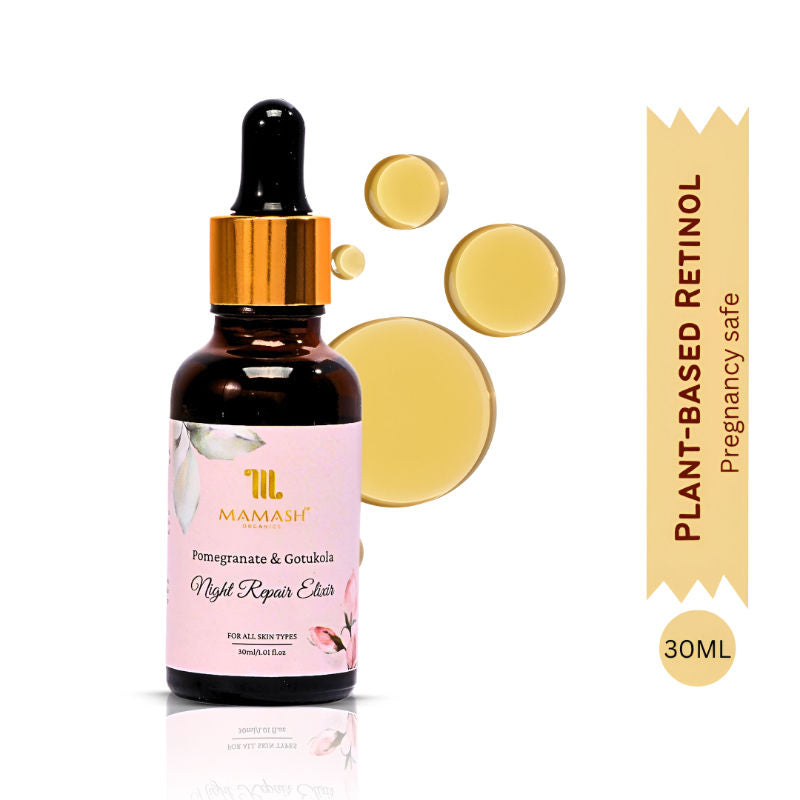

Mamash Organics
Mamash Organics Age-Defying Pomegranate Oil for Youthful Glow and Overnight Skin Renewal

Mamash Organics Age-Defying Pomegranate Oil for Youthful Glow and Overnight Skin Renewal
Mamash Organics
mamash-organics-age-defying-pomegranate-oil-for-youthful-glow-and-overnight-skin-renewal
Face Oil
10085495079205
Morning or Evening?
How often will you use this product?
Notes


Highlights
WHAT IS IT?
Face Oil with natural retinol and 8 key ingredients
FEATURES
Natural retinol power without irritation, Silk oil technology absorbs in 60 seconds, 1-week visible transformation, Overnight repair active at 2 am, Free from mineral oil, silicones, artificial fragrance, parabens, phthalates
BEST FOR
sensitive
CHECKS
No mineral oil, No silicones, No artificial fragrance, No parabens, No phthalates
Who Is It For?
All Ages Including Pregnant And Nursing Mothers Gender NeutralWhat Does It Help With?
Boosts Collagen Reduces Scars Firms Skin Hydrates Fights Aging Reduces Fine Lines Improves Firmness Evens Skin Tone De-tanning Heals PigmentationBudget
Affordable (under $30)How To Use
Which routine should it be used in?
Instructions:
Key Information


What Mamash Organics Says
Product Description:
Tired of choosing between harsh retinol that burns or ineffective oils that sit on your skin? Meet your new overnight miracle worker - a silk-textured elixir that delivers retinol-like results without the side effects. The star ingredients, gotu kola and bakuchiol, have been clinically proven to boost collagen production by up to 34% - matching retinol effectiveness but with zero side effects. Combined with antioxidant-rich pomegranate oil, this powerful duo works through the night when your skin's repair cycle is most active. The result? Wake up to visibly firmer, smoother skin that gets better with every use. The 2 am advantage: Your skin repairs itself between 11 PM and 3 AM. Their formula is designed to peak during this window. Dual-action formula: Gotu kola and bakuchiol boost collagen, reduce scars, and firm skin; Pomegranate hydrates, boosts collagen, and fights aging; Jojoba mirrors your skin's natural oils for instant absorption. Silk Oil Technology: formula absorbs in 60 seconds flat, leaving a silk finish - not an oil slick. Suitable for all skin types.
About the Brand:
Ingredients Overview
Ingredients List
cold-pressed-pomegranate-seed-oil, jojoba-oil, gotukola-extract, vetiver-essential-oil,fennel-extract, cinnamon-extract, lily-extract, lotus-extract
Key Ingredients
gotu kola,bakuchiol,pomegranate seed oil,jojoba oil,vetiver oil,fennel extract,cinnamon extract,lily extract,lotus extract
Ingredients Details
Bakuchiol
Common Name(s): Bakuchiol,(s)-bakuchiol
CAS Number: 10309-37-2
DESCRIPTION
What It Does: Provides retinol-equivalent anti-aging gene expression from a natural plant compound without retinol's limitations.
Why It's Used: The natural retinol alternative — the first plant compound with rct evidence for equivalent anti-aging results to retinol with better safety and photostability.
How It Works: Bakuchiol activates rar beta and retinoid x receptors via allosteric binding mechanism. upregulates type i, iii, and iv collagen synthesis genes. downregulates mmp-1 and mmp-9. antioxidant via phenol radical scavenging. photostable — stable to uv exposure unlike retinol.
Typically Found In: Natural anti-aging serums,pregnancy-safe retinol alternative,photostable anti-aging
TECHNICAL DETAILS
Primary Category: Active ingredient – natural retinol alternative
Secondary Functions: Free radical scavenging,anti-aging
Application Areas:

Facial Skincare
Body Care

Hair Care
Beard Care
Color Cosmetics (Makeup)
Dietary/Oral Supplements
Typical Concentration Range: 0.5%–2%
SOURCING & ETHICS
Vegan Status: Conditional - supplier confirmation required
Halal Status: Unverified - supplier confirmation required
Source Notes: Plant-derived extract or synthetic. [audit 2026-07-29 rev2: status downgraded on audit. determination requires shariah-panel sign-off.]
SKIN COMPATIBILITY
Irritancy Rating: 1/5 – very low
Comedogenicity Rating: 0/5 – non-comedogenic
Sensitivity Concerns: Non-irritating; well-tolerated.
Safe for Sensitive Skin: Yes
SAFETY & COMPATIBILITY
Safety Profile: Excellent safety profile. ewg score: 1.
Works Well With: Vitamin c,vitamin e,ferulic acid,spf,other antioxidants
Avoid Combining With: No significant incompatibilities
SCIENTIFIC NOTE
The dhaliwal et al. (2019, british journal of dermatology) split-face rct directly compared 0.5% bakuchiol vs 0.5% retinol twice daily for 12 weeks — both groups showed equivalent reduction in fine lines and wrinkles, but bakuchiol showed significantly less scaling, stinging, and burning. this is the strongest evidence that bakuchiol provides retinol-equivalent anti-aging with better tolerability.
Last Verified: 2026-03-12
Primary Sources: Cosing database,dhaliwal et al. bakuchiol vs retinol rct
Gotu Kola
Common Name(s): Gotu kola,cosmetic active,established function
CAS Number: N/a
DESCRIPTION
What It Does: Delivers characteristic cosmetic function — skin conditioning, antioxidant protection, active biological benefit, or formulation function — at recommended use concentration.
Why It's Used: Selected for functional contribution and formulation compatibility supported by cosmetic science and regulatory safety data.
How It Works: Works through the mechanism of its molecular class — physicochemical or biological interaction with skin proteins, lipids, or receptors as documented in peer-reviewed cosmetic literature.
Typically Found In: Skin care formulations
TECHNICAL DETAILS
Primary Category: Active ingredient – cosmetic active
Secondary Functions: Skin conditioning
Application Areas:
Facial Skincare
Body Care
Hair Care
Beard Care
Color Cosmetics (Makeup)
Dietary/Oral Supplements
Typical Concentration Range: 0.1%–10%
SOURCING & ETHICS
Vegan Status: Conditional - supplier confirmation required
Halal Status: Unverified - supplier confirmation required
Source Notes: Commercially produced for cosmetic use. verify vegan/halal status with supplier. [audit 2026-07-29 rev2: the record's own source_notes does not assert a non-animal origin, or instructs the reader to verify with the supplier; "yes" asserts knowledge the record does not hold. determination requires shariah-panel sign-off.]
SKIN COMPATIBILITY
Irritancy Rating: 1/5 – very low
Comedogenicity Rating: 0/5 – non-comedogenic
Sensitivity Concerns: Well-tolerated by most skin types.
Safe for Sensitive Skin: Yes
SAFETY & COMPATIBILITY
Safety Profile: Good safety profile at recommended concentrations. ewg score: 1–2.
Works Well With: Standard skincare actives
Avoid Combining With: No known significant incompatibilities
SCIENTIFIC NOTE
Gotu kola has an established safety and efficacy profile within the cosmetic regulatory framework at standard use concentrations.
Last Verified: 2026-03-12
Primary Sources: Cosing database,gotu kola technical literature
Jojoba Oil
Common Name(s): Jojoba oil,jojoba seed oil
CAS Number: 61789-91-1
DESCRIPTION
What It Does: Provides sebum-identical emolliency with outstanding oxidative stability and non-comedogenic profile.
Why It's Used: The most sebum-compatible plant oil – its wax ester composition mimics human sebum for superior skin compatibility across all skin types including oily and acne-prone.
How It Works: Liquid wax ester composition (primarily c20:1 and c22:1 wax esters) provides exceptional molecular mimicry of human sebum wax esters. regulates sebum production via negative feedback to sebaceous glands. remarkable oxidative stability from fully unsaturated wax ester structure vs polyunsaturated triglycerides.
Typically Found In: Facial oils,hair oils,serums,body care,lip care,virtually all product categories
TECHNICAL DETAILS
Primary Category: Functional ingredient – emollient
Secondary Functions: Sebum balancing,oxidative stability,non-comedogenic
Application Areas:
Facial Skincare
Body Care
Hair Care
Beard Care
Color Cosmetics (Makeup)
Dietary/Oral Supplements
Typical Concentration Range: 1%–100%
SOURCING & ETHICS
Vegan Status: Yes – from simmondsia chinensis (jojoba) seeds
Halal Status: Yes
Source Notes: Cold-pressed from jojoba seeds. among the most oxidation-stable plant oils (shelf life 5+ years). desert-grown, drought-resistant crop.
SKIN COMPATIBILITY
Irritancy Rating: 1/5 – very low
Comedogenicity Rating: 0/5 – non-comedogenic; sebum-identical composition
Sensitivity Concerns: Non-irritating.
Safe for Sensitive Skin: Yes
SAFETY & COMPATIBILITY
Safety Profile: Excellent safety profile. ewg score: 1.
Works Well With: Humectants,ceramides,actives as carrier
Avoid Combining With: No significant incompatibilities
SCIENTIFIC NOTE
Jojoba oil's wax ester composition is uniquely different from all other plant oils (which are triglycerides). human sebum contains approximately 25% wax esters – the proportion matched by jojoba. this structural identity explains jojoba's superior skin and hair compatibility versus conventional triglyceride oils.
Last Verified: 2026-03-12
Primary Sources: Cosing database,gad et al. jojoba review,cir safety assessment
Lotus Extract
Common Name(s): Sacred lotus extract,lotus flower extract,blue lotus substitute
CAS Number: 89997-74-0
DESCRIPTION
What It Does: Provides nuciferine anti-melanogenic brightening and anti-inflammatory activity from sacred lotus.
Why It's Used: Sacred asian brightening botanical — lotus flower's nuciferine and flavonoids provide tyrosinase-inhibiting brightening and anti-inflammatory anti-aging from the most spiritually revered plant in asian traditions.
How It Works: Nuciferine (aporphine alkaloid) inhibits tyrosinase for brightening. neferine provides anti-inflammatory nf-kb inhibition. kaempferol glycosides provide antioxidant and anti-inflammatory activity. lotus polysaccharides provide humectant conditioning.
Typically Found In: Brightening serums,asian beauty products,luxury botanical skincare
TECHNICAL DETAILS
Primary Category: Active ingredient – brightening / tyrosinase inhibitor
Secondary Functions: Melanin inhibition,hyperpigmentation reduction
Application Areas:
Facial Skincare
Body Care
Hair Care
Beard Care
Color Cosmetics (Makeup)
Dietary/Oral Supplements
Typical Concentration Range: 0.1%–5%
SOURCING & ETHICS
Vegan Status: Yes – from nelumbo nucifera flowers
Halal Status: Yes
Source Notes: Synthetic or plant-derived.
SKIN COMPATIBILITY
Irritancy Rating: 1/5 – very low
Comedogenicity Rating: 0/5 – non-comedogenic
Sensitivity Concerns: Non-irritating; well-tolerated.
Safe for Sensitive Skin: Yes
SAFETY & COMPATIBILITY
Safety Profile: Excellent safety profile. use with spf for maximum efficacy. ewg score: 1.
Works Well With: Niacinamide,vitamin c,alpha-arbutin,tranexamic acid,spf
Avoid Combining With: No significant incompatibilities
SCIENTIFIC NOTE
The sacred lotus's remarkable hydrophobicity ('lotus effect') arises from nano-scale wax crystal structures on its leaves that cause water to bead and roll off, carrying dirt particles. this same nano-scale surface architecture inspired the development of 'lotus effect' self-cleaning materials and surfaces. lotus leaf extract (distinct from flower extract) is increasingly used in cosmetics for mattifying and anti-pollution adsorption properties derived from this nano-scale surface chemistry.
Last Verified: 2026-03-12
Primary Sources: Cosing database,mukherjee et al. lotus review