

Mamaearth
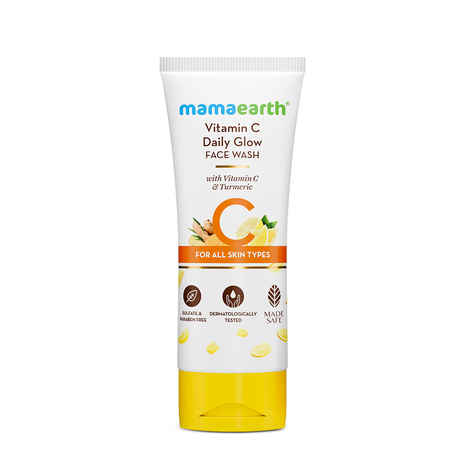
Mamaearth Vitamin C Face Wash with Vitamin C and Turmeric for Skin Illumination - 100 ml

Mamaearth Vitamin C Face Wash with Vitamin C and Turmeric for Skin Illumination - 100 ml
Mamaearth
mamaearth-vitamin-c-face-wash-with-vitamin-c-and-turmeric-for-skin-illumination-100-ml
Cleanse
10084941234469
Morning or Evening?
How often will you use this product?
Notes


Highlights
WHAT IS IT?
Face Wash, contains key ingredients Vitamin C and Turmeric
FEATURES
Brightens and illuminates skin, boosts collagen production, improves blood circulation, controls excess oil, suits all skin types, dermatologically tested, free of toxins, parabens, and mineral oils
BEST FOR
all skin types
CHECKS
Free of Toxins, Parabens, and Mineral Oils
Who Is It For?
All Genders No Specific Age Range MentionedWhat Does It Help With?
Skin Illumination Natural Glow Skin Repair Moisture Retention Oil Control Free Radical Damage ProtectionBudget
Affordable (under ₹300)How To Use
Which routine should it be used in?
Instructions:
Key Information


What Mamaearth Says
Product Description:
The first step in a skincare routine cleansing or washing your face helps in eliminating excess oil dirt and lethargy. Mamaearth Vitamin C Face Wash with the goodness of Vitamin C and Turmeric has brightening properties to give your skin a natural glow. It also helps in skin repair by boosting collagen production and blood circulation leaving the skin radiant and healthy. Perfect for daily use this face wash suits all skin types retains moisture controls excess oil and fights free radical damage. Dermatologically tested this Vitamin C Face Wash has no harmful chemicals and is free of Toxins Parabens and Mineral Oils
About the Brand:
Ingredients Overview
Ingredients List
Aqua, Cocamidopropyl Betaine, Glycerin, Caprylic/Capric Triglyceride, Sodium Methyl Cocoyl Taurate, Disodium Cocoamphodiacetate, Sodium Cocoyl Isethionate, Decyl Glucoside, Olive Oil, Sodium Metabisulfite, Cucumber Extract, Turmeric Extract, Aloe Vera Extract, Citric Acid, Lemon Oil and Sodium Ascorbyl Phosphate
Key Ingredients
Vitamin C, Turmeric
Ingredients Details
Caprylic/capric Triglyceride
Common Name(s): Mct oil,fractionated coconut oil,c8/c10 triglyceride
CAS Number: 73398-61-5
DESCRIPTION
What It Does: Lightweight, stable emollient that solubilizes oil-soluble actives for excellent delivery without greasy feel.
Why It's Used: Universal lightweight emollient base and solubilizer for oil-soluble actives in serums and low-viscosity formulations where mineral oil or petrolatum would be too heavy.
How It Works: Medium-chain length provides ideal balance of spreading coefficient, penetration rate, and barrier-sealing properties. excellent solubilizer for vitamin e, retinoids, and other lipophilic actives.
Typically Found In: Serums,facial oils,sunscreens,anti-aging products,hair products
TECHNICAL DETAILS
Primary Category: Active ingredient – medium-chain triglyceride emollient
Secondary Functions: Active solubilizer,spreading agent
Application Areas:

Facial Skincare
Body Care
Hair Care

Beard Care
Color Cosmetics (Makeup)
Dietary/Oral Supplements
Typical Concentration Range: 1%–50%
SOURCING & ETHICS
Vegan Status: Conditional - feedstock declaration required
Halal Status: Unverified - feedstock declaration required (plant, animal and petrochemical routes all exist)
Source Notes: Fractionated by hydrolysis and re-esterification of coconut oil. only c8 and c10 fatty acids retained. [audit 2026-07-29 rev2: origin-dependent: the same inci exists in plant, animal and petrochemical versions and the name does not discriminate. determination requires shariah-panel sign-off.]
SKIN COMPATIBILITY
Irritancy Rating: 1/5 – very low
Comedogenicity Rating: 1/5 – very low; medium-chain length generally non-comedogenic
Sensitivity Concerns: Non-irritating.
Safe for Sensitive Skin: Yes
SAFETY & COMPATIBILITY
Safety Profile: Excellent safety profile. ewg score: 1.
Works Well With: Humectants,ceramides,actives as carrier
Avoid Combining With: No significant incompatibilities
SCIENTIFIC NOTE
Mct oil's medium-chain length (c8/c10) provides superior oxidative stability vs longer polyunsaturated chains and better skin aesthetics (lighter, less greasy) vs longer chain emollients (c16/c18). excellent solubilizer for retinoic acid, tocopheryl esters, and other lipophilic actives.
Last Verified: 2026-03-12
Primary Sources: Cosing database,cir safety assessment,ewg skin deep
Citric Acid
Common Name(s): Lemon acid,2-hydroxypropane-1,2,3-tricarboxylic acid
CAS Number: 77-92-9
DESCRIPTION
What It Does: Adjusts ph to optimal ranges, chelates destabilizing metal ions, provides mild exfoliation at higher concentrations.
Why It's Used: Universal cosmetic ph adjuster and chelating agent. aha exfoliant activity is secondary.
How It Works: As ph adjuster, donates protons. as chelating agent, three carboxylic groups bind divalent metals (ca²⁺, mg²⁺, fe²⁺) preventing oxidative degradation.
Typically Found In: Nearly all cosmetic formulations,brightening products,exfoliants
TECHNICAL DETAILS
Primary Category: Active ingredient – alpha hydroxy acid (aha)
Secondary Functions: Chelating agent,ph adjustment,preservation enhancement
Application Areas:
Facial Skincare
Body Care
Hair Care
Beard Care
Color Cosmetics (Makeup)
Dietary/Oral Supplements
Typical Concentration Range: 0.1%–10%
SOURCING & ETHICS
Vegan Status: Yes – synthetic or fermentation-derived
Halal Status: Yes
Source Notes: Produced by fermentation of sugars by aspergillus niger. gras (e330). most abundant organic acid in citrus.
SKIN COMPATIBILITY
Irritancy Rating: 1/5 – very low at low concentrations; 2/5 at exfoliant concentrations
Comedogenicity Rating: 0/5 – non-comedogenic
Sensitivity Concerns: Photosensitizing – mandatory spf use. start at low frequency.
Safe for Sensitive Skin: Use with caution – spf required
SAFETY & COMPATIBILITY
Safety Profile: Safe at otc concentrations. eu: ≤10% leave-on at ph ≥3.5. mandatory spf advisory.
Works Well With: Niacinamide,ceramides,hyaluronic acid,spf
Avoid Combining With: Retinol in same step; multiple exfoliants simultaneously
SCIENTIFIC NOTE
Three carboxylic acid groups provide multiple proton donation sites and stronger chelation than monocarboxylic ahas. this makes citric acid the preferred cosmetic chelating agent alongside edta.
Last Verified: 2026-03-12
Primary Sources: Cosing database,cir safety assessment,ewg skin deep
Cocamidopropyl Betaine
Common Name(s): Capb,cocoamidopropyl betaine,coconut betaine
CAS Number: 61789-40-0
DESCRIPTION
What It Does: Boosts foam, enhances mildness, and conditions skin and hair when combined with primary surfactants.
Why It's Used: The standard foam booster and mildness enhancer in virtually all shampoos, body washes, and facial cleansers – provides synergistic mildness improvement with anionic surfactants.
How It Works: Amphoteric (zwitterionic) character provides positive charge interaction with hair keratin for antistatic conditioning. reduces irritation of co-formulated anionic surfactants via ionic complex formation. foam stabilization via bilayer reinforcement in foam lamellae.
Typically Found In: Shampoos,body washes,facial cleansers,baby products
TECHNICAL DETAILS
Primary Category: Functional ingredient – amphoteric surfactant
Secondary Functions: Skin conditioning
Application Areas:
Facial Skincare
Body Care
Hair Care
Beard Care
Color Cosmetics (Makeup)
Dietary/Oral Supplements
Typical Concentration Range: 2%–15%
SOURCING & ETHICS
Vegan Status: Conditional - feedstock declaration required
Halal Status: Unverified - feedstock declaration required (plant, animal and petrochemical routes all exist)
Source Notes: Commercially produced for cosmetic use. verify vegan/halal status with supplier. [audit 2026-07-29 rev2: origin-dependent: the same inci exists in plant, animal and petrochemical versions and the name does not discriminate. determination requires shariah-panel sign-off.]
SKIN COMPATIBILITY
Irritancy Rating: 1/5 – very low
Comedogenicity Rating: 0/5 – non-comedogenic
Sensitivity Concerns: Well-tolerated by most skin types.
Safe for Sensitive Skin: Yes
SAFETY & COMPATIBILITY
Safety Profile: Good safety profile at recommended concentrations. ewg score: 1–2.
Works Well With: Standard skincare actives
Avoid Combining With: No known significant incompatibilities
SCIENTIFIC NOTE
Capb's mildness-enhancing synergy with sls has a molecular mechanism: capb's positive imidazoline head group forms an ion pair complex with sls's anionic sulfate group, reducing sls's free monomer concentration (the irritation-causing species) without significantly reducing micelle-forming capacity (the cleansing species).
Last Verified: 2026-03-12
Primary Sources: Cosing database,ananthapadmanabhan surfactant review,cir safety assessment
Cucumber Extract
Common Name(s): Cucumber extract,cucumber juice
DESCRIPTION
What It Does: Soothes and refreshes irritated skin with anti-inflammatory and astringent properties.
Why It's Used: Classic gentle soothing botanical for sensitive skin formulations with astringent, hydrating, and depuffing properties.
How It Works: Caffeic acid inhibits prostaglandin synthesis. cucurbitacins provide anti-inflammatory activity. high water content provides hydration. ascorbic acid provides antioxidant support. silica provides mild astringency.
Typically Found In: Toners,eye gels,sensitive skin products,after-sun formulations
TECHNICAL DETAILS
Primary Category: Active ingredient – soothing / anti-inflammatory
Secondary Functions: Gentle soothing,astringent,depuffing
Application Areas:
Facial Skincare
Body Care
Hair Care
Beard Care
Color Cosmetics (Makeup)
Dietary/Oral Supplements
Typical Concentration Range: 0.5%–20%
SOURCING & ETHICS
Vegan Status: Yes – plant-derived
Halal Status: Yes
Source Notes: Plant-derived extract or synthetic.
SKIN COMPATIBILITY
Irritancy Rating: 1/5 – very low
Comedogenicity Rating: 0/5 – non-comedogenic
Sensitivity Concerns: Non-irritating; ideal for reactive and sensitive skin.
Safe for Sensitive Skin: Yes – particularly recommended for sensitive skin
SAFETY & COMPATIBILITY
Safety Profile: Excellent safety profile. ewg score: 1.
Works Well With: Ceramides,panthenol,allantoin,hyaluronic acid,centella asiatica
Avoid Combining With: No significant incompatibilities
SCIENTIFIC NOTE
Cucumber's traditional use for puffy eyes has a physiological basis – the combination of mild astringency (silica-mediated protein contraction), anti-inflammatory (caffeic acid), and coolness (high water content evaporation) provides a triple-action depuffing effect that explains its enduring use.
Last Verified: 2026-03-12
Primary Sources: Cosing database,cir safety assessment