

Mamaearth
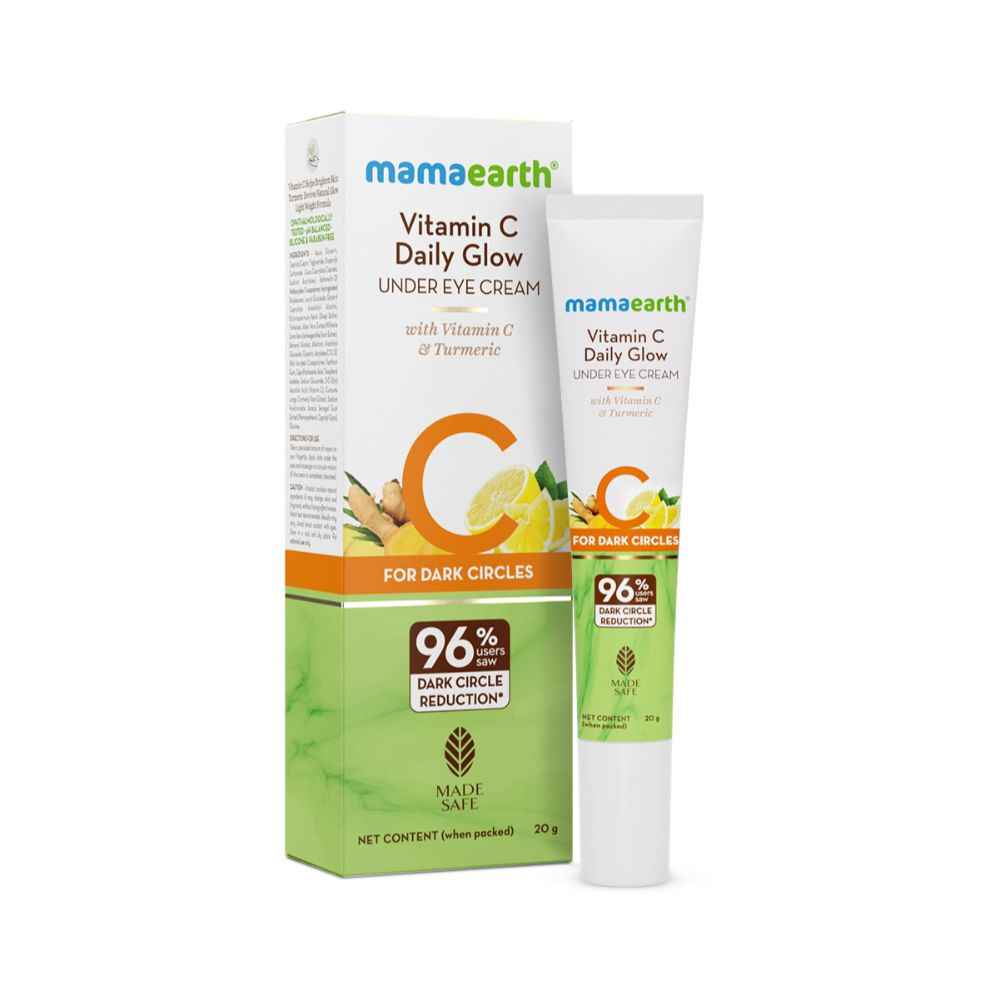
Mamaearth Vitamin C Daily Glow Under Eye Cream with Vitamin C & Turmeric for Dark Circle ReductionA - 20 gm

Mamaearth Vitamin C Daily Glow Under Eye Cream with Vitamin C & Turmeric for Dark Circle ReductionA - 20 gm
Mamaearth
mamaearth-vitamin-c-daily-glow-under-eye-cream-with-vitamin-c-turmeric-for-dark-circle-reductiona-20-gm
Eyecare
10084765892901
Morning or Evening?
How often will you use this product?
Notes


Highlights
WHAT IS IT?
Under Eye Cream with multiple key ingredients (Vitamin C, Turmeric, Aloe Vera)
FEATURES
Reduces dark circles and puffiness by 70%, Visible reduction in wrinkles and fine lines by 46%, Brightens skin naturally, Lightens stubborn pigmentation, Soothes and calms skin, Made Safe certified, Suitable for all skin types
BEST FOR
sensitive
CHECKS
No harmful chemicals or toxins, Parabens, Preservatives
Who Is It For?
All Genders No Specific Age Range MentionedWhat Does It Help With?
Dark Circles Puffiness Wrinkles Fine Lines Dull And Puffy Under EyesBudget
Affordable (under $30)How To Use
Which routine should it be used in?
Instructions:
Key Information


What Mamaearth Says
Product Description:
Late nights stress & too much screen time got your under eyes looking dull and puffy It’s time to fade those dark circles and refresh your under eyes. Meet Mamaearth Vitamin C Daily Glow Under Eye Cream which reduces dark circles & puffiness by 70 & shows visible reduction in wrinkles & fine lines by 46. Crafted with the goodness of Vitamin C that brightens the skin naturally this Under Eye Cream lightens stubborn pigmentation. Also enriched with Turmeric the Vitamin C Daily Glow Under Eye Cream revives your skin’s natural glow and makes under eyes appear glowing & fresher than ever. Aloe Vera in the under eye cream soothes and calms the skin while depuffing them. The result Well rested refreshed and radiant under eyes every single day No more dark circles no under eye bags. That’s not all. Vitamin C Daily Glow Under Eye Cream is also Made Safe certified which means it contains no harmful chemicals or toxins and is suitable for all skin types. What’s more 96 people said this Under Eye Cream reduces dark circles with regular use Basis clinical study more than 96 of users showed a significant reduction in dark circles puffiness & fine lines with regular use 2X a day for 4 weeks done in an independent facility in 2022.
About the Brand:
Ingredients Overview
Ingredients List
Aqua, Glycerin, Caprylic/Capric Triglyceride, Dicaprylyl Carbonate, Coco-Caprylate/Caprate, Sodium Acrylates/ Beheneth-25 Methacrylate Crosspolymer, Hydrogenated Polydecene, Lauryl Glucoside, Glyceryl Caprylate, Arachidyl Alcohol, Butyrospermum Parkii (Shea) Butter, Trehalose, Aloe Vera Extract,Withania Somnifera (Ashwagandha) Root Extract, Behenyl Alcohol, Allantoin, Arachidyl Glucoside, Glycerin, Acrylates/C10-30 Alkyl Acrylate Crosspolymer, Xanthum Gum, Caprylhydroxamic Acid, Tocopheryl Acetate, Sodium Gluconate, 3-O Ethyl Ascorbic Acid (Vitamin C), Curcuma Longa (Turmeric) Root Extract, Sodium Hyaluronate, Acacia Senegal Gum Extract, Phenoxyethanol, Caprylyl Glycol, Glucose
Key Ingredients
Vitamin C, Turmeric, Aloe Vera
Ingredients Details
Acacia Senegal Gum Extract
Common Name(s): Acacia senegal gum extract
DESCRIPTION
What It Does: Provides antioxidant protection, soothing anti-inflammatory effects, and skin-conditioning benefits through plant-derived polyphenols and phytochemicals.
Why It's Used: Plant extracts concentrate bioactive phytochemicals evolved for environmental protection — uv, microbial, and oxidative stressors — that translate to skin benefits.
How It Works: Polyphenols (flavonoids, phenolic acids) inhibit nf-κb-mediated inflammatory signaling, scavenge reactive oxygen species through electron donation, and chelate pro-oxidant metal ions to reduce oxidative skin damage.
Typically Found In: Serums,toners,moisturizers,masks,essences
TECHNICAL DETAILS
Primary Category: Botanical extracts
Secondary Functions: Antioxidant,anti-inflammatory
Application Areas:

Facial Skincare

Body Care
Hair Care
Beard Care
Color Cosmetics (Makeup)
Dietary/Oral Supplements
Typical Concentration Range: 0.1–10%
SOURCING & ETHICS
Vegan Status: Yes
Halal Status: Yes
Source Notes: Plant-derived extract; no animal components.
SKIN COMPATIBILITY
Irritancy Rating: 1
Comedogenicity Rating: 0
Sensitivity Concerns: Low sensitization potential at recommended use concentrations.
Safe for Sensitive Skin: Yes
SAFETY & COMPATIBILITY
Safety Profile: Well-characterized cosmetic ingredient with established safety profile. generally non-irritating at typical use concentrations. suitable for leave-on and rinse-off cosmetics.
Works Well With: Niacinamide,hyaluronic acid,vitamin c,ceramides
Avoid Combining With: Strong oxidizing agents
SCIENTIFIC NOTE
Plant secondary metabolites (flavonoids, terpenes, phenolic acids) are biosynthesized as defense compounds against uv, herbivores, and pathogens. their anti-inflammatory activity typically derives from competitive inhibition of cox-2 and 5-lox enzymes (ic50 1–50 µm), while antioxidant activity involves single electron transfer (set) and hydrogen atom transfer (hat) mechanisms with structure-dependent rate constants.
Last Verified: Cosing eu database; pcpc cosmetic ingredient safety reviews; phytochemical and ethnobotanical literature
Primary Sources: 2025-01-15
Acrylates/c10-30 Alkyl Acrylate Crosspolymer
Common Name(s): Acrylates/c10-30 alkyl acrylate crosspolymer
DESCRIPTION
What It Does: Delivers targeted skin-conditioning or bioactive benefits through a specific mechanism of action suited to the formulation's intended purpose.
Why It's Used: Specialty actives address specific skin concerns through targeted molecular mechanisms, providing efficacy beyond what base formulation ingredients alone can achieve.
How It Works: The bioactive compound interacts with specific molecular targets in skin cells or the extracellular matrix — enzymes, receptors, structural proteins, or signaling molecules — triggering beneficial biological responses.
Typically Found In: Serums,treatments,moisturizers,specialty products
TECHNICAL DETAILS
Primary Category: Specialty actives
Secondary Functions: Skin-conditioning,anti-aging
Application Areas:
Facial Skincare
Body Care
Hair Care
Beard Care
Color Cosmetics (Makeup)
Dietary/Oral Supplements
Typical Concentration Range: 0.01–5%
SOURCING & ETHICS
Vegan Status: Yes
Halal Status: Yes
Source Notes: Specialty active ingredient; check individual sourcing for vegan status.
SKIN COMPATIBILITY
Irritancy Rating: 1
Comedogenicity Rating: 0
Sensitivity Concerns: Low sensitization potential at recommended use concentrations.
Safe for Sensitive Skin: Yes
SAFETY & COMPATIBILITY
Safety Profile: Well-characterized cosmetic ingredient with established safety profile. generally non-irritating at typical use concentrations. suitable for leave-on and rinse-off cosmetics.
Works Well With: Niacinamide,hyaluronic acid,vitamin c,peptides
Avoid Combining With: Incompatible with oxidizing agents; check ph stability
SCIENTIFIC NOTE
Specialty actives typically work through enzyme inhibition (e.g., tyrosinase inhibition for brightening, mmp inhibition for anti-aging), receptor activation (e.g., retinoid receptors, ppar-γ for barrier genes), or transcription factor modulation (e.g., nrf2 for antioxidant gene upregulation). structure-activity relationships determine potency and selectivity.
Last Verified: Cosing eu database; pcpc cosmetic ingredient safety reviews; ingredient-specific safety and efficacy literature
Primary Sources: 2025-01-15
Allantoin
Common Name(s): 5-ureidohydantoin,glyoxyldiureide,aluminum dihydroxy allantoinate
CAS Number: 97-59-6
DESCRIPTION
What It Does: Soothes irritation, accelerates wound healing, promotes skin cell renewal, and provides mild keratolytic exfoliation.
Why It's Used: Gold standard multi-function soothing active – one of the most widely used cosmetic ingredients across all product types for its exceptional tolerability and clinically proven multi-action skin conditioning.
How It Works: Promotes keratinocyte proliferation and fibroblast migration for wound healing. mild keratolytic activity by disrupting corneocyte binding. anti-irritant via direct protein binding and anti-inflammatory cytokine reduction. humectant activity via hydroxyl groups.
Typically Found In: Post-procedure products,sensitive skin formulas,wound care,anti-acne treatments,baby products
TECHNICAL DETAILS
Primary Category: Active ingredient – soothing / anti-inflammatory
Secondary Functions: Wound healing,keratolytic,anti-irritant
Application Areas:
Facial Skincare
Body Care
Hair Care
Beard Care
Color Cosmetics (Makeup)
Dietary/Oral Supplements
Typical Concentration Range: 0.1%–2%
SOURCING & ETHICS
Vegan Status: Yes – synthetic or comfrey-derived
Halal Status: Yes
Source Notes: Plant-derived extract or synthetic.
SKIN COMPATIBILITY
Irritancy Rating: 1/5 – very low
Comedogenicity Rating: 0/5 – non-comedogenic
Sensitivity Concerns: Exceptionally well-tolerated; suitable for all skin types including baby and compromised skin.
Safe for Sensitive Skin: Yes – particularly recommended for sensitive skin
SAFETY & COMPATIBILITY
Safety Profile: Excellent safety profile. ewg score: 1.
Works Well With: Ceramides,panthenol,allantoin,hyaluronic acid,centella asiatica
Avoid Combining With: No significant incompatibilities
SCIENTIFIC NOTE
Allantoin's keratinocyte proliferation stimulation occurs via receptor-mediated signaling (possibly machr activation) rather than non-specific irritation-driven proliferation, making it a true wound-healing stimulant rather than a pro-inflammatory proliferative signal.
Last Verified: Cosing database,cir safety assessment,araújo et al. allantoin review
Primary Sources: 2026-03-12
Arachidyl Alcohol
Common Name(s): Fatty alcohol,co-emulsifier thickener,emollient emulsion stabiliser
CAS Number: N/a
DESCRIPTION
What It Does: Thickens o/w emulsions by forming a lamellar crystal gel network with nonionic emulsifiers, provides co-emulsifier activity at the oil-water interface, and conditions skin from the c16-c18 chain's sc lipid compatibility.
Why It's Used: Fatty alcohols are irreplaceable in conventional o/w cream formulation — the lamellar gel network they form with peg emulsifiers provides the thick, stable cream texture that consumers expect, while delivering emolliency unavailable from wax-only structuring.
How It Works: Cetyl/stearyl alcohol packs into α-gel or β-gel crystal phases with peg surfactants (ceteareth-20, polysorbates) at 60–80°c, forming an ordered lamellar bilayer network on cooling. this network provides zero-shear viscosity (cream texture) and mechanical emulsion stability simultaneously — the fundamental mechanism of classical o/w cream formulation.
Typically Found In: Creams,lotions,o/w emulsions
TECHNICAL DETAILS
Primary Category: Functional ingredient – emollient
Secondary Functions: Barrier sealing,softening
Application Areas:
Facial Skincare
Body Care
Hair Care
Beard Care
Color Cosmetics (Makeup)
Dietary/Oral Supplements
Typical Concentration Range: 1%–15%
SOURCING & ETHICS
Vegan Status: Yes
Halal Status: Yes
Source Notes: Plant-derived, synthetic or animal-derived. verify source.
SKIN COMPATIBILITY
Irritancy Rating: 1/5 – very low
Comedogenicity Rating: 1/5 – low; formulation-dependent
Sensitivity Concerns: Non-irritating.
Safe for Sensitive Skin: Yes
SAFETY & COMPATIBILITY
Safety Profile: Excellent safety profile. ewg score: 1.
Works Well With: Humectants,ceramides,actives as carrier
Avoid Combining With: No significant incompatibilities
SCIENTIFIC NOTE
The fatty alcohol + peg emulsifier ratio is critical: 1:3 (fatty alcohol:peg emulsifier by weight) typically provides optimal lamellar gel network formation and cream texture. deviating from this ratio shifts the phase structure from lamellar gel to micellar, reducing viscosity.
Last Verified: Cosing database,fatty alcohol lamellar gel cream texture review
Primary Sources: 2026-03-12
