

Mamaearth
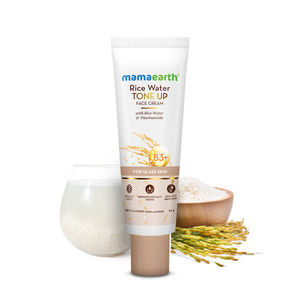
Mamaearth Rice Water Tone Up Face Cream with Rice Water & Niacinamide for Glass Skin 50 gm | Instantly Brightens | Skin Whitening | Even Skin Tone | Adds Glow | All Skin Types | Korean Rice Tone Up

Mamaearth Rice Water Tone Up Face Cream with Rice Water & Niacinamide for Glass Skin 50 gm | Instantly Brightens | Skin Whitening | Even Skin Tone | Adds Glow | All Skin Types | Korean Rice Tone Up
Mamaearth
mamaearth-rice-water-tone-up-face-cream-with-rice-water-niacinamide-for-glass-skin-50-gm-instantly-brightens-skin-whitening-even-skin-tone-adds-glow-all-skin-types-korean-rice-tone-up
Moisturize
10084870684965
Morning or Evening?
How often will you use this product?
Notes


Highlights
WHAT IS IT?
Face moisturizer, contains Ceramide, Niacinamide, Oxylance
FEATURES
Repairs skin barrier, boosts ceramide production, moisturizes without greasy residue, oxygenates and invigorates skin, adds glow
BEST FOR
all skin types
CHECKS
does not leave greasy residue
Who Is It For?
All Genders No Age Range SpecifiedWhat Does It Help With?
Brightens Skin Skin Whitening Even Skin Tone Adds Glow Repairs Skin BarrierBudget
Affordable (under $30)How To Use
Which routine should it be used in?
Instructions:
Key Information


What Mamaearth Says
Product Description:
Formulated with ingredients like Ceramide which repairs the skin barrier & Niacinamide which boosts Ceramide production this powerhouse of moisturization does it all without leaving any greasy residue. Also infused with Oxylance an advanced botanical extract this moisturizer oxygenates & invigorates your skin giving you that postyoga glow effortlessly. So go ahead and give your skin the ultimate nourishment & care it deserves with 4 Ceramide Barrier Repair Moisturizer.
About the Brand:
Ingredients Overview
Ingredients List
Aqua, Glycerin, Isopropyl Myristate, Ethylhexyl Palmitate, Ceteareth-6 Olivate, Titanium Dioxide, Niacinamide, Betaine, Oryza Sativa (Rice) Bran Water, Butyrospermum Parkii (Shea) Butter, Ammonium Acryloyldimethyltaurate/VP Copolymer, Isononyl Isononanoate, Ethylhexyl Olivate, Stearic Acid, Glyceryl Stearate, Isostearic Acid, Sodium Hyaluronate, Polyacrylate-13, Polyisobutene, Polysorbate 20, Phenoxyethanol, Ethylhexylglycerin, Kaolin, Synthetic Fluorphlogopite, Tin Oxide, Boron Nitride, Tocopheryl Acetate and IFRA Certified Allergen Free
Key Ingredients
Ceramide,Niacinamide,Oxylance
Ingredients Details
Ammonium Acryloyldimethyltaurate/vp Copolymer
Common Name(s): Ammonium acryloyldimethyltaurate/vp copolymer
DESCRIPTION
What It Does: Delivers targeted skin-conditioning or bioactive benefits through a specific mechanism of action suited to the formulation's intended purpose.
Why It's Used: Specialty actives address specific skin concerns through targeted molecular mechanisms, providing efficacy beyond what base formulation ingredients alone can achieve.
How It Works: The bioactive compound interacts with specific molecular targets in skin cells or the extracellular matrix — enzymes, receptors, structural proteins, or signaling molecules — triggering beneficial biological responses.
Typically Found In: Serums,treatments,moisturizers,specialty products
TECHNICAL DETAILS
Primary Category: Specialty actives
Secondary Functions: Skin-conditioning,anti-aging
Application Areas:

Facial Skincare

Body Care
Hair Care
Beard Care
Color Cosmetics (Makeup)
Dietary/Oral Supplements
Typical Concentration Range: 0.01–5%
SOURCING & ETHICS
Vegan Status: Yes
Halal Status: Yes
Source Notes: Specialty active ingredient; check individual sourcing for vegan status.
SKIN COMPATIBILITY
Irritancy Rating: 1
Comedogenicity Rating: 0
Sensitivity Concerns: Low sensitization potential at recommended use concentrations.
Safe for Sensitive Skin: Yes
SAFETY & COMPATIBILITY
Safety Profile: Well-characterized cosmetic ingredient with established safety profile. generally non-irritating at typical use concentrations. suitable for leave-on and rinse-off cosmetics.
Works Well With: Niacinamide,hyaluronic acid,vitamin c,peptides
Avoid Combining With: Incompatible with oxidizing agents; check ph stability
SCIENTIFIC NOTE
Specialty actives typically work through enzyme inhibition (e.g., tyrosinase inhibition for brightening, mmp inhibition for anti-aging), receptor activation (e.g., retinoid receptors, ppar-γ for barrier genes), or transcription factor modulation (e.g., nrf2 for antioxidant gene upregulation). structure-activity relationships determine potency and selectivity.
Last Verified: Cosing eu database; pcpc cosmetic ingredient safety reviews; ingredient-specific safety and efficacy literature
Primary Sources: 2025-01-15
Betaine
Common Name(s): Trimethylglycine,tmg,natural betaine
CAS Number: 107-43-7
DESCRIPTION
What It Does: Provides osmoprotective humectant conditioning with anti-irritant and mild foam-boosting activity.
Why It's Used: Natural-origin multifunctional osmolyte from sugar beet providing hydration, anti-irritancy, and conditioning in virtually every cosmetic category.
How It Works: Quaternary ammonium betaine provides zwitterionic character for water binding via ionic hydration. osmoprotective function at 100–500mm as compatible solute protecting cells from osmotic stress. reduces surfactant irritation by competing with sls for protein binding sites. mild foam enhancement.
Typically Found In: Virtually all categories — moisturisers, shampoos, cleansers
TECHNICAL DETAILS
Primary Category: Functional ingredient – humectant
Secondary Functions: Tewl reduction,skin plumping
Application Areas:
Facial Skincare
Body Care
Hair Care
Beard Care
Color Cosmetics (Makeup)
Dietary/Oral Supplements
Typical Concentration Range: 0.5%–10%
SOURCING & ETHICS
Vegan Status: Yes – from beta vulgaris (sugar beet) molasses
Halal Status: Yes
Source Notes: Synthetic or naturally derived. excellent aqueous solubility.
SKIN COMPATIBILITY
Irritancy Rating: 1/5 – very low
Comedogenicity Rating: 0/5 – non-comedogenic
Sensitivity Concerns: Non-irritating; suitable for all skin types.
Safe for Sensitive Skin: Yes
SAFETY & COMPATIBILITY
Safety Profile: Excellent safety profile. ewg score: 1.
Works Well With: Ceramides,emollients,occlusives,glycerin,hyaluronic acid
Avoid Combining With: No significant incompatibilities
SCIENTIFIC NOTE
Betaine's anti-irritant mechanism for surfactant systems involves competitive protein protection: betaine at high concentrations preferentially interacts with skin proteins, occupying binding sites that would otherwise be occupied by surfactant molecules causing protein denaturation. this competition reduces available protein binding for irritating surfactants, explaining betaine's well-documented ability to reduce sls irritation when co-formulated.
Last Verified: Cosing database,craig betaine osmoprotective review,cir safety assessment
Primary Sources: 2026-03-12
Boron Nitride
Common Name(s): Hexagonal boron nitride,bn,white graphite
DESCRIPTION
What It Does: Provides the softest powder feel and best soft-focus diffusion from hexagonal boron nitride.
Why It's Used: The silkiest cosmetic powder ingredient – boron nitride's lowest-friction coefficient provides an unmatched velvety powder feel while providing excellent soft-focus optical diffusion.
How It Works: Hexagonal bn (graphite-like layered structure) provides: (1) lowest coefficient of friction of any cosmetic powder from atomic-layer slip; (2) soft-focus via light diffusion through platelets; (3) oil absorption in inter-layer spaces. optically white from wide band gap (>6 ev).
Typically Found In: Premium foundations,setting powders,luxury cosmetics
TECHNICAL DETAILS
Primary Category: Functional ingredient – mineral soft-focus pigment
Secondary Functions: Skin conditioning
Application Areas:
Facial Skincare
Body Care
Hair Care
Beard Care
Color Cosmetics (Makeup)
Dietary/Oral Supplements
Typical Concentration Range: 0.1%–25%
SOURCING & ETHICS
Vegan Status: Yes – synthetic mineral
Halal Status: Yes
Source Notes: Commercially produced for cosmetic use. verify vegan/halal status with supplier.
SKIN COMPATIBILITY
Irritancy Rating: 1/5 – very low
Comedogenicity Rating: 0/5 – non-comedogenic
Sensitivity Concerns: Well-tolerated by most skin types.
Safe for Sensitive Skin: Yes
SAFETY & COMPATIBILITY
Safety Profile: Good safety profile at recommended concentrations. ewg score: 1–2.
Works Well With: Standard skincare actives
Avoid Combining With: No known significant incompatibilities
SCIENTIFIC NOTE
Boron nitride's 'white graphite' structural analogy is precise: b and n alternating in hexagonal rings provide the same layered structure as carbon in graphite, with the same excellent lubrication from inter-layer slip. the b-n bond's slight polarity (vs c-c's non-polarity in graphite) increases inter-layer electrostatic interaction slightly, making bn slightly less lubricating than graphite per layer but significantly more lubricating than any mineral oxide powder.
Last Verified: Cosing database,cir safety assessment
Primary Sources: 2026-03-12
Ceteareth-6 Olivate
Common Name(s): Nonionic emulsifier,o/w surfactant,emulsion stabiliser
CAS Number: N/a
DESCRIPTION
What It Does: Stabilises o/w emulsions by forming a molecular monolayer at the oil-water interface, provides co-emulsification synergy with other emulsifiers, and contributes to emulsion texture through interfacial film properties.
Why It's Used: Nonionic emulsifiers are preferred for sensitive skin and ph-extreme formulations — no ionic charge means no electrostatic interaction with skin proteins, no ph-dependent function loss, and compatibility with both anionic and cationic co-ingredients.
How It Works: Hlb determines emulsion type: hlb 8–12 for o/w emulsification; hlb 3–6 for w/o. the peg or glycoside head group provides hydrophilicity while the c16–c18 fatty chain provides lipophilicity. at the o/w interface, nonionic emulsifiers form a mixed monolayer reducing interfacial tension from ~35 mn/m (clean oil-water) to 5–10 mn/m, providing thermodynamic stabilisation.
Typically Found In: Creams,lotions,o/w emulsions
TECHNICAL DETAILS
Primary Category: Active ingredient – cosmetic active
Secondary Functions: Skin conditioning
Application Areas:
Facial Skincare
Body Care
Hair Care
Beard Care
Color Cosmetics (Makeup)
Dietary/Oral Supplements
Typical Concentration Range: 1%–10%
SOURCING & ETHICS
Vegan Status: Conditional
Halal Status: Yes
Source Notes: Commercially produced for cosmetic use. verify vegan/halal status with supplier.
SKIN COMPATIBILITY
Irritancy Rating: 1/5 – very low
Comedogenicity Rating: 0/5 – non-comedogenic
Sensitivity Concerns: Well-tolerated by most skin types.
Safe for Sensitive Skin: Yes
SAFETY & COMPATIBILITY
Safety Profile: Good safety profile at recommended concentrations. ewg score: 1–2.
Works Well With: Standard skincare actives
Avoid Combining With: No known significant incompatibilities
SCIENTIFIC NOTE
Mixed emulsifier systems (e.g., glyceryl stearate + peg-100 stearate, or cetearyl glucoside + cetearyl alcohol) provide better emulsion stability than single emulsifiers — synergistic packing of different molecular geometries creates a more cohesive, mechanically robust interfacial film.
Last Verified: Cosing database,nonionic emulsifier hlb system review
Primary Sources: 2026-03-12
