

Nykaa E retail limited
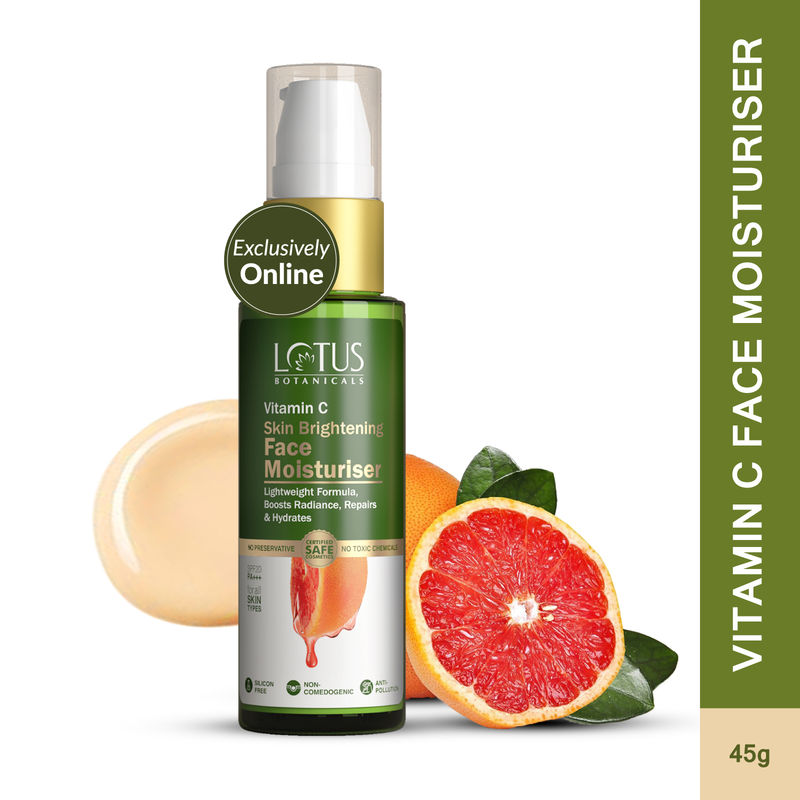
Lotus Botanicals Vitamin C Skin Brightening Face Moisturiser

Lotus Botanicals Vitamin C Skin Brightening Face Moisturiser
Nykaa E retail limited
lotus-botanicals-vitamin-c-skin-brightening-face-moisturiser
Moisturize
10084822647077
Morning or Evening?
How often will you use this product?
Notes


Highlights
WHAT IS IT?
Face Moisturizer with key ingredient Vitamin C
FEATURES
Protective moisturiser that shields skin from sun's rays and preserves youthfulness, non-greasy texture, quickly absorbs, enriched with vitamin C rich fruit extract, niacinamide and SPF 20, antioxidant rich, reduces pigmentation, dark spots, signs of ageing, pH balanced, suitable for all skin types, 100% vegan and cruelty free, recyclable packaging, free from parabens, silicone, mineral oil and preservatives
BEST FOR
sensitive
CHECKS
parabens, silicone, mineral oil, preservatives
Who Is It For?
All Genders No Specific Age Range MentionedWhat Does It Help With?
Reduces Pigmentation Dark Spots Signs Of Ageing Protects Against Sun Damage Hydrates And Keeps Skin SuppleBudget
Affordable (under $30)How To Use
Which routine should it be used in?
Instructions:
Key Information


What Nykaa E retail limited Says
Product Description:
Nothing is more beautiful than naturally radiant and well hydrated skin. With its feather light texture and non-greasy formula, Lotus Botanicals Vitamin C Skin Brightening Face Moisturiser reduces pigmentation, dark spots, and signs of ageing. SPF 20 in this cream shields skin from sun damage and helps you maintain your youthful glow.
About the Brand:
Ingredients Overview
Ingredients List
Aqua, Niacinamide, Caprylic-capric triglyceride, Sorbitan Stearate (and) Sucrose Cocoate, Heptyl Undecylenate, Ethylhexyl Methoxycinnamate (and) Butyl Methoxydibenzoylmethane (and) Benzophenone-3 (and) Phospholipids (and) 1,3-Butylene Glycol, Glycerin, Titanium Dioxide & Isocetyl Stearoyl Stearate, Propanediol, Cetostearyl Alcohol, Cetyl alcohol, Glyceryl monostearate, Hydroxyethyl Urea, Glyceryl Stearate and PEG-100 Stearate, Biosaccharide Gum-4, Tocopheryl acetate, Enteromorpha Compressa Extract (and) Silybum Marianum Fruit Extract (and) Ocimum Sanctum Leaf Extract (and) Citric Acid, Xanthan Gum, Allantoin, Terminalia Ferdinandiana (Kakadu Plum) fruit extract, EDTA disodium, Butylated hydroxytoluene, Caprylhydroxamic Acid (and) Phenethyl Alcohol, CI 15985, Fragrance
Key Ingredients
Vitamin C, Niacinamide, SPF 20, Antioxidants
Ingredients Details
Allantoin
Common Name(s): 5-ureidohydantoin,glyoxyldiureide,aluminum dihydroxy allantoinate
CAS Number: 97-59-6
DESCRIPTION
What It Does: Soothes irritation, accelerates wound healing, promotes skin cell renewal, and provides mild keratolytic exfoliation.
Why It's Used: Gold standard multi-function soothing active – one of the most widely used cosmetic ingredients across all product types for its exceptional tolerability and clinically proven multi-action skin conditioning.
How It Works: Promotes keratinocyte proliferation and fibroblast migration for wound healing. mild keratolytic activity by disrupting corneocyte binding. anti-irritant via direct protein binding and anti-inflammatory cytokine reduction. humectant activity via hydroxyl groups.
Typically Found In: Post-procedure products,sensitive skin formulas,wound care,anti-acne treatments,baby products
TECHNICAL DETAILS
Primary Category: Active ingredient – soothing / anti-inflammatory
Secondary Functions: Wound healing,keratolytic,anti-irritant
Application Areas:

Facial Skincare
Body Care

Hair Care
Beard Care
Color Cosmetics (Makeup)
Dietary/Oral Supplements
Typical Concentration Range: 0.1%–2%
SOURCING & ETHICS
Vegan Status: Yes – synthetic or comfrey-derived
Halal Status: Yes
Source Notes: Plant-derived extract or synthetic.
SKIN COMPATIBILITY
Irritancy Rating: 1/5 – very low
Comedogenicity Rating: 0/5 – non-comedogenic
Sensitivity Concerns: Exceptionally well-tolerated; suitable for all skin types including baby and compromised skin.
Safe for Sensitive Skin: Yes – particularly recommended for sensitive skin
SAFETY & COMPATIBILITY
Safety Profile: Excellent safety profile. ewg score: 1.
Works Well With: Ceramides,panthenol,allantoin,hyaluronic acid,centella asiatica
Avoid Combining With: No significant incompatibilities
SCIENTIFIC NOTE
Allantoin's keratinocyte proliferation stimulation occurs via receptor-mediated signaling (possibly machr activation) rather than non-specific irritation-driven proliferation, making it a true wound-healing stimulant rather than a pro-inflammatory proliferative signal.
Last Verified: Cosing database,cir safety assessment,araújo et al. allantoin review
Primary Sources: 2026-03-12
Biosaccharide Gum-4
Common Name(s): Biosaccharide gum-4,biosaccharide gum-4,microbial exopolysaccharide,biotechnology polysaccharide active
CAS Number: N/a
DESCRIPTION
What It Does: Provides moisture retention from the polysaccharide's multiple hydroxyl groups, film-forming conditioning from the polymer chain architecture, and in some grades prebiotic selective fermentation by beneficial skin microbiome organisms.
Why It's Used: Microbial biosaccharides provide pharmaceutical-grade consistency unavailable from plant polysaccharides — controlled fermentation delivers the same polysaccharide structure and mw distribution every batch for reproducible clinical performance.
How It Works: Microbial eps fermentation in defined bioreactor medium → specific polysaccharide backbone structure determined by organism's transferase enzymes → consistent mw distribution (mw/mn < 1.5) → reproducible rheological and biological properties. the specific polysaccharide structure determines: moisture retention (h-bonding density), film quality (chain flexibility), and prebiotic selectivity (monosaccharide composition).
Typically Found In: Skin care,microbiome formulas
TECHNICAL DETAILS
Primary Category: Active ingredient – skin microbiome support
Secondary Functions: Microbiome balance,prebiotic effect
Application Areas:
Facial Skincare
Body Care
Hair Care
Beard Care
Color Cosmetics (Makeup)
Dietary/Oral Supplements
Typical Concentration Range: 0.1%–5%
SOURCING & ETHICS
Vegan Status: Yes
Halal Status: Yes
Source Notes: Fermentation-derived or plant-extracted.
SKIN COMPATIBILITY
Irritancy Rating: 1/5 – very low
Comedogenicity Rating: 0/5 – non-comedogenic
Sensitivity Concerns: Non-irritating; beneficial for sensitive skin.
Safe for Sensitive Skin: Yes
SAFETY & COMPATIBILITY
Safety Profile: Excellent safety profile. ewg score: 1.
Works Well With: Ceramides,niacinamide,soothing actives
Avoid Combining With: No significant incompatibilities
SCIENTIFIC NOTE
Biosaccharide gum grades are organism-specific — each biosaccharide gum number designates a specific organism and structure with distinct functional properties. formulators should characterise the specific grade's viscosity, water retention, and prebiotic activity for target application.
Last Verified: Cosing database,biosaccharide gum-4 microbial eps review
Primary Sources: 2026-03-22
Cetyl Alcohol
Common Name(s): 1-hexadecanol,palmityl alcohol,n-cetyl alcohol
CAS Number: 36653-82-4
DESCRIPTION
What It Does: Provides c16 fatty alcohol emolliency and thickening for well-textured cosmetic emulsions.
Why It's Used: Lighter-textured fatty alcohol alternative to stearyl alcohol for creams and conditioners requiring less heavy emolliency.
How It Works: C16 chain length provides slightly lower melting point (49°c) than stearyl (60°c) giving softer, lighter emulsion texture. forms lamellar networks for thickening and stability. direct skin and hair conditioning via fatty alcohol film.
Typically Found In: Creams,hair conditioners,lotions
TECHNICAL DETAILS
Primary Category: Functional ingredient – fatty alcohol
Secondary Functions: Barrier sealing,softening
Application Areas:
Facial Skincare
Body Care
Hair Care
Beard Care
Color Cosmetics (Makeup)
Dietary/Oral Supplements
Typical Concentration Range: 1%–15%
SOURCING & ETHICS
Vegan Status: Yes – from vegetable or coconut/palm fatty acids
Halal Status: Yes
Source Notes: Plant-derived, synthetic or animal-derived. verify source.
SKIN COMPATIBILITY
Irritancy Rating: 1/5 – very low
Comedogenicity Rating: 1/5 – low; formulation-dependent
Sensitivity Concerns: Non-irritating.
Safe for Sensitive Skin: Yes
SAFETY & COMPATIBILITY
Safety Profile: Excellent safety profile. ewg score: 1.
Works Well With: Humectants,ceramides,actives as carrier
Avoid Combining With: No significant incompatibilities
SCIENTIFIC NOTE
Cetyl alcohol's c16 chain length is at the approximate thermal transition point for fatty alcohol lamellar crystallization at skin temperature (33°c). this transition (from ordered crystalline to disordered liquid phase near skin temperature) provides the characteristic 'melts on application' sensory profile that makes cetyl alcohol-containing products feel cooling and light on initial application.
Last Verified: Cosing database,cir safety assessment
Primary Sources: 2026-03-12
Ci 15985
Common Name(s): Ci 15985,approved cosmetic colorant,colour cosmetics pigment
CAS Number: N/a
DESCRIPTION
What It Does: Provides colour in cosmetic formulations within the permitted application areas and concentrations specified by fda 21 cfr 73/74 and eu cosmetics regulation annex iv.
Why It's Used: Regulatory compliance requires verifying both the permitted use category (fd&c, d&c, ext. d&c) and the specific application area approval for each colorant in each target market.
How It Works: Colour arises from selective wavelength absorption by the chromophore structure — electronic transitions (d-orbital for transition metal pigments; π→π* for organic chromophores) absorb specific visible wavelengths providing the perceived complementary colour.
Typically Found In: Colour cosmetics
TECHNICAL DETAILS
Primary Category: Active ingredient – mineral / metal active
Secondary Functions: Antimicrobial,sebum regulation,antioxidant enzyme cofactor
Application Areas:
Facial Skincare
Body Care
Hair Care
Beard Care
Color Cosmetics (Makeup)
Dietary/Oral Supplements
Typical Concentration Range: Per product type — check fda/eu permitted list
SOURCING & ETHICS
Vegan Status: Conditional
Halal Status: Conditional
Source Notes: Mineral/inorganic compound. cosmetic or pharmaceutical grade.
SKIN COMPATIBILITY
Irritancy Rating: 1/5 – very low
Comedogenicity Rating: 0/5 – non-comedogenic
Sensitivity Concerns: Non-irritating at recommended concentrations.
Safe for Sensitive Skin: Yes at recommended concentrations
SAFETY & COMPATIBILITY
Safety Profile: Excellent safety profile at cosmetic concentrations. ewg score: 1–2.
Works Well With: Niacinamide,salicylic acid,other actives
Avoid Combining With: No significant incompatibilities at standard concentrations
SCIENTIFIC NOTE
All cosmetic colorants in the us require fda batch certification confirming identity and purity per lot — uncertified batches cannot legally appear in finished us cosmetics. eu annex iv lists permitted colorants with specific maximum concentrations and use restrictions by product category.
Last Verified: Fda 21 cfr 73/74,eu cosmetics regulation annex iv,colorant regulatory review
Primary Sources: 2026-03-12
