
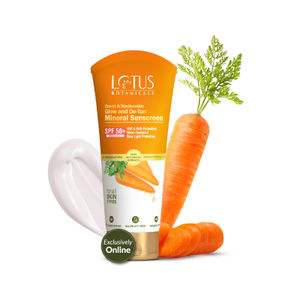

Lotus Botanicals
Lotus Botanicals Carrot & Niacinamide Glow and De-Tan Mineral Sunscreen, SPF 50+ - 50 gm

Lotus Botanicals Carrot & Niacinamide Glow and De-Tan Mineral Sunscreen, SPF 50+ - 50 gm
Lotus Botanicals
lotus-botanicals-carrot-niacinamide-glow-and-de-tan-mineral-sunscreen-spf-50-50-gm
Suncare
10085462507813
Morning or Evening?
How often will you use this product?
Notes


Highlights
WHAT IS IT?
Mineral sunscreen with zinc oxide and titanium dioxide
FEATURES
Broad-spectrum SPF50+ and PA++++, protects UVA/UVB rays, reduces tan, water resistant, non-greasy, absorbs quickly, protects against blue light, suitable for sensitive skin, free from parabens, sulfates, silicones, infused with antioxidants
BEST FOR
sensitive
CHECKS
Parabens, Sulphates, Silicones
Who Is It For?
All Skin Types Including Sensitive Skin All Genders No Age SpecifiedWhat Does It Help With?
Sun Protection Reduces Tan Reduces Sunspots And Dark Spots Lightens Skin Prevents Darkening Protects Against Blue Light Protection From Premature Aging Protects From Free Radicals And Environmental StressorsBudget
Affordable (under $30)How To Use
Which routine should it be used in?
Instructions:
Key Information


What Lotus Botanicals Says
Product Description:
Lotus Botanicals Carrot & Niacinamide Glow and DeTan Mineral Sunscreen SPF50 and PA is a highperformance sunscreen that offers effective sun protection while providing nourishing benefits for your skin and blue light protection. Formulated with a blend of natural ingredients this sunscreen is specifically designed to give your skin a healthy glow and help in reducing tan.With a broadspectrum SPF50 and PA rating this sunscreen offers robust defense against UVA and UVB rays safeguarding your skin from sun damage and premature aging. It not only helps to reduce sunspots dark spots caused by sun exposure and pigmentation but also lightens skin and prevents further darkening of the skin because of its detanning properties.It&aposs waterresistant formula makes it ideal for outdoor activities while its quick absorption and nongreasy texture make it easy to apply and comfortable to wear. What sets this sunscreen apart is its ability to protect against blue light. With increasing exposure to electronic devices such as smartphones and computers our skin is vulnerable to the damaging effects of blue light. Lotus Botanicals Carrot & Niacinamide Glow and DeTan Mineral Sunscreen acts as a barrier defending your skin against the harmful effects of blue light such as premature aging and potential skin damage.Formulated as a mineral sunscreen it utilizes zinc oxide and titanium dioxide as physical filters creating a protective shield on the skin&aposs surface that reflects and scatters UV rays rather than absorbing them. This makes it suitable for all skin types including sensitive skin as it minimizes the risk of irritation or allergic reactions.It is free from harmful chemicals like parabens sulphates & silicones. In addition to providing effective sun protection Lotus Botanicals Carrot & Niacinamide Glow and DeTan Mineral Sunscreen is also infused with antioxidants that help protect the skin from free radicals and environmental stressors. Its allinone solution offers both sun protection and skincare benefits making it a musthave product for anyone looking for a natural and effective way to protect and improve their skin.
About the Brand:
Ingredients Overview
Ingredients List
zinc-oxide,titanium-dioxide
Key Ingredients
zinc oxide,titanium dioxide,carrot,niacinamide
Ingredients Details
Niacinamide
Common Name(s): Vitamin b3,nicotinamide,pyridine-3-carboxamide
CAS Number: 98-92-0
DESCRIPTION
What It Does: Niacinamide strengthens the skin barrier, reduces visible pore size, regulates sebum production, fades dark spots, and improves skin texture and tone.
Why It's Used: It is used because it addresses multiple skin concerns at once without irritation, making it suitable for all skin types. it is stable in formulations and pairs well with most other actives.
How It Works: Niacinamide inhibits the transfer of melanosomes (pigment packets) to skin cells, reducing hyperpigmentation. it also stimulates ceramide synthesis to strengthen the skin barrier and reduces inflammation by modulating cytokine activity.
Typically Found In: Serums,moisturizers,toners,cleansers,eye creams,sunscreens,primers
TECHNICAL DETAILS
Primary Category: Active ingredient – vitamin
Secondary Functions: Barrier repair,brightening,anti-inflammatory
Application Areas:

Facial Skincare
Body Care

Hair Care
Beard Care
Color Cosmetics (Makeup)
Dietary/Oral Supplements
Typical Concentration Range: 2%–10% (typical: 5%; higher concentrations may cause flushing in some individuals)
SOURCING & ETHICS
Vegan Status: Yes – synthetically produced
Halal Status: Yes – synthetic origin
Source Notes: Commercially produced via synthesis from nicotinic acid or 3-cyanopyridine. no animal-derived sources used in cosmetic-grade niacinamide.
SKIN COMPATIBILITY
Irritancy Rating: 1/5 – very low; concentrations above 10% may cause temporary flushing in sensitive individuals
Comedogenicity Rating: 0/5 – non-comedogenic
Sensitivity Concerns: At concentrations >10%, some users experience niacin flush (transient redness/tingling). generally very well-tolerated.
Safe for Sensitive Skin: Yes – one of the best-tolerated actives for sensitive skin
SAFETY & COMPATIBILITY
Safety Profile: Extensively studied and considered very safe. ewg hazard score: 1. no significant systemic toxicity concerns at topical concentrations.
Works Well With: Retinol,peptides,ahas/bhas,hyaluronic acid,ceramides,zinc,vitamin c,spf
Avoid Combining With: High concentrations of vitamin c (ascorbic acid) may theoretically convert to niacin – use at different times if using pure l-ascorbic acid above 15%
SCIENTIFIC NOTE
Niacinamide is a precursor to nad+ and nadp+, coenzymes vital to cellular energy metabolism. its benefits for dna repair and mitochondrial function make it a key ingredient in anti-aging strategies.
Last Verified: 2026-03-12
Primary Sources: Cosing database,cir safety assessment,ewg skin deep,pubmed clinical studies
Titanium Dioxide
Common Name(s): Ci 77891,tio2,rutile,anatase
CAS Number: 13463-67-7
DESCRIPTION
What It Does: Physically reflects and scatters uvb and uva-ii radiation providing broad-spectrum physical sun protection.
Why It's Used: Most widely used mineral uv filter – photostable, non-irritating physical sun protection compatible with all skin types including baby and sensitive skin.
How It Works: High refractive index (2.5–2.7) and semiconductor bandgap provide physical reflection and absorption of uv radiation. primarily uvb (280–320nm) and uva-ii (320–340nm) protection, less effective for uva-i (340–400nm) vs zinc oxide.
Typically Found In: Sunscreens,tinted products,foundations,baby sunscreens
TECHNICAL DETAILS
Primary Category: Active ingredient – mineral uv filter
Secondary Functions: Photostable uv filter,opacifier
Application Areas:
Facial Skincare
Body Care
Hair Care
Beard Care
Color Cosmetics (Makeup)
Dietary/Oral Supplements
Typical Concentration Range: 1%–25% (spf products: eu max 25%)
SOURCING & ETHICS
Vegan Status: Yes – inorganic mineral
Halal Status: Yes
Source Notes: Produced from ilmenite or rutile mineral processing. nano tio2 (<100nm) for transparency; non-nano for opacity.
SKIN COMPATIBILITY
Irritancy Rating: 1/5 – very low
Comedogenicity Rating: 0/5 – non-comedogenic
Sensitivity Concerns: Non-irritating; suitable for baby and sensitive skin.
Safe for Sensitive Skin: Yes at recommended concentrations
SAFETY & COMPATIBILITY
Safety Profile: Excellent safety profile. fda category i grase for sunscreen. eu max 25%. non-nano preferred for safety. ewg score: 1.
Works Well With: Niacinamide,salicylic acid,other actives
Avoid Combining With: No significant incompatibilities at standard concentrations
SCIENTIFIC NOTE
Tio2 provides superior uvb protection vs zno but inferior uva-i coverage. this complementarity means tio2+zno combination sunscreens provide more complete uv spectrum coverage (uvb+uva-i+uva-ii) than either mineral filter alone.
Last Verified: 2026-03-12
Primary Sources: Cosing database,fda sunscreen grase ruling,ewg sunscreen database
Zinc Oxide
Common Name(s): Zinc white,chinese white,calamine component
CAS Number: 1314-13-2
DESCRIPTION
What It Does: Physically reflects and scatters uv radiation while providing antimicrobial, anti-inflammatory, and wound healing benefits.
Why It's Used: Multi-action mineral uv filter that simultaneously provides sun protection and skin-therapeutic benefits – the cornerstone of physical sunscreen formulations.
How It Works: Wide bandgap semiconductor physically reflects and scatters uv radiation (uva 320–400nm and uvb 280–320nm). dissolves to zn²⁺ providing antimicrobial activity, inhibiting bacterial and fungal growth. anti-inflammatory via inhibition of 5-lipoxygenase and il-8 production.
Typically Found In: Sunscreens,baby products,diaper creams,wound care,anti-acne formulations
TECHNICAL DETAILS
Primary Category: Active ingredient – mineral uv filter / antimicrobial
Secondary Functions: Broad-spectrum uv filter,anti-acne,diaper rash treatment
Application Areas:
Facial Skincare
Body Care
Hair Care
Beard Care
Color Cosmetics (Makeup)
Dietary/Oral Supplements
Typical Concentration Range: 1%–25% (spf products: 10–25%; eu max 25%)
SOURCING & ETHICS
Vegan Status: Conditional - supplier confirmation required
Halal Status: Unverified - supplier confirmation required
Source Notes: Produced from zinc metal oxidation or chemical synthesis. nano zinc oxide (<100nm) improves aesthetics. [audit 2026-07-29 rev2: the record's own source_notes does not assert a non-animal origin, or instructs the reader to verify with the supplier; "yes" asserts knowledge the record does not hold. determination requires shariah-panel sign-off.]
SKIN COMPATIBILITY
Irritancy Rating: 1/5 – very low
Comedogenicity Rating: 0/5 – non-comedogenic
Sensitivity Concerns: Non-irritating; recommended for sensitive, baby, and rosacea-prone skin.
Safe for Sensitive Skin: Yes at recommended concentrations
SAFETY & COMPATIBILITY
Safety Profile: Excellent safety profile. fda category i generally recognized as safe and effective (grase) for sunscreen. eu cosmetics regulation: max 25%. ewg sunscreen score: 1.
Works Well With: Niacinamide,salicylic acid,other actives
Avoid Combining With: No significant incompatibilities at standard concentrations
SCIENTIFIC NOTE
Zinc oxide's broad-spectrum uv coverage extends into the uva1 region (360–400nm) more effectively than titanium dioxide, making it preferred for photoaging protection. nano zinc oxide (<100nm) achieves transparency on skin while maintaining uv protection efficiency.
Last Verified: 2026-03-12
Primary Sources: Cosing database,fda sunscreen grase ruling,ewg sunscreen database,eu cosmetics regulation