

L'Oreal Paris
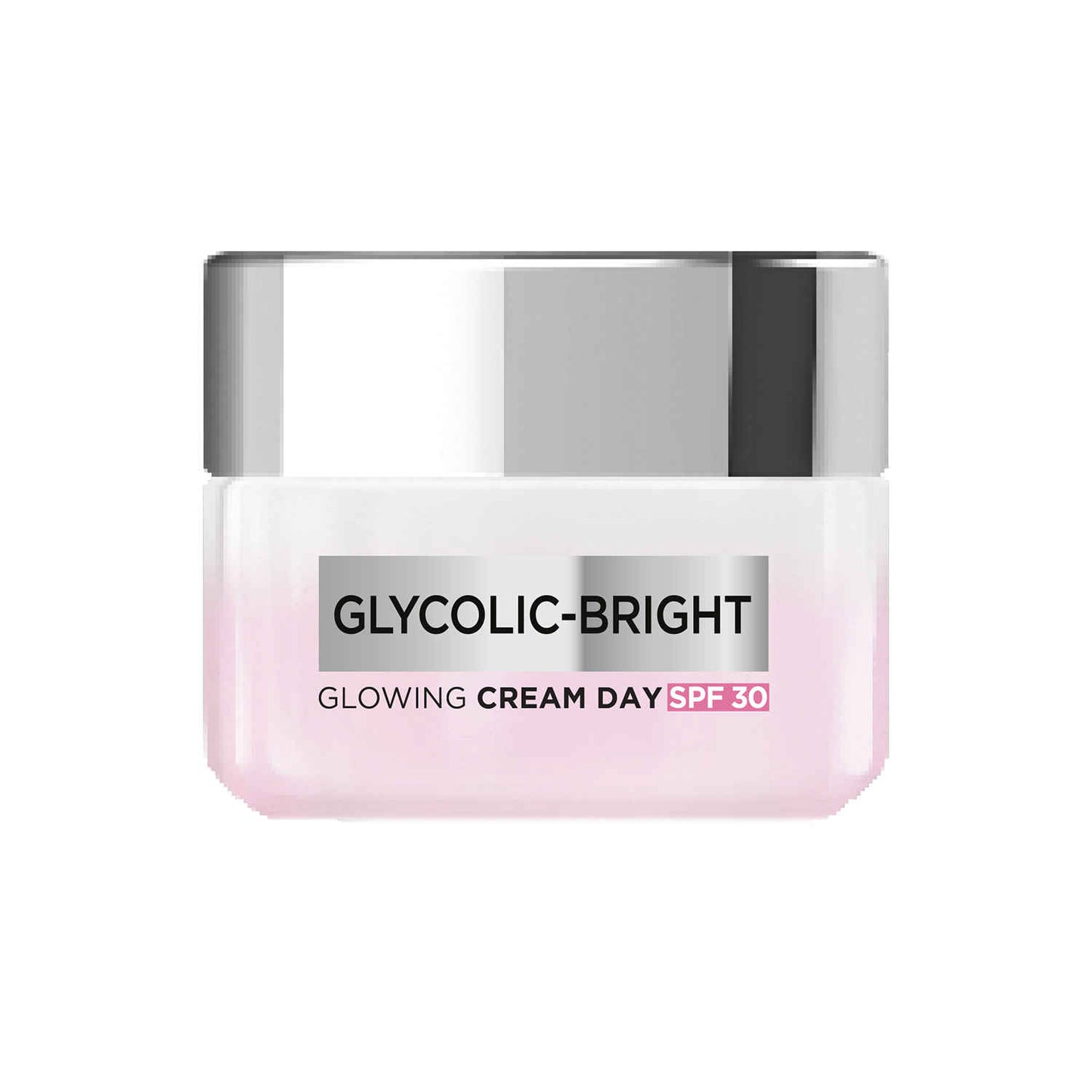
Loreal Paris Glycolic Bright Day Cream with SPF 30, 50 ml |Skin Brightening & Visibly Minimizes Spots For Even Glowing Skin

Loreal Paris Glycolic Bright Day Cream with SPF 30, 50 ml |Skin Brightening & Visibly Minimizes Spots For Even Glowing Skin
L'Oreal Paris
loreal-paris-glycolic-bright-day-cream-with-spf-30-50-ml-skin-brightening-visibly-minimizes-spots-for-even-glowing-skin
Moisturize
10084871569701
Morning or Evening?
How often will you use this product?
Notes


Highlights
WHAT IS IT?
Skin Brightening Day Cream with Glycolic Acid, Quantity options: 2 (50 ml, 15 ml)
FEATURES
Stimulates cell renewal, reduces dark spots, contains glycolic acid, enriched with SPF 17, suitable for all skin types, dermatologically tested, great for daily use
BEST FOR
sensitive
CHECKS
Does not contain alcohol, parabens, sulfates
Who Is It For?
All Genders Suitable For All Ages Implied (not Explicitly Stated)What Does It Help With?
Dark Spot Reduction Uneven Skin Tone Dull Skin Roughness HyperpigmentationBudget
Mid-range ($30-$75)How To Use
Which routine should it be used in?
Instructions:
Key Information


What L'Oreal Paris Says
Product Description:
Brighten your lacklustre skin with the power of the allnew L’Oreal Paris Glycolic Bright Glowing Day cream with SPF 17. This skin brightening cream is enriched with the goodness of glycolic acid for the skin. Glycolic acid skin care is enriched with the power of glycolic acid which is the smallest AHA. It is proven to penetrate faster and deeper into the skin. As we age the skin’s natural ability to renew cells reduces. This in turn causes an increase in melanin production and buildup leading to dark spots and dullness. The L’Oreal Paris glycolic acid day cream accelerates cell renewal removes melanin and visibly reduces dark spots with each use. The L’Oreal Paris day cream with glycolic acid benefits for skin is also formulated with SPF 17. The L’Oreal day cream with SPF acts as the skin’s protective shield against harmful UV rays. With the L’Oreal glycolic acid day cream you can improve the four dimensions of your skin roughness dull skin dark spots and uneven skin. The glycolic acid day cream is highly effective great for daily use dermatologically tested and suitable for all skin types. • STIMULATES CELL RENEWAL The L’Oreal Paris brightening cream reduces dark spots in 2 weeks hyperpigmentation and reveals even skin tone by stimulating cell renewal • CONTAINS GLYCOLIC ACID This dark spot treatment serum is formulated with glycolic acid that is used in dermatological peeling treatments • BEST FOR REGULAR USE The brightening cream is highly effective yet gentle for daily use • DERMATOLOGICALLY TESTED This Glycolic acid serum is dermatologically tested suitable for all skin types and helps you flaunt glowing skin on the go • ENRICHED WITH SPF This skin brightening cream is infused with SPF 17 to increase the skin’s protective shield against harmful UV rays.
Ingredients Overview
Ingredients List
AQUA / WATER, GLYCERIN, OCTOCRYLENE, HOMOSALATE, ETHYLHEXYL SALICYLATE,DIMETHICONE, SILICA, BUTYL METHOXYDIBENZOYLMETHANE, NIACINAMIDE, GLYCERYL STEARATE, PEG-100 STEARATE, GLYCOLIC ACID,STEARIC ACID, DICAPRYLYL CARBONATE, STEARETH-100, LINALOOL, GERANIOL, DIMETHICONE/VINYL DIMETHICONE CROSSPOLYMER, EUGENOL,PARFUM / FRAGRANCE, SODIUM HYDROXIDE, SODIUM HYALURONATE, MYRISTIC ACID, CYCLODEXTRIN, PALMITIC ACID, PHENOXYETHANOL, PHENYLETHYL RESORCINOL, GUANOSINE, AMMONIUM POLYACRYLOYLDIMETHYL TAURATE, ASCORBYL GLUCOSIDE, TOCOPHEROL, LIMONENE,CAPRYLYL GLYCOL, CITRONELLOL, TRISODIUM ETHYLENEDIAMINE DISUCCINATE, XANTHAN GUM,PENTAERYTHRITYL TETRA-DI-T-BUTYL HYDROXYHYDROCINNAMATE, PISUM SATIVUM EXTRACT / PEA EXTRACT, HEXYL CINNAMAL, BENZYL ALCOHOL. (F.I.L. Z283395/1)
Key Ingredients
glycolic acid, SPF 17
Ingredients Details
Ammonium Polyacryloyldimethyl Taurate
Common Name(s): Carbomer/acrylate crosspolymer,highly efficient gel former,rheology modifier
CAS Number: N/a
DESCRIPTION
What It Does: Forms transparent to translucent high-viscosity gels at very low concentration, suspends particles and pigments against sedimentation through yield stress, and provides the elegant shear-thinning texture of premium gel serums.
Why It's Used: The most efficient aqueous thickener available — achieving gel viscosity at 0.1% that requires 3–5% of xanthan gum or 2% of cellulose thickeners, enabling clean-label lightweight formulations with high active loading.
How It Works: At ph <4: –cooh groups protonated, polymer coiled compact, low viscosity. neutralisation with naoh/tea deprotonates –cooh to –coo⁻; like-charge repulsion expands polymer coil 100–1000×. above overlap concentration c* (~0.1%), expanded coils entangle forming viscoelastic gel network providing high zero-shear viscosity and shear-thinning.
Typically Found In: Gel serums,transparent toners,suspension systems
TECHNICAL DETAILS
Primary Category: Active ingredient – cosmetic active
Secondary Functions: Skin conditioning
Application Areas:

Facial Skincare

Body Care
Hair Care
Beard Care
Color Cosmetics (Makeup)
Dietary/Oral Supplements
Typical Concentration Range: 0.1%–2%
SOURCING & ETHICS
Vegan Status: Yes
Halal Status: Yes
Source Notes: Commercially produced for cosmetic use. verify vegan/halal status with supplier.
SKIN COMPATIBILITY
Irritancy Rating: 1/5 – very low
Comedogenicity Rating: 0/5 – non-comedogenic
Sensitivity Concerns: Well-tolerated by most skin types.
Safe for Sensitive Skin: Yes
SAFETY & COMPATIBILITY
Safety Profile: Good safety profile at recommended concentrations. ewg score: 1–2.
Works Well With: Standard skincare actives
Avoid Combining With: No known significant incompatibilities
SCIENTIFIC NOTE
Carbomer is edta-sensitive — divalent cation contamination (ca²⁺, mg²⁺ from hard water) can collapse the electrostatic gel network. including edta or citric acid chelation in carbomer-gelled formulas is standard practice to maintain gel integrity.
Last Verified: Cosing database,carbomer polyacrylate gel mechanism review
Primary Sources: 2026-03-12
Ascorbyl Glucoside
Common Name(s): Aa2g,2-o-alpha-d-glucopyranosyl-l-ascorbic acid
CAS Number: 129499-78-1
DESCRIPTION
What It Does: Provides stable gradual-release vitamin c activity for brightening and antioxidant protection.
Why It's Used: Most formulation-stable vitamin c derivative — ascorbyl glucoside remains stable in aqueous formulations where pure ascorbic acid oxidises within days, providing sustained vitamin c delivery over weeks of shelf life.
How It Works: Alpha-glucoside bond resists oxidation until cleaved by skin alpha-glucosidase enzymes. releases free l-ascorbic acid in viable epidermis. released ascorbic acid inhibits tyrosinase, stimulates collagen synthesis, and provides antioxidant activity. glucose group provides enhanced water solubility vs ascorbic acid.
Typically Found In: Stable vitamin c serums,brightening products,anti-aging
TECHNICAL DETAILS
Primary Category: Active ingredient – stable vitamin c glucoside
Secondary Functions: Tyrosinase inhibitor,collagen cofactor
Application Areas:
Facial Skincare
Body Care
Hair Care
Beard Care
Color Cosmetics (Makeup)
Dietary/Oral Supplements
Typical Concentration Range: 1%–5%
SOURCING & ETHICS
Vegan Status: Yes – enzymatic synthesis from ascorbic acid and glucose
Halal Status: Yes
Source Notes: Synthetically produced vitamin c derivative.
SKIN COMPATIBILITY
Irritancy Rating: 1/5 – very low
Comedogenicity Rating: 0/5 – non-comedogenic
Sensitivity Concerns: Non-irritating; suitable for all skin types.
Safe for Sensitive Skin: Yes
SAFETY & COMPATIBILITY
Safety Profile: Excellent safety profile. ewg score: 1.
Works Well With: Tocopherol,ferulic acid,niacinamide,spf
Avoid Combining With: No significant incompatibilities
SCIENTIFIC NOTE
Ascorbyl glucoside's stability advantage (18+ months in aqueous formulation vs days for ascorbic acid) arises from the glucose group's steric protection of ascorbic acid's c2 enediol that is the primary oxidation site. glucosidase cleavage in skin removes this protection in situ, releasing active ascorbic acid only where enzymatic activity exists — providing both formulation stability and bioactivation where needed.
Last Verified: Cosing database,yamamoto et al. ascorbyl glucoside stability study
Primary Sources: 2026-03-12
Butyl Methoxydibenzoylmethane
Common Name(s): Butyl methoxydibenzoylmethane,organic uv filter,photostabilising sunscreen active
CAS Number: N/a
DESCRIPTION
What It Does: Absorbs uv radiation at specific wavelengths (uva 320–400 nm, uvb 290–320 nm) and dissipates photon energy as heat rather than skin-damaging photochemical reactions.
Why It's Used: Organic uv filters are chosen for their high molar extinction coefficient, specific spectral coverage, and formulation compatibility — individual filters are combined to provide broad-spectrum coverage across uva+uvb.
How It Works: Uv photon absorption by the aromatic chromophore π-system excites the molecule from s₀ ground state to s₁ excited state. rapid internal conversion or photoisomerisation dissipates energy as vibrational heat before it can initiate skin photodamage.
Typically Found In: Sunscreens,photoprotective products
TECHNICAL DETAILS
Primary Category: Active ingredient – cosmetic active
Secondary Functions: Skin conditioning
Application Areas:
Facial Skincare
Body Care
Hair Care
Beard Care
Color Cosmetics (Makeup)
Dietary/Oral Supplements
Typical Concentration Range: Check local sunscreen regulations
SOURCING & ETHICS
Vegan Status: Yes
Halal Status: Yes
Source Notes: Commercially produced for cosmetic use. verify vegan/halal status with supplier.
SKIN COMPATIBILITY
Irritancy Rating: 1/5 – very low
Comedogenicity Rating: 0/5 – non-comedogenic
Sensitivity Concerns: Well-tolerated by most skin types.
Safe for Sensitive Skin: Yes
SAFETY & COMPATIBILITY
Safety Profile: Good safety profile at recommended concentrations. ewg score: 1–2.
Works Well With: Standard skincare actives
Avoid Combining With: No known significant incompatibilities
SCIENTIFIC NOTE
Organic uv filters require photostabilisation (by avobenzone-octocrylene pairing, or triazine stabilisers) as some absorbers degrade on uv exposure — formulator must verify photostability of the chosen filter combination.
Last Verified: Cosing database,butyl methoxydibenzoylmethane organic uv filter review
Primary Sources: 2026-03-12
Caprylyl Glycol
Common Name(s): 1,2-octanediol,octanediol,sensiva sc 50
CAS Number: 1117-86-8
DESCRIPTION
What It Does: Provides the most potent antimicrobial diol activity alongside skin feel enhancement.
Why It's Used: Premium antimicrobial diol — caprylyl glycol's c8 chain provides the strongest membrane-disrupting antimicrobial activity of common diol preservative boosters with unique skin-feel enhancement.
How It Works: C8 1,2-diol: c8 chain length provides strongest bacterial and fungal membrane disruption of common diols. emollient skin feel improvement from c8 chain length interaction with skin surface. active at lower concentrations than shorter-chain diols. synergistic with ethylhexylglycerin.
Typically Found In: Natural preservation systems,skin feel enhancement
TECHNICAL DETAILS
Primary Category: Functional ingredient – antimicrobial humectant
Secondary Functions: Skin conditioning
Application Areas:
Facial Skincare
Body Care
Hair Care
Beard Care
Color Cosmetics (Makeup)
Dietary/Oral Supplements
Typical Concentration Range: 0.1%–1%
SOURCING & ETHICS
Vegan Status: Yes – synthetic
Halal Status: Yes
Source Notes: Commercially produced for cosmetic use. verify vegan/halal status with supplier.
SKIN COMPATIBILITY
Irritancy Rating: 1/5 – very low
Comedogenicity Rating: 0/5 – non-comedogenic
Sensitivity Concerns: Well-tolerated by most skin types.
Safe for Sensitive Skin: Yes
SAFETY & COMPATIBILITY
Safety Profile: Good safety profile at recommended concentrations. ewg score: 1–2.
Works Well With: Standard skincare actives
Avoid Combining With: No known significant incompatibilities
SCIENTIFIC NOTE
Caprylyl glycol's antimicrobial potency follows the chain-length dependent membrane activity of fatty acids: c8 is the optimal chain length for membrane disruption (same as caprylic acid's antimicrobial optimum), providing maximum membrane integration without the skin sensitisation associated with longer chain lengths. this chain-length pharmacophore relationship is why c8 > c6 > c5 in diol antimicrobial potency despite identical head group chemistry.
Last Verified: Cosing database,schülke sensiva sc 50 technical data,cir safety assessment
Primary Sources: 2026-03-12
