

Eminence Organic Skin Care
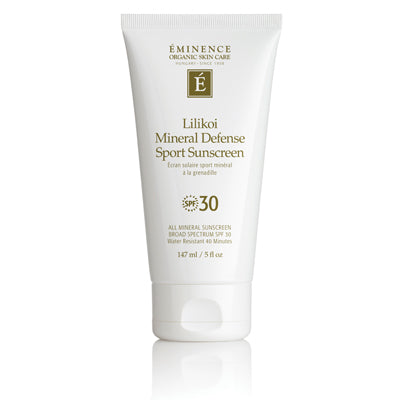
Lilikoi Mineral Defense Sport Sunscreen SPF 30

Lilikoi Mineral Defense Sport Sunscreen SPF 30
Eminence Organic Skin Care
lilikoi-mineral-defense-sport-sunscreen-spf-30
Suncare
9628194570533
Morning or Evening?
How often will you use this product?
Notes


Highlights
WHAT IS IT?
Mineral sunscreen for face and body
FEATURES
Non-greasy, water-resistant up to 40 minutes, suitable for outdoor activities and high-performance sports
BEST FOR
All skin types
CHECKS
Does not contain parabens, sodium lauryl sulfate
Who Is It For?
Adults Both Women And MenWhat Does It Help With?
Sun Protection Uv Damage PreventionBudget
Mid-rangeHow To Use
Which routine should it be used in?
Instructions:
Key Information


What Eminence Organic Skin Care Says
Product Description:
An easy-to-apply sport formulation for face and body, this SPF 30 mineral sunscreen is non-greasy and water-resistant up to 40 minutes. Highly effective for outdoor activities like swimming and high-performance sports where perspiration can impact standard sunscreen efficacy, this zinc oxide sunscreen protects from head to toe.
About the Brand:
Ingredients Overview
Ingredients List
Tilia Cordata (Linden) Flower Tea, Aloe Barbadensis (Aloe) Juice, Camellia Sinensis (Green Tea) Leaf Extract, Vanilla Planifolia (Vanilla) Seed Extract and Soy Lecithin], Coco-Caprylate, Stearyl/Octyldodecyl Citrate Crosspolymer, Cetearyl Olivate, Sorbitan Olivate, Tocopheryl Acetate (Vitamin E), Passiflora Edulis (Passion Fruit) Seed Oil, Rubus Idaeus (Raspberry) Seed Oil, Hippophae Rhamnoides (Seabuckthorn) Oil, Carica Papaya (Papaya) Fruit Extract, Cetearyl Alcohol, Panthenol (Provitamin B5), Lauroyl Lysine, Polyhydroxystearic Acid, Benzyl Alcohol, Dehydroacetic Acid, Xanthan Gum, Sodium Phytate, Biocomplex2™ [Euterpe Oleracea (Acai), Citrus Limon (Lemon), Malpighia Glabra (Barbados Cherry), Emblica Officinalis (Indian Gooseberry), Adansonia Digitata (Baobab), Myrciaria Dubia (Camu Camu), Daucus Carota Sativa (Carrot), Cocos Nucifera (Coconut) Water, Lycium Barbarum (Goji) Berry, Tapioca Starch (from Cassava Root), Thioctic Acid (Alpha Lipoic Acid) and Ubiquinone (Coenzyme Q10)
Key Ingredients
Zinc Oxide 20%
Ingredients Details
Cetearyl Olivate
Common Name(s): Nonionic emulsifier,o/w surfactant,emulsion stabiliser
CAS Number: N/a
DESCRIPTION
What It Does: Stabilises o/w emulsions by forming a molecular monolayer at the oil-water interface, provides co-emulsification synergy with other emulsifiers, and contributes to emulsion texture through interfacial film properties.
Why It's Used: Nonionic emulsifiers are preferred for sensitive skin and ph-extreme formulations — no ionic charge means no electrostatic interaction with skin proteins, no ph-dependent function loss, and compatibility with both anionic and cationic co-ingredients.
How It Works: Hlb determines emulsion type: hlb 8–12 for o/w emulsification; hlb 3–6 for w/o. the peg or glycoside head group provides hydrophilicity while the c16–c18 fatty chain provides lipophilicity. at the o/w interface, nonionic emulsifiers form a mixed monolayer reducing interfacial tension from ~35 mn/m (clean oil-water) to 5–10 mn/m, providing thermodynamic stabilisation.
Typically Found In: Creams,lotions,o/w emulsions
TECHNICAL DETAILS
Primary Category: Active ingredient – cosmetic active
Secondary Functions: Skin conditioning
Application Areas:

Facial Skincare

Body Care
Hair Care
Beard Care
Color Cosmetics (Makeup)
Dietary/Oral Supplements
Typical Concentration Range: 1%–10%
SOURCING & ETHICS
Vegan Status: Conditional
Halal Status: Yes
Source Notes: Commercially produced for cosmetic use. verify vegan/halal status with supplier.
SKIN COMPATIBILITY
Irritancy Rating: 1/5 – very low
Comedogenicity Rating: 0/5 – non-comedogenic
Sensitivity Concerns: Well-tolerated by most skin types.
Safe for Sensitive Skin: Yes
SAFETY & COMPATIBILITY
Safety Profile: Good safety profile at recommended concentrations. ewg score: 1–2.
Works Well With: Standard skincare actives
Avoid Combining With: No known significant incompatibilities
SCIENTIFIC NOTE
Mixed emulsifier systems (e.g., glyceryl stearate + peg-100 stearate, or cetearyl glucoside + cetearyl alcohol) provide better emulsion stability than single emulsifiers — synergistic packing of different molecular geometries creates a more cohesive, mechanically robust interfacial film.
Last Verified: Cosing database,nonionic emulsifier hlb system review
Primary Sources: 2026-03-12
Coco-caprylate
Common Name(s): Coco-caprylate,coco-caprylate,cosmetic functional ingredient,established active
CAS Number: N/a
DESCRIPTION
What It Does: Provides emollient conditioning with spreading value determined by the ester molecular architecture.
Why It's Used: Coco-caprylate is selected for its c8 caprylic ester — the c-chain length provides ultra-light fast-dry short-chain emolliency, which distinguishes coco-caprylate from esters of adjacent chain lengths in the same polarity tier.
How It Works: Ester: acid chain → emolliency type; alcohol chain → spreading speed and skin feel.
Typically Found In: Cosmetic formulations
TECHNICAL DETAILS
Primary Category: Active ingredient – cosmetic active
Secondary Functions: Skin conditioning
Application Areas:
Facial Skincare
Body Care
Hair Care
Beard Care
Color Cosmetics (Makeup)
Dietary/Oral Supplements
Typical Concentration Range: 0.1%–10%
SOURCING & ETHICS
Vegan Status: Conditional
Halal Status: Yes
Source Notes: Commercially produced for cosmetic use. verify vegan/halal status with supplier.
SKIN COMPATIBILITY
Irritancy Rating: 1/5 – very low
Comedogenicity Rating: 0/5 – non-comedogenic
Sensitivity Concerns: Well-tolerated by most skin types.
Safe for Sensitive Skin: Yes
SAFETY & COMPATIBILITY
Safety Profile: Good safety profile at recommended concentrations. ewg score: 1–2.
Works Well With: Standard skincare actives
Avoid Combining With: No known significant incompatibilities
SCIENTIFIC NOTE
Safety documented in cosing at standard formulation concentrations.
Last Verified: Cosing database,coco-caprylate technical review
Primary Sources: 2026-03-22
Sorbitan Olivate
Common Name(s): Sorbitol olive ester,olivem 1000 co-component
CAS Number: N/a
DESCRIPTION
What It Does: Provides the low-hlb complement to cetearyl olivate for stable lamellar liquid crystal emulsification.
Why It's Used: Partner emulsifier to cetearyl olivate in the olivem 1000 natural emulsifier system.
How It Works: Sorbitan (dehydrated sorbitol) esterification with olive fatty acids provides lower hlb emulsifier complementary to cetearyl olivate's higher hlb value. together they span the hlb range needed for stable lamellar emulsification.
Typically Found In: Natural emulsions,lamellar creams
TECHNICAL DETAILS
Primary Category: Functional ingredient – natural olivem emulsifier pair
Secondary Functions: Skin conditioning
Application Areas:
Facial Skincare
Body Care
Hair Care
Beard Care
Color Cosmetics (Makeup)
Dietary/Oral Supplements
Typical Concentration Range: 1%–6%
SOURCING & ETHICS
Vegan Status: Yes – olive oil-derived
Halal Status: Yes
Source Notes: Commercially produced for cosmetic use. verify vegan/halal status with supplier.
SKIN COMPATIBILITY
Irritancy Rating: 1/5 – very low
Comedogenicity Rating: 0/5 – non-comedogenic
Sensitivity Concerns: Well-tolerated by most skin types.
Safe for Sensitive Skin: Yes
SAFETY & COMPATIBILITY
Safety Profile: Good safety profile at recommended concentrations. ewg score: 1–2.
Works Well With: Standard skincare actives
Avoid Combining With: No known significant incompatibilities
SCIENTIFIC NOTE
The cetearyl olivate/sorbitan olivate combination creates an emulsifier pair with the combined hlb precisely tuned (approximately hlb 7-8) for stable oil-in-water lamellar emulsification at the 30:70 typical oil-to-water ratio of moisturizing creams.
Last Verified: Cosing database,naturalis olivem 1000 technical data
Primary Sources: 2026-03-12
Stearyl/octyldodecyl Citrate Crosspolymer
Common Name(s): Stearyl/octyldodecyl citrate crosspolymer
DESCRIPTION
What It Does: Smooths and softens skin by filling intercorneocyte spaces, reducing friction, and providing a pleasant aesthetic skin feel in formulations.
Why It's Used: Synthetic esters provide tailored aesthetic properties — spreadability, skin feel, volatility, refractive index — that natural oils alone cannot consistently deliver.
How It Works: The ester molecule fills microscopic surface irregularities between corneocytes, reducing coefficient of friction, reflecting light uniformly, and providing a lubrication layer that protects the skin surface.
Typically Found In: Moisturizers,sunscreens,color cosmetics,body lotions,lip products
TECHNICAL DETAILS
Primary Category: Synthetic emollients
Secondary Functions: Emollient
Application Areas:
Facial Skincare
Body Care
Hair Care
Beard Care
Color Cosmetics (Makeup)
Dietary/Oral Supplements
Typical Concentration Range: 1–20%
SOURCING & ETHICS
Vegan Status: Yes
Halal Status: Yes
Source Notes: Synthetically produced ester emollient; no animal components.
SKIN COMPATIBILITY
Irritancy Rating: 1
Comedogenicity Rating: 1
Sensitivity Concerns: Low sensitization potential at recommended use concentrations.
Safe for Sensitive Skin: Yes
SAFETY & COMPATIBILITY
Safety Profile: Well-characterized cosmetic ingredient with established safety profile. generally non-irritating at typical use concentrations. suitable for leave-on and rinse-off cosmetics.
Works Well With: Silicones,uv filters,other emollients
Avoid Combining With: Strongly alkaline conditions (risk of saponification of ester-type emollients)
SCIENTIFIC NOTE
The spreading coefficient of an emollient is governed by its surface tension, viscosity, and polarity. esters with branched alkyl chains (e.g., isopropyl, isostearyl) spread rapidly and leave a non-tacky film; linear long-chain esters provide more substantive moisturization. hlb value determines the preferred formulation system (w/o vs o/w emulsions).
Last Verified: Cosing eu database; pcpc cosmetic ingredient safety reviews; ingredient-specific safety and efficacy literature
Primary Sources: 2025-01-15
