

Forest Essentials
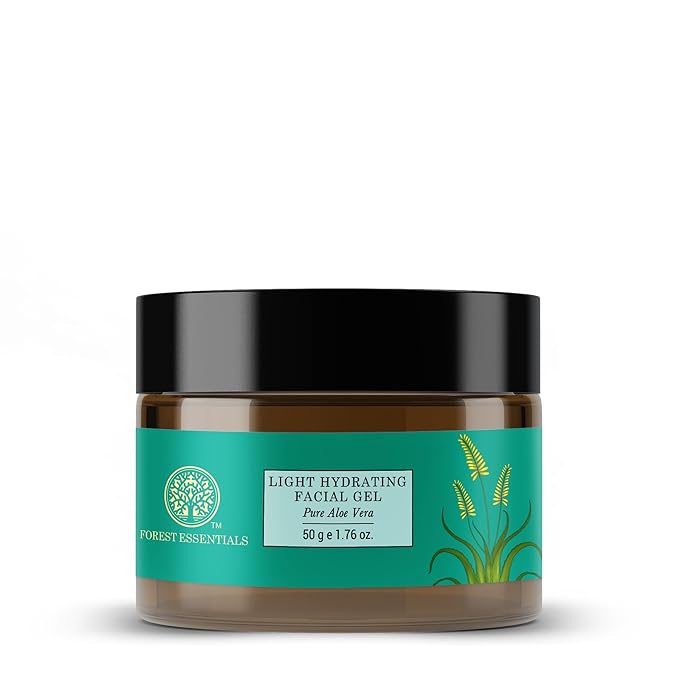
Light Hydrating Facial Gel Pure Aloe Vera

Light Hydrating Facial Gel Pure Aloe Vera
Forest Essentials
light-hydrating-facial-gel-pure-aloe-vera
Moisturize
9706840654117
Morning or Evening?
How often will you use this product?
Notes


Highlights
WHAT IS IT?
A hydrating facial gel with Aloe Vera and other Ayurvedic extracts
FEATURES
Naturally cooling, moisturizing, hydrating, soothing, refreshing
BEST FOR
likely suitable for all skin types including sensitive skin
CHECKS
Free of harsh chemicals, parabens, sulfates
Who Is It For?
Suitable For Adults Of All GendersWhat Does It Help With?
Hydration Soothing And Refreshing The SkinBudget
Mid-rangeHow To Use
Which routine should it be used in?
Instructions:
Key Information


What Forest Essentials Says
Product Description:
This Light Hydrating Aloe Vera Facial Gel is a blend of naturally hydrating pure Aloe Vera and Glycerin that soothes, refreshes and moisturizes the skin.
About the Brand:
Ingredients Overview
Ingredients List
Fresh Aloe Vera Leaf Pulp (Aloe Barbadensis) - 30.0%, Wheat Germ Seed Extract (Triticum Vulgare) - 15.0%, Ashwagandha Root Extract (Withania Somnifera) - 15.0%. Base Contains Aqua, Dehydroxanthan Gum (Natural Thickener), Sodium Lavulinate &Sodium Anisate (Natural Preservative) , Phytic Acid (Natural Chelating Agent) - Q.S.
Key Ingredients
Aloe Vera, Wheat Germ Oil, Ashwagandha
Ingredients Details
Dehydroxanthan Gum
Common Name(s): Modified xanthan gum,enhanced sensory biopolymer thickener,natural origin rheology modifier
CAS Number: N/a
DESCRIPTION
What It Does: Provides efficient aqueous thickening with improved sensory profile — less stringiness, smoother skin feel, better cold processability — versus native xanthan while retaining the electrolyte tolerance and natural origin.
Why It's Used: Modified xanthan solves native xanthan's main formulation limitation (draggy, stringy texture) without abandoning the biopolymer's core benefits — enabling natural-label formulations with premium sensory performance.
How It Works: Chemical modification alters xanthan double-helix conformation and inter-chain association. pyruvate removal (dehydroxanthan) reduces anionic side-chain repulsion producing shorter relaxation times and lower elasticity (less stringy); hydroxypropyl substitution disrupts crystalline ordering for improved cold-water dispersion.
Typically Found In: Premium natural skin care,cold-process formulas
TECHNICAL DETAILS
Primary Category: Active ingredient – cosmetic active
Secondary Functions: Skin conditioning
Application Areas:

Facial Skincare

Body Care
Hair Care
Beard Care
Color Cosmetics (Makeup)
Dietary/Oral Supplements
Typical Concentration Range: 0.1%–2%
SOURCING & ETHICS
Vegan Status: Yes
Halal Status: Yes
Source Notes: Commercially produced for cosmetic use. verify vegan/halal status with supplier.
SKIN COMPATIBILITY
Irritancy Rating: 1/5 – very low
Comedogenicity Rating: 0/5 – non-comedogenic
Sensitivity Concerns: Well-tolerated by most skin types.
Safe for Sensitive Skin: Yes
SAFETY & COMPATIBILITY
Safety Profile: Good safety profile at recommended concentrations. ewg score: 1–2.
Works Well With: Standard skincare actives
Avoid Combining With: No known significant incompatibilities
SCIENTIFIC NOTE
Modified xanthan inci names signal specific modification chemistry to informed formulators — enabling rational selection based on target application: dehydroxanthan for spray applications; hydroxypropyl for cold-process natural-certified systems.
Last Verified: Cosing database,dehydroxanthan gum modified xanthan sensory improvement review
Primary Sources: 2026-03-12
Phytic Acid
Common Name(s): Inositol hexaphosphate,ip6,phytate
CAS Number: 83-86-3
DESCRIPTION
What It Does: Provides multi-function brightening through copper chelation, antioxidant, and gentle exfoliant activity.
Why It's Used: Multi-function brightener — phytic acid's six phosphate groups provide copper chelation for tyrosinase inhibition alongside direct antioxidant and gentle aha-like exfoliation in a natural grain-derived compound.
How It Works: Six phosphate groups provide multiple copper-chelating sites for tyrosinase active site copper removal. also chelates iron for antioxidant (fenton reaction inhibition). mild acidic ph provides gentle aha-like exfoliation. found naturally in rice bran, legumes.
Typically Found In: Natural brightening products,multi-function serums,rice-derived formulas
TECHNICAL DETAILS
Primary Category: Active ingredient – ip6 brightening chelator
Secondary Functions: Melanin inhibition,hyperpigmentation reduction
Application Areas:
Facial Skincare
Body Care
Hair Care
Beard Care
Color Cosmetics (Makeup)
Dietary/Oral Supplements
Typical Concentration Range: 0.1%–5%
SOURCING & ETHICS
Vegan Status: Yes – from rice bran, wheat, legumes
Halal Status: Yes
Source Notes: Synthetic or plant-derived.
SKIN COMPATIBILITY
Irritancy Rating: 1/5 – very low
Comedogenicity Rating: 0/5 – non-comedogenic
Sensitivity Concerns: Non-irritating; well-tolerated.
Safe for Sensitive Skin: Yes
SAFETY & COMPATIBILITY
Safety Profile: Excellent safety profile. use with spf for maximum efficacy. ewg score: 1.
Works Well With: Niacinamide,vitamin c,alpha-arbutin,tranexamic acid,spf
Avoid Combining With: No significant incompatibilities
SCIENTIFIC NOTE
Phytic acid's hexaphosphate structure gives it six chelating sites for metal ions — iron and copper are the primary targets. by chelating both copper (tyrosinase cofactor) and iron (fenton reaction catalyst), phytic acid simultaneously inhibits melanin synthesis and prevents oxidative damage — a dual brightening + antioxidant mechanism from a single plant-derived molecule.
Last Verified: Cosing database,graf phytic acid review
Primary Sources: 2026-03-12
Sodium Anisate
Common Name(s): Sodium anisate,cosmetic active,functional ingredient
CAS Number: N/a
DESCRIPTION
What It Does: Delivers characteristic cosmetic function at recommended use concentration.
Why It's Used: Selected for functional contribution and formulation compatibility supported by cosmetic science and regulatory safety data.
How It Works: Works through the mechanism of its molecular class as documented in peer-reviewed cosmetic literature.
Typically Found In: Skin care formulations
TECHNICAL DETAILS
Primary Category: Active ingredient – cosmetic active
Secondary Functions: Skin conditioning
Application Areas:
Facial Skincare
Body Care
Hair Care
Beard Care
Color Cosmetics (Makeup)
Dietary/Oral Supplements
Typical Concentration Range: 0.1%–10%
SOURCING & ETHICS
Vegan Status: Conditional
Halal Status: Yes
Source Notes: Commercially produced for cosmetic use. verify vegan/halal status with supplier.
SKIN COMPATIBILITY
Irritancy Rating: 1/5 – very low
Comedogenicity Rating: 0/5 – non-comedogenic
Sensitivity Concerns: Well-tolerated by most skin types.
Safe for Sensitive Skin: Yes
SAFETY & COMPATIBILITY
Safety Profile: Good safety profile at recommended concentrations. ewg score: 1–2.
Works Well With: Standard skincare actives
Avoid Combining With: No known significant incompatibilities
SCIENTIFIC NOTE
Sodium anisate has an established safety profile within the cosmetic regulatory framework at standard use concentrations.
Last Verified: Cosing database,sodium anisate technical literature
Primary Sources: 2026-03-12
