
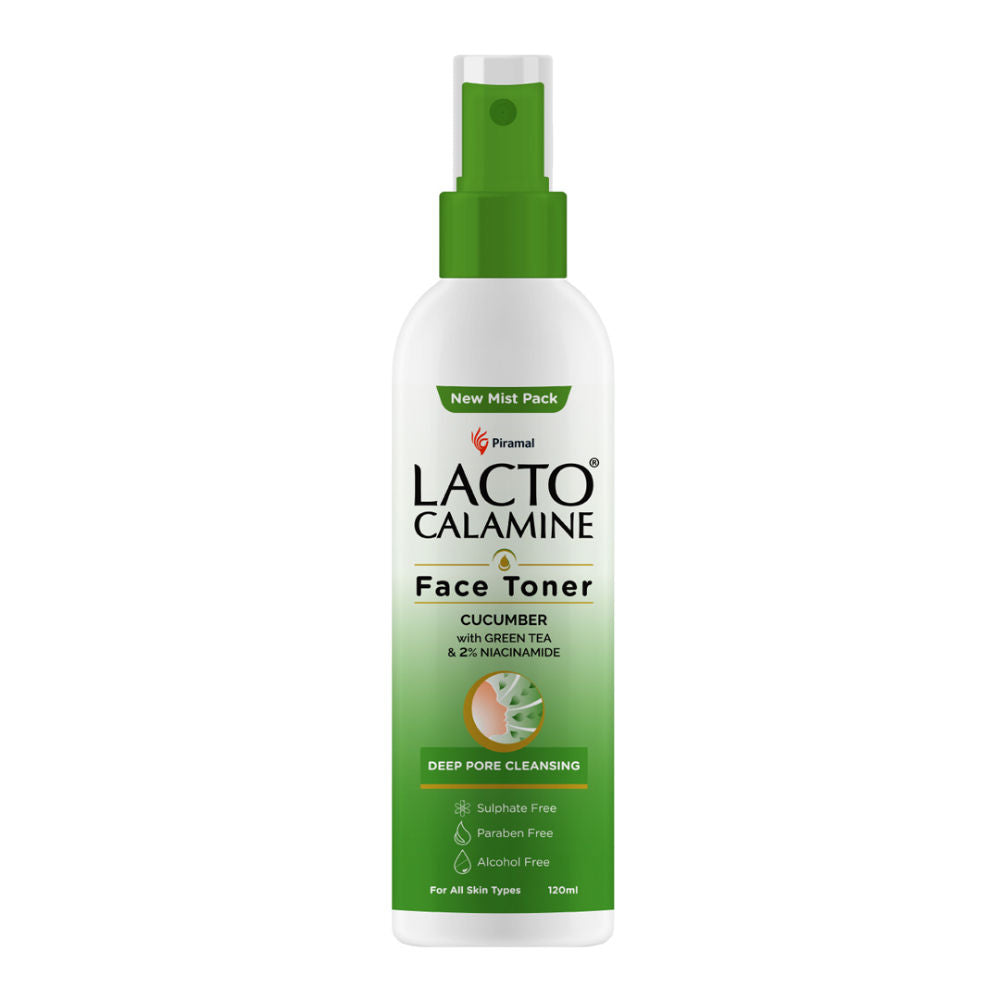

Lacto Calamine
Lacto Calamine Cucumber Face Toner with Green Tea, 2% Niacinamide for Cool & Hydrated Skin

Lacto Calamine Cucumber Face Toner with Green Tea, 2% Niacinamide for Cool & Hydrated Skin
Lacto Calamine
lacto-calamine-cucumber-face-toner-with-green-tea-2-niacinamide-for-cool-hydrated-skin
Tone
10084969251109
Morning or Evening?
How often will you use this product?
Notes


Highlights
WHAT IS IT?
Face Toner with 3 key ingredients
FEATURES
Helps control excess oil, cools and hydrates skin, has antimicrobial properties
BEST FOR
oily
CHECKS
Paraben-Free, Sulfate-free, Preservative-free (implied since not mentioned), Fragrance-free (implied since not mentioned)
Who Is It For?
All Genders No Specific Age Range MentionedWhat Does It Help With?
Oil Control Hydration Antimicrobial Benefits Cooling EffectBudget
Affordable (under $30)How To Use
Which routine should it be used in?
Instructions:
Key Information


What Lacto Calamine Says
Product Description:
Explore the entire range of Toners & Mists available on Nykaa. Shop more Lacto Calamine products here. You can browse through the complete world of Lacto Calamine Toners & Mists.
About the Brand:
Ingredients Overview
Ingredients List
Purified Water, Niacinamide, Glycerin, Capryloyl Glycine, Sodium Salicylate, Sodium PCA, D-Panthenol, Camellia sinensis (Green Tea) Leaf Extract, Cucumis sativus (Cucumber) Extract, Aloe barbadensis (Aloe Vera) Leaf Extract Phenoxyethanol, Ethylhexylglycerin, Disodium Cocoamphodiacetate, Sodium Gluconate, Imidazolidinyl Urea, PEG-40 Hydrogenated Castor Oil, Perfume, CI 19140/CI 42051, Benzyl Salicylate, Hexyl Cinnamal, Butylphenyl Methylpropional, D-Limonene, Linalool, Citronellol
Key Ingredients
Niacinamide, Cucumber, Green Tea
Ingredients Details
Benzyl Salicylate
Common Name(s): Benzyl 2-hydroxybenzoate,salicylate ester
CAS Number: 118-58-1
DESCRIPTION
What It Does: Provides floral-balsamic scent with uv-absorbing fixative properties.
Why It's Used: Natural jasmine-associated fragrance ester with mild uv protection contribution for fragranced sun-exposed products.
How It Works: Salicylate ester absorbs uv-b mildly. provides fixative function by slowing evaporation of lighter fragrance top notes. naturally in jasmine absolute (1-3%). good skin absorption.
Typically Found In: Floral fragrances,sun-exposed products
TECHNICAL DETAILS
Primary Category: Fragrance component – floral fixative
Secondary Functions: Skin conditioning
Application Areas:

Facial Skincare

Body Care
Hair Care
Beard Care
Color Cosmetics (Makeup)
Dietary/Oral Supplements
Typical Concentration Range: 0.001%–1%
SOURCING & ETHICS
Vegan Status: Yes – from jasmine absolute, or synthetic
Halal Status: Yes
Source Notes: Commercially produced for cosmetic use. verify vegan/halal status with supplier.
SKIN COMPATIBILITY
Irritancy Rating: 1/5 – very low
Comedogenicity Rating: 0/5 – non-comedogenic
Sensitivity Concerns: Well-tolerated by most skin types.
Safe for Sensitive Skin: Yes
SAFETY & COMPATIBILITY
Safety Profile: Eu cosmetics regulation: declared fragrance allergen. ifra guidelines apply.
Works Well With: Standard skincare actives
Avoid Combining With: No known significant incompatibilities
SCIENTIFIC NOTE
Benzyl salicylate's salicylate moiety provides uv absorption in the uvb range (absorbs at 295-315nm) despite not being a registered uv filter. its occurrence in jasmine absolute means natural jasmine-fragranced products inherently contain a mild uv absorber – an incidental benefit of the natural fragrance chemistry that wasn't intentionally designed as photoprotection.
Last Verified: Cosing database,ifra standards
Primary Sources: 2026-03-12
Butylphenyl Methylpropional
Common Name(s): Fragrance ingredient,eu allergen or aromatic component,olfactory/flavour
CAS Number: N/a
DESCRIPTION
What It Does: Provides specific aromatic character and olfactory experience contributing to product sensory experience and consumer appeal.
Why It's Used: Fragrance components are the primary cause of cosmetic contact sensitisation — eu requires individual label declaration of 26 identified fragrance allergens above threshold concentrations.
How It Works: Terpenoid and phenylpropanoid aromatic chemicals interact with olfactory receptor neurons (orns) in the nasal epithelium — small volatile molecules (logp 2–5, mw 100–300) bind g-protein coupled olfactory receptors triggering neurological scent perception. sensitisation risk from electrophilic reactivity of certain functional groups (aldehydes, α,β-unsaturated carbonyls) with skin proteins.
Typically Found In: All fragrance products
TECHNICAL DETAILS
Primary Category: Active ingredient – cosmetic active
Secondary Functions: Skin conditioning
Application Areas:
Facial Skincare
Body Care
Hair Care
Beard Care
Color Cosmetics (Makeup)
Dietary/Oral Supplements
Typical Concentration Range: Declare on label above threshold (eu)
SOURCING & ETHICS
Vegan Status: Conditional
Halal Status: Yes
Source Notes: Commercially produced for cosmetic use. verify vegan/halal status with supplier.
SKIN COMPATIBILITY
Irritancy Rating: 1/5 – very low
Comedogenicity Rating: 0/5 – non-comedogenic
Sensitivity Concerns: Well-tolerated by most skin types.
Safe for Sensitive Skin: Yes
SAFETY & COMPATIBILITY
Safety Profile: Good safety profile at recommended concentrations. ewg score: 1–2.
Works Well With: Standard skincare actives
Avoid Combining With: No known significant incompatibilities
SCIENTIFIC NOTE
Eu 1223/2009 annex iii allergen threshold: >0.001% in rinse-off, >0.0001% in leave-on — any listed allergen exceeding these levels requires individual inci label declaration separate from the generic fragrance/parfum declaration.
Last Verified: Eu regulation 1223/2009 annex iii,fragrance allergen declaration requirements
Primary Sources: 2026-03-12
Capryloyl Glycine
Common Name(s): N-capryloyl glycine,dermosoft gmcy
CAS Number: 14246-53-8
DESCRIPTION
What It Does: Provides antimicrobial and sebum-regulating activity from naturally-derived caprylic acid-glycine conjugate.
Why It's Used: Natural multifunctional antimicrobial — capryloyl glycine's anti-seborrheic and antimicrobial dual action provides comprehensive oily skin and anti-dandruff benefits from a single naturally-sourced ingredient.
How It Works: Acyl glycine conjugate provides antimicrobial via fatty acid membrane disruption mechanism. inhibits lipase enzyme reducing sebum fatty acid liberation (sebum regulation). mild surfactant from carboxylate head group. anti-dandruff via malassezia inhibition.
Typically Found In: Anti-seborrheic products,natural antimicrobials,anti-dandruff
TECHNICAL DETAILS
Primary Category: Functional ingredient – acyl amino acid surfactant/preservative
Secondary Functions: Skin conditioning
Application Areas:
Facial Skincare
Body Care
Hair Care
Beard Care
Color Cosmetics (Makeup)
Dietary/Oral Supplements
Typical Concentration Range: 0.5%–2%
SOURCING & ETHICS
Vegan Status: Yes – caprylic acid from coconut + glycine from plant fermentation
Halal Status: Yes
Source Notes: Commercially produced for cosmetic use. verify vegan/halal status with supplier.
SKIN COMPATIBILITY
Irritancy Rating: 1/5 – very low
Comedogenicity Rating: 0/5 – non-comedogenic
Sensitivity Concerns: Well-tolerated by most skin types.
Safe for Sensitive Skin: Yes
SAFETY & COMPATIBILITY
Safety Profile: Good safety profile at recommended concentrations. ewg score: 1–2.
Works Well With: Standard skincare actives
Avoid Combining With: No known significant incompatibilities
SCIENTIFIC NOTE
Capryloyl glycine's sebum regulation via lipase inhibition mirrors the same mechanism as triethyl citrate and ethylhexylglycerin — convergent mechanism discovery across structurally diverse ingredient classes. the parallel lipase inhibition by ester-based (triethyl citrate), ether-based (ethylhexylglycerin), and amide-based (capryloyl glycine) compounds validates lipase inhibition as a universally accessible target for sebum control through multiple chemical approaches.
Last Verified: Cosing database,schülke dermosoft gmcy technical data
Primary Sources: 2026-03-12
Citronellol
Common Name(s): (r)-3,7-dimethyl-6-octen-1-ol,rhodinol
CAS Number: 106-22-9
DESCRIPTION
What It Does: Provides soft, lasting rose-floral fragrance note.
Why It's Used: Essential rose fragrance monoterpene for lasting smooth floral notes in high-quality perfumery and cosmetic fragrances.
How It Works: Allylic alcohol monoterpene provides fixative property in fragrance blends. good skin substantivity for lasting scent. softer, rounder rose note vs geraniol's fresher character. natural in rose otto at 18-34%.
Typically Found In: Rose perfumes,floral fragrances,luxury skincare
TECHNICAL DETAILS
Primary Category: Fragrance component – monoterpene alcohol
Secondary Functions: Skin conditioning
Application Areas:
Facial Skincare
Body Care
Hair Care
Beard Care
Color Cosmetics (Makeup)
Dietary/Oral Supplements
Typical Concentration Range: 0.001%–1%
SOURCING & ETHICS
Vegan Status: Yes – from rose, geranium, citronella oils
Halal Status: Yes
Source Notes: Commercially produced for cosmetic use. verify vegan/halal status with supplier.
SKIN COMPATIBILITY
Irritancy Rating: 1/5 – very low
Comedogenicity Rating: 0/5 – non-comedogenic
Sensitivity Concerns: Well-tolerated by most skin types.
Safe for Sensitive Skin: Yes
SAFETY & COMPATIBILITY
Safety Profile: Eu cosmetics regulation: declared fragrance allergen. ifra guidelines apply.
Works Well With: Standard skincare actives
Avoid Combining With: No known significant incompatibilities
SCIENTIFIC NOTE
Citronellol's r-enantiomer (natural) vs s-enantiomer (synthetic) provide meaningfully different scent character – a remarkable demonstration of chiral scent discrimination by olfactory receptors. the (r) form provides the characteristic rose note while the (s) form has a distinctly different, less pleasant character. this enantiomeric scent difference means that the biological handedness of naturally-sourced vs racemic synthetic citronellol produces perceptibly different fragrance quality.
Last Verified: Cosing database,ifra standards
Primary Sources: 2026-03-12
