

Nykaa E retail limited
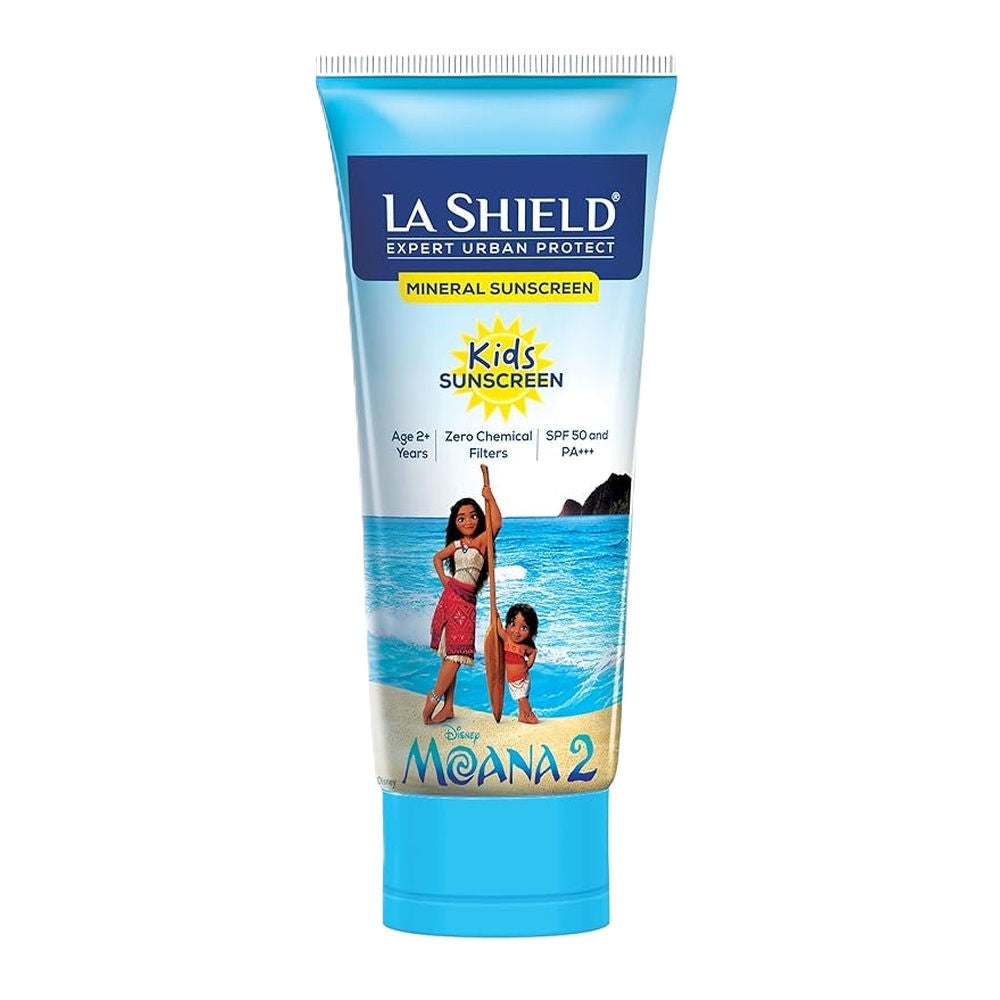
LA SHIELD KIDS SUNSCREEN SPF 50 PA+++ ZERO CHEMICAL FILTERS KIDS 2+ YEARS VIT E+ HYALURONATE(65G)

LA SHIELD KIDS SUNSCREEN SPF 50 PA+++ ZERO CHEMICAL FILTERS KIDS 2+ YEARS VIT E+ HYALURONATE(65G)
Nykaa E retail limited
la-shield-kids-sunscreen-spf-50-pa-zero-chemical-filters-kids-2-years-vit-e-hyaluronate-65g
Suncare
10084911022373
Morning or Evening?
How often will you use this product?
Notes


Highlights
WHAT IS IT?
Mineral sunscreen with SPF 50 PA+++
FEATURES
Zero chemical filters, Contains Vitamin E and Hyaluronate
BEST FOR
sensitive
CHECKS
Chemical filters free
Who Is It For?
Children 2+ YearsWhat Does It Help With?
Sun Protection Skin HydrationBudget
Affordable (under $30)How To Use
Which routine should it be used in?
Instructions:
Key Information


What Nykaa E retail limited Says
Product Description:
A kids sunscreen with SPF 50 PA+++ protection, containing Vitamin E and Hyaluronate, specifically formulated for children 2+ years
About the Brand:
Ingredients Overview
Ingredients List
Aqua, Zinc Oxide, C12-15 Alkyl benzoate, isostearic acid, polyhydroxystearic acid, cyclopentasilozane, Aluminium starch octenylsuccinate, Titanium dioxide, silica, socium chloride, Magnesium Aluminium Silicate, Xanthan Gum, Sodium hyaluronate
Key Ingredients
Vitamin E, Hyaluronate
Ingredients Details
C12-15 Alkyl Benzoate
Common Name(s): C12-15 alkyl benzoate,cosmetic active,functional ingredient
CAS Number: N/a
DESCRIPTION
What It Does: Delivers characteristic cosmetic function at recommended use concentration.
Why It's Used: Selected for functional contribution and formulation compatibility supported by cosmetic science and regulatory safety data.
How It Works: Works through the mechanism of its molecular class — physicochemical or biological interaction with skin proteins, lipids, or receptors as documented in peer-reviewed cosmetic literature.
Typically Found In: Skin care formulations
TECHNICAL DETAILS
Primary Category: Active ingredient – cosmetic active
Secondary Functions: Skin conditioning
Application Areas:

Facial Skincare

Body Care
Hair Care
Beard Care
Color Cosmetics (Makeup)
Dietary/Oral Supplements
Typical Concentration Range: 0.1%–10%
SOURCING & ETHICS
Vegan Status: Conditional - supplier confirmation required
Halal Status: Unverified - supplier confirmation required
Source Notes: Commercially produced for cosmetic use. verify vegan/halal status with supplier. [audit 2026-07-29 rev2: the record's own source_notes does not assert a non-animal origin, or instructs the reader to verify with the supplier; "yes" asserts knowledge the record does not hold. determination requires shariah-panel sign-off.]
SKIN COMPATIBILITY
Irritancy Rating: 1/5 – very low
Comedogenicity Rating: 0/5 – non-comedogenic
Sensitivity Concerns: Well-tolerated by most skin types.
Safe for Sensitive Skin: Yes
SAFETY & COMPATIBILITY
Safety Profile: Good safety profile at recommended concentrations. ewg score: 1–2.
Works Well With: Standard skincare actives
Avoid Combining With: No known significant incompatibilities
SCIENTIFIC NOTE
C12-15 alkyl benzoate has an established safety and efficacy profile within the cosmetic regulatory framework at standard use concentrations.
Last Verified:
Isostearic Acid
Common Name(s): Isooctadecanoic acid,branched c18 fatty acid
CAS Number: 2724-58-5
DESCRIPTION
What It Does: Provides liquid c18 emolliency with excellent oxidative stability and pigment compatibility.
Why It's Used: Premium liquid fatty acid emollient for colour cosmetics and antiperspirant sticks requiring liquid c18 character at room temperature without the unsaturation and oxidation sensitivity of oleic acid.
How It Works: Branched c18 structure provides low melting point (liquid at room temperature, vs stearic acid mp 69°c). excellent chemical stability (no double bonds vs oleic acid's one). good pigment wetting and dispersibility for colour cosmetics. skin-conditioning from fatty acid chain.
Typically Found In: Colour cosmetics,antiperspirant sticks,stable lip products
TECHNICAL DETAILS
Primary Category: Functional ingredient – branched fatty acid
Secondary Functions: Barrier sealing,softening
Application Areas:
Facial Skincare
Body Care
Hair Care
Beard Care
Color Cosmetics (Makeup)
Dietary/Oral Supplements
Typical Concentration Range: 0.5%–15%
SOURCING & ETHICS
Vegan Status: Conditional - feedstock declaration required
Halal Status: Unverified - feedstock declaration required (plant, animal and petrochemical routes all exist)
Source Notes: Plant-derived, synthetic or animal-derived. verify source. [audit 2026-07-29 rev2: origin-dependent: the same inci exists in plant, animal and petrochemical versions and the name does not discriminate. determination requires shariah-panel sign-off.]
SKIN COMPATIBILITY
Irritancy Rating: 1/5 – very low
Comedogenicity Rating: 1/5 – low; formulation-dependent
Sensitivity Concerns: Non-irritating.
Safe for Sensitive Skin: Yes
SAFETY & COMPATIBILITY
Safety Profile: Excellent safety profile. ewg score: 1.
Works Well With: Humectants,ceramides,actives as carrier
Avoid Combining With: No significant incompatibilities
SCIENTIFIC NOTE
Isostearic acid's liquid-state advantage over stearic acid arises from the methyl branch disrupting crystal packing: while linear stearic acid forms tight crystalline packing above 69°c (solid at room temperature), the methyl branch in isostearic acid prevents efficient crystal lattice formation, keeping it liquid at room temperature. this crystalline packing disruption principle is analogous to how cell membrane unsaturated fatty acids maintain membrane fluidity.
Last Verified: 2026-03-12
Primary Sources: Cosing database,cir safety assessment
Polyhydroxystearic Acid
Common Name(s): Polyhydroxystearic acid,phsa,12-hydroxystearic acid polymer
DESCRIPTION
What It Does: Helps create stable w/o emulsions and keeps mineral sunscreen ingredients evenly dispersed.
Why It's Used: Phsa is specifically valuable in sunscreen formulations for stabilizing mineral sunscreens (tio2/zno) in w/o emulsions and for dispersing mineral pigments in color cosmetics.
How It Works: Polymerized 12-hydroxystearic acid forms a coiled polymer structure that adsorbs onto mineral particle surfaces; stabilizes pigment/sunscreen dispersions by steric exclusion; enables stable w/o emulsions with mineral uv filters.
Typically Found In: Mineral sunscreens,color cosmetics,w/o emulsions,pigment dispersions
TECHNICAL DETAILS
Primary Category: Functional ingredient – emulsifier
Secondary Functions: Dispersing agent,pigment dispersing,w/o emulsification
Application Areas:
Facial Skincare
Body Care
Hair Care
Beard Care
Color Cosmetics (Makeup)
Dietary/Oral Supplements
Typical Concentration Range: 0.5%–5%
SOURCING & ETHICS
Vegan Status: Conditional - feedstock declaration required
Halal Status: Unverified - feedstock declaration required (plant, animal and petrochemical routes all exist)
Source Notes: Polymerized 12-hydroxystearic acid from hydrogenated castor oil (ricinus communis); naturally derived. [audit 2026-07-29 rev2: origin-dependent: the same inci exists in plant, animal and petrochemical versions and the name does not discriminate. determination requires shariah-panel sign-off.]
SKIN COMPATIBILITY
Irritancy Rating: 1/5 – very low
Comedogenicity Rating: 1/5 – low
Sensitivity Concerns: Generally well tolerated. used extensively in sunscreen formulation.
Safe for Sensitive Skin: Yes
SAFETY & COMPATIBILITY
Safety Profile: Excellent safety profile. ewg score: 1.
Works Well With: Hydrogenated castor oil derivatives,mineral sunscreens (tio2/zno),mineral pigments,w/o emulsifiers
Avoid Combining With: Not compatible with highly aqueous systems (lipophilic polymer)
SCIENTIFIC NOTE
Polyhydroxystearic acid (phsa) is a specialty polymer emulsifier derived from ricinoleic acid polymerization; it adsorbs onto mineral particle surfaces via the terminal carboxylic acid, with the polymer chains providing steric stabilization of the particle dispersion.
Last Verified: 2026-03-27
Primary Sources: Cosing database,inci dictionary,croda hypermer sunscreen technology,european sunscreen association
Silica
Common Name(s): Silica,cosmetic active,functional ingredient
CAS Number: N/a
DESCRIPTION
What It Does: Delivers characteristic cosmetic function at recommended use concentration.
Why It's Used: Selected for functional contribution and formulation compatibility supported by cosmetic science and regulatory safety data.
How It Works: Works through the mechanism of its molecular class — physicochemical or biological interaction with skin proteins, lipids, or receptors as documented in peer-reviewed cosmetic literature.
Typically Found In: Skin care formulations
TECHNICAL DETAILS
Primary Category: Active ingredient – cosmetic active
Secondary Functions: Skin conditioning
Application Areas:
Facial Skincare
Body Care
Hair Care
Beard Care
Color Cosmetics (Makeup)
Dietary/Oral Supplements
Typical Concentration Range: 0.1%–10%
SOURCING & ETHICS
Vegan Status: Conditional - supplier confirmation required
Halal Status: Unverified - supplier confirmation required
Source Notes: Commercially produced for cosmetic use. verify vegan/halal status with supplier. [audit 2026-07-29 rev2: the record's own source_notes does not assert a non-animal origin, or instructs the reader to verify with the supplier; "yes" asserts knowledge the record does not hold. determination requires shariah-panel sign-off.]
SKIN COMPATIBILITY
Irritancy Rating: 1/5 – very low
Comedogenicity Rating: 0/5 – non-comedogenic
Sensitivity Concerns: Well-tolerated by most skin types.
Safe for Sensitive Skin: Yes
SAFETY & COMPATIBILITY
Safety Profile: Good safety profile at recommended concentrations. ewg score: 1–2.
Works Well With: Standard skincare actives
Avoid Combining With: No known significant incompatibilities
SCIENTIFIC NOTE
Silica has an established safety and efficacy profile within the cosmetic regulatory framework at standard use concentrations.
Last Verified: 2026-03-12
Primary Sources: Cosing database,silica technical literature