

Klairs
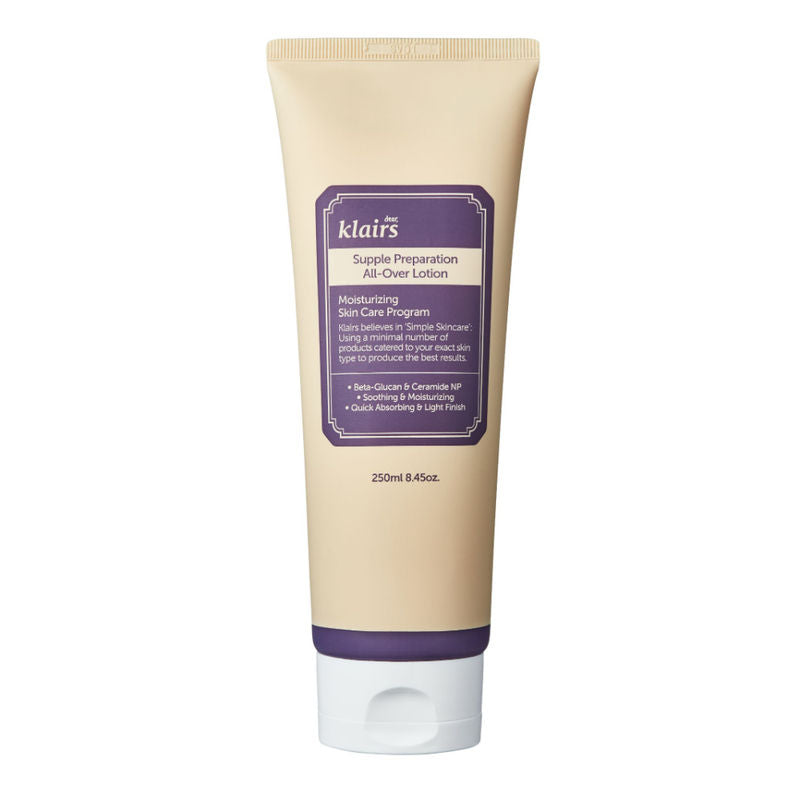
Klairs Supple Preparation All Over Lotion

Klairs Supple Preparation All Over Lotion
Klairs
klairs-supple-preparation-all-over-lotion
Moisturize
10084768121125
Morning or Evening?
How often will you use this product?
Notes


Highlights
WHAT IS IT?
all-in-one lotion, multiple key ingredients
FEATURES
Hydrating lotion for face and body,Makes skin smooth and hydrated without stickiness,Enhances moisture retention and prevents drying,Strengthens skin barrier,Relieves irritation and nourishes skin,Suitable for all skin types including sensitive skin
BEST FOR
sensitive
CHECKS
Fragrance-free,Non-comedogenic
Who Is It For?
All Ages And GendersWhat Does It Help With?
Moisturizing Hydration Skin Barrier Strengthening Irritation Relief Antioxidant ProtectionBudget
Premium ($76-$150)How To Use
Which routine should it be used in?
Instructions:
Key Information


What Klairs Says
Product Description:
The Dear, Klairs Supple Preparation All Over Lotion is an all-in-one lotion that provides refreshing moisture from head to toe, strengthens the skin barrier, and provides antioxidant effects. It keeps the skin from drying for a long time and forms a barrier to keep the skin protected from external stressors. Also, it helps to relieve irritation with ceramide NP, hyaluronic acid, polyquaternium-51, and beta-glucan while shea butter and jojoba oil nourishes delicate skin.
About the Brand:
Ingredients Overview
Ingredients List
Water,Glycerin,Caprylic/Capric Triglyceride,Sodium Hyaluronate,Butyrospermum Parkii (Shea Butter),Cetyl Ethylhexanoate,Simmondsia Chinensis (Jojoba) Seed Oil,Glyceryl Stearate,Sorbitan Stearate,Cetyl Alcohol,Stearic Acid,Beta-Glucan,Sorbitan Sesquioleate,Microcrystalline Wax,Cyclopentasiloxane,Betaine,Ceramide NP,Polyquaternium-51,PEG-100 Stearate,Illicium Verum(Anise) Fruit Extract,Citrus Paradisi(Grapefruit) Fruit Extract,Nelumbium Speciosum Flower Extract,Paeonia Suffruticosa Root Extract,Scutellaria Baicalensis Root Extract,Dimethicone,Tocopheryl Acetate,Chlorphenesin,Carbomer,Arginine,Citric Acid,Ethylhexylglycerin,Portulaca Oleracea Extract,Althaea Rosea Flower Extract,Aloe Barbadensis Leaf Extract,Apium Graveolens (Celery) Extract,Brassica Oleracea Capitata (Cabbage) Leaf Extract,Brassica Oleracea Italica (Broccoli) Extract,Brassica Rapa (Turnip) Leaf Extract,Daucus Carota Sativa (Carrot) Root Extract,Oryza Sativa (Rice) Bran Extract,Solanum Lycopersicum (Tomato) Fruit/Leaf/Stem Extract,Natto Gum,Centella Asiatica Extract,Disodium EDTA,Lysine HCL,Proline,Sodium Ascorbyl Phosphate,Acetyl Methionine,Theanine
Key Ingredients
Beta-Glucan,Hyaluronic Acid,Polyquaternium-51,Ceramide NP,Shea Butter,Jojoba Oil
Ingredients Details
Acetyl Methionine
Common Name(s): Acetyl methionine,cosmetic active,functional ingredient
CAS Number: N/a
DESCRIPTION
What It Does: Delivers characteristic cosmetic function at recommended use concentration.
Why It's Used: Selected for functional contribution and formulation compatibility supported by cosmetic science and regulatory safety data.
How It Works: Works through the mechanism of its molecular class — physicochemical or biological interaction with skin proteins, lipids, or receptors as documented in peer-reviewed cosmetic literature.
Typically Found In: Skin care formulations
TECHNICAL DETAILS
Primary Category: Active ingredient – cosmetic active
Secondary Functions: Skin conditioning
Application Areas:

Facial Skincare

Body Care
Hair Care
Beard Care
Color Cosmetics (Makeup)
Dietary/Oral Supplements
Typical Concentration Range: 0.1%–10%
SOURCING & ETHICS
Vegan Status: Conditional
Halal Status: Yes
Source Notes: Commercially produced for cosmetic use. verify vegan/halal status with supplier.
SKIN COMPATIBILITY
Irritancy Rating: 1/5 – very low
Comedogenicity Rating: 0/5 – non-comedogenic
Sensitivity Concerns: Well-tolerated by most skin types.
Safe for Sensitive Skin: Yes
SAFETY & COMPATIBILITY
Safety Profile: Good safety profile at recommended concentrations. ewg score: 1–2.
Works Well With: Standard skincare actives
Avoid Combining With: No known significant incompatibilities
SCIENTIFIC NOTE
Acetyl methionine has an established safety and efficacy profile within the cosmetic regulatory framework at standard use concentrations.
Last Verified: Cosing database,acetyl methionine technical literature
Primary Sources: 2026-03-12
Aloe Barbadensis Leaf Extract
Common Name(s): Aloe barbadensis leaf extract,botanical extract,phytochemical active
CAS Number: N/a
DESCRIPTION
What It Does: Provides antioxidant protection from reactive oxygen species, reduces inflammatory cytokine production in skin, and conditions skin surface through the plant's secondary metabolite complex.
Why It's Used: Chosen for its natural origin narrative, traditional use heritage, and multi-functional phytochemical profile that supports several concurrent skin care claims from one ingredient.
How It Works: Polyphenols, terpenoids, and alkaloids in the extract scavenge ros via hydrogen atom transfer, inhibit nf-kb or cox-2 inflammatory pathways, and interact with skin surface proteins for conditioning.
Typically Found In: Botanical skin care,natural products
TECHNICAL DETAILS
Primary Category: Active ingredient – antioxidant
Secondary Functions: Free radical scavenging,anti-aging
Application Areas:
Facial Skincare
Body Care
Hair Care
Beard Care
Color Cosmetics (Makeup)
Dietary/Oral Supplements
Typical Concentration Range: 0.1%–10%
SOURCING & ETHICS
Vegan Status: Yes
Halal Status: Yes
Source Notes: Plant-derived extract or synthetic.
SKIN COMPATIBILITY
Irritancy Rating: 1/5 – very low
Comedogenicity Rating: 0/5 – non-comedogenic
Sensitivity Concerns: Non-irritating; well-tolerated.
Safe for Sensitive Skin: Yes
SAFETY & COMPATIBILITY
Safety Profile: Excellent safety profile. ewg score: 1.
Works Well With: Vitamin c,vitamin e,ferulic acid,spf,other antioxidants
Avoid Combining With: No significant incompatibilities
SCIENTIFIC NOTE
Plant secondary metabolites evolved as uv photoprotectants and antimicrobial agents — mechanisms that directly translate to cosmetic antioxidant and anti-inflammatory activity in human skin.
Last Verified: Cosing database,aloe barbadensis leaf extract botanical review
Primary Sources: 2026-03-12
Althaea Rosea Flower Extract
Common Name(s): Althaea rosea flower extract,althaea rosea flower extract,botanical extract,phytochemical active
CAS Number: N/a
DESCRIPTION
What It Does: Provides antioxidant protection from polyphenol radical scavenging, anti-inflammatory activity from terpenoid nf-kb/cox pathway inhibition, and skin conditioning from the phytochemical secondary metabolite complex.
Why It's Used: Althaea rosea flower extract is selected for the characteristic secondary metabolite signature of althaea rosea — whether polyphenols, terpenoids, alkaloids, or polysaccharides, the phytochemical profile provides antioxidant, anti-inflammatory, or skin conditioning benefits specific to this botanical species.
How It Works: Botanical secondary metabolites: polyphenol catechol h-atom donation for ros scavenging (rate constants 10⁶-10⁹ m⁻¹s⁻¹); terpenoids inhibit iκb kinase blocking nf-κb; flavonoids compete at cox-1/2; alkaloids modulate specific receptors for targeted bioactivity.
Typically Found In: Botanical skin care
TECHNICAL DETAILS
Primary Category: Active ingredient – antioxidant
Secondary Functions: Free radical scavenging,anti-aging
Application Areas:
Facial Skincare
Body Care
Hair Care
Beard Care
Color Cosmetics (Makeup)
Dietary/Oral Supplements
Typical Concentration Range: 0.1%–10%
SOURCING & ETHICS
Vegan Status: Conditional
Halal Status: Conditional
Source Notes: Plant-derived extract or synthetic.
SKIN COMPATIBILITY
Irritancy Rating: 1/5 – very low
Comedogenicity Rating: 0/5 – non-comedogenic
Sensitivity Concerns: Non-irritating; well-tolerated.
Safe for Sensitive Skin: Yes
SAFETY & COMPATIBILITY
Safety Profile: Excellent safety profile. ewg score: 1.
Works Well With: Vitamin c,vitamin e,ferulic acid,spf,other antioxidants
Avoid Combining With: No significant incompatibilities
SCIENTIFIC NOTE
Standardise to marker compounds for consistent bioactivity — field-grown material varies 3-10× in secondary metabolite content.
Last Verified: Cosing database,althaea rosea flower extract botanical extract review
Primary Sources: 2026-03-22
Arginine
Common Name(s): L-arginine,2-amino-5-guanidinopentanoic acid
CAS Number: 74-79-3
DESCRIPTION
What It Does: Conditions skin, attracts moisture, supports wound healing, and improves microcirculation via no synthesis.
Why It's Used: Multi-functional amino acid for skin hydration, conditioning, and wound healing in peptide and nmf formulations.
How It Works: Guanidinium group binds water (humectant). substrate for nitric oxide synthase (enos) producing nitric oxide that vasodilates capillaries improving skin nutrition. stimulates fibroblast proliferation for wound healing.
Typically Found In: Anti-aging serums,wound healing products,nmf moisturizers,scalp treatments
TECHNICAL DETAILS
Primary Category: Active ingredient – amino acid
Secondary Functions: Wound healing,microcirculation,nmf component
Application Areas:
Facial Skincare
Body Care
Hair Care
Beard Care
Color Cosmetics (Makeup)
Dietary/Oral Supplements
Typical Concentration Range: 0.5%–5%
SOURCING & ETHICS
Vegan Status: Yes – plant-derived or synthetic
Halal Status: Yes
Source Notes: Fermentation-derived or synthetic. natural skin component.
SKIN COMPATIBILITY
Irritancy Rating: 1/5 – very low
Comedogenicity Rating: 0/5 – non-comedogenic
Sensitivity Concerns: Non-irritating; endogenous skin molecule.
Safe for Sensitive Skin: Yes
SAFETY & COMPATIBILITY
Safety Profile: Excellent safety profile. natural skin nmf component. ewg score: 1.
Works Well With: Hyaluronic acid,ceramides,peptides,other amino acids
Avoid Combining With: No significant incompatibilities
SCIENTIFIC NOTE
Arginine is a conditionally essential amino acid in wound healing where local demand exceeds synthesis capacity. topical arginine provides the nos substrate locally for no-mediated vasodilation and immune cell function in healing tissue.
Last Verified: Cosing database,cir safety assessment,witte & barbul arginine wound healing review
Primary Sources: 2026-03-12
