
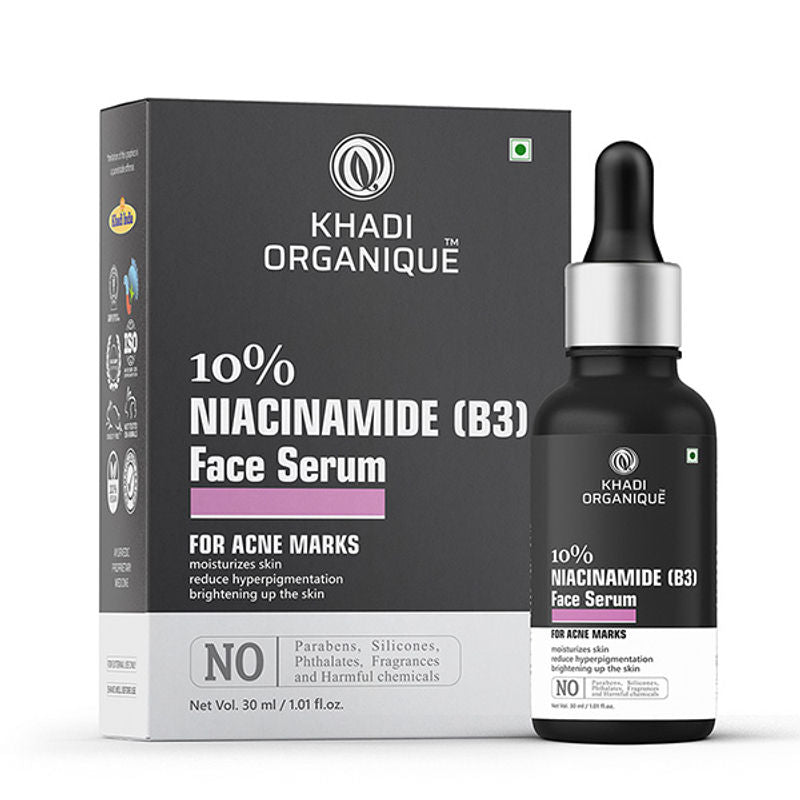

Khadi Organique
Khadi Organique 10% Niacinamide B3 Face Serum

Khadi Organique 10% Niacinamide B3 Face Serum
Khadi Organique
khadi-organique-10-niacinamide-b3-face-serum
Serum
10084910137637
Morning or Evening?
How often will you use this product?
Notes


Highlights
WHAT IS IT?
Face Serum with 5 key ingredients
FEATURES
Blemish and pore refining, 10% Niacinamide and Zinc infusion, Controls sebum, Brightens skin tone, Reduces hyperpigmentation, Evens complexion, Reduces acne marks, Antioxidant, Anti-aging, Repairs skin barrier, Hydrates skin, Prevents sagging, Stimulates collagen, Free from harmful chemicals, 100% vegan, cruelty free
BEST FOR
sensitive
CHECKS
Parabens, Sulphates, Silicone, Phthalates, Synthetic fragrance, Harmful chemicals
Who Is It For?
What Does It Help With?
Skin Elasticity Texture Fine Lines Wrinkles Dark Spots Sebum Control Hyperpigmentation Acne Marks Skin Hydration Collagen ProductionBudget
Affordable (under $30)How To Use
Which routine should it be used in?
Instructions:
Key Information


What Khadi Organique Says
Product Description:
Khadi Organique Niacinamide Face Serum effectively protects your skin from damage by neutralizing free radicals and regulating excess sebum secretion for plump and healthy looking skin. It easily improve skin’s elasticity and texture for reducing signs of aging such as fine lines, wrinkles and dark spots. This face serum is loaded With powerful antioxidants that strengthen your skin’s barrier and increases moisture content for younger, healthier looking skin. Features: Blemish and pore refining serum, Infused With 10% niacinamide and zinc, Controls sebum production in skin, Brightens skin tone and reduces hyperpigmentation, Evens out skin complexion, Helps to reduce the appearance of acne marks, Works as a powerful antioxidant, Fights premature signs of aging, Repairs damaged skin barrier, Moisturizes and hydrates skin, Prevents sagging skin and helps stimulate collagen production for a youthful glow, Free from parabens, sulphates, silicone, phthalates, synthetic fragrance and harmful chemicals, 100% vegan and cruelty free.
About the Brand:
Ingredients Overview
Ingredients List
Moringa Extract (Moringa oleifera) – 1.00%, Bearberry Extract (Arctostaphylos Uva Ursi) – 1.00%, Neem, Aqua, Propanediol, Xylitylglucoside, Polyglutamic Acid, Pullulan, Sodium Hyaluronate, Betaine, Hydroxyethyl cellulose, Disodium EDTA, Niacinamide (B3), Zinc PCA, Ethylhexylglycerin Extract (Melia azadirachta) – 1.00%, Aloe vera Extract (Aloe barbadensis) – 1.00%.
Key Ingredients
10% Niacinamide, Niacinamide (B3), Zinc PCA, Moringa, Bearberry
Ingredients Details
Betaine
Common Name(s): Trimethylglycine,tmg,natural betaine
CAS Number: 107-43-7
DESCRIPTION
What It Does: Provides osmoprotective humectant conditioning with anti-irritant and mild foam-boosting activity.
Why It's Used: Natural-origin multifunctional osmolyte from sugar beet providing hydration, anti-irritancy, and conditioning in virtually every cosmetic category.
How It Works: Quaternary ammonium betaine provides zwitterionic character for water binding via ionic hydration. osmoprotective function at 100–500mm as compatible solute protecting cells from osmotic stress. reduces surfactant irritation by competing with sls for protein binding sites. mild foam enhancement.
Typically Found In: Virtually all categories — moisturisers, shampoos, cleansers
TECHNICAL DETAILS
Primary Category: Functional ingredient – humectant
Secondary Functions: Tewl reduction,skin plumping
Application Areas:

Facial Skincare
Body Care
Hair Care

Beard Care
Color Cosmetics (Makeup)
Dietary/Oral Supplements
Typical Concentration Range: 0.5%–10%
SOURCING & ETHICS
Vegan Status: Yes – from beta vulgaris (sugar beet) molasses
Halal Status: Yes
Source Notes: Synthetic or naturally derived. excellent aqueous solubility.
SKIN COMPATIBILITY
Irritancy Rating: 1/5 – very low
Comedogenicity Rating: 0/5 – non-comedogenic
Sensitivity Concerns: Non-irritating; suitable for all skin types.
Safe for Sensitive Skin: Yes
SAFETY & COMPATIBILITY
Safety Profile: Excellent safety profile. ewg score: 1.
Works Well With: Ceramides,emollients,occlusives,glycerin,hyaluronic acid
Avoid Combining With: No significant incompatibilities
SCIENTIFIC NOTE
Betaine's anti-irritant mechanism for surfactant systems involves competitive protein protection: betaine at high concentrations preferentially interacts with skin proteins, occupying binding sites that would otherwise be occupied by surfactant molecules causing protein denaturation. this competition reduces available protein binding for irritating surfactants, explaining betaine's well-documented ability to reduce sls irritation when co-formulated.
Last Verified: Cosing database,craig betaine osmoprotective review,cir safety assessment
Primary Sources: 2026-03-12
Disodium Edta
Common Name(s): Edathamil disodium,edta disodium,versene 100
CAS Number: 139-33-3
DESCRIPTION
What It Does: Provides metal ion chelation to prevent product degradation and boost preservative and antioxidant efficacy.
Why It's Used: The most essential stability ingredient in cosmetics — disodium edta's metal chelation prevents rancidity, discoloration, and preservative failure caused by trace metal contamination in virtually all aqueous cosmetic formulations.
How It Works: Ethylenediaminetetraacetic acid provides six potential coordination sites for metal ions (aminodiacetate groups). chelates ca²⁺, mg²⁺ (stability), fe³⁺ (fenton radical prevention), cu²⁺ (oxidase inhibition). disrupts gram-negative bacterial outer membrane by chelating membrane calcium, enhancing preservative penetration.
Typically Found In: Virtually all aqueous cosmetics — creams, lotions, shampoos, toners
TECHNICAL DETAILS
Primary Category: Functional ingredient – chelating agent
Secondary Functions: Skin conditioning
Application Areas:
Facial Skincare
Body Care
Hair Care
Beard Care
Color Cosmetics (Makeup)
Dietary/Oral Supplements
Typical Concentration Range: 0.005%–0.1%
SOURCING & ETHICS
Vegan Status: Yes – synthetic
Halal Status: Yes
Source Notes: Commercially produced for cosmetic use. verify vegan/halal status with supplier.
SKIN COMPATIBILITY
Irritancy Rating: 1/5 – very low
Comedogenicity Rating: 0/5 – non-comedogenic
Sensitivity Concerns: Well-tolerated by most skin types.
Safe for Sensitive Skin: Yes
SAFETY & COMPATIBILITY
Safety Profile: Good safety profile at recommended concentrations. ewg score: 1–2.
Works Well With: Standard skincare actives
Avoid Combining With: No known significant incompatibilities
SCIENTIFIC NOTE
Disodium edta's preservative potentiation against gram-negative bacteria is mechanistically elegant: gram-negative outer membranes contain lipopolysaccharide stabilised by calcium and magnesium bridges. edta chelates these metal ions, destabilising the lps layer and creating pores that allow hydrophobic preservatives (phenoxyethanol, parabens) to penetrate — converting gram-negative-resistant preservatives into broad-spectrum ones.
Last Verified: Cosing database,cir safety assessment
Primary Sources: 2026-03-12
Polyglutamic Acid
Common Name(s): Pga,poly-l-glutamic acid,natto gum
CAS Number: 25513-46-6
DESCRIPTION
What It Does: Provides 4-5× greater water retention than hyaluronic acid for unmatched skin hydration.
Why It's Used: The most powerful humectant available – 4-5× the water-binding capacity of ha – for formulations requiring maximum hydration intensity in a single ingredient.
How It Works: High density of free glutamic acid carboxylate groups provides exceptional water binding capacity (~5000× its dry weight in water, vs ha's ~1000×). forms thin hydrating film on skin surface. inhibits hyaluronidase, protecting endogenous ha from degradation. also promotes ha synthesis.
Typically Found In: Premium hydrating serums,ultra-hydration products
TECHNICAL DETAILS
Primary Category: Active ingredient – microbial humectant
Secondary Functions: Maximum water retention,ha protection,film forming
Application Areas:
Facial Skincare
Body Care
Hair Care
Beard Care
Color Cosmetics (Makeup)
Dietary/Oral Supplements
Typical Concentration Range: 0.1%–5%
SOURCING & ETHICS
Vegan Status: Yes – bacillus subtilis fermentation
Halal Status: Yes
Source Notes: Synthetic or naturally derived. excellent aqueous solubility.
SKIN COMPATIBILITY
Irritancy Rating: 1/5 – very low
Comedogenicity Rating: 0/5 – non-comedogenic
Sensitivity Concerns: Non-irritating; suitable for all skin types.
Safe for Sensitive Skin: Yes
SAFETY & COMPATIBILITY
Safety Profile: Excellent safety profile. ewg score: 1.
Works Well With: Ceramides,emollients,occlusives,glycerin,hyaluronic acid
Avoid Combining With: No significant incompatibilities
SCIENTIFIC NOTE
Pga's water-holding capacity of ~5000g water/g pga (vs ha's ~1000g water/g) derives from its exceptionally dense carboxylate group array. the glutamic acid polymer backbone provides a carboxylate group every ~0.37nm along the chain – the highest density of water-binding anionic groups achievable in a linear biopolymer structure.
Last Verified: Cosing database,shen et al. polyglutamic acid cosmetic review
Primary Sources: 2026-03-12
Propanediol
Common Name(s): 1,3-propanediol,zemea,bio-propanediol
CAS Number: 504-63-2
DESCRIPTION
What It Does: Provides humectant and solvent functionality from sustainable corn-based fermentation.
Why It's Used: Bio-based propylene glycol alternative from renewable corn — propanediol provides equivalent functionality to propylene glycol with sustainable renewable feedstock and superior skin feel.
How It Works: Two oh groups provide humectant water binding. excellent solvent for fragrances, actives, and preservatives. mild antimicrobial from diol structure for preservative system boosting. renew corn fermentation origin (dupont zemea process). better skin feel than propylene glycol — less sticky.
Typically Found In: Virtually all cosmetic categories as pg alternative
TECHNICAL DETAILS
Primary Category: Functional ingredient – humectant
Secondary Functions: Tewl reduction,skin plumping
Application Areas:
Facial Skincare
Body Care
Hair Care
Beard Care
Color Cosmetics (Makeup)
Dietary/Oral Supplements
Typical Concentration Range: 1%–20%
SOURCING & ETHICS
Vegan Status: Yes – from corn sugar fermentation
Halal Status: Yes
Source Notes: Synthetic or naturally derived. excellent aqueous solubility.
SKIN COMPATIBILITY
Irritancy Rating: 1/5 – very low
Comedogenicity Rating: 0/5 – non-comedogenic
Sensitivity Concerns: Non-irritating; suitable for all skin types.
Safe for Sensitive Skin: Yes
SAFETY & COMPATIBILITY
Safety Profile: Excellent safety profile. ewg score: 1.
Works Well With: Ceramides,emollients,occlusives,glycerin,hyaluronic acid
Avoid Combining With: No significant incompatibilities
SCIENTIFIC NOTE
Propanediol's dupont tate & lyle bio products 'zemea' process ferments corn sugar to 1,3-propanediol using engineered e. coli — one of the first commercially viable bio-fermentation routes to a cosmetic diol previously made only from petroleum. the renewable route produces chemically identical 1,3-propanediol while reducing carbon footprint by approximately 40% vs petrochemical synthesis.
Last Verified: Cosing database,dupont tate & lyle zemea technical data,cir safety assessment
Primary Sources: 2026-03-12
