

Kama Ayurveda
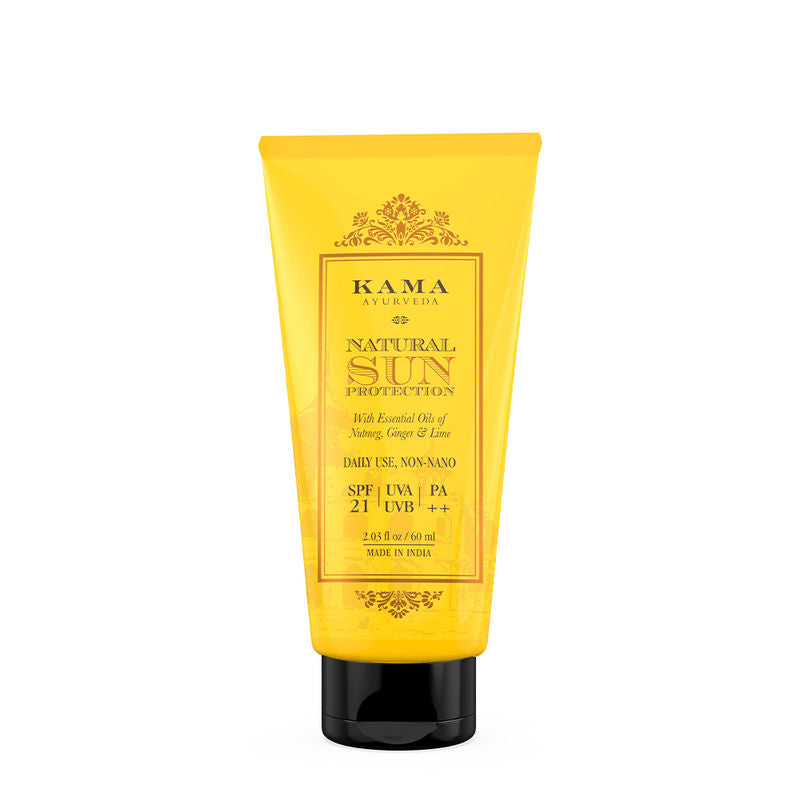
Kama Ayurveda Natural Sun Protection SPF-21 Sunscreen

Kama Ayurveda Natural Sun Protection SPF-21 Sunscreen
Kama Ayurveda
kama-ayurveda-natural-sun-protection-spf-21-sunscreen
Suncare
10084868030757
Morning or Evening?
How often will you use this product?
Notes


Highlights
WHAT IS IT?
Sunscreen product with natural ingredients
FEATURES
Free from Non-nano particles, All natural ingredients, PA++, SPF 21, Blocks UVA and UVB, Safe for Children above 3 years, Non-Comedogenic
BEST FOR
sensitive
CHECKS
Non-Nano particles, Greasiness
Who Is It For?
Children Above 3 Years All GendersWhat Does It Help With?
Sun Protection Uva/uvb Blocking Non-comedogenicBudget
Premium ($76-$150)How To Use
Which routine should it be used in?
Instructions:
Key Information


What Kama Ayurveda Says
Product Description:
An all-natural & gentle sun protection formula that sinks into the skin within 3-5 minutes of application without greasiness. With essential oils of Nutmeg, Ginger & Lime. Non-Nano - Free from the coarser Non-nano particles block sun rays by forming a shield without being absorbed into the bloodstream. All natural ingredients. With PA++. SPF 21. Blocks UVA and UVB sun rays. Safe for Children above 3 years. Non-Comedogenic.
About the Brand:
Ingredients Overview
Ingredients List
Aqua, Caprylic/Capric Triglyceride, Titanium Dioxide, Polyhydroxystearic Acid, Aluminum Stearate, Alumina, Zinc Oxide (Uncoated), Isoamyl Laurate, Isoamyl Cocoate, Glycerine, Cetearyl Olivate, Sorbitan Olivate, Butyrospermum Parkii (Shea) Butter, C14-22 Alcohols, C12-20 Alkyl Glucoside, Cetyl Alcohol, Glyceryl Caprylate, Parfum, Cera Alba, Cetostearyl Alcohol, Xanthan Gum
Key Ingredients
Nutmeg essential oil,Ginger essential oil,Lime essential oil
Ingredients Details
Alumina
Common Name(s): Alumina,cosmetic active,functional ingredient
CAS Number: N/a
DESCRIPTION
What It Does: Delivers characteristic cosmetic function at recommended use concentration.
Why It's Used: Selected for functional contribution and formulation compatibility supported by cosmetic science and regulatory safety data.
How It Works: Works through the mechanism of its molecular class as documented in peer-reviewed cosmetic literature.
Typically Found In: Skin care formulations
TECHNICAL DETAILS
Primary Category: Active ingredient – cosmetic active
Secondary Functions: Skin conditioning
Application Areas:

Facial Skincare

Body Care
Hair Care
Beard Care
Color Cosmetics (Makeup)
Dietary/Oral Supplements
Typical Concentration Range: 0.1%–10%
SOURCING & ETHICS
Vegan Status: Conditional - supplier confirmation required
Halal Status: Unverified - supplier confirmation required
Source Notes: Commercially produced for cosmetic use. verify vegan/halal status with supplier. [audit 2026-07-29 rev2: the record's own source_notes does not assert a non-animal origin, or instructs the reader to verify with the supplier; "yes" asserts knowledge the record does not hold. determination requires shariah-panel sign-off.]
SKIN COMPATIBILITY
Irritancy Rating: 1/5 – very low
Comedogenicity Rating: 0/5 – non-comedogenic
Sensitivity Concerns: Well-tolerated by most skin types.
Safe for Sensitive Skin: Yes
SAFETY & COMPATIBILITY
Safety Profile: Good safety profile at recommended concentrations. ewg score: 1–2.
Works Well With: Standard skincare actives
Avoid Combining With: No known significant incompatibilities
SCIENTIFIC NOTE
Alumina has an established safety profile within the cosmetic regulatory framework at standard use concentrations.
Last Verified:
Aluminum Stearate
Common Name(s): Aluminum stearate,cosmetic active,functional ingredient
CAS Number: N/a
DESCRIPTION
What It Does: Delivers characteristic cosmetic function at recommended use concentration.
Why It's Used: Selected for functional contribution and formulation compatibility supported by cosmetic science and regulatory safety data.
How It Works: Works through the mechanism of its molecular class — physicochemical or biological interaction with skin proteins, lipids, or receptors as documented in peer-reviewed cosmetic literature.
Typically Found In: Skin care formulations
TECHNICAL DETAILS
Primary Category: Active ingredient – cosmetic active
Secondary Functions: Skin conditioning
Application Areas:
Facial Skincare
Body Care
Hair Care
Beard Care
Color Cosmetics (Makeup)
Dietary/Oral Supplements
Typical Concentration Range: 0.1%–10%
SOURCING & ETHICS
Vegan Status: Conditional - feedstock declaration required
Halal Status: Unverified - feedstock declaration required (plant, animal and petrochemical routes all exist)
Source Notes: Commercially produced for cosmetic use. verify vegan/halal status with supplier. [audit 2026-07-29 rev2: origin-dependent: the same inci exists in plant, animal and petrochemical versions and the name does not discriminate. determination requires shariah-panel sign-off.]
SKIN COMPATIBILITY
Irritancy Rating: 1/5 – very low
Comedogenicity Rating: 0/5 – non-comedogenic
Sensitivity Concerns: Well-tolerated by most skin types.
Safe for Sensitive Skin: Yes
SAFETY & COMPATIBILITY
Safety Profile: Good safety profile at recommended concentrations. ewg score: 1–2.
Works Well With: Standard skincare actives
Avoid Combining With: No known significant incompatibilities
SCIENTIFIC NOTE
Aluminum stearate has an established safety and efficacy profile within the cosmetic regulatory framework at standard use concentrations.
Last Verified: 2026-03-12
Primary Sources: Cosing database,aluminum stearate technical literature
C12-20 Alkyl Glucoside
Common Name(s): C12-20 alkyl glucoside
DESCRIPTION
What It Does: Delivers targeted skin-conditioning or bioactive benefits through a specific mechanism of action suited to the formulation's intended purpose.
Why It's Used: Specialty actives address specific skin concerns through targeted molecular mechanisms, providing efficacy beyond what base formulation ingredients alone can achieve.
How It Works: The bioactive compound interacts with specific molecular targets in skin cells or the extracellular matrix — enzymes, receptors, structural proteins, or signaling molecules — triggering beneficial biological responses.
Typically Found In: Serums,treatments,moisturizers,specialty products
TECHNICAL DETAILS
Primary Category: Specialty actives
Secondary Functions: Skin-conditioning,anti-aging
Application Areas:
Facial Skincare
Body Care
Hair Care
Beard Care
Color Cosmetics (Makeup)
Dietary/Oral Supplements
Typical Concentration Range: 0.01–5%
SOURCING & ETHICS
Vegan Status: Conditional - supplier confirmation required
Halal Status: Unverified - supplier confirmation required
Source Notes: Specialty active ingredient; check individual sourcing for vegan status. [audit 2026-07-29 rev2: the record's own source_notes does not assert a non-animal origin, or instructs the reader to verify with the supplier; "yes" asserts knowledge the record does not hold. determination requires shariah-panel sign-off.]
SKIN COMPATIBILITY
Irritancy Rating: 1
Comedogenicity Rating: 0
Sensitivity Concerns: Low sensitization potential at recommended use concentrations.
Safe for Sensitive Skin: Yes
SAFETY & COMPATIBILITY
Safety Profile: Well-characterized cosmetic ingredient with established safety profile. generally non-irritating at typical use concentrations. suitable for leave-on and rinse-off cosmetics.
Works Well With: Niacinamide,hyaluronic acid,vitamin c,peptides
Avoid Combining With: Incompatible with oxidizing agents; check ph stability
SCIENTIFIC NOTE
Specialty actives typically work through enzyme inhibition (e.g., tyrosinase inhibition for brightening, mmp inhibition for anti-aging), receptor activation (e.g., retinoid receptors, ppar-γ for barrier genes), or transcription factor modulation (e.g., nrf2 for antioxidant gene upregulation). structure-activity relationships determine potency and selectivity.
Last Verified: 2025-01-15
Primary Sources: Cosing eu database; pcpc cosmetic ingredient safety reviews; ingredient-specific safety and efficacy literature
C14-22 Alcohols
Common Name(s): Fatty alcohol,co-emulsifier thickener,emollient emulsion stabiliser
CAS Number: N/a
DESCRIPTION
What It Does: Thickens o/w emulsions by forming a lamellar crystal gel network with nonionic emulsifiers, provides co-emulsifier activity at the oil-water interface, and conditions skin from the c16-c18 chain's sc lipid compatibility.
Why It's Used: Fatty alcohols are irreplaceable in conventional o/w cream formulation — the lamellar gel network they form with peg emulsifiers provides the thick, stable cream texture that consumers expect, while delivering emolliency unavailable from wax-only structuring.
How It Works: Cetyl/stearyl alcohol packs into α-gel or β-gel crystal phases with peg surfactants (ceteareth-20, polysorbates) at 60–80°c, forming an ordered lamellar bilayer network on cooling. this network provides zero-shear viscosity (cream texture) and mechanical emulsion stability simultaneously — the fundamental mechanism of classical o/w cream formulation.
Typically Found In: Creams,lotions,o/w emulsions
TECHNICAL DETAILS
Primary Category: Functional ingredient – emollient
Secondary Functions: Barrier sealing,softening
Application Areas:
Facial Skincare
Body Care
Hair Care
Beard Care
Color Cosmetics (Makeup)
Dietary/Oral Supplements
Typical Concentration Range: 1%–15%
SOURCING & ETHICS
Vegan Status: Conditional - supplier confirmation required
Halal Status: Unverified - supplier confirmation required
Source Notes: Plant-derived, synthetic or animal-derived. verify source. [audit 2026-07-29 rev2: the record's own source_notes does not assert a non-animal origin, or instructs the reader to verify with the supplier; "yes" asserts knowledge the record does not hold. determination requires shariah-panel sign-off.]
SKIN COMPATIBILITY
Irritancy Rating: 1/5 – very low
Comedogenicity Rating: 1/5 – low; formulation-dependent
Sensitivity Concerns: Non-irritating.
Safe for Sensitive Skin: Yes
SAFETY & COMPATIBILITY
Safety Profile: Excellent safety profile. ewg score: 1.
Works Well With: Humectants,ceramides,actives as carrier
Avoid Combining With: No significant incompatibilities
SCIENTIFIC NOTE
The fatty alcohol + peg emulsifier ratio is critical: 1:3 (fatty alcohol:peg emulsifier by weight) typically provides optimal lamellar gel network formation and cream texture. deviating from this ratio shifts the phase structure from lamellar gel to micellar, reducing viscosity.
Last Verified: 2026-03-12
Primary Sources: Cosing database,fatty alcohol lamellar gel cream texture review