

Pure Fiji
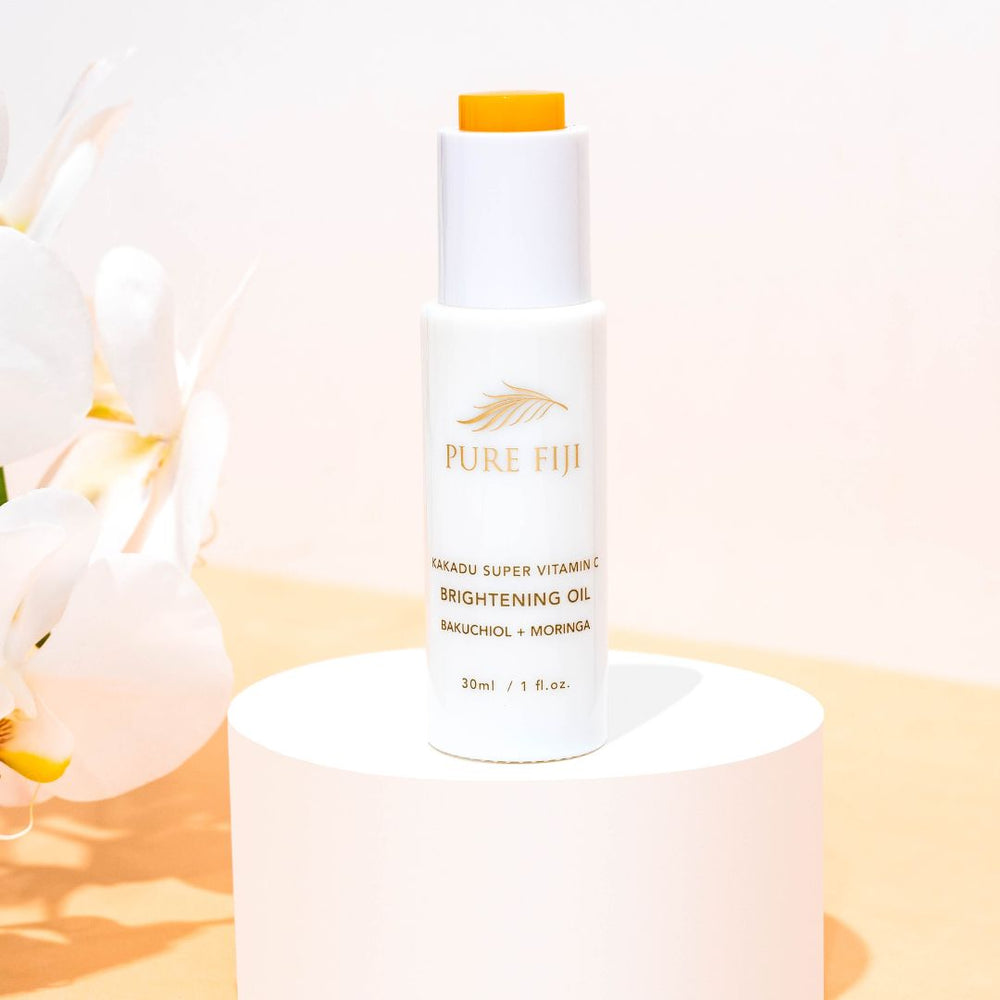
Kakadu Super Vitamin C Brightening Oil with Bakuchiol + Moringa (1oz/30ml)

Kakadu Super Vitamin C Brightening Oil with Bakuchiol + Moringa (1oz/30ml)
Pure Fiji
kakadu-super-vitamin-c-brightening-oil-with-bakuchiol-moringa-1oz-30ml
Face Oil
9706861199653
Morning or Evening?
How often will you use this product?
Notes


Highlights
WHAT IS IT?
Face oil with multiple key ingredients
FEATURES
Brightening, smoothing, anti-aging, collagen-boosting
BEST FOR
suitable for multiple skin types
CHECKS
Free of parabens, phthalates, phenoxyethanol, sulfates, artifical colors, synthetics, PEGs, GMOs
Who Is It For?
Adults Both Women And MenWhat Does It Help With?
Dark Spots Uneven Tone Dullness Fine Lines And Wrinkles Loss Of FirmnessBudget
PremiumHow To Use
Which routine should it be used in?
Instructions:
Key Information


What Pure Fiji Says
Product Description:
Brighten and smooth your skin with this super concentrated Vitamin C oil powered by Kakadu plum, Bakuchiol and Moringa Oil. This lightweight yet intense formula delivers an instant radiance boost leaving skin looking luminous while smoothing fine lines, wrinkles, boosting collagen and balancing skin tone. 100% Natural Origin
About the Brand:
Ingredients Overview
Ingredients List
Caprylic / Capric Triglycerides, Aleurites Moluccana (Sikeci) Seed Oil, Macadamia integrifolia (Macadamia) Oil, Terminalia Ferdinandiana (Kakadu Plum) Oil, Moringa Oleifera (Moringa) Seed Oil, Ascorbyl Tetraisopalmitate (Vitamin C), Cocos Nucifera (Coconut) Oil, Tocopheral (Vitamin E), Calophyllum Inophyllum (Dilo) Seed Oil, Bakuchiol (Vitamin A), Fragrance.
Key Ingredients
Kakadu Plum Oil, Bakuchiol, Moringa Oil, Ascorbyl Tetraisopalmitate (Vitamin C derivative)
Ingredients Details
Ascorbyl Tetraisopalmitate
Common Name(s): Atip,vc-ip,vitamin c tetraisopalmitate
CAS Number: 183476-82-6
DESCRIPTION
What It Does: Delivers potent, stable vitamin c deep into skin for antioxidant protection, brightening, and collagen stimulation.
Why It's Used: Premium anti-aging where deep vitamin c penetration and exceptional stability are both required.
How It Works: Four isopalmitate chains facilitate passive diffusion through stratum corneum lipid bilayers. esterases progressively cleave chains releasing ascorbic acid in deeper skin layers.
Typically Found In: Premium serums,oil-based vitamin c,anti-aging oils
TECHNICAL DETAILS
Primary Category: Active ingredient – vitamin c derivative
Secondary Functions: Superior penetration,stable vitamin c
Application Areas:

Facial Skincare

Body Care
Hair Care
Beard Care
Color Cosmetics (Makeup)
Dietary/Oral Supplements
Typical Concentration Range: 0.5%–3%
SOURCING & ETHICS
Vegan Status: Yes – synthetic
Halal Status: Yes
Source Notes: Fully synthetic. produced by esterification of ascorbic acid with isopalmitic acid derivatives.
SKIN COMPATIBILITY
Irritancy Rating: 1/5 – very low
Comedogenicity Rating: 0/5 – non-comedogenic
Sensitivity Concerns: Non-irritating; suitable for all skin types.
Safe for Sensitive Skin: Yes
SAFETY & COMPATIBILITY
Safety Profile: Excellent safety profile. ewg score: 1.
Works Well With: Tocopherol,ferulic acid,niacinamide,spf
Avoid Combining With: No significant incompatibilities
SCIENTIFIC NOTE
Ex vivo penetration studies confirm significantly higher skin penetration depth vs l-ascorbic acid. the four isopalmitate chains facilitate partitioning into the lipid-continuous stratum corneum phase.
Last Verified: ##########
Primary Sources: Cosing database,pinnell vitamin c derivatives review
Bakuchiol
Common Name(s): Bakuchiol,(s)-bakuchiol
CAS Number: 10309-37-2
DESCRIPTION
What It Does: Provides retinol-equivalent anti-aging gene expression from a natural plant compound without retinol's limitations.
Why It's Used: The natural retinol alternative — the first plant compound with rct evidence for equivalent anti-aging results to retinol with better safety and photostability.
How It Works: Bakuchiol activates rar beta and retinoid x receptors via allosteric binding mechanism. upregulates type i, iii, and iv collagen synthesis genes. downregulates mmp-1 and mmp-9. antioxidant via phenol radical scavenging. photostable — stable to uv exposure unlike retinol.
Typically Found In: Natural anti-aging serums,pregnancy-safe retinol alternative,photostable anti-aging
TECHNICAL DETAILS
Primary Category: Active ingredient – natural retinol alternative
Secondary Functions: Free radical scavenging,anti-aging
Application Areas:
Facial Skincare
Body Care
Hair Care
Beard Care
Color Cosmetics (Makeup)
Dietary/Oral Supplements
Typical Concentration Range: 0.5%–2%
SOURCING & ETHICS
Vegan Status: Conditional - supplier confirmation required
Halal Status: Unverified - supplier confirmation required
Source Notes: Plant-derived extract or synthetic. [audit 2026-07-29 rev2: status downgraded on audit. determination requires shariah-panel sign-off.]
SKIN COMPATIBILITY
Irritancy Rating: 1/5 – very low
Comedogenicity Rating: 0/5 – non-comedogenic
Sensitivity Concerns: Non-irritating; well-tolerated.
Safe for Sensitive Skin: Yes
SAFETY & COMPATIBILITY
Safety Profile: Excellent safety profile. ewg score: 1.
Works Well With: Vitamin c,vitamin e,ferulic acid,spf,other antioxidants
Avoid Combining With: No significant incompatibilities
SCIENTIFIC NOTE
The dhaliwal et al. (2019, british journal of dermatology) split-face rct directly compared 0.5% bakuchiol vs 0.5% retinol twice daily for 12 weeks — both groups showed equivalent reduction in fine lines and wrinkles, but bakuchiol showed significantly less scaling, stinging, and burning. this is the strongest evidence that bakuchiol provides retinol-equivalent anti-aging with better tolerability.
Last Verified: 2026-03-12
Primary Sources: Cosing database,dhaliwal et al. bakuchiol vs retinol rct
Coconut Oil
Common Name(s): Coconut oil,botanical oil,phytochemical active
CAS Number: N/a
DESCRIPTION
What It Does: Provides antioxidant protection from reactive oxygen species, reduces inflammatory cytokine production in skin, and conditions skin through the plant's phytochemical complex.
Why It's Used: Natural origin narrative, traditional use heritage, and multi-functional phytochemical profile supporting concurrent skin care claims from one ingredient.
How It Works: Polyphenols, terpenoids, and alkaloids scavenge ros via h• donation, inhibit nf-kb or cox-2 inflammatory pathways, and interact with skin surface proteins for conditioning.
Typically Found In: Botanical skin care,natural products
TECHNICAL DETAILS
Primary Category: Active ingredient – antioxidant
Secondary Functions: Free radical scavenging,anti-aging
Application Areas:
Facial Skincare
Body Care
Hair Care
Beard Care
Color Cosmetics (Makeup)
Dietary/Oral Supplements
Typical Concentration Range: 0.1%–10%
SOURCING & ETHICS
Vegan Status: Conditional - supplier confirmation required
Halal Status: Yes
Source Notes: Plant-derived extract or synthetic. [audit 2026-07-29 rev2: status downgraded on audit. determination requires shariah-panel sign-off.]
SKIN COMPATIBILITY
Irritancy Rating: 1/5 – very low
Comedogenicity Rating: 0/5 – non-comedogenic
Sensitivity Concerns: Non-irritating; well-tolerated.
Safe for Sensitive Skin: Yes
SAFETY & COMPATIBILITY
Safety Profile: Excellent safety profile. ewg score: 1.
Works Well With: Vitamin c,vitamin e,ferulic acid,spf,other antioxidants
Avoid Combining With: No significant incompatibilities
SCIENTIFIC NOTE
Plant secondary metabolites evolved as photoprotectants and antimicrobials — mechanisms directly applicable to cosmetic antioxidant and anti-inflammatory activity in human skin.
Last Verified: 2026-03-12
Primary Sources: Cosing database,coconut oil botanical review
Macadamia Oil
Common Name(s): Macadamia nut oil,australian nut oil
CAS Number: 128497-20-1
DESCRIPTION
What It Does: Provides sebum-compatible palmitoleic acid emolliency balancing aging skin's declining sebum production.
Why It's Used: Highest palmitoleic acid plant oil for sebum-mimetic skin conditioning particularly relevant for mature skin where palmitoleic acid (sebum's dominant fatty acid) production declines.
How It Works: Very high palmitoleic acid (c16:1 omega-7, 17-22%) closely mimics human sebum composition. palmitoleic acid declines in human sebum with age, making macadamia oil's high content particularly relevant for mature skin conditioning.
Typically Found In: Anti-aging facial oils,mature skin products,hair oils
TECHNICAL DETAILS
Primary Category: Functional ingredient – emollient
Secondary Functions: Palmitoleic acid sebum mimicry,anti-aging
Application Areas:
Facial Skincare
Body Care
Hair Care
Beard Care
Color Cosmetics (Makeup)
Dietary/Oral Supplements
Typical Concentration Range: 1%–50%
SOURCING & ETHICS
Vegan Status: Conditional - supplier confirmation required
Halal Status: Unverified - supplier confirmation required
Source Notes: Plant-derived, synthetic or animal-derived. verify source. [audit 2026-07-29 rev2: the record's own source_notes does not assert a non-animal origin, or instructs the reader to verify with the supplier; "yes" asserts knowledge the record does not hold. determination requires shariah-panel sign-off.]
SKIN COMPATIBILITY
Irritancy Rating: 1/5 – very low
Comedogenicity Rating: 2/5 – low
Sensitivity Concerns: Non-irritating.
Safe for Sensitive Skin: Yes
SAFETY & COMPATIBILITY
Safety Profile: Excellent safety profile. ewg score: 1.
Works Well With: Humectants,ceramides,actives as carrier
Avoid Combining With: No significant incompatibilities
SCIENTIFIC NOTE
Sebum palmitoleic acid content declines from ~23% at age 20 to ~14% at age 60. this decline corresponds to reduced skin surface antimicrobial protection (palmitoleic acid is antimicrobial against s. aureus) and changed sebum film properties. topical macadamia oil replenishes this age-declining fatty acid.
Last Verified: 2026-03-12
Primary Sources: Cosing database,cir safety assessment,cashman & warshaw sebum composition review