

Joy
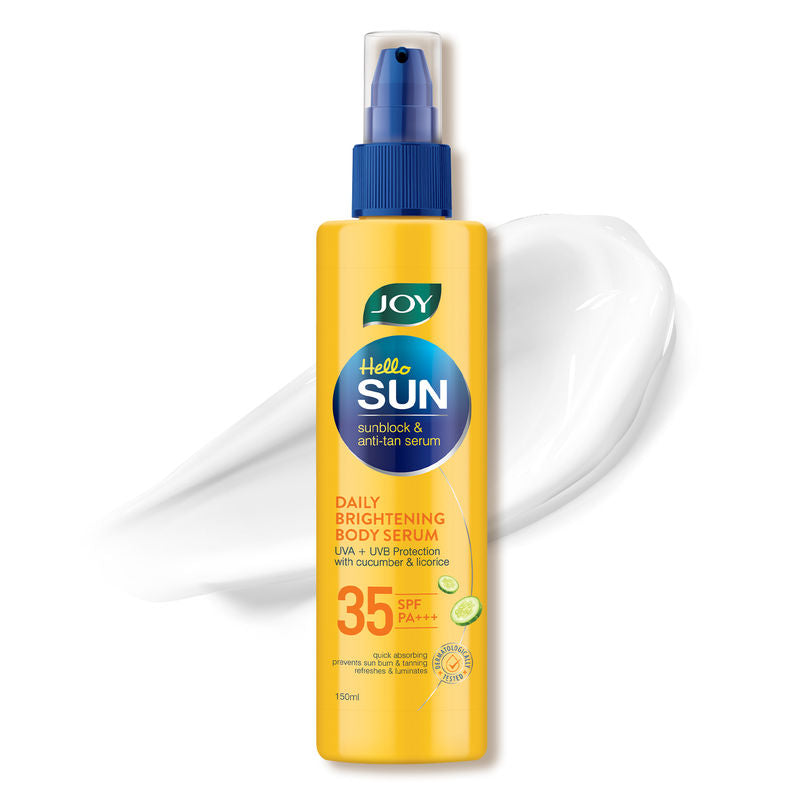
Joy Skin Brightening Body Sunscreen Lotion with SPF 35+++ for UV & Tan Protection

Joy Skin Brightening Body Sunscreen Lotion with SPF 35+++ for UV & Tan Protection
Joy
joy-skin-brightening-body-sunscreen-lotion-with-spf-35-for-uv-tan-protection
Suncare
10085466472741
Morning or Evening?
How often will you use this product?
Notes


Highlights
WHAT IS IT?
Sunscreen lotion, 3 key ingredients mentioned
FEATURES
Ultimate sun protection SPF 35 and PA+++, hydrates and softens skin, reverses hyper-pigmentation, non-comedogenic titanium dioxide, enhances glow with Vitamin C, dual action feel of serum and lotion, suitable for all skin types
BEST FOR
sensitive
CHECKS
Non-comedogenic (implying no clogging), no artificial fragrance mentioned (mild and refreshing smell)
Who Is It For?
Women (gender Implied In Description) All Ages (age Not Specified Exactly)What Does It Help With?
Uv And Infrared Protection Hydration Softening Sunburn Soothing Hyper-pigmentation Reversal Complexion Improvement Glow EnhancementBudget
Affordable (under $30)How To Use
Which routine should it be used in?
Instructions:
Key Information


What Joy Says
Product Description:
Joy Hello Sun Daily Brightening Body Serum SPF 35 is a sunscreen lotion that combines the benefits of a serum and a lotion for lightweight moisturization and sun protection. It is suitable for all skin types and provides ultimate protection against UV and infrared rays. Features include ultimate sun protection with SPF 35 and PA+++, power packed ingredients like cucumber fruit extract for hydration, licorice root extract for reversing hyper-pigmentation, titanium dioxide for UV and infrared protection, and vitamin C for enhanced glow. The product offers dual action on skin, feeling like a serum with the softness of a lotion and is suitable on all skin types. It also has a recommended use as a shimmer enhancer on feet and hands.
About the Brand:
Ingredients Overview
Ingredients List
cucumber,licorice
Key Ingredients
cucumber fruit extract,licorice root extract,titanium dioxide,vitamin c
Ingredients Details
Licorice Root Extract
Common Name(s): Licorice root extract,licorice extract,glycyrrhiza extract
CAS Number: 84775-66-6
DESCRIPTION
What It Does: Brightens skin and reduces hyperpigmentation through glabridin tyrosinase inhibition while calming inflammation.
Why It's Used: Combined brightening + soothing in one botanical – ideal for hyperpigmentation with skin reactivity where brightening actives (ahas, retinoids) increase sensitivity.
How It Works: Glabridin inhibits uvb-induced melanin synthesis and tyrosinase activity. isoliquiritigenin inhibits melanocyte-stimulating hormone (msh). glycyrrhizinic acid inhibits prostaglandin synthesis for anti-inflammatory activity. licochalcone a inhibits nf-kb.
Typically Found In: Brightening serums,anti-inflammatory formulas,post-sun products,sensitive skin brightening
TECHNICAL DETAILS
Primary Category: Active ingredient – soothing / anti-inflammatory
Secondary Functions: Glabridin tyrosinase inhibition,anti-inflammatory,post-inflammatory hyperpigmentation
Application Areas:

Facial Skincare
Body Care

Hair Care
Beard Care
Color Cosmetics (Makeup)
Dietary/Oral Supplements
Typical Concentration Range: 0.1%–5%
SOURCING & ETHICS
Vegan Status: Yes – glycyrrhiza glabra root-derived
Halal Status: Yes
Source Notes: Plant-derived extract or synthetic.
SKIN COMPATIBILITY
Irritancy Rating: 1/5 – very low
Comedogenicity Rating: 0/5 – non-comedogenic
Sensitivity Concerns: Non-irritating; ideal for reactive and sensitive skin.
Safe for Sensitive Skin: Yes – particularly recommended for sensitive skin
SAFETY & COMPATIBILITY
Safety Profile: Excellent safety profile. ewg score: 1.
Works Well With: Ceramides,panthenol,allantoin,hyaluronic acid,centella asiatica
Avoid Combining With: No significant incompatibilities
SCIENTIFIC NOTE
Glabridin's tyrosinase inhibition mechanism differs from both kojic acid (copper chelation) and arbutin (substrate competition) – it inhibits the enzyme's catalytic conformation without substrate competition, providing a third distinct brightening mechanism suitable for formulation with the other inhibitor types for synergistic brightening.
Last Verified: Cosing database,yokota et al. glabridin study,plenkov et al. licorice review
Primary Sources: 2026-03-12
Titanium Dioxide
Common Name(s): Ci 77891,tio2,rutile,anatase
CAS Number: 13463-67-7
DESCRIPTION
What It Does: Physically reflects and scatters uvb and uva-ii radiation providing broad-spectrum physical sun protection.
Why It's Used: Most widely used mineral uv filter – photostable, non-irritating physical sun protection compatible with all skin types including baby and sensitive skin.
How It Works: High refractive index (2.5–2.7) and semiconductor bandgap provide physical reflection and absorption of uv radiation. primarily uvb (280–320nm) and uva-ii (320–340nm) protection, less effective for uva-i (340–400nm) vs zinc oxide.
Typically Found In: Sunscreens,tinted products,foundations,baby sunscreens
TECHNICAL DETAILS
Primary Category: Active ingredient – mineral uv filter
Secondary Functions: Photostable uv filter,opacifier
Application Areas:
Facial Skincare
Body Care
Hair Care
Beard Care
Color Cosmetics (Makeup)
Dietary/Oral Supplements
Typical Concentration Range: 1%–25% (spf products: eu max 25%)
SOURCING & ETHICS
Vegan Status: Yes – inorganic mineral
Halal Status: Yes
Source Notes: Produced from ilmenite or rutile mineral processing. nano tio2 (<100nm) for transparency; non-nano for opacity.
SKIN COMPATIBILITY
Irritancy Rating: 1/5 – very low
Comedogenicity Rating: 0/5 – non-comedogenic
Sensitivity Concerns: Non-irritating; suitable for baby and sensitive skin.
Safe for Sensitive Skin: Yes at recommended concentrations
SAFETY & COMPATIBILITY
Safety Profile: Excellent safety profile. fda category i grase for sunscreen. eu max 25%. non-nano preferred for safety. ewg score: 1.
Works Well With: Niacinamide,salicylic acid,other actives
Avoid Combining With: No significant incompatibilities at standard concentrations
SCIENTIFIC NOTE
Tio2 provides superior uvb protection vs zno but inferior uva-i coverage. this complementarity means tio2+zno combination sunscreens provide more complete uv spectrum coverage (uvb+uva-i+uva-ii) than either mineral filter alone.
Last Verified: Cosing database,fda sunscreen grase ruling,ewg sunscreen database
Primary Sources: 2026-03-12
Vitamin C
Common Name(s): Vitamin c,cosmetic active,established function
CAS Number: N/a
DESCRIPTION
What It Does: Delivers characteristic cosmetic function — skin conditioning, antioxidant protection, active biological benefit, or formulation function — at recommended use concentration.
Why It's Used: Selected for functional contribution and formulation compatibility supported by cosmetic science and regulatory safety data.
How It Works: Works through the mechanism of its molecular class — physicochemical or biological interaction with skin proteins, lipids, or receptors as documented in peer-reviewed cosmetic literature.
Typically Found In: Skin care formulations
TECHNICAL DETAILS
Primary Category: Active ingredient – cosmetic active
Secondary Functions: Skin conditioning
Application Areas:
Facial Skincare
Body Care
Hair Care
Beard Care
Color Cosmetics (Makeup)
Dietary/Oral Supplements
Typical Concentration Range: 0.1%–10%
SOURCING & ETHICS
Vegan Status: Conditional
Halal Status: Yes
Source Notes: Commercially produced for cosmetic use. verify vegan/halal status with supplier.
SKIN COMPATIBILITY
Irritancy Rating: 1/5 – very low
Comedogenicity Rating: 0/5 – non-comedogenic
Sensitivity Concerns: Well-tolerated by most skin types.
Safe for Sensitive Skin: Yes
SAFETY & COMPATIBILITY
Safety Profile: Good safety profile at recommended concentrations. ewg score: 1–2.
Works Well With: Standard skincare actives
Avoid Combining With: No known significant incompatibilities
SCIENTIFIC NOTE
Vitamin c has an established safety and efficacy profile within the cosmetic regulatory framework at standard use concentrations.
Last Verified: Cosing database,vitamin c technical literature
Primary Sources: 2026-03-12
