

Joy
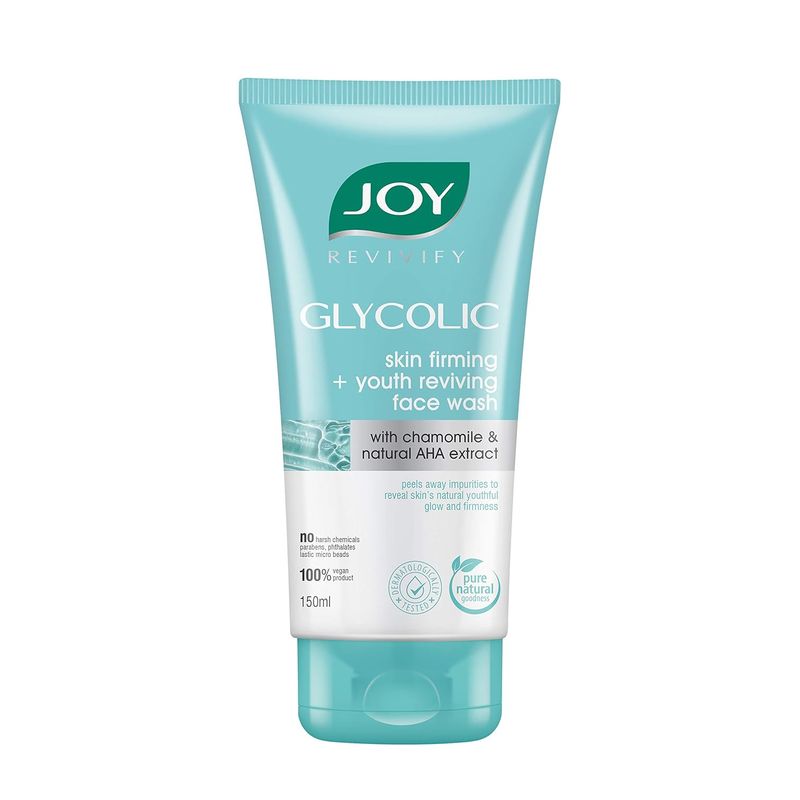
Joy Revivify Glycolic Skin Firming + Youth Revive Face Wash - Natural AHA & Chamomile Extract

Joy Revivify Glycolic Skin Firming + Youth Revive Face Wash - Natural AHA & Chamomile Extract
Joy
joy-revivify-glycolic-skin-firming-youth-revive-face-wash-natural-aha-chamomile-extract
Cleanse
10085020762405
Morning or Evening?
How often will you use this product?
Notes


Highlights
WHAT IS IT?
Face wash with natural AHA & chamomile extracts
FEATURES
Glycolic acid gently cleanses, Chamomile and natural AHA enriched, Removes impurities, Suitable for all skin types, Dermatologically tested, Not tested on animals
BEST FOR
all skin types
CHECKS
No harsh chemicals mentioned
Who Is It For?
Women All AgesWhat Does It Help With?
Skin Firming Youth Revival Skin Brightening Removing ImpuritiesBudget
Affordable (under $30)How To Use
Which routine should it be used in?
Instructions:
Key Information


What Joy Says
Product Description:
Make the new Joy Revivify Glycolic Skin Firming + Youth Reviving Face Wash a must in your skincare ritual for youthful skin. Designed after meticulous study and research, this skin brightening face wash is what you get after combing the best of age-old science and cutting-edge skincare technology. Features: Glycolic face wash that gently cleanses your skin leaving it clean and clear, Enriched with the goodness of chamomile and natural AHA extract, Removes impurities and dirt to reveal skin's natural glow, Suitable for all skin types, Dermatologically tested, Joy skin and hair care products are not tested on animals.
About the Brand:
Ingredients Overview
Ingredients List
Water, Sodium Laureth Sulfate, Glycolic Acid, Cocamidopropyl Betaine, Glycerine, Disodium Cocoamphodiacetate, Polyacrylate Crosspolymer-6, Sodium Hydroxide, PEG-40 Hydrogenated Castor Oil, Perfume, Salicylic Acid, Salix Alba (Willow) Bark Extract, Melaleuca Alternifolia (Tea Tree Oil), Tamarindus Indica (Tamarind) Seed Extract, Chamomile Recuitita (Chamomile) Extract, Pyrus Malus (Apple) Extract, Citrus Limon (Lemon) Extract, Hydrolyzed Jojoba Esters, Disodium EDTA, Methylchloroisothiazolinone, Methylisothiazolinone
Key Ingredients
Chamomile Extracts,Natural AHAs
Ingredients Details
Cocamidopropyl Betaine
Common Name(s): Capb,cocoamidopropyl betaine,coconut betaine
CAS Number: 61789-40-0
DESCRIPTION
What It Does: Boosts foam, enhances mildness, and conditions skin and hair when combined with primary surfactants.
Why It's Used: The standard foam booster and mildness enhancer in virtually all shampoos, body washes, and facial cleansers – provides synergistic mildness improvement with anionic surfactants.
How It Works: Amphoteric (zwitterionic) character provides positive charge interaction with hair keratin for antistatic conditioning. reduces irritation of co-formulated anionic surfactants via ionic complex formation. foam stabilization via bilayer reinforcement in foam lamellae.
Typically Found In: Shampoos,body washes,facial cleansers,baby products
TECHNICAL DETAILS
Primary Category: Functional ingredient – amphoteric surfactant
Secondary Functions: Skin conditioning
Application Areas:

Facial Skincare
Body Care
Hair Care

Beard Care
Color Cosmetics (Makeup)
Dietary/Oral Supplements
Typical Concentration Range: 2%–15%
SOURCING & ETHICS
Vegan Status: Yes – from coconut fatty acids and dimethylaminopropylamine
Halal Status: Yes
Source Notes: Commercially produced for cosmetic use. verify vegan/halal status with supplier.
SKIN COMPATIBILITY
Irritancy Rating: 1/5 – very low
Comedogenicity Rating: 0/5 – non-comedogenic
Sensitivity Concerns: Well-tolerated by most skin types.
Safe for Sensitive Skin: Yes
SAFETY & COMPATIBILITY
Safety Profile: Good safety profile at recommended concentrations. ewg score: 1–2.
Works Well With: Standard skincare actives
Avoid Combining With: No known significant incompatibilities
SCIENTIFIC NOTE
Capb's mildness-enhancing synergy with sls has a molecular mechanism: capb's positive imidazoline head group forms an ion pair complex with sls's anionic sulfate group, reducing sls's free monomer concentration (the irritation-causing species) without significantly reducing micelle-forming capacity (the cleansing species).
Last Verified: Cosing database,ananthapadmanabhan surfactant review,cir safety assessment
Primary Sources: 2026-03-12
Disodium Cocoamphodiacetate
Common Name(s): Dccda,sodium cocoamphoacetate
CAS Number: 68650-39-5
DESCRIPTION
What It Does: Provides gentle, low-irritation cleansing particularly suitable for eye area and baby products.
Why It's Used: Baby wash and eye-area cleanser primary surfactant for minimum-irritation cleansing at sensitive skin and eye contact areas.
How It Works: Amphoteric structure with lower cationicity than capb reduces positive charge-mediated protein binding. very low eye irritation in draize test. conditioning activity via residual cationic character interaction with keratin.
Typically Found In: Baby washes,eye makeup removers,gentle eye-area cleansers
TECHNICAL DETAILS
Primary Category: Functional ingredient – amphoteric mild surfactant
Secondary Functions: Skin conditioning
Application Areas:
Facial Skincare
Body Care
Hair Care
Beard Care
Color Cosmetics (Makeup)
Dietary/Oral Supplements
Typical Concentration Range: 2%–15%
SOURCING & ETHICS
Vegan Status: Yes – from coconut fatty acids
Halal Status: Yes
Source Notes: Commercially produced for cosmetic use. verify vegan/halal status with supplier.
SKIN COMPATIBILITY
Irritancy Rating: 1/5 – very low
Comedogenicity Rating: 0/5 – non-comedogenic
Sensitivity Concerns: Well-tolerated by most skin types.
Safe for Sensitive Skin: Yes
SAFETY & COMPATIBILITY
Safety Profile: Good safety profile at recommended concentrations. ewg score: 1–2.
Works Well With: Standard skincare actives
Avoid Combining With: No known significant incompatibilities
SCIENTIFIC NOTE
Eye irritation testing (draize rabbit eye test and human volunteer eye sting test) demonstrates disodium cocoamphodiacetate has among the lowest irritation scores of any commercial surfactant, making it the preferred primary surfactant for 'no-more-tears' baby shampoo formulations and eye-area cleansers.
Last Verified: Cosing database,cir safety assessment
Primary Sources: 2026-03-12
Disodium Edta
Common Name(s): Edathamil disodium,edta disodium,versene 100
CAS Number: 139-33-3
DESCRIPTION
What It Does: Provides metal ion chelation to prevent product degradation and boost preservative and antioxidant efficacy.
Why It's Used: The most essential stability ingredient in cosmetics — disodium edta's metal chelation prevents rancidity, discoloration, and preservative failure caused by trace metal contamination in virtually all aqueous cosmetic formulations.
How It Works: Ethylenediaminetetraacetic acid provides six potential coordination sites for metal ions (aminodiacetate groups). chelates ca²⁺, mg²⁺ (stability), fe³⁺ (fenton radical prevention), cu²⁺ (oxidase inhibition). disrupts gram-negative bacterial outer membrane by chelating membrane calcium, enhancing preservative penetration.
Typically Found In: Virtually all aqueous cosmetics — creams, lotions, shampoos, toners
TECHNICAL DETAILS
Primary Category: Functional ingredient – chelating agent
Secondary Functions: Skin conditioning
Application Areas:
Facial Skincare
Body Care
Hair Care
Beard Care
Color Cosmetics (Makeup)
Dietary/Oral Supplements
Typical Concentration Range: 0.005%–0.1%
SOURCING & ETHICS
Vegan Status: Yes – synthetic
Halal Status: Yes
Source Notes: Commercially produced for cosmetic use. verify vegan/halal status with supplier.
SKIN COMPATIBILITY
Irritancy Rating: 1/5 – very low
Comedogenicity Rating: 0/5 – non-comedogenic
Sensitivity Concerns: Well-tolerated by most skin types.
Safe for Sensitive Skin: Yes
SAFETY & COMPATIBILITY
Safety Profile: Good safety profile at recommended concentrations. ewg score: 1–2.
Works Well With: Standard skincare actives
Avoid Combining With: No known significant incompatibilities
SCIENTIFIC NOTE
Disodium edta's preservative potentiation against gram-negative bacteria is mechanistically elegant: gram-negative outer membranes contain lipopolysaccharide stabilised by calcium and magnesium bridges. edta chelates these metal ions, destabilising the lps layer and creating pores that allow hydrophobic preservatives (phenoxyethanol, parabens) to penetrate — converting gram-negative-resistant preservatives into broad-spectrum ones.
Last Verified: Cosing database,cir safety assessment
Primary Sources: 2026-03-12
Glycerine
Common Name(s): Glycerin,universal humectant,water-binding skin conditioning
CAS Number: N/a
DESCRIPTION
What It Does: Attracts and retains moisture in the sc, improves skin barrier function at low concentrations, provides gentle keratolytic softening, and acts as a co-solvent for water-soluble actives.
Why It's Used: The reference humectant — lowest cost, best safety profile, universal formulation compatibility, and present naturally in the sc via lipase-mediated glycerolipid hydrolysis makes glycerin the industry standard against which all humectants are benchmarked.
How It Works: Three hydroxyl groups form 6 h-bonds with water molecules per glycerol unit — the highest oh-group density per carbon of any commercial humectant. glycerin also down-regulates epidermal serine proteases that overactivate in dry sc, improving desquamation and barrier integrity.
Typically Found In: All cosmetics,universal
TECHNICAL DETAILS
Primary Category: Functional ingredient – humectant
Secondary Functions: Tewl reduction,skin plumping
Application Areas:
Facial Skincare
Body Care
Hair Care
Beard Care
Color Cosmetics (Makeup)
Dietary/Oral Supplements
Typical Concentration Range: 1%–40%
SOURCING & ETHICS
Vegan Status: Yes
Halal Status: Yes
Source Notes: Synthetic or naturally derived. excellent aqueous solubility.
SKIN COMPATIBILITY
Irritancy Rating: 1/5 – very low
Comedogenicity Rating: 0/5 – non-comedogenic
Sensitivity Concerns: Non-irritating; suitable for all skin types.
Safe for Sensitive Skin: Yes
SAFETY & COMPATIBILITY
Safety Profile: Excellent safety profile. ewg score: 1.
Works Well With: Ceramides,emollients,occlusives,glycerin,hyaluronic acid
Avoid Combining With: No significant incompatibilities
SCIENTIFIC NOTE
Epidermal lipases hydrolyse sc glycerophospholipids during cornification, releasing glycerol that contributes to the natural nmf — topical glycerin directly supplements this endogenous sc humectant pool.
Last Verified: Cosing database,glycerin universal humectant review
Primary Sources: 2026-03-12
