

Nykaa E retail limited
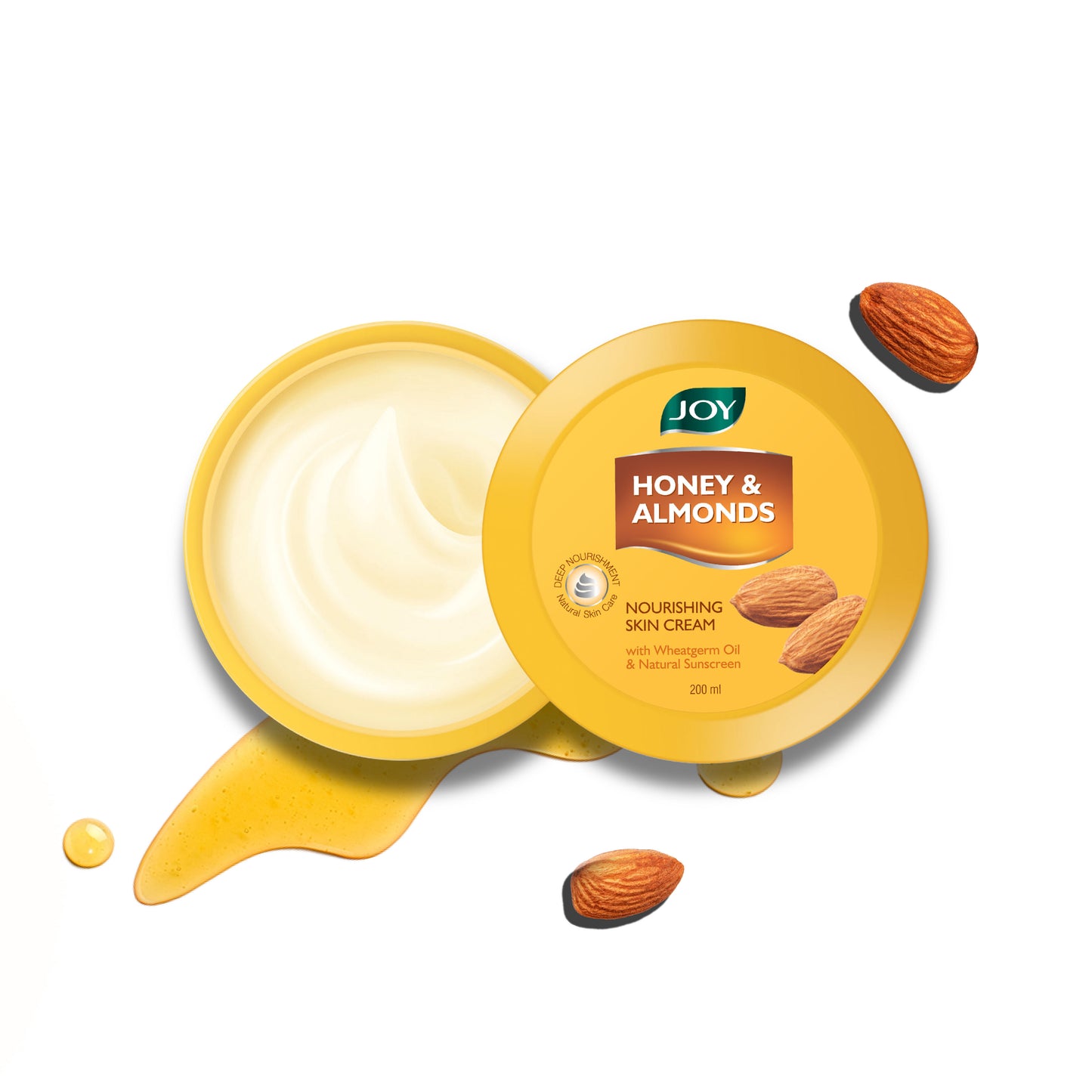
Joy Honey & Almonds Body & Skin Cream For Summers With Wheatgerm Oil For Deep Nourishment (200ML)

Joy Honey & Almonds Body & Skin Cream For Summers With Wheatgerm Oil For Deep Nourishment (200ML)
Nykaa E retail limited
joy-honey-almonds-body-skin-cream-for-summers-with-wheatgerm-oil-for-deep-nourishment-200ml
Body care
10084845879589
Morning or Evening?
How often will you use this product?
Notes


Highlights
WHAT IS IT?
Body and skin cream with honey, almonds and wheatgerm oil
FEATURES
Deep nourishing formula suitable for summer use
BEST FOR
normal
CHECKS
Who Is It For?
All Age Groups And GendersWhat Does It Help With?
Skin Nourishment And MoisturizationBudget
Affordable (under $30)How To Use
Which routine should it be used in?
Instructions:
Key Information

What Nykaa E retail limited Says
Product Description:
A nourishing body and skin cream enriched with honey, almonds and wheatgerm oil
About the Brand:
Ingredients Overview
Ingredients List
Honey, Almond Oil, Vitamin E, Aloe Vera
Key Ingredients
honey, almonds, wheatgerm oil
Ingredients Details
Almond Oil
Common Name(s): Almond oil,botanical carrier oil,emollient fatty acid delivery
CAS Number: N/a
DESCRIPTION
What It Does: Softens and conditions skin by integrating into sc lipid bilayers, delivers essential fatty acids (oleic, linoleic, linolenic) for barrier lipid synthesis, and provides rich, non-stripping moisturisation.
Why It's Used: Natural carrier oils provide the closest compositional match to endogenous sc lipids, delivering emolliency through genuine barrier integration rather than simple surface occlusion.
How It Works: Fatty acid triglycerides partition into sc lipid bilayers — oleic acid (c18:1) provides fluid, emollient integration; linoleic acid (c18:2) acts as essential ceramide precursor; saturated fatty acids provide more occlusive barrier reinforcement.
Typically Found In: Moisturisers,facial oils,natural skin care
TECHNICAL DETAILS
Primary Category: Functional ingredient – emollient
Secondary Functions: Barrier sealing,softening
Application Areas:

Facial Skincare
Body Care
Hair Care

Beard Care
Color Cosmetics (Makeup)
Dietary/Oral Supplements
Typical Concentration Range: 1%–100%
SOURCING & ETHICS
Vegan Status: Conditional - supplier confirmation required
Halal Status: Unverified - supplier confirmation required
Source Notes: Plant-derived, synthetic or animal-derived. verify source. [audit 2026-07-29 rev2: the record's own source_notes does not assert a non-animal origin, or instructs the reader to verify with the supplier; "yes" asserts knowledge the record does not hold. determination requires shariah-panel sign-off.]
SKIN COMPATIBILITY
Irritancy Rating: 1/5 – very low
Comedogenicity Rating: 1/5 – low; formulation-dependent
Sensitivity Concerns: Non-irritating.
Safe for Sensitive Skin: Yes
SAFETY & COMPATIBILITY
Safety Profile: Excellent safety profile. ewg score: 1.
Works Well With: Humectants,ceramides,actives as carrier
Avoid Combining With: No significant incompatibilities
SCIENTIFIC NOTE
Essential fatty acids — linoleic (c18:2, n-6) and α-linolenic (c18:3, n-3) acids — cannot be synthesised by the body; topical delivery through carrier oils provides direct substrate for ceramide and eicosanoid biosynthesis in the epidermis.
Last Verified: 2026-03-12
Primary Sources: Cosing database,almond oil carrier oil botanical review
Aloe Vera
Common Name(s): Aloe vera juice,aloe vera gel,aloe barbadensis
CAS Number: 85507-69-3
DESCRIPTION
What It Does: Provides acemannan-based wound healing and comprehensive moisturising skin conditioning from the quintessential healing plant.
Why It's Used: The most universally recognised natural healing plant — aloe vera's acemannan polysaccharides, vitamins, and enzymes provide a comprehensive wound healing and soothing profile with thousands of years of documented use.
How It Works: Acemannan (poly-mannose) activates dectin-1 for wound healing immune stimulation. gibberellin promotes fibroblast growth. salicylic acid derivative provides anti-inflammatory. vitamins c and e provide antioxidant. glucomannan provides humectant.
Typically Found In: After-sun products,wound healing,moisturisers,virtually all skin care categories
TECHNICAL DETAILS
Primary Category: Active ingredient – aloe vera gel
Secondary Functions: Redness reduction,anti-inflammatory,calming
Application Areas:
Facial Skincare
Body Care
Hair Care
Beard Care
Color Cosmetics (Makeup)
Dietary/Oral Supplements
Typical Concentration Range: 0.5%–99%
SOURCING & ETHICS
Vegan Status: Yes – from aloe barbadensis leaf
Halal Status: Yes
Source Notes: Plant-derived extract or synthetic.
SKIN COMPATIBILITY
Irritancy Rating: 1/5 – very low
Comedogenicity Rating: 0/5 – non-comedogenic
Sensitivity Concerns: Non-irritating; ideal for reactive and sensitive skin.
Safe for Sensitive Skin: Yes – particularly recommended for sensitive skin
SAFETY & COMPATIBILITY
Safety Profile: Excellent safety profile. ewg score: 1.
Works Well With: Ceramides,panthenol,allantoin,hyaluronic acid,centella asiatica
Avoid Combining With: No significant incompatibilities
SCIENTIFIC NOTE
Aloe vera's clinical evidence for sunburn relief is among the best for any botanical wound healing ingredient. multiple rcts demonstrate that aloe vera gel reduces healing time of first and second degree burns and sunburns, attributed primarily to acemannan's immunomodulatory wound healing activity and the anti-inflammatory salicylate derivatives providing prostaglandin inhibition.
Last Verified: 2026-03-12
Primary Sources: Cosing database,surjushe et al. aloe vera skin review,cir safety assessment
Honey
Common Name(s): Honey,bee-derived humectant antimicrobial,wound healing active
CAS Number: N/a
DESCRIPTION
What It Does: Provides humectant moisture retention from the hygroscopic fructose/glucose matrix, antimicrobial activity from enzymatically generated h₂o₂ and (in manuka) methylglyoxal, anti-inflammatory activity from phenolic compounds, and wound healing promotion from growth factor activation.
Why It's Used: Honey is the only food-derived ingredient with documented clinical wound healing efficacy in medical grade form (medihoney) — combining humectancy, antimicrobial, anti-inflammatory, and healing activity in a gras, consumer-familiar ingredient.
How It Works: Glucose oxidase in honey catalyses glucose + o₂ → gluconolactone + h₂o₂ — providing sustained low-level h₂o₂ generation that provides bactericidal activity without tissue toxicity. manuka honey's methylglyoxal (mgo) provides additional non-peroxide antimicrobial activity through protein glycation of bacterial enzymes.
Typically Found In: Wound care,anti-aging,humectant products
TECHNICAL DETAILS
Primary Category: Active ingredient – cosmetic active
Secondary Functions: Skin conditioning
Application Areas:
Facial Skincare
Body Care
Hair Care
Beard Care
Color Cosmetics (Makeup)
Dietary/Oral Supplements
Typical Concentration Range: 1%–20%
SOURCING & ETHICS
Vegan Status: No - animal-derived
Halal Status: Conditional - bee-derived; widely held permissible, confirm certifier stance
Source Notes: Commercially produced for cosmetic use. verify vegan/halal status with supplier. [audit 2026-07-29 rev2: bee-derived; permissibility widely accepted but fatwa varies by jurisdiction. determination requires shariah-panel sign-off.]
SKIN COMPATIBILITY
Irritancy Rating: 1/5 – very low
Comedogenicity Rating: 0/5 – non-comedogenic
Sensitivity Concerns: Well-tolerated by most skin types.
Safe for Sensitive Skin: Yes
SAFETY & COMPATIBILITY
Safety Profile: Good safety profile at recommended concentrations. ewg score: 1–2.
Works Well With: Standard skincare actives
Avoid Combining With: No known significant incompatibilities
SCIENTIFIC NOTE
Manuka honey's unique mānuka factor (umf) grades correlate with methylglyoxal (mgo) concentration — umf10+ (mgo 263 mg/kg) provides bactericidal activity against mrsa at concentrations achievable in topical formulation.
Last Verified: 2026-03-12
Primary Sources: Cosing database,honey manuka honey wound healing antimicrobial review
Vitamin E
Common Name(s): Vitamin e,cosmetic active,functional ingredient
CAS Number: N/a
DESCRIPTION
What It Does: Delivers characteristic cosmetic function at recommended use concentration.
Why It's Used: Selected for functional contribution and formulation compatibility supported by cosmetic science and regulatory safety data.
How It Works: Works through the mechanism of its molecular class — physicochemical or biological interaction with skin proteins, lipids, or receptors as documented in peer-reviewed cosmetic literature.
Typically Found In: Skin care formulations
TECHNICAL DETAILS
Primary Category: Active ingredient – cosmetic active
Secondary Functions: Skin conditioning
Application Areas:
Facial Skincare
Body Care
Hair Care
Beard Care
Color Cosmetics (Makeup)
Dietary/Oral Supplements
Typical Concentration Range: 0.1%–10%
SOURCING & ETHICS
Vegan Status: Conditional - supplier confirmation required
Halal Status: Unverified - supplier confirmation required
Source Notes: Commercially produced for cosmetic use. verify vegan/halal status with supplier. [audit 2026-07-29 rev2: the record's own source_notes does not assert a non-animal origin, or instructs the reader to verify with the supplier; "yes" asserts knowledge the record does not hold. determination requires shariah-panel sign-off.]
SKIN COMPATIBILITY
Irritancy Rating: 1/5 – very low
Comedogenicity Rating: 0/5 – non-comedogenic
Sensitivity Concerns: Well-tolerated by most skin types.
Safe for Sensitive Skin: Yes
SAFETY & COMPATIBILITY
Safety Profile: Good safety profile at recommended concentrations. ewg score: 1–2.
Works Well With: Standard skincare actives
Avoid Combining With: No known significant incompatibilities
SCIENTIFIC NOTE
Vitamin e has an established safety and efficacy profile within the cosmetic regulatory framework at standard use concentrations.
Last Verified: 2026-03-12
Primary Sources: Cosing database,vitamin e technical literature