

Jovees
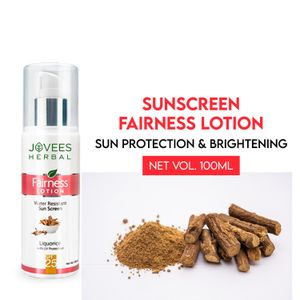
Jovees Herbal Sunscreen Fairness Lotion SPF 25 | For Women/Men | UV Protection, Water Resistant, Brightening and Moisturizing Lotion | Paraben and Alcohol Free | 100ML

Jovees Herbal Sunscreen Fairness Lotion SPF 25 | For Women/Men | UV Protection, Water Resistant, Brightening and Moisturizing Lotion | Paraben and Alcohol Free | 100ML
Jovees
jovees-herbal-sunscreen-fairness-lotion-spf-25-for-women-men-uv-protection-water-resistant-brightening-and-moisturizing-lotion-paraben-and-alcohol-free-100ml
Suncare
10085005885733
Morning or Evening?
How often will you use this product?
Notes


Highlights
WHAT IS IT?
Sunscreen lotion with SPF 25 protection, suitable for oily and sensitive skin
FEATURES
Lightweight, nongreasy texture, quick absorption, UV protection, water resistant, brightening, moisturizing, paraben and alcohol free
BEST FOR
sensitive
CHECKS
Does not contain parabens, alcohol
Who Is It For?
Women And Men Suitable For Oily And Sensitive SkinWhat Does It Help With?
Protection From Harmful Sun Rays Tanning Uneven Skin Tone Darkening Pigmentation HydrationBudget
Affordable (under $30)How To Use
Which routine should it be used in?
Instructions:
Key Information

What Jovees Says
Product Description:
Jovees Sunscreen Fairness SPF 25 Lotion a skincare marvel crafted specially for those with oily and sensitive skin. This lightweight formula boasts a nongreasy texture that quickly absorbs providing a seamless shield against the sun's harmful rays. Crafted with great care this sunscreen lotion is designed to combat the dual challenges of tanning and uneven skin tone. Its SPF 25 protection ensures a robust defense against the sun preventing the harmful effects that lead to darkening and pigmentation. Unlike other sunscreens that might increase oiliness this formulation strikes a delicate balance. It works at hydrating your skin without leaving a heavy or sticky residue making it an ideal choice for those prone to oiliness. This makes it suitable for daily use providing consistent protection without compromising on comfort
About the Brand:
Ingredients Overview
Ingredients List
Liquorice extract, Chamomile extract, Sandal extract, Aloe vera extract, Carrot extract, Sunflower oil, Olive oil, Zinc oxide, Titanium dioxide, Oxybenzone, Cetyl, Cetostearyl, Glyceryl stearate, Capric Caprylic triglyceride, Glycerin, Phenoxyethanol, Parfum, Purified water
Key Ingredients
Ingredients Details
Carrot Extract
Common Name(s): Carrot extract extract
DESCRIPTION
What It Does: Provides antioxidant protection, soothing anti-inflammatory effects, and skin-conditioning benefits through plant-derived polyphenols and phytochemicals.
Why It's Used: Plant extracts concentrate bioactive phytochemicals evolved for environmental protection — uv, microbial, and oxidative stressors — that translate to skin benefits.
How It Works: Polyphenols (flavonoids, phenolic acids) inhibit nf-κb-mediated inflammatory signaling, scavenge reactive oxygen species through electron donation, and chelate pro-oxidant metal ions to reduce oxidative skin damage.
Typically Found In: Serums,toners,moisturizers,masks,essences
TECHNICAL DETAILS
Primary Category: Botanical extracts
Secondary Functions: Antioxidant,anti-inflammatory
Application Areas:

Facial Skincare

Body Care
Hair Care
Beard Care
Color Cosmetics (Makeup)
Dietary/Oral Supplements
Typical Concentration Range: 0.1–10%
SOURCING & ETHICS
Vegan Status: Yes
Halal Status: Yes
Source Notes: Plant-derived extract; no animal components.
SKIN COMPATIBILITY
Irritancy Rating: 1899-12-31 00:00:00 -0800
Sensitivity Concerns: Low sensitization potential at recommended use concentrations.
Safe for Sensitive Skin: Yes
SAFETY & COMPATIBILITY
Safety Profile: Well-characterized cosmetic ingredient with established safety profile. generally non-irritating at typical use concentrations. suitable for leave-on and rinse-off cosmetics.
Works Well With: Niacinamide,hyaluronic acid,vitamin c,ceramides
Avoid Combining With: Strong oxidizing agents
SCIENTIFIC NOTE
Plant secondary metabolites (flavonoids, terpenes, phenolic acids) are biosynthesized as defense compounds against uv, herbivores, and pathogens. their anti-inflammatory activity typically derives from competitive inhibition of cox-2 and 5-lox enzymes (ic50 1–50 µm), while antioxidant activity involves single electron transfer (set) and hydrogen atom transfer (hat) mechanisms with structure-dependent rate constants.
Last Verified: 2025-01-15
Primary Sources: Cosing eu database; pcpc cosmetic ingredient safety reviews; phytochemical and ethnobotanical literature
Glycerin
Common Name(s): Glycerol,glycerine,1,2,3-propanetriol
CAS Number: 56-81-5
DESCRIPTION
What It Does: Glycerin pulls water from the environment and deeper skin layers into the outer skin layer (epidermis), boosting moisture levels and keeping skin soft, smooth, and plump.
Why It's Used: It is used in virtually every moisturizer, serum, and cleanser because it is highly effective at hydrating skin, is well-tolerated by all skin types, and enhances the texture and spreadability of formulations.
How It Works: As a humectant, glycerin forms hydrogen bonds with water molecules, trapping them in the skin. it also reinforces the skin barrier by integrating into lipid structures between skin cells.
Typically Found In: Moisturizers,serums,cleansers,toners,sheet masks,sunscreens,body lotions,shampoos,conditioners
TECHNICAL DETAILS
Primary Category: Humectant
Secondary Functions: Skin barrier support,emollient,solvent
Application Areas:
Facial Skincare
Body Care
Hair Care
Beard Care
Color Cosmetics (Makeup)
Dietary/Oral Supplements
Typical Concentration Range: 1%–30% (typical: 3–10%)
SOURCING & ETHICS
Vegan Status: Conditional - feedstock declaration required
Halal Status: Unverified - feedstock declaration required (plant, animal and petrochemical routes all exist)
Source Notes: Derived from plant oils via hydrolysis or saponification; synthetic versions also available. palm-derived glycerin carries sustainability concerns. [audit 2026-07-29 rev2: origin-dependent: the same inci exists in plant, animal and petrochemical versions and the name does not discriminate. determination requires shariah-panel sign-off.]
SKIN COMPATIBILITY
Irritancy Rating: 1/5 – very low; non-irritating at all standard concentrations
Comedogenicity Rating: 0/5 – non-comedogenic
Sensitivity Concerns: Extremely rare allergic reactions; generally safe for all skin types including sensitive and baby skin
Safe for Sensitive Skin: Yes
SAFETY & COMPATIBILITY
Safety Profile: Widely recognized as safe. ewg hazard score: 1. no significant concerns for irritation, sensitization, or toxicity at typical concentrations (up to 50%).
Works Well With: Hyaluronic acid,ceramides,niacinamide,panthenol,urea,peptides,retinol,ahas/bhas
Avoid Combining With: No known incompatibilities at standard concentrations
SCIENTIFIC NOTE
Glycerin is an endogenous skin component found naturally in the stratum corneum. aquaporin-3 channels in keratinocytes facilitate glycerin transport, making it integral to natural skin hydration pathways.
Last Verified: 2026-03-12
Primary Sources: Cosing database,cir safety assessment,ewg skin deep,inci decoder
Glyceryl Stearate
Common Name(s): Glycerol monostearate,gms,glycerin monostearate
CAS Number: 31566-31-1
DESCRIPTION
What It Does: Provides o/w emulsification with emolliency and skin feel improvement from a natural glycerol ester.
Why It's Used: Standard cosmetic monoglyceride emulsifier – widely used for o/w cream formation with clean, natural-origin credentials and good sensory profile.
How It Works: Monoglyceride structure (one fatty acid + glycerol) provides amphiphilic hlb ~3-4 for o/w emulsification when combined with higher hlb co-emulsifiers. forms alpha-gel lamellar structure with water for emulsion stabilization. direct skin conditioning via fatty acid film.
Typically Found In: Creams,lotions,moisturizers – standard in o/w emulsions
TECHNICAL DETAILS
Primary Category: Functional ingredient – monoglyceride emulsifier
Secondary Functions: Barrier sealing,softening
Application Areas:
Facial Skincare
Body Care
Hair Care
Beard Care
Color Cosmetics (Makeup)
Dietary/Oral Supplements
Typical Concentration Range: 1%–10%
SOURCING & ETHICS
Vegan Status: Conditional - feedstock declaration required
Halal Status: Unverified - feedstock declaration required (plant, animal and petrochemical routes all exist)
Source Notes: Plant-derived, synthetic or animal-derived. verify source. [audit 2026-07-29 rev2: origin-dependent: the same inci exists in plant, animal and petrochemical versions and the name does not discriminate. determination requires shariah-panel sign-off.]
SKIN COMPATIBILITY
Irritancy Rating: 1/5 – very low
Comedogenicity Rating: 1/5 – low; formulation-dependent
Sensitivity Concerns: Non-irritating.
Safe for Sensitive Skin: Yes
SAFETY & COMPATIBILITY
Safety Profile: Excellent safety profile. ewg score: 1.
Works Well With: Humectants,ceramides,actives as carrier
Avoid Combining With: No significant incompatibilities
SCIENTIFIC NOTE
Glyceryl stearate's alpha-gel lamellar phase formation (distinguishable by x-ray crystallography from beta crystalline phase) provides superior emulsion stability compared to its beta crystalline form. the alpha-gel phase creates a viscoelastic network that resists droplet coalescence – the fundamental mechanism behind gms's long use as a reliable primary emulsifier.
Last Verified: 2026-03-12
Primary Sources: Cosing database,cir safety assessment
Olive Oil
Common Name(s): Olive oil oil
DESCRIPTION
What It Does: Nourishes and softens skin through its balanced fatty acid profile, while antioxidant compounds protect against oxidative skin damage.
Why It's Used: Plant oils provide physiologically compatible lipid structures that integrate into the skin barrier and deliver fat-soluble antioxidants directly to skin cells.
How It Works: Fatty acids integrate into stratum corneum lipid lamellae, reinforcing the lipid barrier. antioxidants (tocopherols, carotenoids, polyphenols) neutralize ros through electron donation or singlet oxygen quenching.
Typically Found In: Face oils,serums,moisturizers,hair treatments,body oils
TECHNICAL DETAILS
Primary Category: Plant oils
Secondary Functions: Emollient,antioxidant
Application Areas:
Facial Skincare
Body Care
Hair Care
Beard Care
Color Cosmetics (Makeup)
Dietary/Oral Supplements
Typical Concentration Range: 0.5–30%
SOURCING & ETHICS
Vegan Status: Yes
Halal Status: Yes
Source Notes: Cold-pressed or solvent-extracted plant oil; no animal components.
SKIN COMPATIBILITY
Irritancy Rating: 1899-12-31 00:00:00 -0800
Comedogenicity Rating: 2000-01-01 00:00:00 -0800
Sensitivity Concerns: Low sensitization potential at recommended use concentrations.
Safe for Sensitive Skin: Yes
SAFETY & COMPATIBILITY
Safety Profile: Well-characterized cosmetic ingredient with established safety profile. generally non-irritating at typical use concentrations. suitable for leave-on and rinse-off cosmetics.
Works Well With: Vitamin e,ceramides,other plant oils,squalane
Avoid Combining With: Strong oxidizers (accelerate rancidity)
SCIENTIFIC NOTE
Vegetable oils are triglyceride matrices where the fatty acid composition determines skin compatibility, barrier function, and comedogenicity. oleic acid-rich oils (>60%) soften barrier lipids and enhance penetration; linoleic acid-rich oils reinforce ceramide-poor stratum corneum; saturated fatty acid-rich oils provide occlusion without skin penetration.
Last Verified: 2025-01-15
Primary Sources: Cosing eu database; pcpc cosmetic ingredient safety reviews; aocs plant oil composition databases; fatty acid pharmacology reviews