

Isntree
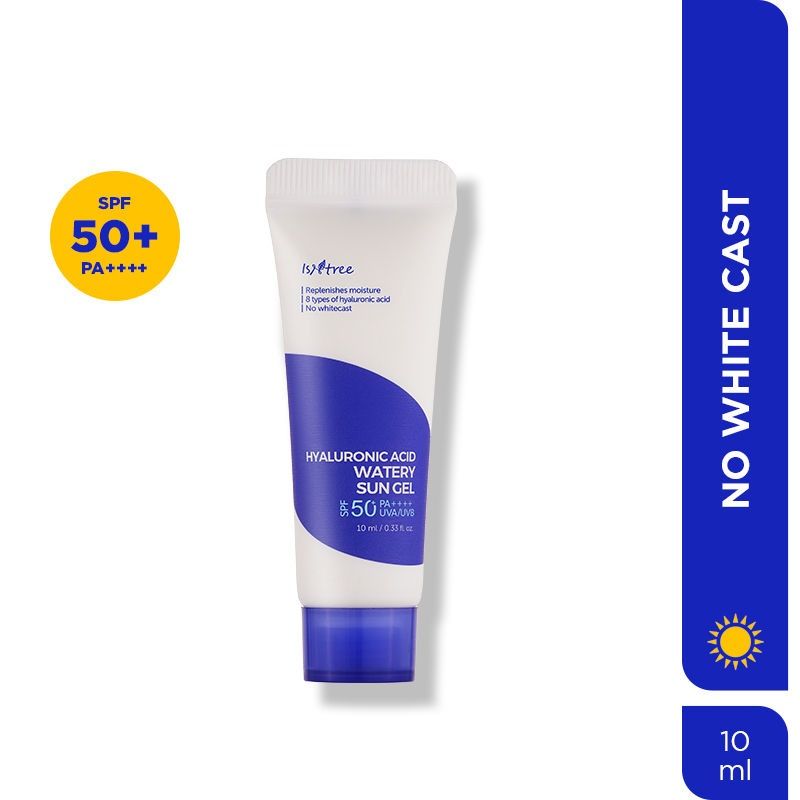
Isntree Hyaluronic Acid Watery Sun Gel SPF 50+ Pa++++ UVA/UVB

Isntree Hyaluronic Acid Watery Sun Gel SPF 50+ Pa++++ UVA/UVB
Isntree
isntree-hyaluronic-acid-watery-sun-gel-spf-50-pa-uva-uvb
Suncare
10084731814181
Morning or Evening?
How often will you use this product?
Notes


Highlights
WHAT IS IT?
Watery Sun Gel with multiple hyaluronic acid derivatives and other ingredients
FEATURES
Broad-spectrum SPF50+ PA++++ protection, lightweight and hydrating formula, dewy finish, fragrance-free, non-comedogenic, chemical sunscreen filters
BEST FOR
normal
CHECKS
No harsh chemicals, no artificial fragrances
Who Is It For?
All Genders All AgesWhat Does It Help With?
Sunburn Prevention Premature Aging Prevention Hyperpigmentation Prevention HydrationBudget
Affordable (under $30)How To Use
Which routine should it be used in?
Instructions:
Key Information


What Isntree Says
Product Description:
Shield your skin from harmful UV rays while achieving a lightweight, hydrated feel with Isntree Hyaluronic Acid Watery Sun Gel. This fragrance-free sunscreen is suitable for all skin types, especially those seeking a non-greasy, hydrating sun protection option. This broad-spectrum formula boasts SPF50+ PA++++ protection, safeguarding your skin against UVA and UVB rays to prevent sunburn, premature aging, and hyperpigmentation. Hyaluronic acid, a powerful humectant, delivers deep hydration throughout the day, keeping your skin feeling plump and supple. The chemical filters ensure a lightweight, non-comedogenic formula that absorbs quickly and leaves a dewy finish. Free of harsh chemicals, artificial fragrances, and non-comedogenic, Isntree Hyaluronic Acid Watery Sun Gel offers a gentle yet effective solution for sun protection that feels comfortable on your skin. Features: Broad-Spectrum Protection (SPF50+ PA++++): Protects against UVA and UVB rays to prevent sunburn, premature aging, and hyperpigmentation. Lightweight and Hydrating: Chemical filters ensure a lightweight, non-greasy feel. Hyaluronic acid delivers deep hydration for a comfortable wear. Dewy Finish: Leaves a radiant, dewy look without feeling sticky.
About the Brand:
Ingredients Overview
Ingredients List
Water,Butylene-Glycol,Ethylhexyl-Salicylate,Homosalate,Dibutyl-Adipate,Niacinamide,Bis-Ethylhexyloxyphenol-Methoxyphenyl-Triazine,Cyclopentasiloxane,Methylene-Bis-Benzotriazolyl-Tetramethylbutylphenol,Polysilicone-15,Diethylamino-Hydroxybenzoyl-Hexyl-Benzoate,1,2-Hexanediol,Pentylene-Glycol,Pinus-Pinaster-Bark-Extract,Ceramide-NP,Centella-Asiatica-Extract,Glycerin,Portulaca-Oleracea-Extract,Houttuynia-Cordata-Extract,Olea-Europaea-(Olive)-Fruit-Oil,Ficus-Carica-(Fig)-Fruit-Extract,Sodium-Hyaluronate,Ceteth-10,Hydrogenated-Lecithin,Decyl-Glucoside,Propanediol,Tocopherol,Astaxanthin,Hyaluronic-Acid,Sodium-Hyaluronate-Crosspolymer,Ascorbyl-Propyl-Hyaluronate,Hydrolyzed-Hyaluronic-Acid,Hydroxypropyltrimonium-Hyaluronate,Acrylates/C10-30-Alkyl-Acrylate-Crosspolymer,Sodium-Acetylated-Hyaluronate,Hydrolyzed-Sodium-Hyaluronate,Adenosine,Xanthan-Gum,Cetyl-PEG/PPG-10/1-Dimethicone,Tromethamine,Carbomer,Propylene-Glycol,Ethylhexylglycerin
Key Ingredients
Astaxanthin, Centella Asiatica extract, Fig fruit extract, Ceramide, Sodium hyaluronate, Hyaluronic acid
Ingredients Details
1-2-hexanediol
Common Name(s): 1-2-hexanediol,cosmetic active,functional ingredient
CAS Number: N/a
DESCRIPTION
What It Does: Delivers characteristic cosmetic function at recommended use concentration.
Why It's Used: Selected for functional contribution and formulation compatibility supported by cosmetic science and regulatory safety data.
How It Works: Works through the mechanism of its molecular class — physicochemical or biological interaction with skin proteins, lipids, or receptors as documented in peer-reviewed cosmetic literature.
Typically Found In: Skin care formulations
TECHNICAL DETAILS
Primary Category: Active ingredient – cosmetic active
Secondary Functions: Skin conditioning
Application Areas:

Facial Skincare

Body Care
Hair Care
Beard Care
Color Cosmetics (Makeup)
Dietary/Oral Supplements
Typical Concentration Range: 0.1%–10%
SOURCING & ETHICS
Vegan Status: Conditional - supplier confirmation required
Halal Status: Unverified - supplier confirmation required
Source Notes: Commercially produced for cosmetic use. verify vegan/halal status with supplier. [audit 2026-07-29 rev2: the record's own source_notes does not assert a non-animal origin, or instructs the reader to verify with the supplier; "yes" asserts knowledge the record does not hold. determination requires shariah-panel sign-off.]
SKIN COMPATIBILITY
Irritancy Rating: 1/5 – very low
Comedogenicity Rating: 0/5 – non-comedogenic
Sensitivity Concerns: Well-tolerated by most skin types.
Safe for Sensitive Skin: Yes
SAFETY & COMPATIBILITY
Safety Profile: Good safety profile at recommended concentrations. ewg score: 1–2.
Works Well With: Standard skincare actives
Avoid Combining With: No known significant incompatibilities
SCIENTIFIC NOTE
1-2-hexanediol has an established safety and efficacy profile within the cosmetic regulatory framework at standard use concentrations.
Last Verified: 2026-03-12
Primary Sources: Cosing database,1-2-hexanediol technical literature
Adenosine
Common Name(s): Adenine riboside,9-beta-d-ribofuranosyladenine
CAS Number: 58-61-7
DESCRIPTION
What It Does: Reduces fine lines, stimulates collagen, firms skin, and reduces inflammation.
Why It's Used: Fda-recognized anti-wrinkle active with multi-action collagen stimulation + wrinkle reduction + anti-inflammatory efficacy.
How It Works: Activates adenosine a2a receptors on fibroblasts stimulating collagen type i. also activates pka pathway promoting atp production and reducing inflammatory cytokines.
Typically Found In: Anti-aging serums,wrinkle treatments,korean skincare
TECHNICAL DETAILS
Primary Category: Active ingredient – purine nucleoside / anti-aging
Secondary Functions: Collagen stimulation,anti-inflammatory,cell energy
Application Areas:
Facial Skincare
Body Care
Hair Care
Beard Care
Color Cosmetics (Makeup)
Dietary/Oral Supplements
Typical Concentration Range: 0.04%–0.1%
SOURCING & ETHICS
Vegan Status: Conditional - supplier confirmation required
Halal Status: Unverified - supplier confirmation required
Source Notes: Synthetically produced for cosmetic use. [audit 2026-07-29 rev2: status downgraded on audit. determination requires shariah-panel sign-off.]
SKIN COMPATIBILITY
Irritancy Rating: 1/5 – very low
Comedogenicity Rating: 0/5 – non-comedogenic
Sensitivity Concerns: Non-irritating; excellent tolerability.
Safe for Sensitive Skin: Yes
SAFETY & COMPATIBILITY
Safety Profile: Excellent safety profile. fda-recognized as safe and effective anti-wrinkle ingredient. ewg score: 1.
Works Well With: Other b vitamins,niacinamide,antioxidant complexes
Avoid Combining With: No significant incompatibilities
SCIENTIFIC NOTE
A 2002 clinical study demonstrated 0.04% adenosine cream significantly reduced wrinkle depth and increased skin elasticity after 4 weeks. fda recognition requires controlled clinical trial evidence.
Last Verified: 2026-03-12
Primary Sources: Cosing database,adenosine anti-aging clinical data,fda otc anti-wrinkle monograph
Astaxanthin
Common Name(s): 3,3'-dihydroxy-beta-carotene-4,4'-dione,ketocarotenoid
CAS Number: 472-61-7
DESCRIPTION
What It Does: Provides the most powerful natural antioxidant activity from the unique membrane-spanning ketocarotenoid.
Why It's Used: Maximum natural antioxidant — astaxanthin's unmatched singlet oxygen quenching capacity from marine microalgae provides superior photodamage prevention per unit applied.
How It Works: Unique spanning carotenoid structure crosses membrane bilayer quenching radicals at both inner and outer membrane surfaces simultaneously. singlet oxygen quenching kq ~3×10¹⁰ l/mol/s — highest of all carotenoids. 11 conjugated double bonds for exceptional electron transfer. inhibits nf-kb for anti-inflammatory activity.
Typically Found In: Premium anti-aging serums,sunscreen boosters,photoprotection products
TECHNICAL DETAILS
Primary Category: Active ingredient – antioxidant
Secondary Functions: Free radical scavenging,anti-aging
Application Areas:
Facial Skincare
Body Care
Hair Care
Beard Care
Color Cosmetics (Makeup)
Dietary/Oral Supplements
Typical Concentration Range: 0.01%–0.2%
SOURCING & ETHICS
Vegan Status: Conditional - supplier confirmation required
Halal Status: Unverified - supplier confirmation required
Source Notes: Plant-derived extract or synthetic. [audit 2026-07-29 rev2: status downgraded on audit. determination requires shariah-panel sign-off.]
SKIN COMPATIBILITY
Irritancy Rating: 1/5 – very low
Comedogenicity Rating: 0/5
Sensitivity Concerns: Non-irritating; well-tolerated.
Safe for Sensitive Skin: Yes
SAFETY & COMPATIBILITY
Safety Profile: Excellent safety profile. ewg score: 1.
Works Well With: Vitamin c,vitamin e,ferulic acid,spf,other antioxidants
Avoid Combining With: No significant incompatibilities
SCIENTIFIC NOTE
Astaxanthin's membrane-spanning structural uniqueness: its 3.6nm molecular length exactly spans a phospholipid bilayer membrane, allowing simultaneous quenching of radicals at both membrane surfaces. no other known antioxidant achieves this dual-surface protection — the structural basis for astaxanthin's extraordinary antioxidant potency.
Last Verified: 2026-03-12
Primary Sources: Cosing database,naguib astaxanthin antioxidant comparison study
Carbomer
Common Name(s): Carbopol,polyacrylic acid,carboxyvinyl polymer
DESCRIPTION
What It Does: Provides transparent gel textures and thickening at very low concentrations via ph-responsive swelling.
Why It's Used: The most widely used gel thickener – provides crystal-clear, stable gels at concentrations as low as 0.1-0.5% with ph-controlled viscosity.
How It Works: Highly crosslinked polyacrylic acid remains tightly coiled at acidic ph. neutralization with naoh or triethanolamine ionizes carboxylic groups causing electrostatic repulsion that unfolds and swells the polymer coils, dramatically increasing viscosity. concentration-dependent thickening.
Typically Found In: Gels,serums,emulsions,sunscreens
TECHNICAL DETAILS
Primary Category: Functional ingredient – polyacrylic acid thickener
Secondary Functions: Skin conditioning
Application Areas:
Facial Skincare
Body Care
Hair Care
Beard Care
Color Cosmetics (Makeup)
Dietary/Oral Supplements
Typical Concentration Range: 0.1%–2%
SOURCING & ETHICS
Vegan Status: Conditional - supplier confirmation required
Halal Status: Unverified - supplier confirmation required
Source Notes: Commercially produced for cosmetic use. verify vegan/halal status with supplier. [audit 2026-07-29 rev2: the record's own source_notes does not assert a non-animal origin, or instructs the reader to verify with the supplier; "yes" asserts knowledge the record does not hold. determination requires shariah-panel sign-off.]
SKIN COMPATIBILITY
Irritancy Rating: 1/5 – very low
Comedogenicity Rating: 0/5 – non-comedogenic
Sensitivity Concerns: Well-tolerated by most skin types.
Safe for Sensitive Skin: Yes
SAFETY & COMPATIBILITY
Safety Profile: Good safety profile at recommended concentrations. ewg score: 1–2.
Works Well With: Standard skincare actives
Avoid Combining With: No known significant incompatibilities
SCIENTIFIC NOTE
Carbomer's ph-responsive swelling mechanism provides an elegant formulation control tool: a neutralized gel can be liquefied by ph reduction (adding acid) and re-thickened by reneutralization. this reversible rheology control allows two-phase products that mix on application without the need for mechanical emulsification.
Last Verified: 2026-03-12
Primary Sources: Cosing database,cir safety assessment