
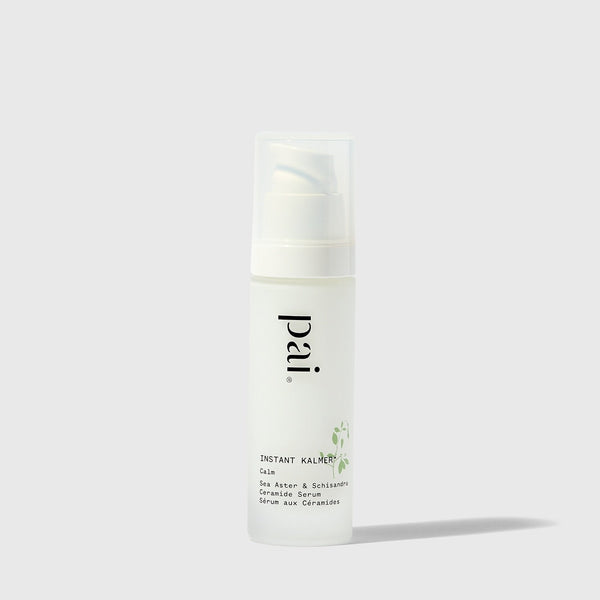

Pai Skincare
Instant Kalmer

Instant Kalmer
Pai Skincare
instant-kalmer
Serum
9628126970149
Morning or Evening?
How often will you use this product?
Notes


Highlights
WHAT IS IT?
A lightweight face serum with multiple ingredients
FEATURES
Calms angry and reactive skin, strengthens skin barrier, prevents redness
BEST FOR
Sensitive, irritated and redness-prone skin
CHECKS
Free from ingredients that irritate rosacea and eczema, fragrance-free
Who Is It For?
Not Specified But Suitable For Adults (18+) Of All Genders With Sensitive SkinWhat Does It Help With?
Redness Irritation Sensitivity Eczema Psoriasis RosaceaBudget
Mid-rangeHow To Use
Which routine should it be used in?
Instructions:
Key Information


What Pai Skincare Says
Product Description:
Calm angry and reactive skin with Instant Kalmer, our lightweight face serum. Enriched with Sea Aster to help bring zen to unsettled skin and Ceramides to help strengthen the skin barrier. Free from ingredients that irritate rosacea and eczema, this gentle formula works to instantly calm and prevent redness over time. Instant Kalmer is fragrance-free.
About the Brand:
Ingredients Overview
Ingredients List
AQUA, CITRUS AURANTIUM DULCIS FRUIT WATER (orange fruit water), LACTOBACILLUS FERMENT, GLYCERIN (organically derived vegetable glycerine), CARTHAMUS TINCTORIUS SEED OIL (safflower oil), AVENA SATIVA KERNEL OIL (oat kernel extract), CAPRYLIC/CAPRIC TRIGLYCERIDE, ASTER MARITIMA/TRIPOLIUM EXTRACT (sea aster extract), SODIUM LEVULINATE, LYSOLECITHIN, SCLEROTIUM GUM, OPHIOPOGON JAPONICUS ROOT EXTRACT, SCHIZANDRA SPHENANTHERA FRUIT EXTRACT (magnolia berry extract), SODIUM ANISATE, XANTHAN GUM, PULLULAN, MALTODEXTRIN, SODIUM DEHYDROACETATE, GLYCOSPHINGOLIPIDS, GLYCOLIPIDS, BETA-SITOSTEROL, SODIUM HYALURONATE, TOCOPHEROL (vitamin e), LACTIC ACID, SILICA
Key Ingredients
Sea Aster, Ceramides, Schisandra (Magnolia Berry)
Ingredients Details
Caprylic/capric Triglyceride
Common Name(s): Mct oil,fractionated coconut oil,c8/c10 triglyceride
CAS Number: 73398-61-5
DESCRIPTION
What It Does: Lightweight, stable emollient that solubilizes oil-soluble actives for excellent delivery without greasy feel.
Why It's Used: Universal lightweight emollient base and solubilizer for oil-soluble actives in serums and low-viscosity formulations where mineral oil or petrolatum would be too heavy.
How It Works: Medium-chain length provides ideal balance of spreading coefficient, penetration rate, and barrier-sealing properties. excellent solubilizer for vitamin e, retinoids, and other lipophilic actives.
Typically Found In: Serums,facial oils,sunscreens,anti-aging products,hair products
TECHNICAL DETAILS
Primary Category: Active ingredient – medium-chain triglyceride emollient
Secondary Functions: Active solubilizer,spreading agent
Application Areas:

Facial Skincare
Body Care
Hair Care

Beard Care
Color Cosmetics (Makeup)
Dietary/Oral Supplements
Typical Concentration Range: 1%–50%
SOURCING & ETHICS
Vegan Status: Yes – from coconut/palm kernel oil
Halal Status: Yes
Source Notes: Fractionated by hydrolysis and re-esterification of coconut oil. only c8 and c10 fatty acids retained.
SKIN COMPATIBILITY
Irritancy Rating: 1/5 – very low
Comedogenicity Rating: 1/5 – very low; medium-chain length generally non-comedogenic
Sensitivity Concerns: Non-irritating.
Safe for Sensitive Skin: Yes
SAFETY & COMPATIBILITY
Safety Profile: Excellent safety profile. ewg score: 1.
Works Well With: Humectants,ceramides,actives as carrier
Avoid Combining With: No significant incompatibilities
SCIENTIFIC NOTE
Mct oil's medium-chain length (c8/c10) provides superior oxidative stability vs longer polyunsaturated chains and better skin aesthetics (lighter, less greasy) vs longer chain emollients (c16/c18). excellent solubilizer for retinoic acid, tocopheryl esters, and other lipophilic actives.
Last Verified: Cosing database,cir safety assessment,ewg skin deep
Primary Sources: 2026-03-12
Lactobacillus Ferment
Common Name(s): Lactic acid bacteria ferment,probiotic lysate,lab ferment
CAS Number: N/a
DESCRIPTION
What It Does: Provides postbiotic benefits including barrier support, anti-inflammatory, and microbiome-balancing activity from lactic acid bacteria ferment.
Why It's Used: Postbiotic ingredient for microbiome-supportive skincare addressing the growing evidence for skin microbiome dysbiosis in inflammatory skin conditions.
How It Works: Lactobacillus-derived exopolysaccharides and peptides activate toll-like receptors tlr2/tlr6 on keratinocytes upregulating antimicrobial peptide production. lipoteichoic acid (lta) component modulates immune response reducing pro-inflammatory cytokine production. lactic acid component maintains skin acidic ph.
Typically Found In: Probiotic skincare,microbiome-supportive products,sensitive skin formulas
TECHNICAL DETAILS
Primary Category: Active ingredient – skin microbiome support
Secondary Functions: Tlr2/tlr6 activation,amp upregulation,microbiome support
Application Areas:
Facial Skincare
Body Care
Hair Care
Beard Care
Color Cosmetics (Makeup)
Dietary/Oral Supplements
Typical Concentration Range: 0.1%–5%
SOURCING & ETHICS
Vegan Status: Yes – bacterial fermentation
Halal Status: Yes
Source Notes: Fermentation-derived or plant-extracted.
SKIN COMPATIBILITY
Irritancy Rating: 1/5 – very low
Comedogenicity Rating: 0/5 – non-comedogenic
Sensitivity Concerns: Non-irritating; beneficial for sensitive skin.
Safe for Sensitive Skin: Yes
SAFETY & COMPATIBILITY
Safety Profile: Excellent safety profile. ewg score: 1.
Works Well With: Ceramides,niacinamide,soothing actives
Avoid Combining With: No significant incompatibilities
SCIENTIFIC NOTE
Topical application of heat-killed (pasteurized) lactobacillus demonstrates comparable or superior efficacy to live bacteria for skin benefits in controlled studies – the active components (exopolysaccharides, lta, cell wall components) are heat-stable, and live bacteria in cosmetics face regulatory and stability challenges.
Last Verified: Cosing database,seite & misery microbiome skin review
Primary Sources: 2026-03-12
Lysolecithin
Common Name(s): Liposome/lysolecithin,phospholipid delivery vehicle,encapsulated active carrier
CAS Number: N/a
DESCRIPTION
What It Does: Encapsulates water-soluble and lipid-soluble actives in separate aqueous/lipid compartments for controlled release, enhances sc penetration of encapsulated actives through lipid bilayer-sc fusion, and provides biomimetic skin conditioning from the phospholipid structure identical to skin cell membranes.
Why It's Used: Liposomal encapsulation solves the delivery paradox of water-soluble actives in lipid-rich sc: encapsulation in phospholipid bilayers provides simultaneous aqueous (active protection) and lipid (sc compatibility) character enabling sc penetration of otherwise sc-impermeable actives.
How It Works: Phospholipid bilayer vesicles (liposomes) form spontaneously from hydrated phospholipids above their phase transition temperature. at the sc surface, liposome membranes undergo fusion with sc lipid bilayers releasing encapsulated contents into the sc. lysolecithin (single-chain phospholipid) provides surfactant-like sc penetration enhancement through lamellar lipid disruption at sub-cmc concentrations.
Typically Found In: Active delivery systems,premium skin care
TECHNICAL DETAILS
Primary Category: Functional ingredient – emollient
Secondary Functions: Barrier sealing,softening
Application Areas:
Facial Skincare
Body Care
Hair Care
Beard Care
Color Cosmetics (Makeup)
Dietary/Oral Supplements
Typical Concentration Range: 0.1%–5%
SOURCING & ETHICS
Vegan Status: Conditional
Halal Status: Yes
Source Notes: Plant-derived, synthetic or animal-derived. verify source.
SKIN COMPATIBILITY
Irritancy Rating: 1/5 – very low
Comedogenicity Rating: 1/5 – low; formulation-dependent
Sensitivity Concerns: Non-irritating.
Safe for Sensitive Skin: Yes
SAFETY & COMPATIBILITY
Safety Profile: Excellent safety profile. ewg score: 1.
Works Well With: Humectants,ceramides,actives as carrier
Avoid Combining With: No significant incompatibilities
SCIENTIFIC NOTE
Liposome size controls sc penetration: small unilamellar vesicles (suv, 20–100 nm) penetrate follicular route; large multilamellar vesicles (mlv, >500 nm) remain at skin surface for controlled topical release. size selection determines the delivery depth and active release profile.
Last Verified: Cosing database,liposome phospholipid active delivery review
Primary Sources: 2026-03-12
Sodium Levulinate
Common Name(s): Sodium levulinate,cosmetic active,functional ingredient
CAS Number: N/a
DESCRIPTION
What It Does: Delivers characteristic cosmetic function at recommended use concentration.
Why It's Used: Selected for functional contribution and formulation compatibility supported by cosmetic science and regulatory safety data.
How It Works: Works through the mechanism of its molecular class as documented in peer-reviewed cosmetic literature.
Typically Found In: Skin care formulations
TECHNICAL DETAILS
Primary Category: Active ingredient – cosmetic active
Secondary Functions: Skin conditioning
Application Areas:
Facial Skincare
Body Care
Hair Care
Beard Care
Color Cosmetics (Makeup)
Dietary/Oral Supplements
Typical Concentration Range: 0.1%–10%
SOURCING & ETHICS
Vegan Status: Conditional
Halal Status: Yes
Source Notes: Commercially produced for cosmetic use. verify vegan/halal status with supplier.
SKIN COMPATIBILITY
Irritancy Rating: 1/5 – very low
Comedogenicity Rating: 0/5 – non-comedogenic
Sensitivity Concerns: Well-tolerated by most skin types.
Safe for Sensitive Skin: Yes
SAFETY & COMPATIBILITY
Safety Profile: Good safety profile at recommended concentrations. ewg score: 1–2.
Works Well With: Standard skincare actives
Avoid Combining With: No known significant incompatibilities
SCIENTIFIC NOTE
Sodium levulinate has an established safety profile within the cosmetic regulatory framework at standard use concentrations.
Last Verified: Cosing database,sodium levulinate technical literature
Primary Sources: 2026-03-12
