

Perricone MD
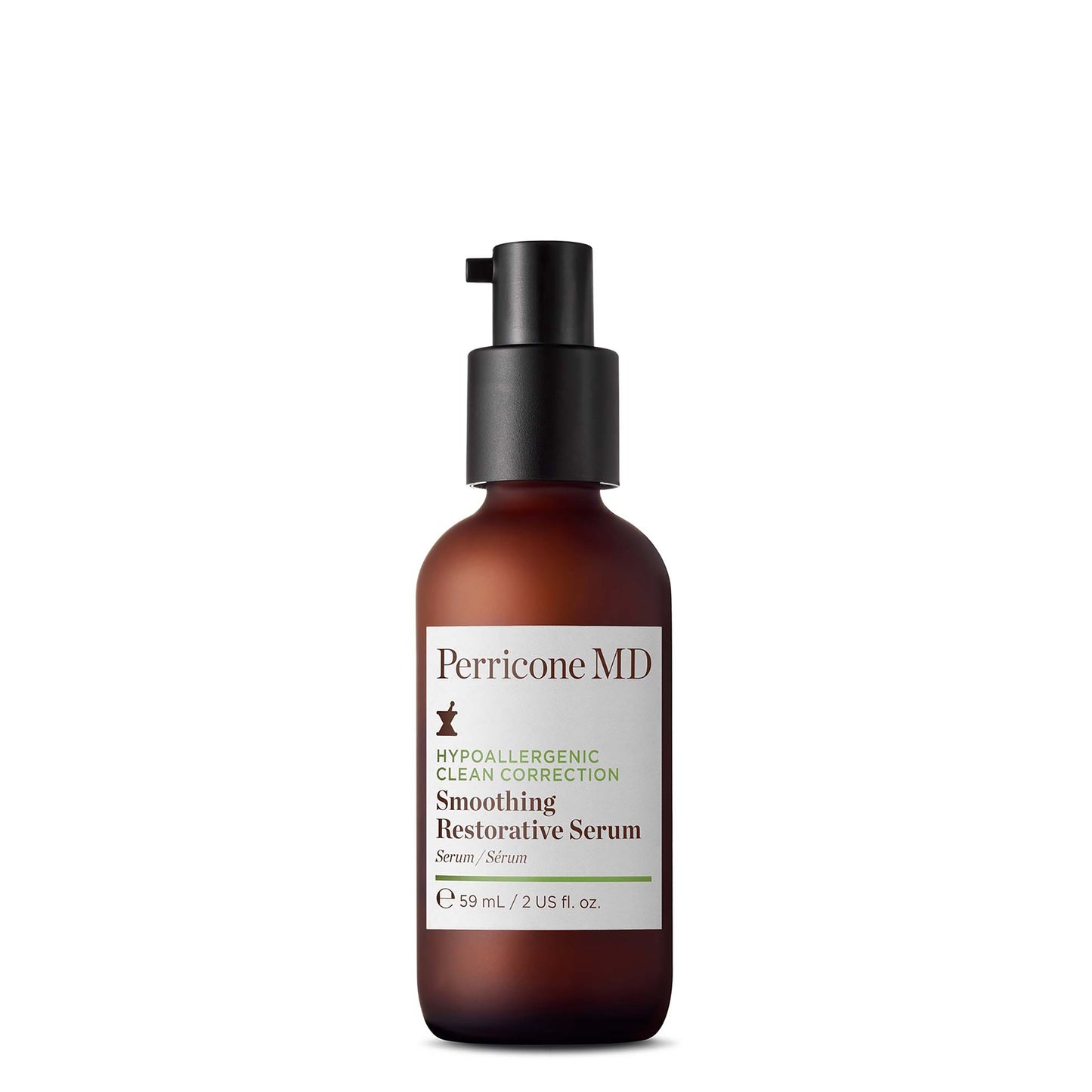
Hypoallergenic Clean Correction Smoothing Restorative Serum

Hypoallergenic Clean Correction Smoothing Restorative Serum
Perricone MD
hypoallergenic-clean-correction-smoothing-restorative-serum
Serum
9643616731429
Morning or Evening?
How often will you use this product?
Notes


Highlights
WHAT IS IT?
Serum with multiple ingredients
FEATURES
Vegan, non-comedogenic, dermatologist-tested, free of 26 known allergens, fragrance-free, gluten-free, sulfate-free, silicone-free, paraben-free
BEST FOR
Sensitive skin
CHECKS
Does not contain fragrance, gluten, sulfates, silicones, parabens, formaldehyde, butylene- and propylene-glycol, peg, phthalates, bha and bht
Who Is It For?
Adults Both Women And MenWhat Does It Help With?
Fine Lines Wrinkles Uneven Tone Uneven Texture Dullness Irritated SkinBudget
PremiumHow To Use
Which routine should it be used in?
Instructions:
Key Information


What Perricone MD Says
Product Description:
This gentle yet effective serum reduces the look of fine lines, wrinkles, uneven tone and uneven texture for a smoother, healthier and more radiant appearance. Lightweight and fast-absorbing, this ultra-lightweight serum soothes and comforts sensitive skin.
About the Brand:
Ingredients Overview
Ingredients List
Water/Aqua/Eau, Isononyl Isononanoate, Niacinamide, Polyglyceryl-4 Caprate, Propanediol, Glyceryl Stearate SE, Beta Vulgaris (Beet) Root Extract, Bakuchiol, Hydroxyethyl Acrylate/Sodium Acryloyldimethyl Taurate Copolymer, Brassica Campestris (Rapeseed) Seed Oil, Caprylyl Glycol, 1,2-Hexanediol, Phosphatidylcholine, Glycerin, Panthenol, Lactobacillus/Soybean Ferment Extract, Lycium Chinense Stem Extract, Glycyrrhiza Glabra (Licorice) Root Extract, Polyglyceryl-3 Diisostearate, Cucumis Sativus (Cucumber) Fruit Extract, Potassium Stearate, Citric Acid, Sorbitan Isostearate, Ocimum Sanctum Leaf Extract, Phaseolus Angularis Seed Extract, Lactic Acid, Lysine, Mannose, Sodium Mannose Phosphate, Althaea Officinalis Root Extract, Oryza Sativa (Rice) Bran Water, Xanthan Gum, Copper Sulfate, Proline, Pentylene Glycol, Tocopherol, Ascorbyl Palmitate
Key Ingredients
Bakuchiol, Niacinamide, Holy Basil
Ingredients Details
Bakuchiol
Common Name(s): Bakuchiol,(s)-bakuchiol
CAS Number: 10309-37-2
DESCRIPTION
What It Does: Provides retinol-equivalent anti-aging gene expression from a natural plant compound without retinol's limitations.
Why It's Used: The natural retinol alternative — the first plant compound with rct evidence for equivalent anti-aging results to retinol with better safety and photostability.
How It Works: Bakuchiol activates rar beta and retinoid x receptors via allosteric binding mechanism. upregulates type i, iii, and iv collagen synthesis genes. downregulates mmp-1 and mmp-9. antioxidant via phenol radical scavenging. photostable — stable to uv exposure unlike retinol.
Typically Found In: Natural anti-aging serums,pregnancy-safe retinol alternative,photostable anti-aging
TECHNICAL DETAILS
Primary Category: Active ingredient – natural retinol alternative
Secondary Functions: Free radical scavenging,anti-aging
Application Areas:

Facial Skincare
Body Care

Hair Care
Beard Care
Color Cosmetics (Makeup)
Dietary/Oral Supplements
Typical Concentration Range: 0.5%–2%
SOURCING & ETHICS
Vegan Status: Yes – from psoralea corylifolia seeds
Halal Status: Yes
Source Notes: Plant-derived extract or synthetic.
SKIN COMPATIBILITY
Irritancy Rating: 1/5 – very low
Comedogenicity Rating: 0/5 – non-comedogenic
Sensitivity Concerns: Non-irritating; well-tolerated.
Safe for Sensitive Skin: Yes
SAFETY & COMPATIBILITY
Safety Profile: Excellent safety profile. ewg score: 1.
Works Well With: Vitamin c,vitamin e,ferulic acid,spf,other antioxidants
Avoid Combining With: No significant incompatibilities
SCIENTIFIC NOTE
The dhaliwal et al. (2019, british journal of dermatology) split-face rct directly compared 0.5% bakuchiol vs 0.5% retinol twice daily for 12 weeks — both groups showed equivalent reduction in fine lines and wrinkles, but bakuchiol showed significantly less scaling, stinging, and burning. this is the strongest evidence that bakuchiol provides retinol-equivalent anti-aging with better tolerability.
Last Verified: Cosing database,dhaliwal et al. bakuchiol vs retinol rct
Primary Sources: 2026-03-12
Brassica Campestris (rapeseed) Seed Oil
Common Name(s): Brassica campestris (rapeseed) seed oil,botanical oil,phytochemical active
CAS Number: N/a
DESCRIPTION
What It Does: Provides antioxidant protection from reactive oxygen species, reduces inflammatory cytokine production in skin, and conditions skin surface through the plant's secondary metabolite complex.
Why It's Used: Chosen for its natural origin narrative, traditional use heritage, and multi-functional phytochemical profile that supports several concurrent skin care claims from one ingredient.
How It Works: Polyphenols, terpenoids, and alkaloids in the oil scavenge ros via hydrogen atom transfer, inhibit nf-kb or cox-2 inflammatory pathways, and interact with skin surface proteins for conditioning.
Typically Found In: Botanical skin care,natural products
TECHNICAL DETAILS
Primary Category: Active ingredient – antioxidant
Secondary Functions: Free radical scavenging,anti-aging
Application Areas:
Facial Skincare
Body Care
Hair Care
Beard Care
Color Cosmetics (Makeup)
Dietary/Oral Supplements
Typical Concentration Range: 0.1%–10%
SOURCING & ETHICS
Vegan Status: Yes
Halal Status: Yes
Source Notes: Plant-derived extract or synthetic.
SKIN COMPATIBILITY
Irritancy Rating: 1/5 – very low
Comedogenicity Rating: 0/5 – non-comedogenic
Sensitivity Concerns: Non-irritating; well-tolerated.
Safe for Sensitive Skin: Yes
SAFETY & COMPATIBILITY
Safety Profile: Excellent safety profile. ewg score: 1.
Works Well With: Vitamin c,vitamin e,ferulic acid,spf,other antioxidants
Avoid Combining With: No significant incompatibilities
SCIENTIFIC NOTE
Plant secondary metabolites evolved as uv photoprotectants and antimicrobial agents — mechanisms that directly translate to cosmetic antioxidant and anti-inflammatory activity in human skin.
Last Verified: Cosing database,brassica campestris (rapeseed) seed botanical review
Primary Sources: 2026-03-12
Glyceryl Stearate Se
Common Name(s): Glyceryl monostearate se,self-emulsifying glyceryl stearate
DESCRIPTION
What It Does: Provides self-emulsifying o/w emulsification with less co-emulsifier requirement.
Why It's Used: Simplified emulsification for formulations where self-emulsification reduces complexity vs standard gms requiring hlb-matched co-emulsifier blends.
How It Works: Small amount of embedded sodium/potassium stearate soap provides in-situ hlb modification enabling self-emulsification without requiring precisely hlb-matched co-emulsifier. forms stable o/w emulsions with water alone under high-shear mixing.
Typically Found In: Simple cream formulations,single-emulsifier systems
TECHNICAL DETAILS
Primary Category: Functional ingredient – self-emulsifying monoglyceride
Secondary Functions: Barrier sealing,softening
Application Areas:
Facial Skincare
Body Care
Hair Care
Beard Care
Color Cosmetics (Makeup)
Dietary/Oral Supplements
Typical Concentration Range: 1%–10%
SOURCING & ETHICS
Vegan Status: Yes – from vegetable glycerol and stearic acid
Halal Status: Yes
Source Notes: Plant-derived, synthetic or animal-derived. verify source.
SKIN COMPATIBILITY
Irritancy Rating: 1/5 – very low
Comedogenicity Rating: 1/5 – low; formulation-dependent
Sensitivity Concerns: Non-irritating.
Safe for Sensitive Skin: Yes
SAFETY & COMPATIBILITY
Safety Profile: Excellent safety profile. ewg score: 1.
Works Well With: Humectants,ceramides,actives as carrier
Avoid Combining With: No significant incompatibilities
SCIENTIFIC NOTE
Glyceryl stearate se's built-in self-emulsification arises from the small percentage (~2-5%) of potassium stearate soap co-crystallized with the monoglyceride. this soap provides the high-hlb co-emulsifier 'partner' needed for stable o/w emulsification without requiring the formulator to select and add a separate high-hlb emulsifier – an elegant simplification of classic emulsifier hlb matching theory.
Last Verified: Cosing database,cir safety assessment
Primary Sources: 2026-03-12
Hydroxyethyl Acrylate/sodium Acryloyldimethyl Taurate Copolymer
Common Name(s): Hydroxyethyl acrylate/sodium acryloyldimethyl taurate copolymer
DESCRIPTION
What It Does: Provides antioxidant protection, soothing anti-inflammatory effects, and skin-conditioning benefits through plant-derived polyphenols and phytochemicals.
Why It's Used: Plant extracts concentrate bioactive phytochemicals evolved for environmental protection — uv, microbial, and oxidative stressors — that translate to skin benefits.
How It Works: Polyphenols (flavonoids, phenolic acids) inhibit nf-κb-mediated inflammatory signaling, scavenge reactive oxygen species through electron donation, and chelate pro-oxidant metal ions to reduce oxidative skin damage.
Typically Found In: Lotions,creams,serums,masks
TECHNICAL DETAILS
Primary Category: Minerals
Secondary Functions: Skin-conditioning
Application Areas:
Facial Skincare
Body Care
Hair Care
Beard Care
Color Cosmetics (Makeup)
Dietary/Oral Supplements
Typical Concentration Range: 0.1–10%
SOURCING & ETHICS
Vegan Status: Yes
Halal Status: Yes
Source Notes: Mineral-derived ingredient; no biological origin.
SKIN COMPATIBILITY
Irritancy Rating: 1
Comedogenicity Rating: 0
Sensitivity Concerns: Low sensitization potential at recommended use concentrations.
Safe for Sensitive Skin: Yes
SAFETY & COMPATIBILITY
Safety Profile: Well-characterized cosmetic ingredient with established safety profile. generally non-irritating at typical use concentrations. suitable for leave-on and rinse-off cosmetics.
Works Well With: Plant extracts,peptides,vitamins
Avoid Combining With: Strong chelating agents (reduce mineral availability)
SCIENTIFIC NOTE
Plant secondary metabolites (flavonoids, terpenes, phenolic acids) are biosynthesized as defense compounds against uv, herbivores, and pathogens. their anti-inflammatory activity typically derives from competitive inhibition of cox-2 and 5-lox enzymes (ic50 1–50 µm), while antioxidant activity involves single electron transfer (set) and hydrogen atom transfer (hat) mechanisms with structure-dependent rate constants.
Last Verified: Cosing eu database; pcpc cosmetic ingredient safety reviews; ingredient-specific safety and efficacy literature
Primary Sources: 2025-01-15
