
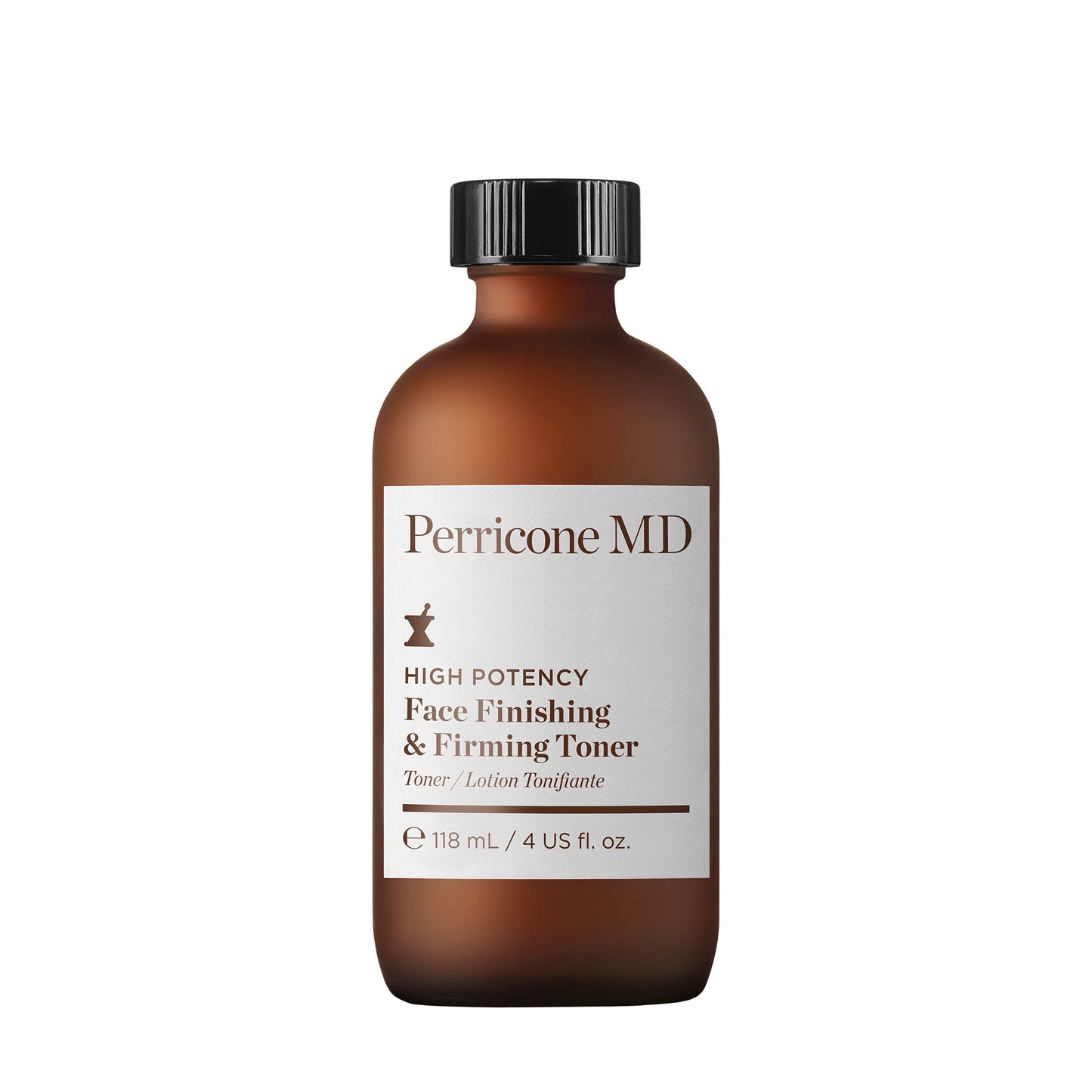

Perricone MD
High Potency Face Finishing & Firming Toner

High Potency Face Finishing & Firming Toner
Perricone MD
high-potency-face-finishing-firming-toner
Tone
9643620434213
Morning or Evening?
How often will you use this product?
Notes


Highlights
WHAT IS IT?
Toner
FEATURES
Gets rid of dead skin, oil & dirt; Reduces enlarged pores; Visibly tightens and smooths; Refines uneven complexion
BEST FOR
Not specified, likely suitable for all skin types
CHECKS
Does not contain parabens
Who Is It For?
Adults (18+) Suitable For Both Women And MenWhat Does It Help With?
Loss Of Firmness Enlarged Pores Uneven Texture Dullness Dirt Oil & Impurity Build-upBudget
Mid-rangeHow To Use
Which routine should it be used in?
Instructions:
Key Information

What Perricone MD Says
Product Description:
This daily, rose-scented lightweight toner gently sloughs off dead skin cells & unclogs pores of impurities, oil & dirt while visibly tightening, smoothing & reducing the look of enlarged pores for a firmer, more refined, even-looking complexion. Revitalizes, hydrates & soothes, leaving skin looking radiant, refreshed & healthy.
About the Brand:
Ingredients Overview
Ingredients List
Water/Aqua/Eau, Rosa Damascena Flower Water, Citric Acid, Glycerin, Dimethyl MEA, Sodium Polystyrene Sulfonate, 1,2-Hexanediol, Sodium Benzoate, Rose Extract, Polysorbate 20, Propanediol, Glycyrrhiza Glabra (Licorice) Rhizome/Root, Hydrolyzed Rhodophyceae Extract, Panthenol, Fragrance (Parfum), Tetrasodium Glutamate Diacetate, Magnesium Aspartate, Zinc Gluconate, Potassium Sorbate, Humulus Lupulus (Hops) Extract, Xylitol, Caprylic Acid, Phenoxyethanol, Vitis Vinifera (Grape) Leaf Extract, Caprylyl Glycol, Menthol, Copper Gluconate, Citronellol, Geraniol, Hydroxycitronellal
Key Ingredients
DMAE, Alpha-Hydroxy Acid (AHA), Rosewater
Ingredients Details
12 Hexanediol
Common Name(s): 12 hexanediol
DESCRIPTION
What It Does: Delivers targeted skin-conditioning or bioactive benefits through a specific mechanism of action suited to the formulation's intended purpose.
Why It's Used: Specialty actives address specific skin concerns through targeted molecular mechanisms, providing efficacy beyond what base formulation ingredients alone can achieve.
How It Works: The bioactive compound interacts with specific molecular targets in skin cells or the extracellular matrix — enzymes, receptors, structural proteins, or signaling molecules — triggering beneficial biological responses.
Typically Found In: Serums,treatments,moisturizers,specialty products
TECHNICAL DETAILS
Primary Category: Specialty actives
Secondary Functions: Skin-conditioning,anti-aging
Application Areas:

Facial Skincare

Body Care
Hair Care
Beard Care
Color Cosmetics (Makeup)
Dietary/Oral Supplements
Typical Concentration Range: 0.01–5%
SOURCING & ETHICS
Vegan Status: Yes
Halal Status: Yes
Source Notes: Specialty active ingredient; check individual sourcing for vegan status.
SKIN COMPATIBILITY
Irritancy Rating: 1899-12-31 00:00:00 -0800
Sensitivity Concerns: Low sensitization potential at recommended use concentrations.
Safe for Sensitive Skin: Yes
SAFETY & COMPATIBILITY
Safety Profile: Well-characterized cosmetic ingredient with established safety profile. generally non-irritating at typical use concentrations. suitable for leave-on and rinse-off cosmetics.
Works Well With: Niacinamide,hyaluronic acid,vitamin c,peptides
Avoid Combining With: Incompatible with oxidizing agents; check ph stability
SCIENTIFIC NOTE
Specialty actives typically work through enzyme inhibition (e.g., tyrosinase inhibition for brightening, mmp inhibition for anti-aging), receptor activation (e.g., retinoid receptors, ppar-γ for barrier genes), or transcription factor modulation (e.g., nrf2 for antioxidant gene upregulation). structure-activity relationships determine potency and selectivity.
Last Verified: Cosing eu database; pcpc cosmetic ingredient safety reviews; ingredient-specific safety and efficacy literature
Primary Sources: 2025-01-15
Citric Acid
Common Name(s): Lemon acid,2-hydroxypropane-1,2,3-tricarboxylic acid
CAS Number: 77-92-9
DESCRIPTION
What It Does: Adjusts ph to optimal ranges, chelates destabilizing metal ions, provides mild exfoliation at higher concentrations.
Why It's Used: Universal cosmetic ph adjuster and chelating agent. aha exfoliant activity is secondary.
How It Works: As ph adjuster, donates protons. as chelating agent, three carboxylic groups bind divalent metals (ca²⁺, mg²⁺, fe²⁺) preventing oxidative degradation.
Typically Found In: Nearly all cosmetic formulations,brightening products,exfoliants
TECHNICAL DETAILS
Primary Category: Active ingredient – alpha hydroxy acid (aha)
Secondary Functions: Chelating agent,ph adjustment,preservation enhancement
Application Areas:
Facial Skincare
Body Care
Hair Care
Beard Care
Color Cosmetics (Makeup)
Dietary/Oral Supplements
Typical Concentration Range: 0.1%–10%
SOURCING & ETHICS
Vegan Status: Yes – synthetic or fermentation-derived
Halal Status: Yes
Source Notes: Produced by fermentation of sugars by aspergillus niger. gras (e330). most abundant organic acid in citrus.
SKIN COMPATIBILITY
Irritancy Rating: 1/5 – very low at low concentrations; 2/5 at exfoliant concentrations
Comedogenicity Rating: 0/5 – non-comedogenic
Sensitivity Concerns: Photosensitizing – mandatory spf use. start at low frequency.
Safe for Sensitive Skin: Use with caution – spf required
SAFETY & COMPATIBILITY
Safety Profile: Safe at otc concentrations. eu: ≤10% leave-on at ph ≥3.5. mandatory spf advisory.
Works Well With: Niacinamide,ceramides,hyaluronic acid,spf
Avoid Combining With: Retinol in same step; multiple exfoliants simultaneously
SCIENTIFIC NOTE
Three carboxylic acid groups provide multiple proton donation sites and stronger chelation than monocarboxylic ahas. this makes citric acid the preferred cosmetic chelating agent alongside edta.
Last Verified: Cosing database,cir safety assessment,ewg skin deep
Primary Sources: 2026-03-12
Dimethyl Mea
Common Name(s): Dmae,dimethylaminoethanol,membrane stabiliser anti-aging
CAS Number: N/a
DESCRIPTION
What It Does: Provides immediate skin firmness from the topical amine's interaction with skin surface proteins, reduces age-related lipofuscin accumulation in cell membranes through acetylcholine pathway enhancement, and conditions skin with mild surfactant activity.
Why It's Used: Dmae's dual immediate-effect (surface protein tightening) and long-term mechanism (membrane lipofuscin reduction) enables both instant and cumulative anti-aging claim support from one ingredient.
How It Works: Dmae as a membrane phospholipid precursor incorporates into cell membranes as dimethylethanolamine phospholipid, improving membrane fluidity and reducing cross-linked lipofuscin accumulation. at the skin surface, dmae's cationic amine group interacts with skin surface carboxylate groups creating mild surface contraction providing immediate firmness perception.
Typically Found In: Anti-aging firming,membrane health
TECHNICAL DETAILS
Primary Category: Active ingredient – antioxidant
Secondary Functions: Free radical scavenging,anti-aging
Application Areas:
Facial Skincare
Body Care
Hair Care
Beard Care
Color Cosmetics (Makeup)
Dietary/Oral Supplements
Typical Concentration Range: 0.5%–3%
SOURCING & ETHICS
Vegan Status: Yes
Halal Status: Yes
Source Notes: Plant-derived extract or synthetic.
SKIN COMPATIBILITY
Irritancy Rating: 1/5 – very low
Comedogenicity Rating: 0/5 – non-comedogenic
Sensitivity Concerns: Non-irritating; well-tolerated.
Safe for Sensitive Skin: Yes
SAFETY & COMPATIBILITY
Safety Profile: Excellent safety profile. ewg score: 1.
Works Well With: Vitamin c,vitamin e,ferulic acid,spf,other antioxidants
Avoid Combining With: No significant incompatibilities
SCIENTIFIC NOTE
Dmae penetration studies show significant transdermal absorption (significantly more than most cosmetic actives) — the cholinergic activity may have systemic implications at high concentrations. use at standard cosmetic concentrations (0.5–3%) is considered safe.
Last Verified: Cosing database,dmae membrane stabiliser anti-aging review
Primary Sources: 2026-03-12
Glycerin
Common Name(s): Glycerol,glycerine,1,2,3-propanetriol
CAS Number: 56-81-5
DESCRIPTION
What It Does: Glycerin pulls water from the environment and deeper skin layers into the outer skin layer (epidermis), boosting moisture levels and keeping skin soft, smooth, and plump.
Why It's Used: It is used in virtually every moisturizer, serum, and cleanser because it is highly effective at hydrating skin, is well-tolerated by all skin types, and enhances the texture and spreadability of formulations.
How It Works: As a humectant, glycerin forms hydrogen bonds with water molecules, trapping them in the skin. it also reinforces the skin barrier by integrating into lipid structures between skin cells.
Typically Found In: Moisturizers,serums,cleansers,toners,sheet masks,sunscreens,body lotions,shampoos,conditioners
TECHNICAL DETAILS
Primary Category: Humectant
Secondary Functions: Skin barrier support,emollient,solvent
Application Areas:
Facial Skincare
Body Care
Hair Care
Beard Care
Color Cosmetics (Makeup)
Dietary/Oral Supplements
Typical Concentration Range: 1%–30% (typical: 3–10%)
SOURCING & ETHICS
Vegan Status: Yes – plant-derived (coconut, soy, palm) or synthetic
Halal Status: Yes – when plant-derived or synthetic; verify source with supplier
Source Notes: Derived from plant oils via hydrolysis or saponification; synthetic versions also available. palm-derived glycerin carries sustainability concerns.
SKIN COMPATIBILITY
Irritancy Rating: 1/5 – very low; non-irritating at all standard concentrations
Comedogenicity Rating: 0/5 – non-comedogenic
Sensitivity Concerns: Extremely rare allergic reactions; generally safe for all skin types including sensitive and baby skin
Safe for Sensitive Skin: Yes
SAFETY & COMPATIBILITY
Safety Profile: Widely recognized as safe. ewg hazard score: 1. no significant concerns for irritation, sensitization, or toxicity at typical concentrations (up to 50%).
Works Well With: Hyaluronic acid,ceramides,niacinamide,panthenol,urea,peptides,retinol,ahas/bhas
Avoid Combining With: No known incompatibilities at standard concentrations
SCIENTIFIC NOTE
Glycerin is an endogenous skin component found naturally in the stratum corneum. aquaporin-3 channels in keratinocytes facilitate glycerin transport, making it integral to natural skin hydration pathways.
Last Verified: Cosing database,cir safety assessment,ewg skin deep,inci decoder
Primary Sources: 2026-03-12
