

Pai Skincare
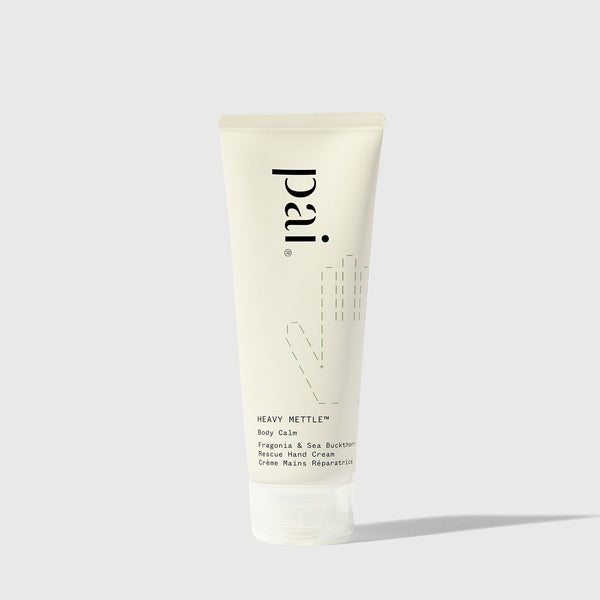
Heavy Mettle

Heavy Mettle
Pai Skincare
heavy-mettle
Body care
9628134408485
Morning or Evening?
How often will you use this product?
Notes


Highlights
WHAT IS IT?
Hand cream with multiple natural ingredients
FEATURES
Hydrating, soothing, nourishing
BEST FOR
Dry, sensitive skin
CHECKS
Does not contain parabens or other harsh chemicals
Who Is It For?
Adults Both Women And MenWhat Does It Help With?
Dry Chapped HandsBudget
Mid-rangeHow To Use
Which routine should it be used in?
Instructions:
Key Information


What Pai Skincare Says
Product Description:
A courageous hand cream for dry, chapped hands in need of serious moisture. Sea buckthorn provides deep nourishment while fragonia lifts the spirits.
About the Brand:
Ingredients Overview
Ingredients List
AQUA, VITIS VINIFERA SEED OIL (grape seed oil), GLYCERIN (organically derived vegetable glycerine), PERSEA GRATISSIMA OIL (avocado oil), LACTOBACILLUS FERMENT, CETEARYL ALCOHOL, ROSA CANINA SEED EXTRACT (rosehip seed oil), MACADAMIA TERNIFOLIA SEED OIL (macadamia oil), CITRUS AURANTIUM DULCIS FRUIT WATER (orange fruit water), BUTYROSPERMUM PARKII BUTTER (shea butter), PRUNUS DOMESTICA SEED OIL (plum oil), CETEARYL GLUCOSIDE, HIPPOPHAE RHAMNOIDES FRUIT EXTRACT (sea buckthorn oil), AGONIS FRAGRANS BRANCH/LEAF OIL (fragonia oil), PELARGONIUM GRAVEOLENS OIL (rose geranium oil), SODIUM STEAROYL GLUTAMATE, RICINUS COMMUNIS SEED OIL (castor oil), LACTIC ACID, TOCOPHEROL (vitamin e), SODIUM ANISATE, SODIUM LEVULINATE, BETA-SITOSTEROL, PRUNUS AMYGDALUS AMARA KERNEL OIL (bitter almond oil), ROSMARINUS OFFICINALIS LEAF EXTRACT (rosemary extract), SQUALENE
Key Ingredients
Sea buckthorn oil, Fragonia oil, Shea butter, Rosehip seed oil
Ingredients Details
Cetearyl Alcohol
Common Name(s): Cetostearyl alcohol,c16-18 fatty alcohol
CAS Number: 8005-44-5
DESCRIPTION
What It Does: Provides fatty alcohol emulsification and thickening for stable, well-textured emulsions.
Why It's Used: The most widely used fatty alcohol in cosmetics – provides emulsification, thickening, and emolliency simultaneously from a single ingredient with excellent safety profile.
How It Works: Forms bilayer lamellar structures in water with emulsifiers creating a viscous structured network that thickens and stabilizes emulsions. fatty alcohol emolliency provides direct skin conditioning. bilayer formation reduces inter-droplet coalescence in emulsions.
Typically Found In: Creams,lotions,conditioners – virtually all emulsion products
TECHNICAL DETAILS
Primary Category: Functional ingredient – fatty alcohol emulsifier/thickener
Secondary Functions: Barrier sealing,softening
Application Areas:

Facial Skincare
Body Care
Hair Care

Beard Care
Color Cosmetics (Makeup)
Dietary/Oral Supplements
Typical Concentration Range: 1%–25%
SOURCING & ETHICS
Vegan Status: Yes - standard ethanol routes are non-animal; confirm denaturant origin
Halal Status: Conditional - ethanol production route and residual concentration; jurisdiction-dependent, refer to certifier stance
Source Notes: Plant-derived, synthetic or animal-derived. verify source. [audit 2026-07-29 rev2: ethanol pathway; determination depends on route, on whether the plant also produces beverage alcohol, and on residual concentration. determination requires shariah-panel sign-off.]
SKIN COMPATIBILITY
Irritancy Rating: 1/5 – very low
Comedogenicity Rating: 1/5 – low; formulation-dependent
Sensitivity Concerns: Non-irritating.
Safe for Sensitive Skin: Yes
SAFETY & COMPATIBILITY
Safety Profile: Excellent safety profile. ewg score: 1.
Works Well With: Humectants,ceramides,actives as carrier
Avoid Combining With: No significant incompatibilities
SCIENTIFIC NOTE
Cetearyl alcohol's ability to form lamellar liquid crystal structures ('krafft phases') with water and co-emulsifiers provides not only emulsion stability but also enhanced skin penetration via the lamellar skin barrier pathway. these crystalline structures can act as a reservoir for active ingredients, slowly releasing them as the lamellar structure melts on skin contact.
Last Verified: 2026-03-12
Primary Sources: Cosing database,cir safety assessment
Lactobacillus Ferment
Common Name(s): Lactic acid bacteria ferment,probiotic lysate,lab ferment
CAS Number: N/a
DESCRIPTION
What It Does: Provides postbiotic benefits including barrier support, anti-inflammatory, and microbiome-balancing activity from lactic acid bacteria ferment.
Why It's Used: Postbiotic ingredient for microbiome-supportive skincare addressing the growing evidence for skin microbiome dysbiosis in inflammatory skin conditions.
How It Works: Lactobacillus-derived exopolysaccharides and peptides activate toll-like receptors tlr2/tlr6 on keratinocytes upregulating antimicrobial peptide production. lipoteichoic acid (lta) component modulates immune response reducing pro-inflammatory cytokine production. lactic acid component maintains skin acidic ph.
Typically Found In: Probiotic skincare,microbiome-supportive products,sensitive skin formulas
TECHNICAL DETAILS
Primary Category: Active ingredient – skin microbiome support
Secondary Functions: Tlr2/tlr6 activation,amp upregulation,microbiome support
Application Areas:
Facial Skincare
Body Care
Hair Care
Beard Care
Color Cosmetics (Makeup)
Dietary/Oral Supplements
Typical Concentration Range: 0.1%–5%
SOURCING & ETHICS
Vegan Status: Yes – bacterial fermentation
Halal Status: Yes
Source Notes: Fermentation-derived or plant-extracted.
SKIN COMPATIBILITY
Irritancy Rating: 1/5 – very low
Comedogenicity Rating: 0/5 – non-comedogenic
Sensitivity Concerns: Non-irritating; beneficial for sensitive skin.
Safe for Sensitive Skin: Yes
SAFETY & COMPATIBILITY
Safety Profile: Excellent safety profile. ewg score: 1.
Works Well With: Ceramides,niacinamide,soothing actives
Avoid Combining With: No significant incompatibilities
SCIENTIFIC NOTE
Topical application of heat-killed (pasteurized) lactobacillus demonstrates comparable or superior efficacy to live bacteria for skin benefits in controlled studies – the active components (exopolysaccharides, lta, cell wall components) are heat-stable, and live bacteria in cosmetics face regulatory and stability challenges.
Last Verified: 2026-03-12
Primary Sources: Cosing database,seite & misery microbiome skin review