

Guerlain
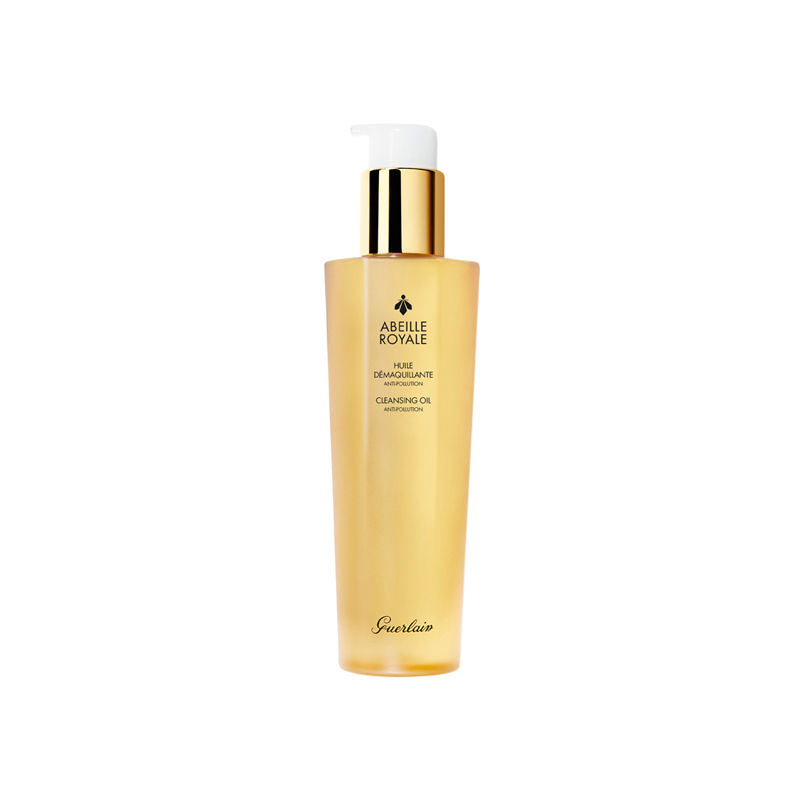
Guerlain Abeille Royale Cleansing Oil

Guerlain Abeille Royale Cleansing Oil
Guerlain
guerlain-abeille-royale-cleansing-oil
Cleanse
10085111890213
Morning or Evening?
How often will you use this product?
Notes


Highlights
WHAT IS IT?
Cleansing Oil with 12 ingredients
FEATURES
Gentle makeup removal including waterproof, removes pollutant particles, preserves skin hydration and pH, ultra-fine texture transforms into milky emulsion, leaves skin fresh and luminous
BEST FOR
sensitive
CHECKS
No greasy film
Who Is It For?
Adults All GendersWhat Does It Help With?
Makeup Removal Pollutant Particle Removal Skin Hydration PreservationBudget
Premium ($76-$150)How To Use
Which routine should it be used in?
Instructions:
Key Information


What Guerlain Says
Product Description:
The cleansing oil gently removes all types of makeup, even waterproof, from the face, eyes, and lips, and helps rid the skin of impurities and pollutant particles. The oil is applied directly to dry skin with the hands and gently massaged in to make makeup removal a moment of pure pleasure. Its ultra-fine texture with honeyed scents transforms on contact with water into a milky emulsion that rinses off easily, without leaving a greasy film. The skin is left fresh, supple, and comfortable. Ready to begin the Abeille Royale skincare ritual. Features: The skin's hydration is preserved. The skin's pH level is unaltered. Rids the skin of pollutant particles irrespective of size. The skin is clean and neat. The skin is immediately more luminous. The skin is fresh.
About the Brand:
Ingredients Overview
Ingredients List
Ethylhexyl-Palmitate,Caprylic/capric-Triglyceride,Isononyl-Isononanoate,Peg-20-Glyceryl-Triisostearate,Pentaerythrityl-Tetraethylhexanoate,Squalane,Royal-Jelly,Mel-(Honey),Caprylyl-Glycol,Parfum-(Fragrance),Aqua-(Water),Helianthus-Annuus-(Sunflower)-Seed-Oil-Unsaponifiables,Phytosterols
Key Ingredients
Royal Jelly,Mel-(Honey),Squalane
Ingredients Details
Phytosterols
Common Name(s): Plant sterols,beta-sitosterol complex,phytosterol mix
CAS Number: 83-46-5
DESCRIPTION
What It Does: Provides plant sterol barrier lipid analogue with anti-inflammatory and 5-alpha-reductase inhibiting activity.
Why It's Used: Comprehensive plant sterol complex providing barrier repair, anti-inflammatory, and anti-androgenic activity in a natural plant-derived mixture mimicking cholesterol's skin functions.
How It Works: Beta-sitosterol integrates into stratum corneum lipid bilayers as cholesterol structural analogue for barrier repair. inhibits 5-alpha-reductase type i and ii for dht reduction. anti-inflammatory via nf-kb inhibition. campesterol and stigmasterol provide complementary barrier and anti-inflammatory activities.
Typically Found In: Barrier repair creams,anti-acne products,anti-aging formulas
TECHNICAL DETAILS
Primary Category: Active ingredient – plant sterol complex
Secondary Functions: Barrier sealing,softening
Application Areas:

Facial Skincare
Body Care
Hair Care

Beard Care
Color Cosmetics (Makeup)
Dietary/Oral Supplements
Typical Concentration Range: 0.1%–3%
SOURCING & ETHICS
Vegan Status: Conditional - supplier confirmation required
Halal Status: Unverified - supplier confirmation required
Source Notes: Plant-derived, synthetic or animal-derived. verify source. [audit 2026-07-29 rev2: the record's own source_notes does not assert a non-animal origin, or instructs the reader to verify with the supplier; "yes" asserts knowledge the record does not hold. determination requires shariah-panel sign-off.]
SKIN COMPATIBILITY
Irritancy Rating: 1/5 – very low
Comedogenicity Rating: 1/5 – low; formulation-dependent
Sensitivity Concerns: Non-irritating.
Safe for Sensitive Skin: Yes
SAFETY & COMPATIBILITY
Safety Profile: Excellent safety profile. ewg score: 1.
Works Well With: Humectants,ceramides,actives as carrier
Avoid Combining With: No significant incompatibilities
SCIENTIFIC NOTE
Phytosterols' multiple concurrent mechanisms (barrier repair + 5-ar inhibition + anti-inflammation) from a single ingredient class provides comprehensive acne-relevant benefits from natural plant cell membrane components. beta-sitosterol's structural identity to cholesterol (one ethyl group difference at c-24) allows barrier integration while the different c-24 substitution subtly alters enzyme binding, providing 5-ar inhibition not seen with mammalian cholesterol.
Last Verified: 2026-03-12
Primary Sources: Cosing database,bouic phytosterol review
Squalane
Common Name(s): Perhydrosqualene,2,6,10,15,19,23-hexamethyltetracosane
CAS Number: 0111-01-03
DESCRIPTION
What It Does: Provides endogenous-skin-identical emolliency with exceptional stability and skin compatibility.
Why It's Used: The most skin-compatible emollient – chemically identical to human sebum squalene component with outstanding tolerability across all skin types.
How It Works: Fully saturated hydrocarbon with zero oxidation sites provides exceptional stability unlike squalene's 6 double bonds. integrates into stratum corneum lipid bilayers with near-perfect biocompatibility. provides antioxidant protection to formulation via radical quenching.
Typically Found In: Facial oils,serums,non-comedogenic moisturizers,luxury body care
TECHNICAL DETAILS
Primary Category: Functional ingredient – emollient
Secondary Functions: Maximum biocompatibility,antioxidant stabilizer,non-comedogenic
Application Areas:
Facial Skincare
Body Care
Hair Care
Beard Care
Color Cosmetics (Makeup)
Dietary/Oral Supplements
Typical Concentration Range: 1%–100%
SOURCING & ETHICS
Vegan Status: Conditional - feedstock declaration required
Halal Status: Unverified - feedstock declaration required (plant, animal and petrochemical routes all exist)
Source Notes: Sustainable plant-derived squalane from sugarcane fermentation (amyris) or olive oil fractionation is preferred over shark liver-derived. chemically identical regardless of source. [audit 2026-07-29 rev2: origin-dependent: the same inci exists in plant, animal and petrochemical versions and the name does not discriminate. determination requires shariah-panel sign-off.]
SKIN COMPATIBILITY
Irritancy Rating: 1/5 – very low
Comedogenicity Rating: 0/5 – non-comedogenic
Sensitivity Concerns: Non-irritating.
Safe for Sensitive Skin: Yes
SAFETY & COMPATIBILITY
Safety Profile: Excellent safety profile. ewg score: 1.
Works Well With: Humectants,ceramides,actives as carrier
Avoid Combining With: No significant incompatibilities
SCIENTIFIC NOTE
Squalene constitutes approximately 12-15% of human sebum – the highest proportion of any skin lipid. topical squalane (stable, hydrogenated form) replenishes this abundant endogenous skin lipid. the complete absence of oxidizable double bonds (unlike squalene's 6 double bonds) eliminates the pro-oxidant concerns of natural squalene oxidation.
Last Verified: 2026-03-12
Primary Sources: Cosing database,huang et al. squalane review,cir safety assessment