
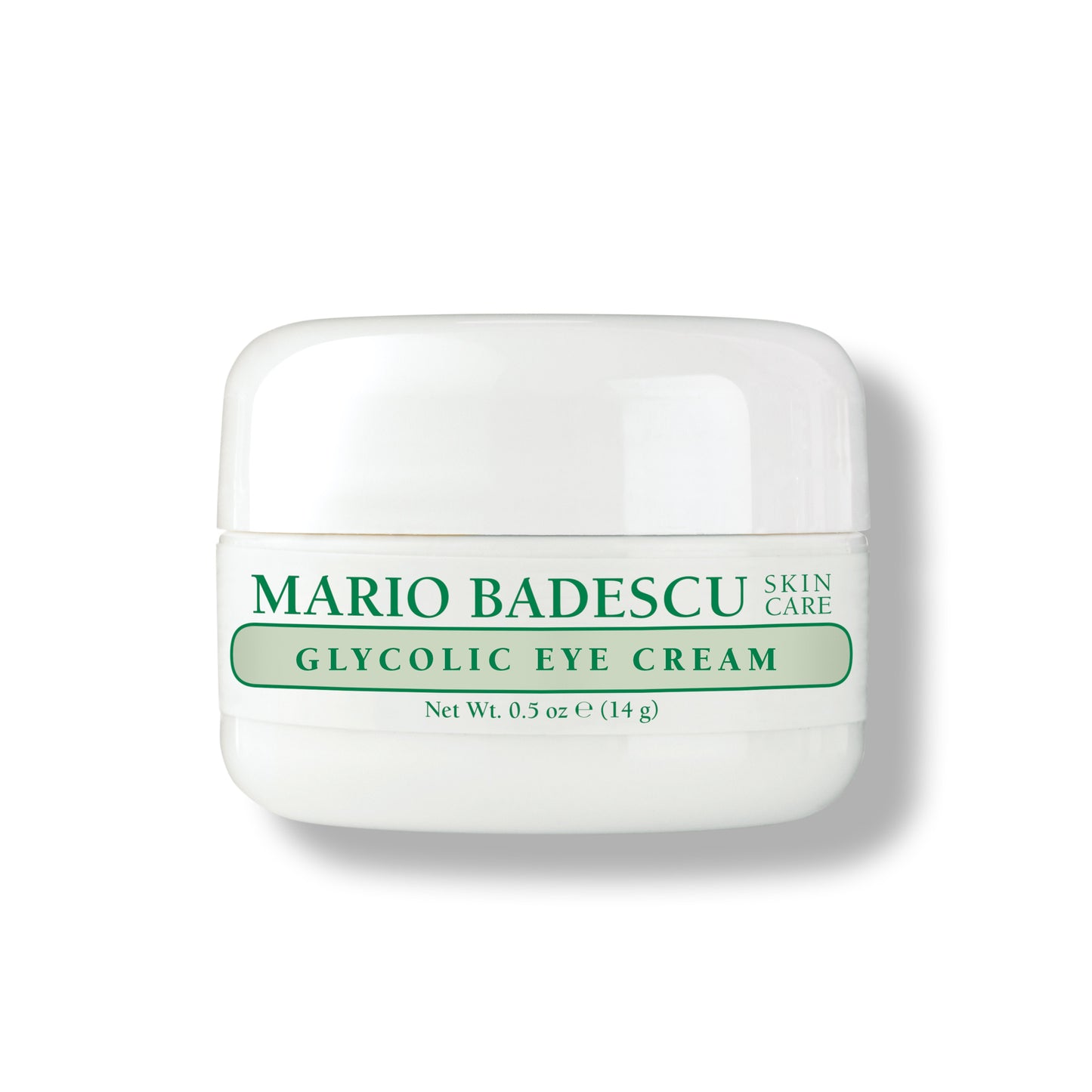

Mario Badescu
Glycolic Eye Cream

Glycolic Eye Cream
Mario Badescu
glycolic-eye-cream
Eyecare
9818355597605
Morning or Evening?
How often will you use this product?
Notes


Highlights
WHAT IS IT?
Eye cream with Glycolic Acid treatment
FEATURES
Retexturizes skin, targets fine lines and wrinkles, provides moisturization, contains antioxidants
BEST FOR
dry
CHECKS
Free of alcohol, sulfate, silicon
Who Is It For?
Adults Concerned With Aging Signs Around EyesWhat Does It Help With?
Fine Lines Wrinkles Crow's Feet Uneven Texture Dry Skin Around EyesBudget
Affordable (under $30)How To Use
Which routine should it be used in?
Instructions:
Key Information


What Mario Badescu Says
Product Description:
Glycolic Eye Cream is a rich, emollient undereye overnight treatment targeting fine lines and wrinkles, crows feet and visible signs of aging around the eyes. Glycolic Acid is a potent AHA that retexturizes the look of the skin, helping reveal a fresh, youthful glow.
About the Brand:
Ingredients Overview
Ingredients List
Olus Oil (Vegetable Oil, Huile Végétale), Aqua (Water, Eau), Olea Europaea (Olive) Leaf Extract, Paraffinum Liquidum (Mineral Oil, Huile Minérale), Cera Alba (Beeswax, Cire d'abeille), C10-30 Cholesterol/Lanosterol Esters, Isopropyl Myristate, Theobroma Cacao (Cocoa) Seed Butter, Glycolic Acid, Tocopherol, Cetyl Alcohol, Propylene Glycol, Diazolidinyl Urea, Sodium Benzoate, Methylparaben, Propylparaben
Key Ingredients
Glycolic Acid, Cocoa Butter, Vitamin E, Olive Leaf Extract
Ingredients Details
Cocoa Butter
Common Name(s): Cocoa butter,cacao butter
CAS Number: 8002-31-1
DESCRIPTION
What It Does: Provides hard-setting occlusive emolliency for body butters and lip balms with skin conditioning stearic acid.
Why It's Used: Classic body care and lip balm solid butter providing strong occlusive moisture retention with the iconic cocoa scent and stable solid-at-room-temperature consistency.
How It Works: High stearic (32-36%) and palmitic (25-30%) acid content provides hard, brittle texture with high melting point (34-38°c). solid at room temperature, melts at body contact for on-skin application. occlusive barrier film reduces tewl. natural polyphenols provide antioxidant activity.
Typically Found In: Body butters,lip balms,hard lotions,soap,cosmetics
TECHNICAL DETAILS
Primary Category: Functional ingredient – emollient
Secondary Functions: Occlusive barrier,hard butter texture,natural aroma
Application Areas:

Facial Skincare
Body Care

Hair Care
Beard Care
Color Cosmetics (Makeup)
Dietary/Oral Supplements
Typical Concentration Range: 1%–100%
SOURCING & ETHICS
Vegan Status: Yes – from theobroma cacao seeds
Halal Status: Yes
Source Notes: Expeller or cold-pressed from roasted cacao beans. natural cocoa butter retains aroma; deodorized available for unscented formulas. very shelf stable (shelf life 3-5 years).
SKIN COMPATIBILITY
Irritancy Rating: 1/5 – very low
Comedogenicity Rating: 4/5 – comedogenic; avoid on acne-prone face
Sensitivity Concerns: Non-irritating.
Safe for Sensitive Skin: Yes
SAFETY & COMPATIBILITY
Safety Profile: Excellent safety profile. ewg score: 1.
Works Well With: Humectants,ceramides,actives as carrier
Avoid Combining With: No significant incompatibilities
SCIENTIFIC NOTE
Cocoa butter is one of the few naturally occurring fats with a sharp melting point transition (34-38°c) just below body temperature, providing solid-at-room-temperature stability while melting completely and uniformly on skin contact. this unique thermal transition gives body butters and lip balms their characteristic texture and application.
Last Verified: 2026-03-12
Primary Sources: Cosing database,cir safety assessment
Glycolic Acid
Common Name(s): Hydroxyacetic acid,2-hydroxyacetic acid
CAS Number: 79-14-1
DESCRIPTION
What It Does: Provides maximum aha efficacy from the smallest most penetrating alpha-hydroxy acid.
Why It's Used: The most potent aha — glycolic acid's smallest molecular size provides the deepest penetration and highest efficacy of any alpha-hydroxy acid for exfoliation and anti-aging.
How It Works: Smallest aha (mw 76) provides deepest stratum corneum penetration. disrupts corneodesmosomes reducing cohesion. stimulates fibroblast collagen i and iii synthesis. efficacy is ph-dependent — free acid fraction determines activity.
Typically Found In: Chemical peels,body lotions,anti-aging serums,exfoliating toners
TECHNICAL DETAILS
Primary Category: Active ingredient – primary aha
Secondary Functions: Brightening,collagen stimulation
Application Areas:
Facial Skincare
Body Care
Hair Care
Beard Care
Color Cosmetics (Makeup)
Dietary/Oral Supplements
Typical Concentration Range: 1%–10% cosmetic; higher professional
SOURCING & ETHICS
Vegan Status: Yes – synthetic or fermentation-derived
Halal Status: Yes
Source Notes: Fermentation-derived or synthetic. ph must be ≤4.0 for aha activity.
SKIN COMPATIBILITY
Irritancy Rating: 2/5 – low to moderate
Comedogenicity Rating: 0/5 – non-comedogenic
Sensitivity Concerns: Photosensitizing – mandatory spf use. start at low frequency.
Safe for Sensitive Skin: Use with caution – spf required
SAFETY & COMPATIBILITY
Safety Profile: Eu cosmetics: max 10% leave-on, ph ≥3.5, mandatory sun protection advisory. professional peel concentrations regulated separately.
Works Well With: Niacinamide,ceramides,hyaluronic acid,spf
Avoid Combining With: Retinol in same step; multiple exfoliants simultaneously
SCIENTIFIC NOTE
Glycolic acid's ph-dependent efficacy is critical: at ph 3.0 ~100% is in the free acid (membrane-permeable) form; at ph 3.5 ~70%; at ph 4.0 ~50%. the eu ph ≥3.5 requirement reduces free acid proportion, lowering efficacy but also reducing irritation — why professional peel concentrations at lower ph are far more active than equivalent cosmetic concentrations.
Last Verified: 2026-03-12
Primary Sources: Cosing database,eu aha guidelines,cir safety assessment
Olive Leaf Extract
Common Name(s): Olive leaf extract extract
DESCRIPTION
What It Does: Provides antioxidant protection, soothing anti-inflammatory effects, and skin-conditioning benefits through plant-derived polyphenols and phytochemicals.
Why It's Used: Plant extracts concentrate bioactive phytochemicals evolved for environmental protection — uv, microbial, and oxidative stressors — that translate to skin benefits.
How It Works: Polyphenols (flavonoids, phenolic acids) inhibit nf-κb-mediated inflammatory signaling, scavenge reactive oxygen species through electron donation, and chelate pro-oxidant metal ions to reduce oxidative skin damage.
Typically Found In: Serums,toners,moisturizers,masks,essences
TECHNICAL DETAILS
Primary Category: Botanical extracts
Secondary Functions: Antioxidant,anti-inflammatory
Application Areas:
Facial Skincare
Body Care
Hair Care
Beard Care
Color Cosmetics (Makeup)
Dietary/Oral Supplements
Typical Concentration Range: 0.1–10%
SOURCING & ETHICS
Vegan Status: Yes
Halal Status: Yes
Source Notes: Plant-derived extract; no animal components.
SKIN COMPATIBILITY
Irritancy Rating: 1899-12-31 00:00:00 -0800
Sensitivity Concerns: Low sensitization potential at recommended use concentrations.
Safe for Sensitive Skin: Yes
SAFETY & COMPATIBILITY
Safety Profile: Well-characterized cosmetic ingredient with established safety profile. generally non-irritating at typical use concentrations. suitable for leave-on and rinse-off cosmetics.
Works Well With: Niacinamide,hyaluronic acid,vitamin c,ceramides
Avoid Combining With: Strong oxidizing agents
SCIENTIFIC NOTE
Plant secondary metabolites (flavonoids, terpenes, phenolic acids) are biosynthesized as defense compounds against uv, herbivores, and pathogens. their anti-inflammatory activity typically derives from competitive inhibition of cox-2 and 5-lox enzymes (ic50 1–50 µm), while antioxidant activity involves single electron transfer (set) and hydrogen atom transfer (hat) mechanisms with structure-dependent rate constants.
Last Verified: 2025-01-15
Primary Sources: Cosing eu database; pcpc cosmetic ingredient safety reviews; phytochemical and ethnobotanical literature
Vitamin E
Common Name(s): Vitamin e,cosmetic active,functional ingredient
CAS Number: N/a
DESCRIPTION
What It Does: Delivers characteristic cosmetic function at recommended use concentration.
Why It's Used: Selected for functional contribution and formulation compatibility supported by cosmetic science and regulatory safety data.
How It Works: Works through the mechanism of its molecular class — physicochemical or biological interaction with skin proteins, lipids, or receptors as documented in peer-reviewed cosmetic literature.
Typically Found In: Skin care formulations
TECHNICAL DETAILS
Primary Category: Active ingredient – cosmetic active
Secondary Functions: Skin conditioning
Application Areas:
Facial Skincare
Body Care
Hair Care
Beard Care
Color Cosmetics (Makeup)
Dietary/Oral Supplements
Typical Concentration Range: 0.1%–10%
SOURCING & ETHICS
Vegan Status: Conditional - supplier confirmation required
Halal Status: Unverified - supplier confirmation required
Source Notes: Commercially produced for cosmetic use. verify vegan/halal status with supplier. [audit 2026-07-29 rev2: the record's own source_notes does not assert a non-animal origin, or instructs the reader to verify with the supplier; "yes" asserts knowledge the record does not hold. determination requires shariah-panel sign-off.]
SKIN COMPATIBILITY
Irritancy Rating: 1/5 – very low
Comedogenicity Rating: 0/5 – non-comedogenic
Sensitivity Concerns: Well-tolerated by most skin types.
Safe for Sensitive Skin: Yes
SAFETY & COMPATIBILITY
Safety Profile: Good safety profile at recommended concentrations. ewg score: 1–2.
Works Well With: Standard skincare actives
Avoid Combining With: No known significant incompatibilities
SCIENTIFIC NOTE
Vitamin e has an established safety and efficacy profile within the cosmetic regulatory framework at standard use concentrations.
Last Verified: 2026-03-12
Primary Sources: Cosing database,vitamin e technical literature