
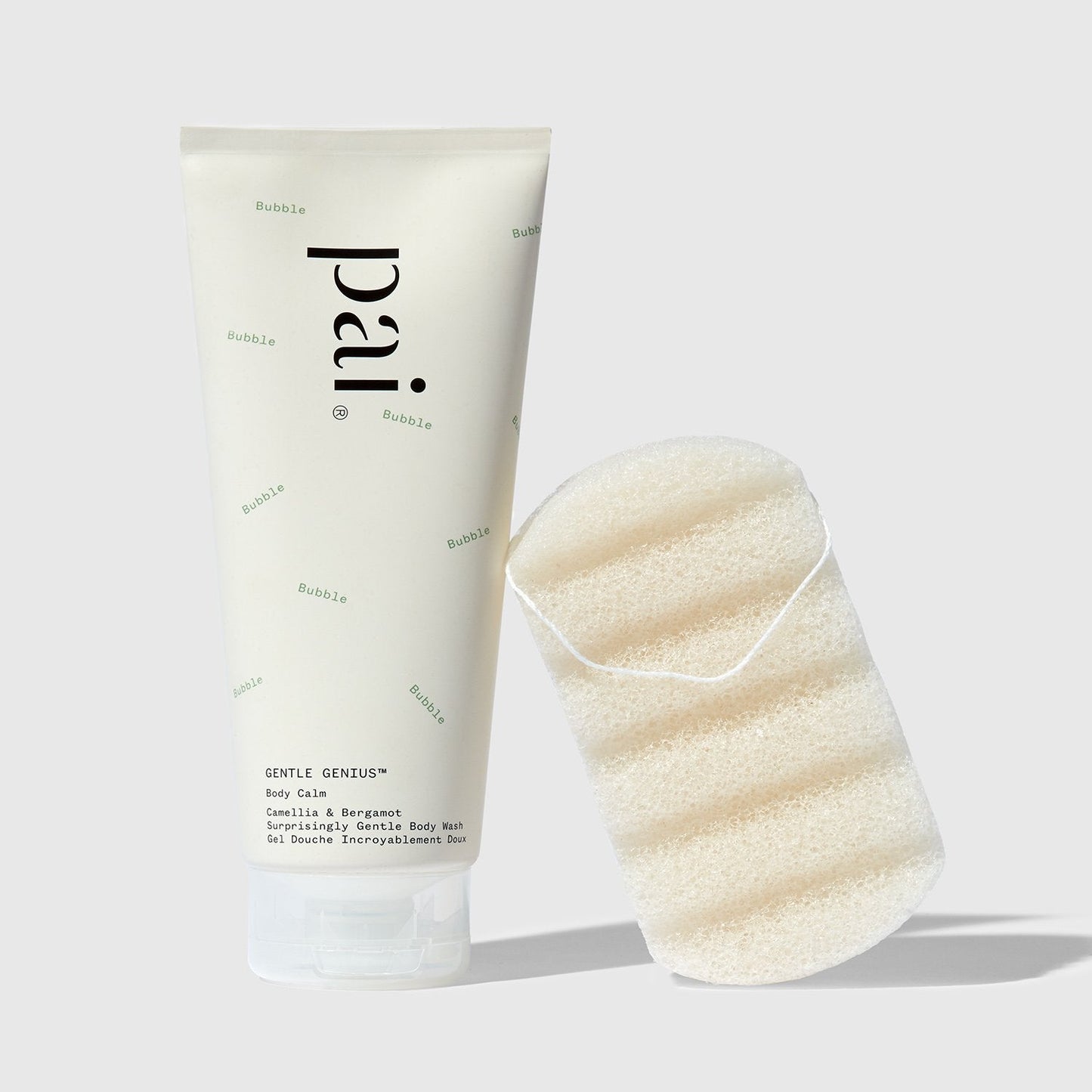

Pai Skincare
Gentle Genius

Gentle Genius
Pai Skincare
gentle-genius
Body care
9628136407333
Morning or Evening?
How often will you use this product?
Notes


Highlights
WHAT IS IT?
A gentle body wash
FEATURES
Sulphate-free, suitable for sensitive skin, patch tested for eczema, dermatitis and psoriasis
BEST FOR
Sensitive skin
CHECKS
Does not contain paraben, alchohol, sulphates, phenoxyethanol, petrochemicals, detergents (SLS/SLES), artificial fragrance
Who Is It For?
Not Specified Likely Suitable For Adults Of All GendersWhat Does It Help With?
Cleansing Sensitive Skin Including Those Prone To Eczema Dermatitis And PsoriasisBudget
Mid-rangeHow To Use
Which routine should it be used in?
Instructions:
Key Information


What Pai Skincare Says
Product Description:
Camellia & Bergamot Surprisingly Gentle Body Wash
About the Brand:
Ingredients Overview
Ingredients List
AQUA, DECYL GLUCOSIDE, GLYCERIN (organically derived vegetable glycerine), POLYGLYCERYL-4 OLEYL ETHER OLIVATE, LACTOBACILLUS, COCO-GLUCOSIDE, GLYCERYL OLEATE, CAMELLIA OLEIFERA SEED OIL (camellia oil), OLIVE OIL POLYGLYCERYL-3 ESTERS, RICINUS COMMUNIS SEED OIL (castor oil), MANGIFERA INDICA FRUIT EXTRACT (mango extract), COCOS NUCIFERA FRUIT EXTRACT (coconut fruit extract), ACACIA SENEGAL GUM (gum arabic), SCHISANDRA SPHENANTHERA FRUIT EXTRACT (magnolia berry extract), CHONDRUS CRISPUS POWDER (carrageenan), XANTHAN GUM, LECITHIN, TOCOPHEROL (vitamin e), SODIUM LEVULINATE, LACTIC ACID, POTASSIUM SORBATE, CITRIC ACID, SODIUM ANISATE, CITRUS AURANTIFOLIA OIL (lime oil), CITRUS AURANTIUM BERGAMIA FRUIT OIL (bergamot oil), HYDROGENATED PALM GLYCERIDES CITRATE, ASCORBYL PALMITATE
Key Ingredients
Camellia Oil, Magnolia Berry
Ingredients Details
Camellia Oleifera Seed Oil Camellia Oil
Common Name(s): Camellia oleifera seed oil camellia oil oil
DESCRIPTION
What It Does: Nourishes and softens skin through its balanced fatty acid profile, while antioxidant compounds protect against oxidative skin damage.
Why It's Used: Plant oils provide physiologically compatible lipid structures that integrate into the skin barrier and deliver fat-soluble antioxidants directly to skin cells.
How It Works: Fatty acids integrate into stratum corneum lipid lamellae, reinforcing the lipid barrier. antioxidants (tocopherols, carotenoids, polyphenols) neutralize ros through electron donation or singlet oxygen quenching.
Typically Found In: Face oils,serums,moisturizers,hair treatments,body oils
TECHNICAL DETAILS
Primary Category: Plant oils
Secondary Functions: Emollient,antioxidant
Application Areas:

Facial Skincare
Body Care
Hair Care

Beard Care
Color Cosmetics (Makeup)
Dietary/Oral Supplements
Typical Concentration Range: 0.5–30%
SOURCING & ETHICS
Vegan Status: Yes
Halal Status: Yes
Source Notes: Cold-pressed or solvent-extracted plant oil; no animal components.
SKIN COMPATIBILITY
Irritancy Rating: 1899-12-31 00:00:00 -0800
Comedogenicity Rating: 2000-01-01 00:00:00 -0800
Sensitivity Concerns: Low sensitization potential at recommended use concentrations.
Safe for Sensitive Skin: Yes
SAFETY & COMPATIBILITY
Safety Profile: Well-characterized cosmetic ingredient with established safety profile. generally non-irritating at typical use concentrations. suitable for leave-on and rinse-off cosmetics.
Works Well With: Vitamin e,ceramides,other plant oils,squalane
Avoid Combining With: Strong oxidizers (accelerate rancidity)
SCIENTIFIC NOTE
Vegetable oils are triglyceride matrices where the fatty acid composition determines skin compatibility, barrier function, and comedogenicity. oleic acid-rich oils (>60%) soften barrier lipids and enhance penetration; linoleic acid-rich oils reinforce ceramide-poor stratum corneum; saturated fatty acid-rich oils provide occlusion without skin penetration.
Last Verified: 2025-01-15
Primary Sources: Cosing eu database; pcpc cosmetic ingredient safety reviews; aocs plant oil composition databases; fatty acid pharmacology reviews
Coco-glucoside
Common Name(s): Coconut glucoside,apg c8-c16
CAS Number: 68515-73-1
DESCRIPTION
What It Does: Provides gentle, natural-origin cleansing with good foam from mixed coconut chain alkyl glucosides.
Why It's Used: Widely used natural surfactant for green beauty formulations requiring good foam performance with natural-origin and mild credentials.
How It Works: Mixed c8-c16 fatty alcohol chain lengths from coconut provide broader foam stability than single-chain glucosides. non-ionic glucoside headgroup provides mildness. better detergency and rinsing than individual chain-length apgs due to mixed chain distribution.
Typically Found In: Natural shampoos,body washes,facial cleansers
TECHNICAL DETAILS
Primary Category: Functional ingredient – coconut alkyl glucoside
Secondary Functions: Skin conditioning
Application Areas:
Facial Skincare
Body Care
Hair Care
Beard Care
Color Cosmetics (Makeup)
Dietary/Oral Supplements
Typical Concentration Range: 2%–20%
SOURCING & ETHICS
Vegan Status: Conditional - supplier confirmation required
Halal Status: Unverified - supplier confirmation required
Source Notes: Commercially produced for cosmetic use. verify vegan/halal status with supplier. [audit 2026-07-29 rev2: the record's own source_notes does not assert a non-animal origin, or instructs the reader to verify with the supplier; "yes" asserts knowledge the record does not hold. determination requires shariah-panel sign-off.]
SKIN COMPATIBILITY
Irritancy Rating: 1/5 – very low
Comedogenicity Rating: 0/5 – non-comedogenic
Sensitivity Concerns: Well-tolerated by most skin types.
Safe for Sensitive Skin: Yes
SAFETY & COMPATIBILITY
Safety Profile: Good safety profile at recommended concentrations. ewg score: 1–2.
Works Well With: Standard skincare actives
Avoid Combining With: No known significant incompatibilities
SCIENTIFIC NOTE
Coco-glucoside's natural chain length distribution (c8-c16) provides synergistic surfactant effects where different chain lengths optimize different properties: shorter chains provide initial foam burst, longer chains provide foam stability and soil removal, creating better overall performance than any single chain length alone.
Last Verified: 2026-03-12
Primary Sources: Cosing database,cir safety assessment
Decyl Glucoside
Common Name(s): Capryl glucoside,apg surfactant,alkyl polyglucoside
CAS Number: 68515-73-1
DESCRIPTION
What It Does: Provides gentle non-ionic cleansing from natural glucose-derived surfactant chemistry.
Why It's Used: Leading natural-origin surfactant for green/natural formulations requiring gentle, non-ionic cleansing with excellent biodegradability credentials.
How It Works: Non-ionic surfactant with glucoside headgroup and decyl (c10) chain provides mild cleansing via micelle formation. non-ionic character provides lower irritation potential than anionic surfactants. fully biodegradable and from renewable sources.
Typically Found In: Natural cleansers,baby products,green beauty formulas,scalp cleansers
TECHNICAL DETAILS
Primary Category: Functional ingredient – alkyl glucoside surfactant
Secondary Functions: Skin conditioning
Application Areas:
Facial Skincare
Body Care
Hair Care
Beard Care
Color Cosmetics (Makeup)
Dietary/Oral Supplements
Typical Concentration Range: 2%–20%
SOURCING & ETHICS
Vegan Status: Conditional - supplier confirmation required
Halal Status: Unverified - supplier confirmation required
Source Notes: Commercially produced for cosmetic use. verify vegan/halal status with supplier. [audit 2026-07-29 rev2: the record's own source_notes does not assert a non-animal origin, or instructs the reader to verify with the supplier; "yes" asserts knowledge the record does not hold. determination requires shariah-panel sign-off.]
SKIN COMPATIBILITY
Irritancy Rating: 1/5 – very low
Comedogenicity Rating: 0/5 – non-comedogenic
Sensitivity Concerns: Well-tolerated by most skin types.
Safe for Sensitive Skin: Yes
SAFETY & COMPATIBILITY
Safety Profile: Good safety profile at recommended concentrations. ewg score: 1–2.
Works Well With: Standard skincare actives
Avoid Combining With: No known significant incompatibilities
SCIENTIFIC NOTE
Alkyl glucosides' (apgs) non-ionic character means they have no electrical charge that could interact with skin surface proteins and phospholipids – a key reason for their exceptional mildness. ionic surfactants (sulfates, carboxylates) bind to positively charged protein lysine/arginine residues causing denaturation; apgs have no such binding affinity.
Last Verified: 2026-03-12
Primary Sources: Cosing database,cir safety assessment
Glycerin Organically Derived Vegetable Glycerine
Common Name(s): Glycerin organically derived vegetable glycerine
DESCRIPTION
What It Does: Attracts water molecules from the environment and deeper skin layers to the stratum corneum, maintaining surface hydration and suppleness.
Why It's Used: Humectants address the most common skin concern — dryness — by providing immediate and sustained moisture delivery to the stratum corneum.
How It Works: Multiple hydroxyl or other polar groups form hydrogen bonds with water molecules, physically trapping water in the stratum corneum while creating an osmotic driving force for water migration from deeper skin layers.
Typically Found In: Serums,moisturizers,toners,essences,masks
TECHNICAL DETAILS
Primary Category: Humectants
Secondary Functions: Humectant,skin-conditioning
Application Areas:
Facial Skincare
Body Care
Hair Care
Beard Care
Color Cosmetics (Makeup)
Dietary/Oral Supplements
Typical Concentration Range: 0.5–20%
SOURCING & ETHICS
Vegan Status: Conditional - feedstock declaration required
Halal Status: Unverified - feedstock declaration required (plant, animal and petrochemical routes all exist)
Source Notes: Synthetic or plant-derived humectant; no animal components. [audit 2026-07-29 rev2: origin-dependent: the same inci exists in plant, animal and petrochemical versions and the name does not discriminate. determination requires shariah-panel sign-off.]
SKIN COMPATIBILITY
Irritancy Rating: 1899-12-31 00:00:00 -0800
Sensitivity Concerns: Low sensitization potential at recommended use concentrations.
Safe for Sensitive Skin: Yes
SAFETY & COMPATIBILITY
Safety Profile: Well-characterized cosmetic ingredient with established safety profile. generally non-irritating at typical use concentrations. suitable for leave-on and rinse-off cosmetics.
Works Well With: Ceramides,other humectants,emollients,occlusives
Avoid Combining With: Very low humidity environments without occlusive layer
SCIENTIFIC NOTE
Humectant efficacy correlates with hygroscopic capacity (g water per g humectant at standard rh). glycerin absorbs ~0.83 g water/g at 90% rh; hyaluronic acid retains up to 1000× its weight in water through the polyelectrolyte expansion of its carboxylate groups. optimal formulations balance humectants with occlusives (waxes, silicones) to prevent transepidermal water loss.
Last Verified: 2025-01-15
Primary Sources: Cosing eu database; pcpc cosmetic ingredient safety reviews; ingredient-specific safety and efficacy literature